
REVIEW · BOSTON
Boston’s Freedom Trail: A Revolutionary Walking Tour
Boston’s Freedom Trail is not just a line of red bricks through downtown. It is a fast-moving story about protest, empire, race, religion, business, and the people who pushed Boston toward revolution. This tour links all 16 official sites in about two and a half hours, beginning at The Embrace and ending in the North End with views of Bunker Hill Monument and the USS Constitution.
I like the full route and the way it connects famous names such as Paul Revere, John Hancock, and Samuel Adams with lesser-known abolitionists, writers, immigrants, and reformers. I also like the strong storytelling from guides such as Kenny, Alissa, Jim, Julia, Alfred, and Charles R., who bring humor and useful context to a route that can feel scattered when walked alone. The main drawback is the pace: you cover a lot of ground, and some people may find it hard to hear or keep up.
Key things to know before you book
- All 16 Freedom Trail sites: You check off the complete official route in one outing, from the Massachusetts State House to the North End.
- A history lesson with range: The tour covers the Revolution, abolition, women’s rights, education, immigration, and Boston’s changing civic life.
- About 2.5 hours on foot: Expect several miles of walking, uneven city streets, stops in cemeteries, and a fairly steady pace.
- A small maximum group: The tour is limited to 25 people, though a group of that size can still make hearing the guide difficult.
- A memorable finish: Copp’s Hill Terrace offers views toward Bunker Hill Monument and the USS Constitution.
- Good value at $31: A guide adds the stories and connections you miss when you simply follow the trail markers yourself.
Starting with The Embrace and Boston Common
The tour begins at The Embrace, the recent memorial to Martin Luther King Jr. and Coretta Scott King, beside the Boston Common Visitor Information Center at 139 Tremont Street. This is a useful meeting point because it places the tour near public transportation and at the edge of Boston’s oldest central park.
Beginning here also signals that this is not a tour limited to powdered wigs and musket fire. The Freedom Trail is usually sold as a Revolutionary War route, but Boston’s story also includes the struggle for civil rights, freedom, education, and equal treatment. The Embrace provides that modern starting note before the group turns toward colonial Boston.
You should arrive ready to walk. The tour does not simply move from one building to the next. It crosses busy downtown streets, passes through historic burial grounds, and heads from the Common toward the North End. Comfortable shoes matter more than a dressy outfit.
A few more walking tours around Boston worth a look
- Boston: Freedom Trail History Small Group Walking Tour
★ 5.0 · 6,450 reviews - Harvard University Campus Guided Walking Tour
★ 4.5 · 3,632 reviews - Boston Freedom Trail Walking Tour with Costumed Guide
★ 4.5 · 2,531 reviews
Massachusetts State House and the fight over authority
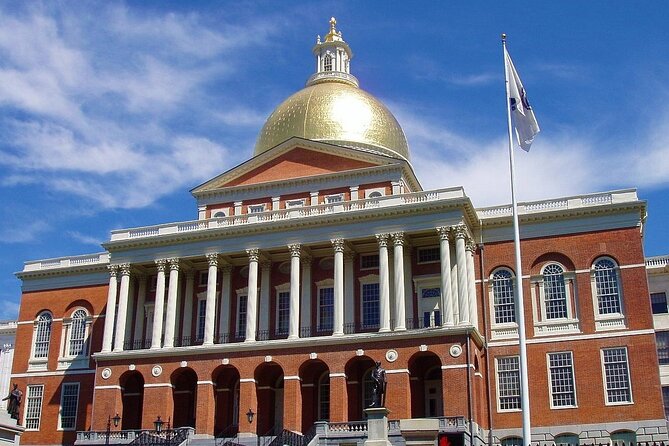
The Massachusetts State House comes early in the walk, with its familiar golden dome. The building dates from the period after independence, and the cornerstone was laid by Samuel Adams in 1795. That detail helps set up one of the tour’s main ideas: Boston’s rebellion did not end when the fighting stopped. The city also had to build a new government.
Here, you get a useful contrast between colonial rule and local political power. The tour explains how Massachusetts leaders moved from opposing British authority to creating their own institutions. It is a short stop, but it gives the rest of the walk a civic frame.
Abolition at the red brick church
The next church stop adds a part of Boston’s past that can be lost in a Revolution-only tour. This red brick church, built in 1809, hosted an abolitionist congregation and heard some of America’s early anti-slavery speeches.
I appreciate this shift in focus. Boston was not simply a city of liberty in a neat, finished sense. It was also a place where people argued over who liberty included and who was excluded. The guide’s job here is to connect the language of the Revolution with later battles over slavery and human rights.
Granary Burying Ground and the famous names
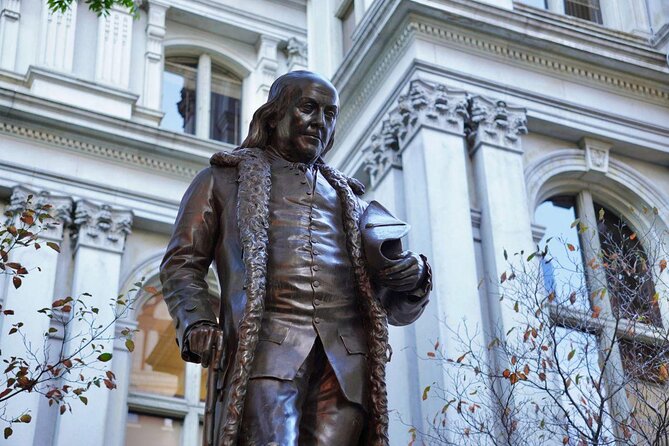
Granary Burying Ground dates to 1660 and contains the graves of John Hancock, Paul Revere, and Samuel Adams. You also hear about the people around them, which is important because the cemetery can otherwise become a quick hunt for famous headstones.
The stop gives you a sense of how tightly packed old Boston was. The burial ground sits in the middle of modern downtown, surrounded by traffic and office buildings, yet its stones preserve the names of people who shaped the city and the new nation.
This is one place where the guide’s storytelling matters most. The stones themselves offer dates and names. A strong guide turns those names into human stories. Guides such as Kenny and Alfred have been especially praised for answering questions and adding side details without losing the main thread.
Same streets, a different route:
- The Full Revolutionary Story Epic Small Group Boston Walking Tour
★ 5.0 · 2,356 reviews - Boston’s Freedom Trail: A Revolutionary Walking Tour
★ 4.9 · 1,748 reviews - Boston: Freedom Trail History Small Group Walking Tour
★ 4.9 · 1,590 reviews - Boston North End Food Tour of 6+ Tastings, Cannoli, Lobster Roll
★ 5.0 · 1,404 reviews
King’s Chapel and the city beneath the city
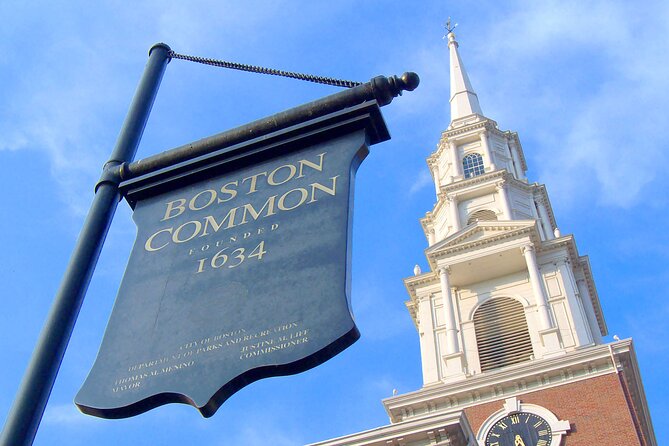
King’s Chapel, built in 1754, was Boston’s first Anglican church. The building’s stone walls, nearby burying ground, and underground crypts offer a different view of colonial society from the Puritan meetinghouses seen elsewhere on the route.
You learn about the church’s construction and the people connected with it. The stop also shows how religious divisions shaped Boston long before the Revolution. The city was not politically or spiritually uniform, and those divisions helped make arguments over British rule even more heated.
Old South Meeting House and the Boston Tea Party
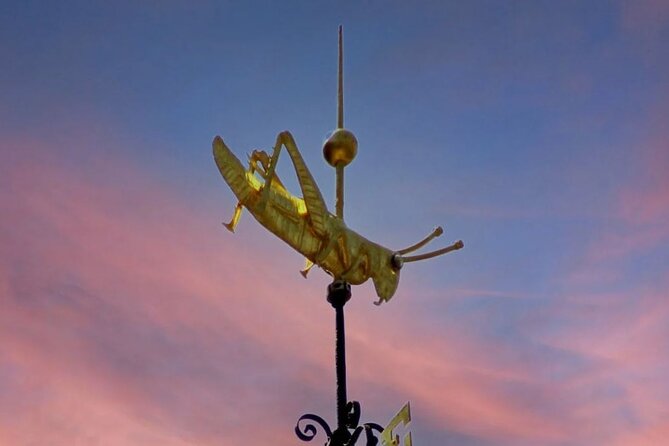
At Old South Meeting House, built in 1729, the tour reaches the beginning of the Boston Tea Party story. This Puritan meetinghouse was where a large gathering debated what to do about the tea shipment and the taxes behind it.
The useful point here is that the Tea Party did not begin as a random act of destruction. It grew out of speeches, organizing, public anger, and a dispute over political representation. The meeting house makes that process easier to picture.
The stop is also a good example of the tour’s limits. The route gives you the setting and the political build-up, but it does not appear to spend a long time reconstructing every detail of the evening itself, such as the exact number of people involved. If the Tea Party is your main interest, you may want to give the site extra time on another visit.
Old Corner Bookstore and Boston’s literary side
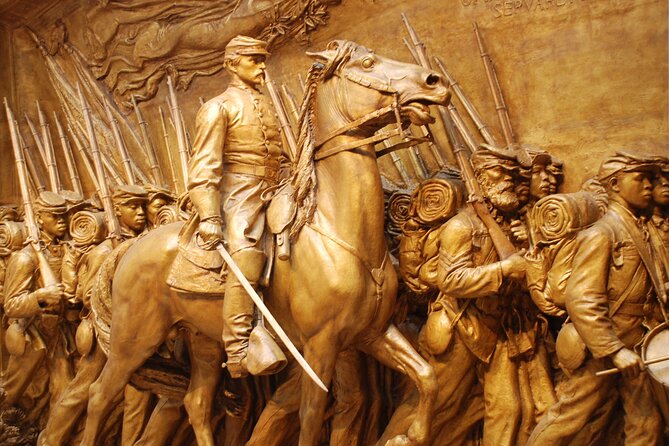
Old Corner Bookstore began as a colonial apothecary in a brick building dating to 1718. In the nineteenth century, it became home to Ticknor & Fields, a publishing house connected with major American writers.
This stop widens the story beyond politics and war. Boston helped shape American literature as well as American government. The building also reminds you that old commercial spaces often changed purpose over time. A colonial shop could become a center of publishing and ideas generations later.
It is a brief stop, but it rewards anyone who likes seeing how Boston’s buildings carried different lives across the centuries.
Old State House and the road to rebellion
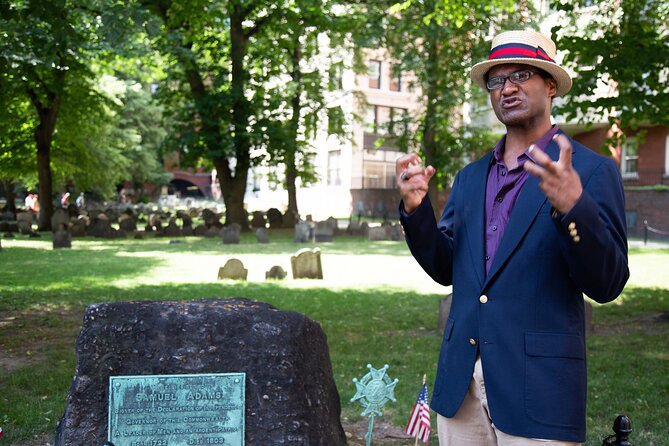
The Old State House, constructed in 1713, once housed the center of British government in Massachusetts. Its red brick walls and the carved lion and unicorn make the building easy to recognize. Inside and around it, Boston’s political conflicts became more public and more dangerous.
The guide explains the speeches, confrontations, and arguments that took place here. This is where abstract complaints about taxation and imperial power began to collide with daily life on Boston’s streets.
The Old State House also leads naturally to the next stop, the Boston Massacre site. You can see how close government offices, crowds, soldiers, and merchants were to one another. That physical closeness matters. The crisis was not happening somewhere far away. It was unfolding in a compact city where tempers could flare quickly.
The Boston Massacre site
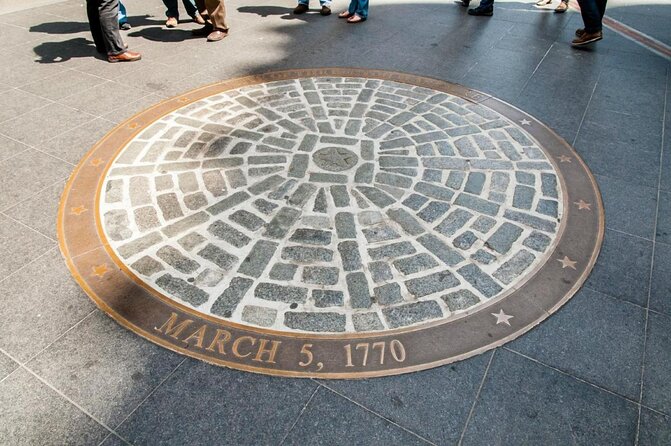
A circle of stones marks the site of the 1770 Boston Massacre. British soldiers fired into a crowd, killing five colonists. The guide reconstructs the night step by step and explains why the event became such a powerful piece of revolutionary propaganda.
This is one of the tour’s strongest moments because it shows how memory and politics work together. The event itself was tragic and confused. The way colonial leaders presented it helped turn anger against British authority.
You should expect a street-side stop rather than a museum visit. The marker is modest, so the explanation does the heavy lifting. Stand close to the guide if you want to catch every detail, especially if the group is large or city noise is high.
Faneuil Hall, speeches, and public protest
Faneuil Hall began as a marketplace in 1743, but its upstairs meeting hall became more important. Known as the Cradle of Liberty, it hosted speeches that helped turn public frustration into organized resistance.
The tour uses Faneuil Hall to explain Boston’s tradition of public debate. This was a commercial place, a meeting place, and a political stage all at once. The connection between trade and protest is worth noting. Merchants, workers, and political leaders did not always share the same motives, but they often met in the same crowded spaces.
Because Faneuil Hall is a popular part of downtown, the area can be busy. Stay close and listen carefully. A guide who speaks clearly makes a major difference here.
Paul Revere House in the North End
The route then moves into the North End and reaches Paul Revere’s House, a wooden building dating to 1680. It is Boston’s oldest surviving building and was home to Revere and his family.
The house gives the famous patriot a more ordinary setting. Before he became a messenger in the revolutionary story, he lived here with his family and worked as a craftsman. The tour explains his life in the house and how he became involved in events much larger than his own neighborhood.
You may not get a long interior visit as part of this walking experience. The value is in seeing the building in its setting and hearing how Revere’s home, work, family, and political activity fit together.
Old North Church and the two lanterns
Old North Church is tied to the best-known signal of the Revolution. On April 18, 1775, two lanterns were displayed from the steeple to indicate that the British were moving by sea rather than by land. The guide explains how the signal was arranged and why it mattered to Paul Revere’s ride.
The story works because the church is still a physical landmark in the North End. You can look up at the steeple and understand why it was useful as a signal point. The stop also corrects the simplified version many people learned as children by adding the planning, people, and risk behind the famous phrase.
Construction or other activity at the church may affect what you can see on a given day. The tour can still explain the site from outside.
Copp’s Hill Burying Ground and the Battle of Bunker Hill
Copp’s Hill Burying Ground dates to 1660 and was used as a British artillery position during the Battle of Bunker Hill. You hear about the battle and the notable Bostonians buried there.
From Copp’s Hill Terrace, you can view the 221-foot Bunker Hill Monument across the water. The monument marks the site where colonial militia held hastily built earthworks and repelled two British attacks before retreating.
This section gives the tour a strong visual finish. You are no longer hearing only about a battle on a page. You are looking toward the monument that marks it, from an old burial ground tied to the fighting itself.
The tour ends at Copp’s Hill Terrace, listed at 520 Commercial Street, with the nearby street location also given as 7 Jackson Avenue. The view includes the masts and rigging of USS Constitution, known as Old Ironsides. It is the oldest warship afloat anywhere in the world and a fitting final image for a tour about war, independence, and the young United States.
Pace, group size, and guide quality
The tour costs $31 per person and lasts about two and a half hours. For that price, I think the guide is the main value. You can follow the red trail markers for free, but the markers cannot explain why the sites connect or introduce the less famous people behind the headlines.
The maximum group size is 25. That is small enough for a personal feel when the guide handles the group well, but it is still large enough to create problems at noisy intersections. Some people have found the pace comfortable, while others have struggled to keep up or hear every word.
The difference often comes down to the guide. Kenny has been praised for giving thoughtful answers and keeping a group engaged. Alissa combines humor with clear explanations, while Jim is known for strong storytelling and a steady pace. Julia has handled crowds and construction with calm flexibility. Charles R. has kept the walking pace manageable, even in rain. Those names are not a guarantee of who you will get, but they show the range of guide styles you may encounter.
Wear comfortable shoes, bring water, and stay near the guide when the group stops. If you use a walking stick or need frequent pauses, this may not be the right format unless you contact the company before booking.
Who should book this Freedom Trail walk?
I would choose this tour for a first visit to Boston, especially if you want the main sites organized into one clear story. It is also a good fit for families with older children and teenagers. Several guides use humor and questions to keep the history moving, rather than turning the walk into a lecture.
History fans will appreciate the wider frame. The tour covers more than the familiar names of the Revolution and includes abolition, women’s rights, education, immigration, publishing, and religion.
I would be more cautious if you want a slow museum-style experience. You do not linger for a long time at each site, and the route covers a lot of ground. Rain can also affect the experience, since the tour requires good weather and may be moved or canceled if conditions are poor.
Should you book it?
Book this tour if you want to see all 16 official Freedom Trail sites and understand how they fit together without planning the route yourself. At $31, it is a sensible buy for a first-time visitor who values stories, context, and a little humor more than independent wandering.
Skip it if you need a slow pace, long indoor visits, or detailed time at one subject such as the Boston Tea Party. For most people with moderate fitness and two and a half hours to spare, this is an efficient and engaging introduction to Boston, with a memorable North End finish.
FAQ
How long does Boston’s Freedom Trail tour last?
The tour lasts approximately 2 hours and 30 minutes.
How much does the tour cost?
The price is $31 per person.
Where does the tour begin?
The tour begins at The Embrace, next to the Boston Common Visitor Information Center at 139 Tremont Street in Boston.
Where does the tour end?
The tour ends at Copp’s Hill Terrace in Boston’s North End, with views of Bunker Hill Monument and the USS Constitution.
Does the tour visit all 16 official Freedom Trail sites?
Yes. The experience is designed to cover all 16 official sites on the Freedom Trail.
What language is the tour offered in?
The tour is offered in English.
How much walking is involved?
You should expect a substantial walking tour lasting about two and a half hours. A moderate level of physical fitness is recommended, and comfortable shoes are important.
What happens if the weather is poor?
The experience requires good weather. If it is canceled because of poor weather, you will be offered another date or a full refund. You can also cancel for a full refund up to 24 hours before the start time.
Just added around Boston
- Boston: North End Pizza Walking Tour with 3 Slices & Cannoli★ 4.8 · 162 reviews
- Boston: Freedom Trail Guided Walking Tour in French★ 4.9 · 106 reviews
- Boston: Salem by Boat – Witch Trials & Walking Tour★ 4.3 · 263 reviews
- Boston: Full Revolution Story Epic Small Group Walking Tour★ 4.9 · 132 reviews
- Boston: 2-Hour Historic Walking Tour★ 4.7 · 88 reviews
- Self Guided Classic Freedom Trail Location Aware (GPS) Walking Audio Tour★ 4.5 · 258 reviews
- Boston History Tour: Scenic Walk Through Time & Landmarks★ 5.0 · 627 reviews
- Entire Freedom Trail Walking Tour: Includes Bunker Hill and USS Constitution★ 5.0 · 732 reviews
Walking Tours, compared.

Magical London: Harry Potter Guided Walking Tour
Read our review →
Reykjavik Food Walk – Local Foodie Adventure in Iceland
Read our review →
History and Hauntings of Salem Guided Walking Tour
Read our review →
New Orleans Premier Ghost, Voodoo and Vampire Walking Tour
Read our review →
Amsterdam Anne Frank: Small-Group Walking Tour & Local Guide
Read our review →
Edinburgh Castle: Guided Walking Tour with Entry Ticket
Read our review →
Anne Frank’s Story – Guided Walking Tour through Amsterdam
Read our review →Browse the lists this tour appears in