

REVIEW · ROME
Rome: Jewish Ghetto Walking Tour
Rome’s Jewish Ghetto is where ancient Rome, Jewish history, and everyday city life meet on the same short walk. You’ll see the Theater of Marcellus, older than the Colosseum, then follow streets shaped by centuries of Jewish life, restriction, courage, and renewal.
I like the way this tour joins famous sights with smaller details, especially the last surviving section of the old ghetto wall and the story behind the Turtle Fountain. I also like the human scale: guides such as James, Angela, Tom, and Daniel are praised for explaining complex history clearly and adjusting the pace when needed.
The main consideration is that this is an outdoor walking tour, and the Great Synagogue is viewed from outside rather than entered as part of the standard route. The walk continues in sun, rain, and city traffic, so good shoes, water, and weather protection matter.
Key points to know before you book
- Ancient Rome comes first: Begin near Trajan’s Column and see the Theater of Marcellus before entering the Jewish Ghetto.
- The Turtle Fountain has a story: Piazza Mattei is more than a pretty photo stop, with a tale of unrequited love attached to it.
- Jewish history is treated across 2,000 years: The route covers the former walled quarter, the Great Synagogue, wartime events, and modern memorial markers.
- Kosher gelato is included: You’ll stop for homemade Kosher gelato or coffee during the walk.
- Tiber Island gives the tour a strong finish: Cross Rome’s oldest functioning bridge and hear about its temple, church, and WWII hospital.
- Guide quality is central: The strongest praise goes to guides who tell history as a story, answer questions, and keep a comfortable pace.
Why this corner of Rome deserves a full walking tour
Rome can make history feel like wallpaper. You pass a column, a church, or a pile of ancient stones, take a photo, and move on. This walk slows the process down and connects the pieces.
The Jewish Ghetto is especially useful for that kind of guided visit. The neighborhood is not only about one period. Its story reaches from ancient Rome through the long life of the Jewish community, the forced confinement of Jews in the quarter, the Second World War, and the present day.
I like that the tour does not isolate Jewish history from the rest of Rome. You begin at Trajan’s Column, pass the Theater of Marcellus, and later cross to Tiber Island. That wider setting helps you understand how the Jewish community lived within, and was repeatedly affected by, the changing city around it.
The tour costs $65 per person and lasts about two and a half hours. That is a fair price if you want an English-speaking guide to supply context at each stop rather than simply point out monuments. You are paying for interpretation, not admission to a major museum or a long list of indoor attractions.
The value is strongest if you enjoy history, ask questions, and want to understand the area beyond its restaurants and photogenic streets. If you prefer to walk independently and read signs at your own pace, you may find the cost harder to justify.
More Jewish Heritage Walks in Rome:
- Highlights of Jewish Ghetto And Trastevere Walking Tour
★ 4.8 · 233 reviews - Rome: Trastevere and Roman Ghetto Guided Walking Tour
★ 4.7 · 79 reviews - Amsterdam Anne Frank: Small-Group Walking Tour & Local Guide
★ 4.8 · 12,789 reviews
Starting at Trajan’s Column in the center of Rome
The meeting point is at Foro Traiano, 84, near Trajan’s Column. Look for the orange Roman Vacations sign. This is a busy central area, so give yourself enough time to find the exact meeting spot.
The opening location sets up the Roman side of the story. Trajan’s Column is one of the city’s major ancient monuments, and beginning here makes it clear that the tour is not limited to one neighborhood or one era.
Your guide is listed as English-speaking, and the guide makes a real difference here. James has been praised for turning the past into a story that held the attention of teenagers. Angela is known for an energetic, warm presentation, while Tom has been described as especially strong at placing centuries of Roman history into context. Daniel has also been praised for explaining difficult subjects in clear, manageable sections.
Those names are useful because the guide assignment can vary. You should expect a live guide, but you will not be choosing a particular person when you book.
Theater of Marcellus: an ancient building still in daily use

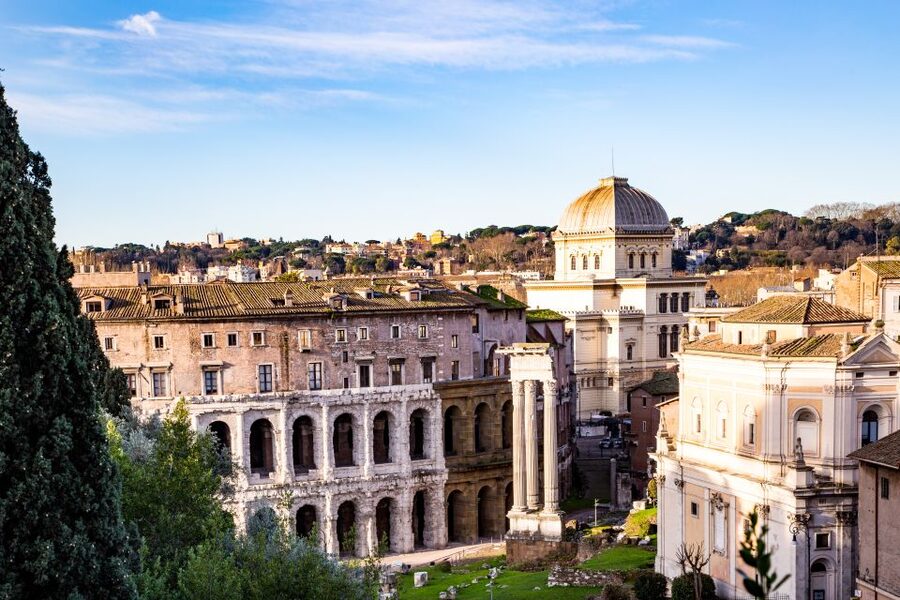
The first main stop is the Theater of Marcellus, with about 20 minutes of guided explanation. It is older than the Colosseum, a fact that alone makes it worth pausing for.
The structure is a good reminder that Rome’s ancient buildings did not always remain frozen ruins. The theater has been used and adapted over time, and the route helps you notice how old Roman structures can remain part of the modern city.
This is also where a strong guide earns the fee. Without explanation, you might see a curved wall and move on. With a clear account of the building and its place in Rome, you begin to read the city in layers.
The stop is outdoors, and the tour continues on foot afterward. If you have trouble walking, say so early. Several guides have been praised for keeping a slower, comfortable pace, but the tour still requires steady movement over roughly two and a half hours.
The Turtle Fountain and its unhappy love story
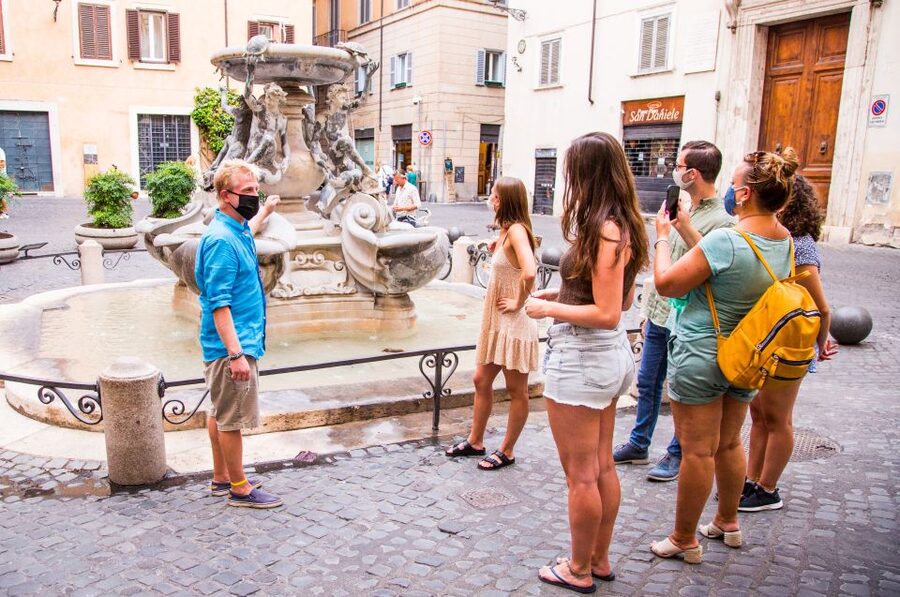
At Piazza Mattei, the group pauses for about 20 minutes at the Fontana delle Tartarughe, or Turtle Fountain. It is one of those Roman fountains that rewards a close look, especially at the small turtles that give it its name.
The guide also tells a story of unrequited love connected with the fountain. This is exactly the sort of detail that can disappear when you explore Rome alone. The fountain becomes more than an attractive square. It gains a human story, even if the surrounding monuments remain the larger draw.
Piazza Mattei also marks the transition from the broader ancient city into the Jewish Ghetto. The route is not a straight march from one monument to another. It uses fountains, streets, walls, and buildings to show how the neighborhood developed.
Take a moment here to look beyond your camera frame. The value of this stop is less about checking off a landmark and more about seeing how a small public space fits into the area’s changing identity.
A few more walking tours around Rome worth a look
- Rome: Guided Food Walking Tour with Wine in Trastevere
★ 4.9 · 3,105 reviews - Rome: Trastevere & Campo de Fiori Street Food Walking Tour
★ 4.9 · 2,768 reviews - Rome: Paranormal Night Walking Tour & Secret Backstreets
★ 4.9 · 1,921 reviews - Rome: Trastevere Street Food Walking Tour with Local Expert
★ 4.8 · 1,784 reviews
Walking through the former Jewish Ghetto
The central part of the tour takes you through the Jewish Ghetto, with a guided section of about 20 minutes before and around the major monuments. The word ghetto refers to the area where Rome’s Jewish population was confined for centuries. That history deserves a serious tone, and the best guides balance hard facts with stories about ordinary life.
You’ll pass the last remaining piece of the wall that kept the Jewish community in this area. It is a modest physical remnant, but it gives the history a scale you can grasp. A paragraph in a guidebook can feel distant. A surviving wall beside the street makes the restriction more immediate.
The tour also helps you notice markers connected with Jewish residents and wartime memory. One visitor explained that after the tour, she could identify memorial markers during later walks around Rome. That is a useful measure of a good walking tour: it changes what you see after the guide has gone.
You do not need to be Jewish to find this section worthwhile. The route deals with the experience of Rome’s Jews, but it also explains broader questions about power, religious communities, discrimination, survival, and memory. The story belongs to Rome as a whole.
Because the subject includes persecution and the Holocaust, this is not a light sightseeing stroll. Some guides present the material with strong personal feeling. That can make the experience powerful, but you should choose another tour if you want only cheerful Roman anecdotes.
Portico d’Ottavia and the Great Synagogue
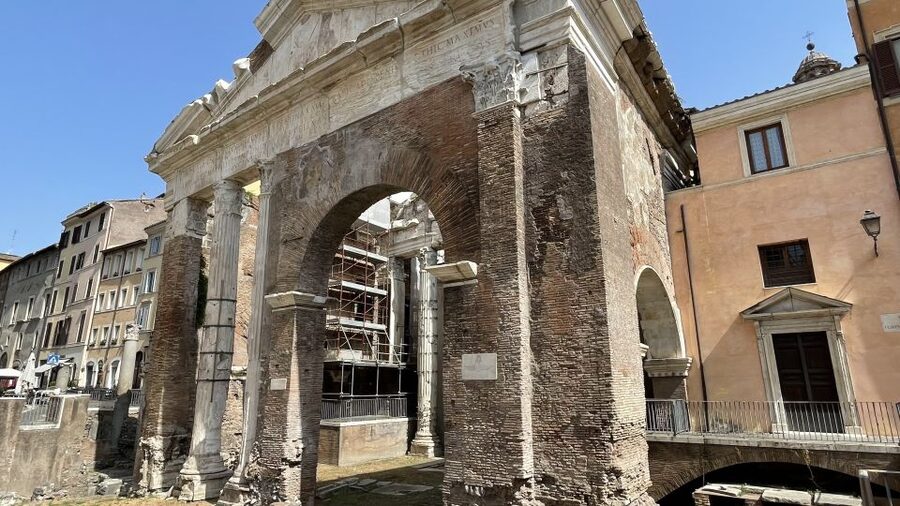
The Portico d’Ottavia receives about 15 minutes of attention. This ancient complex is one of the clearest places on the route to see how the Jewish neighborhood grew around older Roman remains.
The portico also helps link the ancient city to the later community. You are not moving from a Roman monument to an unrelated modern quarter. The two histories overlap in the same streets, with later buildings and religious life developing beside ancient stone.
The Great Synagogue of Rome is another major landmark. The tour explains its importance and the story of Rome’s Jewish community as you pass nearby. You should not expect a standard interior visit. Several people specifically wished the synagogue could have been included from inside, so keep that limitation in mind when comparing this tour with a synagogue-focused visit.
There is also a practical timing point here. One person advised avoiding Friday afternoon just before the Sabbath begins. That makes sense as a planning tip, since the neighborhood’s religious rhythm may affect the atmosphere and access around the area. The tour information does not promise entry into the synagogue, so do not book this walk expecting an indoor religious visit.
Kosher gelato or coffee during the walk
A stop at a gelateria is included, with homemade Kosher gelato or coffee. It is a small inclusion, but it breaks up the history and gives you a chance to pause.
I like this kind of stop because it fits the neighborhood rather than feeling like an unrelated snack break. It also gives the guide a natural chance to answer questions and lets you experience a local food tradition connected with the Jewish quarter.
The included item is limited to Kosher gelato or coffee. Extra food and drinks are not included, so bring some spending money if you want more. Some feedback refers to food and wine stops, but the stated tour details specifically promise gelato or coffee, so that is what you should count on.
If you have dietary needs beyond the stated Kosher offering, ask the operator before booking. The supplied information does not give a full list of ingredients or alternatives.
Crossing to Tiber Island
The final section takes you across the oldest functioning bridge in Rome to Tiber Island. The island receives about 15 minutes of guided attention, but it gives the tour a satisfying change of setting.
Here you hear two very different stories. One concerns the ancient figure Asclepius and the temple that later became a church. The other concerns the hospital that helped save people during World War II.
That contrast is one of the tour’s strongest ideas. Rome’s religious buildings and medical institutions have changed roles over time, but the city continues to use the same sites to care for people and express belief. The island becomes a place where ancient myth, Christian history, and wartime courage meet.
Ending here also keeps the tour from becoming a simple loop through the Ghetto. You finish with a broader view of the Tiber and the city’s long habit of adapting old places for new needs.
How the guides shape the experience

The guide is the main reason to book this tour instead of walking the same streets with a map. The repeated strengths are clear: strong command of Roman and Jewish history, a gift for storytelling, friendly conversation, and the ability to answer questions without losing the group.
James is often praised for his depth of knowledge and story-based presentation. Angela is described as passionate, lively, and especially good at keeping younger people interested. Tom is praised for making 3,000 years of history understandable, while Daniel is noted for his clarity and attention to walking pace.
Other guides, including Maria, Elena, Gabi, and Paul, have also received strong praise for giving a broad view of Rome and Italy. This range suggests that the company has several capable guides, but it also means the exact tone can vary from one departure to another.
Group size may vary. Some departures have been small, and a few became private tours when no one else booked. A small group makes it easier to hear, ask questions, and adjust the pace. You should not assume a private tour, but a less crowded departure is possible.
Practical advice for a 2.5-hour walk
Wear comfortable shoes. Rome’s streets can be tiring even when the route itself is not difficult, and you will be standing for explanations at each stop.
Bring a reusable water bottle, sunscreen, a hat, and clothing suited to the forecast. An umbrella is also advised. Tours run in all weather, so rain does not automatically cancel the walk.
If you plan to enter a church during the route, bring something to cover bare shoulders. The supplied information does not promise church entry, but the reminder is useful for religious sites in Rome.
Arrive early. The guide cannot delay the departure for late arrivals, and missed tours are not refunded. The meeting point is central, but central Rome can be confusing when you are watching traffic, monuments, and street signs at once.
Free cancellation is available up to 24 hours before the tour for a full refund. You can also reserve and pay later, which is useful if your Rome schedule is still shifting.
Who should book this Rome Jewish Ghetto tour?
I would choose this tour if you want more than ancient ruins and grand churches. It is a strong fit for anyone interested in Jewish history, Roman history, religious communities, wartime memory, or the way a neighborhood changes over centuries.
Families can benefit from the storytelling approach, especially if children or teenagers lose interest during standard monument tours. History fans will appreciate the broad time span, while first-time visitors will gain context for a neighborhood they might otherwise pass through quickly.
It is also suitable for non-Jewish visitors. The tour does not assume personal background, and the guides explain the subject for a general audience. Those who have already visited Rome several times may find it especially rewarding because it reveals a side of the city that major attractions often overlook.
I would hesitate if you want to go inside the Great Synagogue, avoid walking in poor weather, or prefer a food-led tour. The gelato is a pleasant inclusion, but this is a history walk first.
Should you book it?
Book it if you want a thoughtful, story-driven walk through one of Rome’s most layered neighborhoods. At $65, the price makes sense when you value a skilled guide, a small-group feel, and clear context at places such as the Theater of Marcellus, Portico d’Ottavia, the former ghetto wall, and Tiber Island.
Plan carefully around Friday afternoon, arrive before the meeting time, and do not expect a synagogue interior visit. If those limits suit you, this is a strong choice for seeing Rome through the lives of the people who have shaped it, not only through its monuments.
FAQ
Where does the Rome Jewish Ghetto walking tour begin?
The tour begins at Foro Traiano, 84, near Trajan’s Column in central Rome. Look for the orange Roman Vacations sign.
How long does the tour last?
The walking tour lasts approximately 2.5 hours.
What language is the tour offered in?
The tour is conducted in English with a live guide.
Is Kosher food included?
The tour includes homemade Kosher gelato or coffee. Extra food and drinks are not included.
Does the tour enter the Great Synagogue of Rome?
The standard tour information describes passing the Great Synagogue and learning about its history. It does not include a confirmed interior visit.
What should I bring?
Bring comfortable shoes, a sun hat, sunscreen, an umbrella, weather-appropriate clothing, and a reusable water bottle. Bring a cover for bare shoulders if you enter a church.
Can I cancel the booking?
You can cancel up to 24 hours in advance for a full refund. You can also reserve now and pay later. Late arrivals and missed tours are not refunded, and the tour operates in all weather conditions.
Just added around Rome
- Rome: Colosseum and Ancient Rome Guided Walking Tour★ 4.5 · 95 reviews
- Rome Walking Tour: Pantheon, Trevi, Navona & Hidden Gems★ 4.8 · 501 reviews
- Rome: Underground Trastevere Guided Walking Tour★ 4.8 · 87 reviews
- Rome: Guided Walking Tour and Pantheon Priority Entry Ticket★ 4.3 · 317 reviews
- Rome: Trevi Fountain, Spanish Steps & Pantheon Walking Tour★ 4.6 · 336 reviews
- Rome: Trastevere and Roman Ghetto Guided Walking Tour★ 4.7 · 79 reviews
- Rome Night Mysteries Guided Walking Tour★ 4.9 · 119 reviews
- Rome: Relics from the Passion of the Christ Walking Tour★ 4.9 · 84 reviews
Jewish Heritage Walking Tours, compared.

Amsterdam Anne Frank: Small-Group Walking Tour & Local Guide
Read our review →
Anne Frank’s Story – Guided Walking Tour through Amsterdam
Read our review →
Jewish Quarter Walking Tour with Admission Tickets
Read our review →
Anne Frank Guided Walking Tour in DE/EN/IT/ES
Read our review →
Old Town and Jewish Quarter Guided Walking Tour
Read our review →

Anne Frank Walking Tour Amsterdam Including Jewish Cultural Quarter
Read our review →
Anne Frank’s Last Walk & See Anne Frank House in Virtual Reality
Read our review →Browse the lists this tour appears in