
REVIEW · BARCELONA
Barcelona 2-Hour Gothic Walking Tour
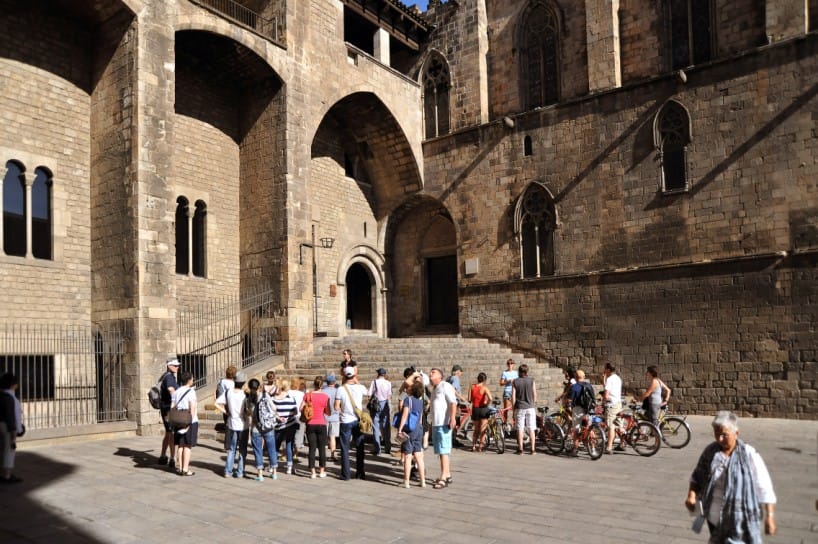
Barcelona’s Gothic Quarter packs Roman ruins, medieval palaces, quiet squares, and Civil War scars into a compact maze. This two-hour walking tour gives you the story behind the stone instead of leaving you to guess which doorway matters.
I like the way the route connects major sights such as the Cathedral, Saló del Tinell, and the former royal palace. I also like the English tour’s free visit to Museu Frederic Marès, an unusual museum that makes a good follow-up to the streets outside. The main consideration is simple: two hours on cobblestones can feel long if you are not ready to walk, so bring water and eat first.
Key points to know before you book
- See Barcelona’s history in layers: Roman Barcino, medieval Catalonia, royal power, religious art, and modern memory all appear along the route.
- The Cathedral is more than a photo stop: The guided visit includes a closer look at its cloister.
- Plaça Sant Felip Neri carries a painful past: Its damaged walls still show scars from Spanish Civil War bombings.
- Guides make the narrow lanes readable: Guides including Olga Escribano, Jordi, Alex, Pilar, and others have been praised for clear history, humor, and personal attention.
- The English tour adds a museum visit: You get free admission and free time at Museu Frederic Marès after the walk.
- The price is fair for a first look: At $32 per person, the tour makes sense if you want context, not just a route through old streets.
Why the Gothic Quarter works best with a guide
Barcelona’s Barri Gòtic is easy to enter and surprisingly hard to understand. You can walk from the Cathedral to Plaça del Rei in minutes, but the area’s meaning is spread across old walls, later buildings, tucked-away courtyards, and small signs that are easy to miss.
A guide gives you a framework. You hear how Roman Barcino became medieval Barcelona, how Catalan kings used the royal palace, and how religious and political power shaped this part of the city. The result is not just a parade of old buildings. You begin to see why the quarter looks the way it does.
The route stays within the Gothic areas, so you are not spending half the tour on transport. That is a real advantage in Barcelona, where a short ride can break the rhythm of a walking visit. It also means the tour covers a lot without requiring a long cross-city trek.
The guides named in the feedback include Olga Escribano, Jordi, Alex, Pilar, Olga, Luca, Theo, and Miguel. Their styles may differ, but the repeated strengths are clear: strong command of local history, friendly delivery, answers to questions, and useful suggestions for the rest of your time in the city. One guide even used pictures to help explain historic sites, a handy touch when the original buildings have changed over the centuries.
More Two-Hour Tours in Barcelona:
- Barcelona: Jewish Quarter 2-Hour Walking Tour
★ 4.8 · 333 reviews - Berlin’s Best: 2 Hour Walking Tour Third Reich and the Cold War
★ 5.0 · 5,486 reviews - Budapest City Landmarks Walking Tour in 2 Hours
★ 5.0 · 2,048 reviews
Starting at Plaça de la Seu
The meeting point is at the tourist information office near Plaça de la Seu. Look for the familiar i symbol. This is a practical starting place because Barcelona Cathedral gives you an immediate sense of the quarter’s scale and style.
Before the group moves off, take a moment to look around the square. The Cathedral’s Gothic frontage is one of the area’s most recognizable sights, but the square also serves as a useful reference point if you return later on your own.
The tour ends back at Plaça de la Seu, so the route is easy to fit into a day of sightseeing. You can continue toward the market areas, the Ramblas, or other parts of the old city without needing to arrange a ride back.
Barcelona Cathedral and its cloister
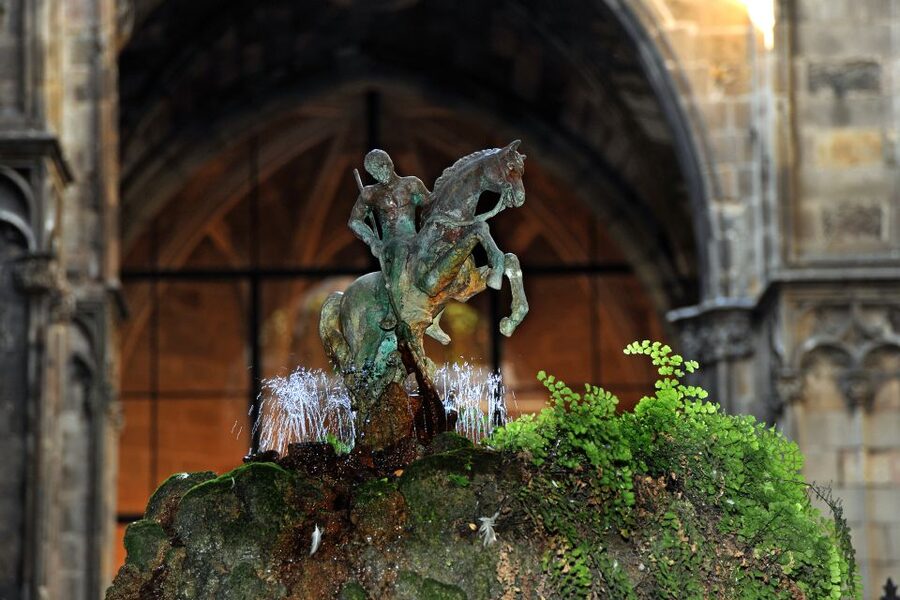
Barcelona Cathedral is one of the central stops, and the tour takes you closer to its architecture rather than treating it as a quick exterior photo. The guided visit includes the cloister, which gives you a quieter counterpoint to the broad façade and busy square.
The cloister is especially useful for understanding how religious buildings worked as living spaces, not just monuments. Listen for the guide’s explanation of the building, its role in the city, and the details that are easy to overlook when you are standing outside with a camera.
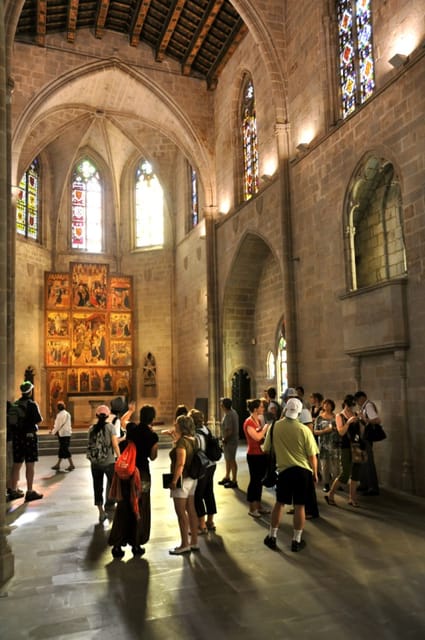
The itinerary also includes the Chapel of Santa Àgata. Its setting near the former royal complex helps connect faith and royal power. This is where a guide adds real value, since the chapel and surrounding buildings can look like separate stops unless someone explains how they fit together.
Opening conditions can vary at historic sites, as one past experience showed when rain led to a tower closure. The tour itself can still offer plenty of history, but do not assume every part of a monument will always be accessible on the day.
Roman Barcelona at the Temple of Augustus
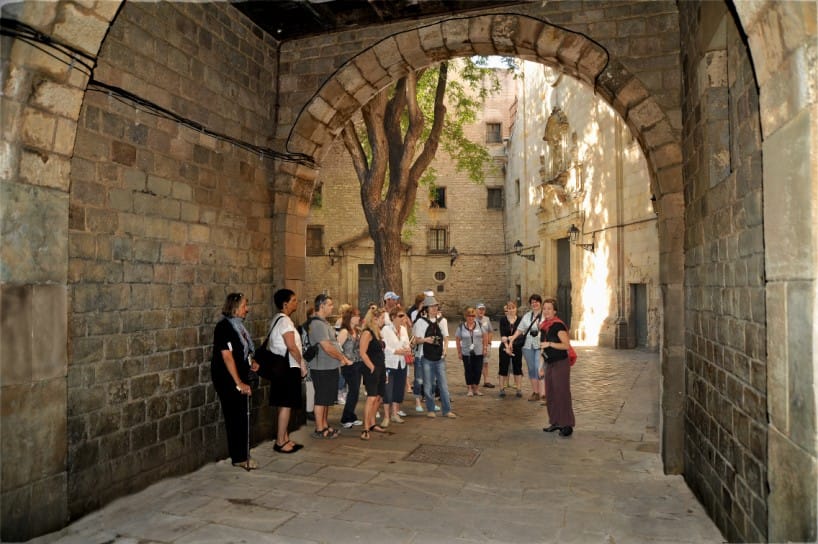
One of the most memorable details on the route is the Roman Temple of Augustus. It is tucked into a medieval courtyard, which is exactly the sort of place you might pass without realizing what you are seeing.
The surviving columns point back to Barcino, the Roman settlement beneath modern Barcelona. This is one of the tour’s best history lessons because it makes the city’s age visible without sending you to a separate archaeological site.
I like this stop for another reason: it shows how Barcelona’s old layers overlap. Roman remains are not isolated in a museum. They appear inside the later city, surrounded by medieval streets and modern life. A guide can point out that connection in a way a quick self-guided walk may miss.
A few more walking tours around Barcelona worth a look
- Barcelona Tapas and Wine Experience Small-Group Walking Tour
★ 5.0 · 5,804 reviews - Barcelona: Tapas Walking Tour with Food, Wine, and History
★ 4.8 · 4,261 reviews - Barcelona: Food Walking Tour with Tapas and Wine
★ 4.9 · 2,180 reviews - Barcelona Tapas Walking Tour: Food, Wine & History
★ 4.5 · 1,928 reviews
Plaça del Rei and the Saló del Tinell
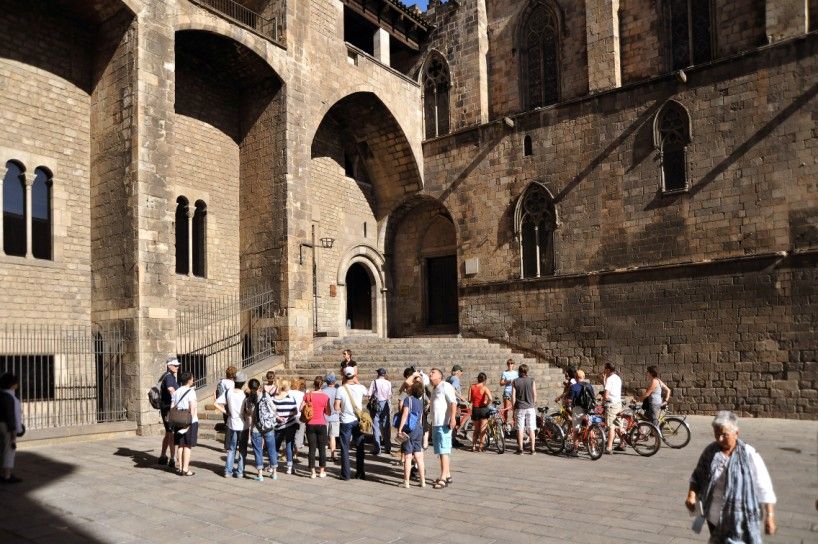
Plaça del Rei is among the most atmospheric spaces in the Gothic Quarter. Its stone buildings and enclosed feel make it easy to imagine the area as a center of royal business and ceremony.
The route highlights the Saló del Tinell, a grand medieval hall within the former royal complex. You also learn about the Palau Reial Major, the palace of the Catalan kings. The setting gives the political story a physical shape: this was not merely a neighborhood of churches and merchants, but a place where decisions were made and power was displayed.
The story of Ferdinand and Isabella receiving Columbus after his return from the New World is part of the historical background presented here. It is a useful reminder that Barcelona was tied to major events beyond Catalonia, even while local institutions and traditions remained central.
Do not expect a long, independent palace visit with unlimited time in every room. The tour has only two hours and covers several sites. Its strength is the connection between places, people, and events. If you want to study one building in detail, you will need to return on your own.
Santa Àgata Chapel and medieval lanes
The Chapel of Santa Àgata adds a more intimate stop to the grander palace and Cathedral visits. Its location within the Gothic Quarter lets you see how religious buildings, royal spaces, and ordinary streets sit close together.
Between the major monuments, the guide leads you through winding lanes and smaller squares. This is where the tour earns its keep for first-time visitors. A map can show you where the streets are, but it cannot easily explain which corners carry stories about merchants, saints, political conflict, or local customs.
The Gothic Quarter is not a preserved stage set. It is also a lived-in part of Barcelona, with shops, cafés, and daily city traffic. The best guides connect the old stone to present-day life without turning the walk into a lecture. Past feedback repeatedly praises guides for making the facts entertaining and answering questions instead of simply reciting dates.
Plaça Sant Felip Neri and the city’s painful memory
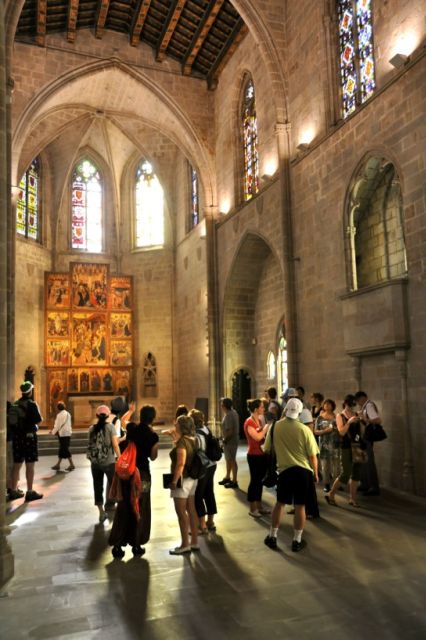
Plaça Sant Felip Neri is one of the most moving stops. It is a quiet square with a Baroque church, but its walls are marked by damage from Spanish Civil War bombings.
The square’s calm atmosphere can make the scars more striking. Children may play there, and music may sometimes drift through the space, while the pockmarked walls quietly preserve a darker memory. This is a stop where the guide’s explanation matters. Without context, you might notice the damaged stone but miss the human story behind it.
I appreciate that the route includes more than attractive architecture. Barcelona’s past includes conflict, loss, and political change, and this square gives the tour emotional range. It also offers a pause from the larger monuments and crowded streets.
Museu Frederic Marès after the walk
The English-language tour includes free admission to Museu Frederic Marès after the walking portion. You have free time there, so you can browse at your own pace rather than being hurried from one gallery to the next.
The museum occupies a medieval palace and contains sculptures, religious art, antique curiosities, and everyday objects collected by Frederic Marès. That mixture makes it different from a standard fine-art museum. You may move from medieval sculpture to personal artifacts and 19th-century household objects in the same visit.
This bonus is important when judging the $32 price. You are not paying only for a guide and a walk. You also receive a separate cultural stop that can easily fill another portion of your afternoon, especially if you enjoy objects with a story behind them.
The museum is included with the English tour, but the free time comes after the guided walk. Plan your energy accordingly. If you are tired after two hours on stone streets, you can keep the museum visit short. If you enjoy small collections and unusual displays, it gives you a good reason to stay longer.
Is $32 a fair price?
At $32 per person, this is not the cheapest way to see the Gothic Quarter. You can walk the streets for free, and many of the exterior sights do not require admission.
The value comes from the interpretation. You get an official local guide, a structured route, guided visits connected to the Cathedral and historic buildings, and free admission to Museu Frederic Marès on the English tour. For someone arriving in Barcelona without much background, that is a reasonable package.
I would be less enthusiastic about the price if you already know the Gothic Quarter well or prefer wandering alone. The tour covers a compact area, and independent visitors can revisit the same streets afterward without paying again. But for a first visit, the explanations can prevent you from walking past the most interesting details.
The tour also works well early in a Barcelona stay. Several people used it to get their bearings and then followed the guide’s suggestions for other sights and food. That makes the $32 more useful than a simple two-hour checklist.
Walking pace, weather, and who should book
You should expect to walk for the full two hours on old streets and cobblestones. One past participant specifically advised eating beforehand and carrying something to drink, sensible advice because there is no meal break built into the route.
The pace has worked well for some people with movement difficulty, especially when the guide is attentive. Still, the official description does not promise a special accessibility arrangement, so ask before booking if you need specific support.
Rain does not necessarily ruin the experience. Past groups used umbrellas and an earpiece system that made the guide easier to hear in wet conditions. Even so, outdoor sightseeing is weather-dependent, and closures can affect parts of a monument.
This tour suits you best if:
- You are visiting Barcelona for the first time.
- You want history explained in plain language.
- You like architecture but do not want to study every monument alone.
- You have two hours and want to stay in one central area.
- You enjoy adding a small museum to a walking route.
- You are comfortable walking on uneven old-city streets.
It may not suit you if you want a private tour, a slow photography walk, or a highly specialized architectural lecture. The experience is designed as a broad introduction, not an exhaustive study of every building.
Should you book the Barcelona Gothic Walking Tour?
I would book this as an early Barcelona activity, especially if you want the Gothic Quarter to make sense before exploring it independently. The strongest parts are the Roman Temple of Augustus, the royal complex around Plaça del Rei, the Cathedral cloister, and the thoughtful stop at Plaça Sant Felip Neri.
The guide matters a lot, and the named guides praised for their warmth and clear storytelling include Olga Escribano, Jordi, Alex, Pilar, Olga, and others. Since the guide assigned to your departure may vary, book for the route and format rather than expecting one particular person.
At $32, the tour is good value for a first visit, provided you are ready to walk and pay attention. Bring water, wear comfortable shoes, and keep time afterward for Museu Frederic Marès. If you want context, local stories, and a practical introduction to Barcelona’s oldest quarter, this is a solid choice.
FAQ
How long is the Barcelona Gothic Walking Tour?
The guided walking tour lasts two hours.
How much does the tour cost?
The listed price is $32 per person.
What language is the tour offered in?
The tour is offered in English with a live tour guide.
Where does the tour meet?
Meet at the tourist information office at Plaça de la Seu, 2. Look for the i symbol.
Where does the tour finish?
The listed drop-off location is Plaça de la Seu, 2, the same area as the meeting point.
Is Barcelona Cathedral included?
Yes. The itinerary includes a guided visit to Barcelona Cathedral, including a closer look at its cloister.
Is Museu Frederic Marès included?
The English tour includes free admission and free time at Museu Frederic Marès after the walking tour.
Which historic places are visited?
The route includes the Gothic Quarter, Barcelona Cathedral, the Chapel of Santa Àgata, the historic area around the Museu d’Història de Barcelona, and Plaça Sant Felip Neri. The tour also highlights the Roman Temple of Augustus, Palau Reial Major, Saló del Tinell, and Plaça del Rei.
Can I cancel or pay later?
You can cancel up to 24 hours before the activity for a full refund. The reserve-now, pay-later option lets you hold a place without paying immediately.
Just added around Barcelona
- Barcelona Walk Like a Local: El Born & Gothic 15+ Sights★ 4.9 · 88 reviews
- Barcelona: Ramblas, Old Town & Gaudí Houses Walking Tour★ 4.9 · 239 reviews
- Barcelona: Gothic Quarter Walking Tour w/ Montjuïc Cable Car★ 4.4 · 90 reviews
- Barcelona: Old Town Private Walking Tour of Past and Present★ 5.0 · 160 reviews
- Barcelona: Private Walking Tour with a Local★ 4.5 · 202 reviews
- Barcelona: Jewish Quarter 2-Hour Walking Tour★ 4.8 · 333 reviews
- Barcelona: Picasso Walking Tour with Picasso Museum Tickets★ 3.5 · 93 reviews
- Barcelona: Gothic Quarter Walking Tour with 10+ Attractions★ 5.0 · 369 reviews
Walking Tours, compared.

Magical London: Harry Potter Guided Walking Tour
Read our review →
Reykjavik Food Walk – Local Foodie Adventure in Iceland
Read our review →
History and Hauntings of Salem Guided Walking Tour
Read our review →
New Orleans Premier Ghost, Voodoo and Vampire Walking Tour
Read our review →
Amsterdam Anne Frank: Small-Group Walking Tour & Local Guide
Read our review →

Edinburgh Castle: Guided Walking Tour with Entry Ticket
Read our review →
Anne Frank’s Story – Guided Walking Tour through Amsterdam
Read our review →Browse the lists this tour appears in