
REVIEW · FRANCE
Marseille: Essential Guided Walking Tour of the City
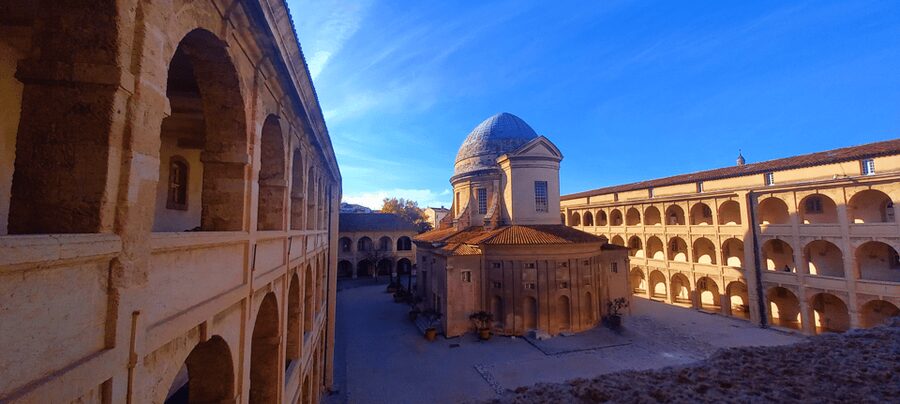
Marseille reveals itself best on foot, where ancient Greek foundations, Roman influence, wartime scars, colorful street art, and salty harbor life all meet within a few kilometers. This tour connects the city’s major sights with smaller streets and personal stories, giving you a useful first look rather than a quick checklist of monuments.
I like the small groups of up to eight and the way Charles uses humor, old photographs, and maps to make Marseille’s past easier to follow. I also like the route’s finish at Le Pharo, where the palace terraces give you broad views across the harbor. The trade-off is a fairly demanding 5-kilometer walk over 150 minutes, with hills and uneven streets in Le Panier, so it is not suited to wheelchair users or anyone wanting a gentle, seated introduction.
Key points to know before booking
- Ancient Marseille in one walk: Follow the city’s story from its Greek and Roman beginnings through medieval religious sites and the modern port.
- Charles leads the tour: He speaks French and English, uses visual aids, and tailors the conversation to the group.
- Le Panier gets proper attention: Allow time for murals, narrow lanes, the Vieille Charité, and Windmill Hill.
- The route links major sights: La Major Cathedral, the Old Port, Canebière, Saint-Victor’s Abbey, and Le Pharo all appear.
- A useful first-day activity: Charles can point you toward restaurants, museums, and other places to visit afterward.
- Plan for walking: Bring water, comfortable shoes, sun protection, and clothing suited to the weather.
Why this Marseille walk works as a first introduction

Marseille can feel scattered at first. The harbor, cathedral, Le Panier, Saint-Victor, and the palace at Le Pharo sit close enough to connect, but each area has its own character. This route helps you understand how they fit together.
You begin at La Major Cathedral and finish near the Old Port or Le Pharo, depending on the drop-off point. That matters because you do not spend the whole tour retracing your steps. You get a one-way progression through the old center and the waterfront, with the city’s story unfolding as you walk.
The tour lasts 150 minutes and covers about 5 kilometers. That is enough time to see a lot without turning the afternoon into a forced march, but you should still expect steady movement. Several stops involve standing while Charles explains the setting, and Le Panier includes slopes and narrow streets.
Charles is the central part of the experience. He is a local, bilingual guide who speaks French and English, and his style leans toward conversation rather than a memorized speech. He uses humor, old images, maps, and stories to show how Marseille changed over time. The small group makes it easier to ask questions, and the guide can adjust the discussion to your interests.
More Guided Tours in France:
- Paris Top Sights Half Day Walking Tour with a Fun Guide
★ 5.0 · 2,893 reviews - Paris: Montmartre Highlights Walking Tour with a Local Guide
★ 4.9 · 2,318 reviews - Paris: Montmartre Cheese, Wine & Pastry Guided Walking Tour
★ 4.8 · 2,255 reviews
Starting beneath La Major Cathedral
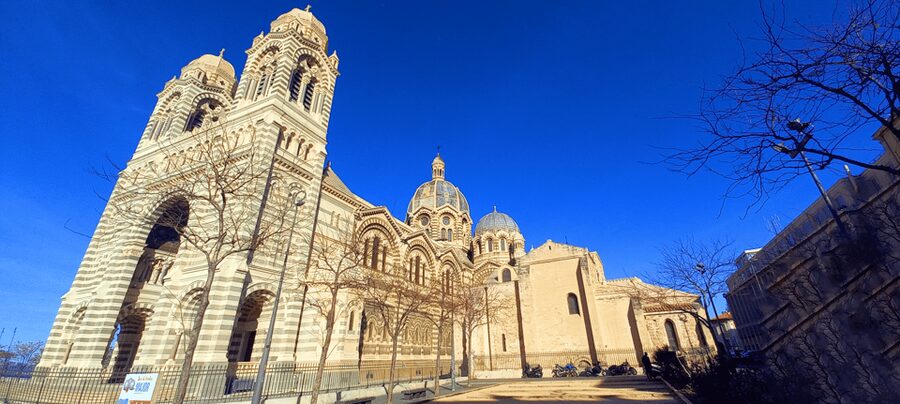
Meet Charles in front of Cathédrale Basilique Sainte-Marie-Majeure, usually called La Major. Look for a guide wearing a white cap. The cathedral’s Neo-Byzantine and Romanesque design gives you an impressive starting point, with striped stonework and a strong connection to Marseille’s seafaring setting.
The opening stop lasts about ten minutes. You get an introduction to the city and the broad arc of its 2,600-year story. This is useful because the rest of the walk jumps across different periods. Without that framework, a Roman reference, a medieval church, and a World War II story could feel like separate facts. Charles links them together.
You should not expect an extended interior visit or a formal religious tour. The value here is the setting and the orientation. Arrive ready to start on time, since the tour quickly moves into Le Panier.
Le Panier, Marseille’s oldest hillside quarter
Le Panier is the heart of the walk. It is one of Marseille’s oldest districts, rising above the Old Port in a tangle of lanes, stairs, small squares, and painted walls. The route spends about 30 minutes here, longer than at most individual stops, and that is a good choice.
Charles points out the district’s street art and murals, then brings the history to life through the Vieille Charité and Windmill Hill. The area has an artistic, slightly bohemian feel, but it is not just a photo stop. Its streets show how Marseille grew in layers, with older buildings and tight passageways shaped by centuries of daily life.
I especially like this part for first-time visitors because it gives you a sense of place that a vehicle tour cannot provide. You can see how close the lanes are, how the streets rise toward the hillside, and how views open toward the harbor. The downside is practical: the pavement may be uneven, and the route is not suitable for wheelchair users.
Le Panier is also the point where comfortable shoes become essential. Wear shoes with good support, and do not count on the entire walk being flat. In warm weather, bring water and sunglasses. One useful detail from Charles’s guiding style is his attention to the group’s comfort. He has been noted for choosing shaded places to pause when the heat is strong.
Church of Accoules and the city’s layered past
The Church of Accoules receives about ten minutes. This shorter stop helps fill in the medieval and religious side of Marseille without slowing the overall route too much.
Here, the tour continues its habit of explaining what you are seeing rather than simply naming it. That approach is important in a city where a church facade, a quiet lane, or an old wall may not explain itself. Charles provides the historical setting and encourages questions, so you can connect the monument to the wider story of the district.
The stop also keeps the walk varied. You move from street art and narrow lanes to a religious landmark, then onward to the more formal streets around Rue de la République.
A few more walking tours around France worth a look
- Montmartre Hidden Gems and Scenic Highlights Walking Tour
★ 5.0 · 2,684 reviews - Montmartre Hill French Gourmet Food and Wine Tasting Walking Tour
★ 5.0 · 2,588 reviews - Paris Île de la Cité and Notre-Dame Walking Tour With Crypt
★ 5.0 · 2,272 reviews - Paris in a Day: Louvre or Orsay, Eiffel Tower, City Walk & Cruise
★ 5.0 · 1,956 reviews
Rue de la République and the route toward the harbor
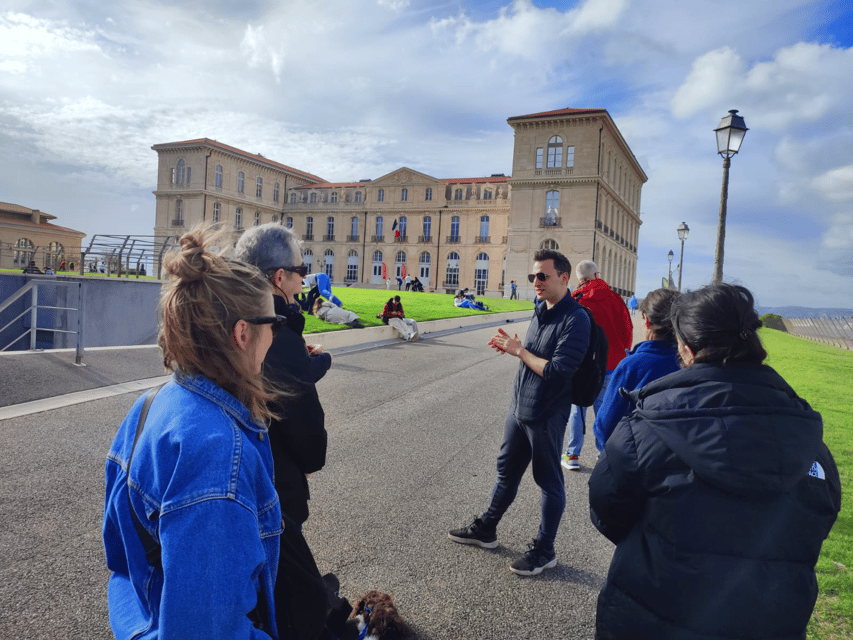
Rue de la République receives about ten minutes of guided sightseeing. Its broad urban scale contrasts with Le Panier’s tight streets, making the change in Marseille’s city plan easy to notice.
This is one of the tour’s useful transitions. You are not simply being led from one famous sight to another. You are seeing how different parts of the city meet: old hillside Marseille, later commercial streets, and the working waterfront. Charles also discusses the city’s Greek and Roman roots and the way later powers shaped its growth.
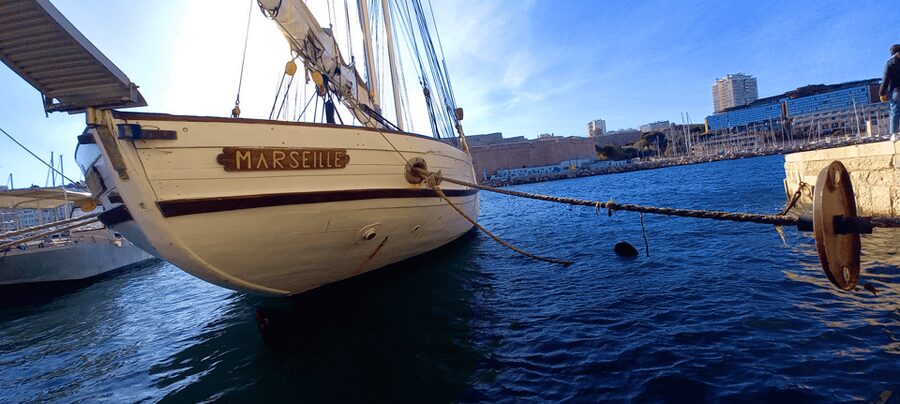
The route then reaches the Old Port, or Vieux Port, for about 15 minutes. This is Marseille’s natural center and one of its most memorable public spaces. Boats and yachts sit in the water, while Fort Saint-Jean and Fort Saint-Nicolas guard the harbor from opposite sides.
The port has served as a focal point since ancient times. Charles explains why it mattered so much to the city and how its role changed. You get both the postcard view and the practical story of a port that helped make Marseille a major Mediterranean city.
Vieux Port, Cours Honoré d’Estienne d’Orves, and Canebière

The harbor section gives you time to take in the water, the forts, and the surrounding streets. Then the walk continues to Cours Honoré d’Estienne d’Orves, a ten-minute stop that shifts the focus back toward city life.
From there, the route connects with Canebière, Marseille’s famous main avenue. The area includes galleries, workshops, boutiques, cafés, bistros, and restaurants. It is a good place to watch the city in motion and compare Marseille’s polished commercial side with the rougher, older feel of Le Panier.
Canebière is not presented as a separate long stop in the schedule, so think of it as part of the walking experience rather than a shopping break. You will have time to notice the businesses and street life, but not time for a leisurely meal. Since food and drinks are not included, you may want to return later if a café or restaurant catches your eye.
This is also where Charles’s local recommendations can be useful. Several participants received suggestions for museums, restaurants, food, and later activities. If you are staying more than one day, take a note on your phone as you walk. The tour is a good way to decide which areas deserve a second visit.
Saint-Victor’s Abbey and a needed pause
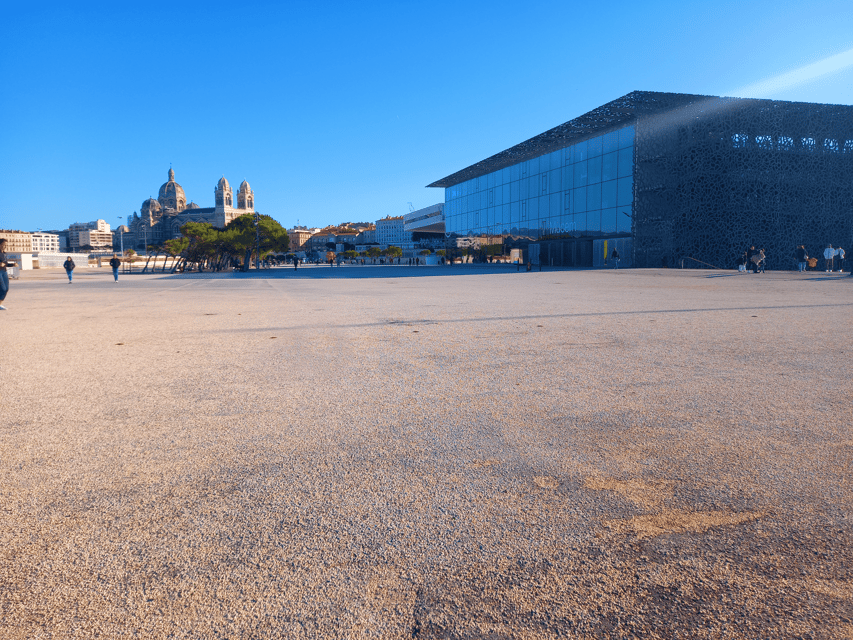
The route continues to the Abbaye Saint-Victor, one of Marseille’s key religious monuments. The scheduled visit lasts about 15 minutes, followed by a 20-minute break with sightseeing and views along the way.
That pause is well placed. By this point, you have crossed much of the historic center and waterfront, and a short rest gives you time to absorb the stories before the final stretch. Food and drinks are not included, so bring water and a snack if you need one.
Saint-Victor also adds another period to the city’s story. The abbey’s Roman architecture and religious importance show that Marseille is not only a port city with Greek origins. It is also a place shaped by Christianity, medieval life, and later urban change.
The break is not a full meal stop. If you need substantial food, plan to eat before or after the tour. The schedule remains active, and the group eventually continues toward Le Pharo.
Le Pharo and the best views of the walk
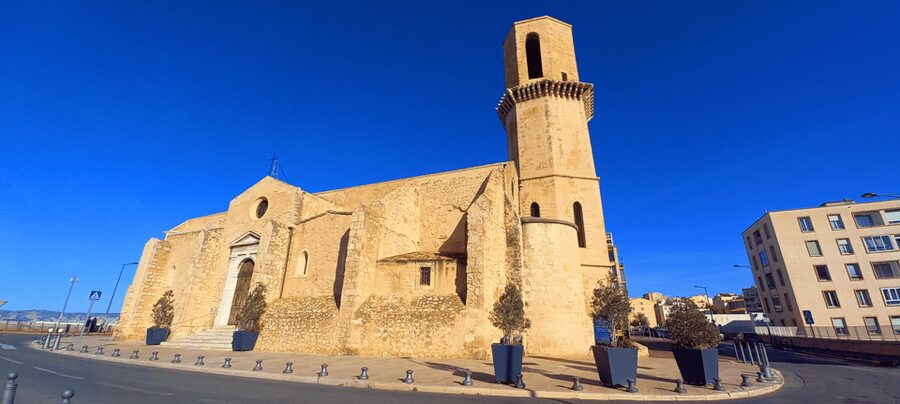
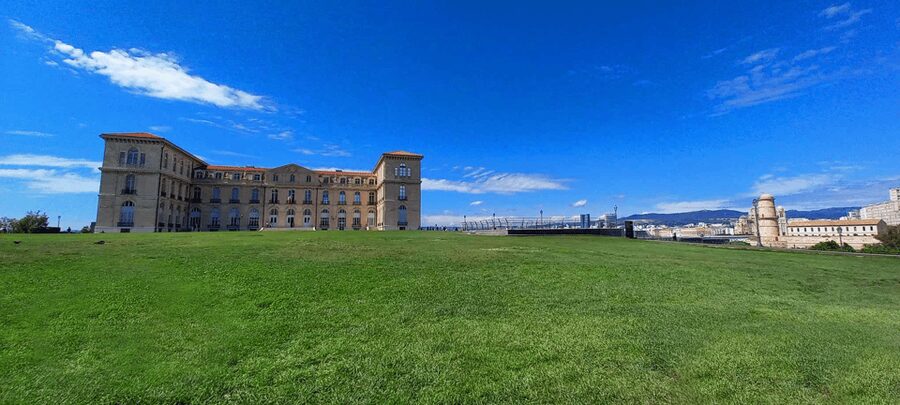
The final major stop is Palais du Pharo, reached through a 30-minute section of walking and guided explanation. Emperor Napoleon III built the palace in the mid-19th century for Empress Eugénie. Its formal architecture and wide terraces provide a sharp contrast to the close streets of Le Panier.
This is the tour’s visual payoff. From Le Pharo, you can look back toward the Old Port and out across the Mediterranean. The views help tie the whole route together. You have seen the harbor from street level, and now you see its position within the larger coastal setting.
The palace is also a good place to discuss Marseille as a city of movement and power. Ancient traders, Roman rulers, religious communities, emperors, sailors, and modern residents all left their mark here. Charles’s storytelling works best when these changes are tied to the view in front of you.
Nearby, Saint-Victor’s Abbey provides the architectural counterpoint. The route does not treat the palace and abbey as isolated attractions. Together, they show the contrast between imperial ambition and older religious foundations.
The tour ends with a deeper sense of how Marseille’s pieces connect. You can finish at the Old Port or Palais du Pharo, giving you flexibility for the rest of the day.
What Charles adds to the experience
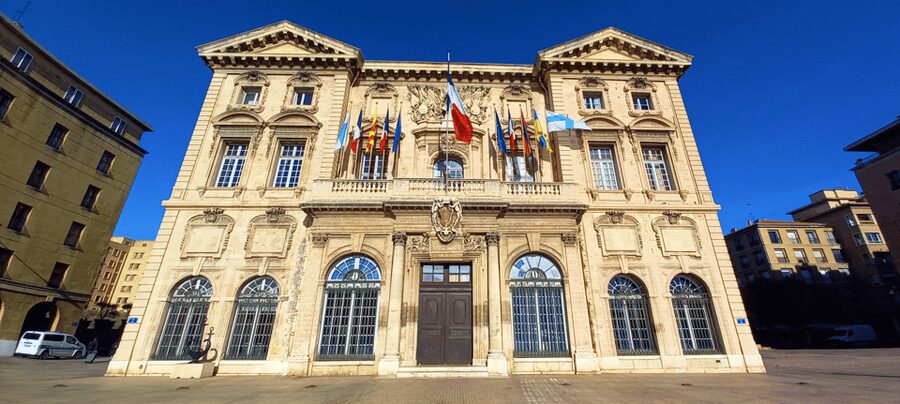
A guide can either make a walking tour feel alive or turn it into a string of dates. Charles appears to favor the first approach. His strengths are clear: he is passionate about Marseille, comfortable in French and English, and able to explain complicated events in an approachable way.
He also uses visual material. Old photographs and maps help you picture streets and buildings before modern redevelopment changed them. This is especially helpful in Marseille, where the present-day city can hide the shape of its earlier neighborhoods.
The small group limit of eight is another real advantage. You can hear without struggling, ask questions without holding up a large crowd, and receive suggestions suited to your interests. Some departures may be smaller still, and private-feeling groups are possible when bookings are light, though that should not be treated as guaranteed.
The guide’s humor is frequently part of the appeal, but the tour is not only entertainment. You get context on ancient Marseille, Roman influence, World War II, architecture, religion, and modern city life. Charles also pays attention to individual participants, including solo visitors, rather than speaking only to couples or families.
Price, pace, and practical value
At $41 per person, this is a reasonable price for a 150-minute small-group tour with a local guide. You are paying for more than access to sights, since the walk itself does not include food, drinks, or special entry tickets. The value comes from the route, interpretation, small group size, and time saved in figuring out Marseille on your own.
I would book it near the beginning of your stay. The route covers enough ground to help you choose where to return, and Charles can suggest places to eat, museums to visit, and other activities. That advice can make the $41 work harder across the rest of your visit.
Bring:
- Comfortable walking shoes
- Water and any food you need
- Sunglasses
- Weather-appropriate clothing
- A hat or other sun protection in hot weather
The walk is listed as 5 kilometers, but the combination of hills, standing, and warm coastal weather can make it feel strenuous. It is not suitable for wheelchair users. If you have limited mobility, ask before booking rather than assuming the historic streets will be easy to manage.
Free cancellation is available up to 24 hours before the tour, and you can reserve now and pay later. Starting times vary, so check availability for the date you want.
Who should book this tour?
Book this if you want a broad introduction to Marseille, prefer walking to sightseeing from a vehicle, and enjoy history explained through stories and local detail. It suits first-time visitors, solo visitors, couples, and small groups who want a social but not crowded outing.
It is also a strong choice if you have only a short time in the city. In two and a half hours, you see the main historic districts, the Old Port, Canebière, Saint-Victor, and Le Pharo, while gaining a useful map of the city in your head.
Think twice if you want a slow museum-focused experience, a flat route, or a tour centered on food. Meals and drinks are not included, and the schedule keeps moving. You will also need to explore interiors on your own if a particular church or building deserves more time.
Final verdict: a smart first walk through Marseille
I would book this tour for a first day in Marseille, especially if you want the city’s history to make sense before exploring on your own. The strongest features are Charles’s clear storytelling, the small group format, the mix of major sights and lesser-known streets, and the finishing views from Le Pharo.
The main caution is the physical effort. Five kilometers, hills, heat, and uneven streets require sensible shoes and water. If you are ready for that, $41 buys a well-planned introduction to Marseille that should leave you with both a better sense of the city and a useful list of places to return to.
FAQ
Where does the Marseille walking tour begin?
Meet your guide in front of La Major Cathedral, officially Cathédrale Basilique Sainte-Marie-Majeure. The guide wears a white cap.
How long does the tour last?
The tour lasts 150 minutes, or about two and a half hours.
How far do you walk?
The route covers about 5 kilometers.
Which languages are available?
The live tour is available in French and English.
Is food or drink included?
No. Food and drinks are not included, so bring water and any snacks you may need.
Is the tour wheelchair accessible?
No. The tour is not suitable for wheelchair users.
Just added around France
- Giverny Monet House and Gardens Skip the line Walking tour★ 4.0 · 217 reviews
- [Walking Tour] Discover the Best of Brest in 2 hours★ 5.0 · 102 reviews
- Bordeaux Historic and Gourmet Food Walking Tour★ 4.5 · 82 reviews
- 2-Hour Walking Tour of the City’s Iconic Sights and History★ 4.0 · 207 reviews
- Bordeaux Walking Tour with a Local Private Guide★ 5.0 · 97 reviews
- Traditional Gourmet Food & Wine Tour in Bordeaux★ 5.0 · 81 reviews
- Free Walking Bordeaux Tour ENG + 1 glass of wine (Tip based)★ 5.0 · 90 reviews
- Bordeaux City – Private Guided Walking Tour with Local Sophia★ 5.0 · 164 reviews
Walking Tours, compared.

Magical London: Harry Potter Guided Walking Tour
Read our review →
Reykjavik Food Walk – Local Foodie Adventure in Iceland
Read our review →
History and Hauntings of Salem Guided Walking Tour
Read our review →
New Orleans Premier Ghost, Voodoo and Vampire Walking Tour
Read our review →
Amsterdam Anne Frank: Small-Group Walking Tour & Local Guide
Read our review →

Edinburgh Castle: Guided Walking Tour with Entry Ticket
Read our review →
Anne Frank’s Story – Guided Walking Tour through Amsterdam
Read our review →Browse the lists this tour appears in