
REVIEW · INDIA
Mahabalipuram walking tour by tourism ministry approved company
Mahabalipuram is one of those places where a pile of weathered stone suddenly turns into a story. In about three hours, this tour takes you through Pallava temples, caves, carvings, and the famous Shore Temple, with a guide explaining why the monuments matter rather than leaving you to guess.
I like the small maximum of 15 people, which gives the guide room to answer questions. I also like the choice between walking and an autorickshaw, a useful touch in the heat and a thoughtful option for older visitors. The main consideration is timing: ten stops in three hours makes this a brisk introduction, not a slow archaeological study.
- See ten major Mahabalipuram sights, including the Pancha Rathas, Arjuna’s Penance, and Shore Temple.
- Learn about Pallava builders and sculpture techniques from a local guide such as Ramesh.
- Choose walking or autorickshaw travel, with buggy rides also available according to the tour experience.
- Keep the group small, with no more than 15 participants.
- Pay about $50 per person, a fair price if you want context and transport between scattered monuments.
- Finish near the Five Rathas or begin near Shore Temple, so confirm the exact meeting order before setting out.
Why Mahabalipuram works best with a guide
Mahabalipuram, also called Mamallapuram, is not one single temple complex. Its monuments are spread across a broad area, and their forms can look puzzling without explanation. A cave carved into granite, a free-standing stone chariot, and a giant boulder may seem unrelated until someone connects them to the Pallava rulers and their religious art.
That is where this tour earns its keep. The guide explains the Pallavas, who created many of the site’s best-known monuments in the 7th century. You also get useful background on the carving methods and the way the buildings were made from living rock or single blocks of stone.
The strongest guide feedback centers on Ramesh. He is described as pleasant, flexible, and a good storyteller, with clear explanations of Pallava sculpture and the techniques used to create it. One especially useful detail is that he extended the tour by about an hour when more time was needed. That should not be treated as a guaranteed feature, but it suggests a guide willing to adapt rather than rush you through a script.
The group cap matters here. With up to 15 people, this is not a private tour, but it is still small enough for questions and personal attention. If your group is interested in architecture, religion, or Indian mythology, you should get more from the visit than you would by walking from monument to monument alone.
Pancha Rathas, five temples carved from stone
The Pancha Rathas, or Five Rathas, make a strong opening because they look like a stone collection of miniature temples and chariots. Each structure was cut from a single piece of rock, giving you a clear sense of the skill and patience involved.
The name connects the group with the five Pandava brothers from the Mahabharata, although the buildings are better understood as experiments in temple design than as ordinary chariots. Your guide can help you notice how each form differs in shape, roof, scale, and decoration.
You have about 20 minutes here. That is enough for an overview and photographs, but not enough for a leisurely architectural inspection of every carving. Look closely at the details before moving on, since this is one of the places where a guide’s explanation makes the stone feel less static.
Admission is included. The site can be busy, and the monument area is not the place to arrange a last-minute pickup if you are using your own vehicle. A practical tip is to organize drop-off and pickup a little away from the busiest temple entrances.
A few more walking tours around India worth a look
- Fontainhas Heritage Walk by Make It Happen
★ 5.0 · 2,834 reviews - The Great Indian Food Tour: Old Delhi Food and Heritage Walk
★ 5.0 · 1,698 reviews - Group Guided Walking Tour in Fort and Colaba
★ 5.0 · 1,073 reviews
Pandava Cave and the stone yali guardians
The Pancha Pandava Cave is described as the largest cave temple at Mahabalipuram. It is supported by six pillars and two pilasters, with three striking yali sculptures on the pillars.
A yali is a mythical creature, often shown with features drawn from several animals. Here, the figures act as both decoration and guardians, giving the cave a more dramatic entrance than its plain rock exterior might suggest.
You spend about 15 minutes at this stop. That is a short visit, but the cave is compact enough for the guide to point out the main features without making you feel lost. If you have mobility concerns, ask about the autorickshaw or buggy option before the walk becomes tiring.
Arjuna’s Penance, a huge story in shallow relief
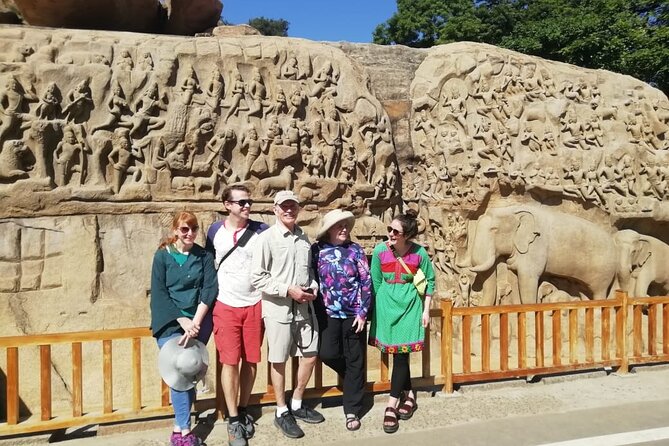
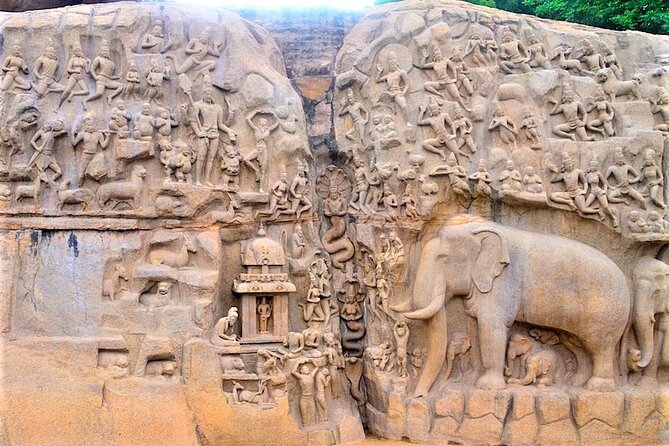
Arjuna’s Penance is one of the tour’s major artistic highlights. The bas-relief stretches about 100 feet long and 45 feet high, with scenes linked to the Mahabharata and a large cast of animals, gods, and mythical figures.
The carving works best when you take time to scan it from one side to the other. Individual figures can be easy to miss, especially if you focus only on the central crack in the rock. Your guide can help separate the mythological story from the many smaller scenes built into the composition.
The planned stop lasts 20 minutes. That gives you time to understand the main subject and take in the scale, though serious art enthusiasts may want longer. This is one reason the tour’s possible extension with Ramesh could matter. The relief rewards attention, and three hours across ten sites leaves little room for lingering.
Krishna’s Butter Ball and a little stone comedy
Krishna’s Butter Ball is a huge granite boulder balanced on a rocky slope. It appears to defy gravity and has remained in place despite its awkward position.
The name refers to the Hindu god Krishna and his fondness for butter. The monument is also one of Mahabalipuram’s lighter moments. After several serious temple carvings, a giant boulder that looks as though it could roll away at any moment adds some welcome humor.
The visit lasts around 15 minutes. You can take in the shape quickly, but the guide’s explanation gives the stop more meaning than a photograph alone. It is also a useful place to appreciate how Mahabalipuram mixes formal sacred architecture with unusual natural and sculpted forms.
Same streets, a different route:
- Spiritual City Walking Tour-THE Pushkar Route
★ 5.0 · 907 reviews - Private Guided Walking Tour in Fort & Colaba
★ 5.0 · 895 reviews - Old Goa Heritage Walk by Make It Happen
★ 5.0 · 797 reviews - Old Delhi Food, Heritage&Cultural Walk with Rickshaw ride to Masterji Kee Haveli
★ 5.0 · 742 reviews
Varaha Cave Temple and Pallava detail
The Varaha Cave is cut from granite and dates to the 7th century. Squatting lions decorate the pillars, and the cave reflects the early Pallava approach to rock-cut temple design.
This is a smaller, more enclosed experience than the Shore Temple. Look at the transition between the rough surrounding rock and the finished surfaces inside. The work was not simply a matter of removing stone. The carvers had to plan the figures, pillars, and sacred space together.
The tour allows about 20 minutes here. That is enough time to study the main carvings while still keeping the overall schedule moving. The cave also shows why the guide’s commentary is useful: the key interest is in the workmanship and religious meaning, not just the size of the structure.
Trimurti Cave and the three major Hindu gods
Trimurti Cave is dedicated to the Hindu trinity of Brahma, Vishnu, and Shiva. It is another fine example of Pallava rock-cut architecture, with elephant carvings adding to the design.
The name Trimurti refers to the three principal deities represented here. The cave gives you a chance to compare different divine figures and see how the Pallava builders shaped a sacred space from solid granite.
You have about 20 minutes. If you are unfamiliar with Hindu iconography, this is a good point to ask questions. The guide can help you identify the gods and explain why their placement matters. The stop is not large, so the short time should feel manageable unless you want to study every carved surface.
Ganesh Ratha, a temple with a changed dedication
Ganesh Ratha is an imposing chariot-shaped temple carved from a single stone. It was originally dedicated to Shiva and is now associated with his son, Ganesh. The building dates to the 7th century and is linked with King Mahendravarman I.
That change in dedication gives the monument an extra layer of interest. It reminds you that temples are not frozen objects. Their use, name, and associated deity can change over time.
The scheduled visit is about 15 minutes. Use it to examine the exterior shape and the way the temple resembles a chariot while functioning as a sacred building. It is another stop where the guide’s story helps you see beyond the outline.
The old lighthouse and Mahabalipuram’s port
The old lighthouse dates to 640 and is described as India’s oldest lighthouse and one of the oldest in the world. Mahabalipuram was a busy port from the 7th century, so the lighthouse had a practical role in helping ships navigate.
This stop broadens the tour beyond temples. Mahabalipuram was not only a religious and artistic center. It was also connected to maritime trade and movement along the Bay of Bengal.
You spend around 20 minutes here. The lighthouse helps you picture the site as a working port rather than an isolated collection of monuments. It also adds a change of subject after several caves and rock-cut temples.
Mahishasura Mardini Cave and two powerful scenes
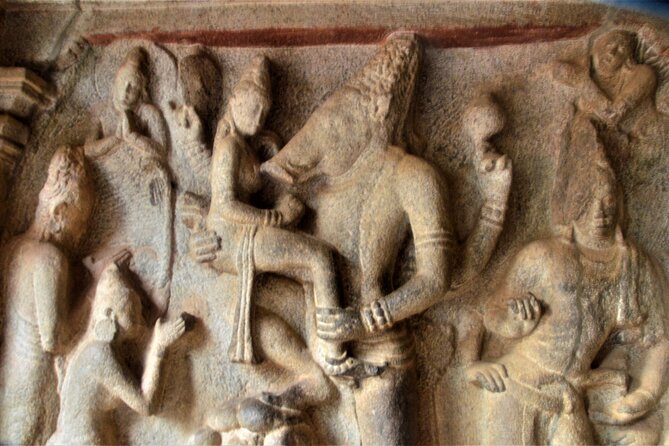
Mahishasura Mardini Cave contains two major bas-reliefs. One shows Vishnu reclining on the coils of a serpent. The other depicts the goddess Durga fighting the demon Mahishasura while riding a lion.
The contrast between the two scenes is striking. Vishnu appears calm and resting, while Durga’s scene is filled with action and conflict. The cave is a compact lesson in how sculptors used posture and movement to express different religious ideas.
The stop lasts about 15 minutes. Since the carvings are inside a cave, listen closely as the guide points out the figures and their stories. Without that help, it is easy to admire the stonework while missing the identities and meaning of the scenes.
Shore Temple beside the Bay of Bengal
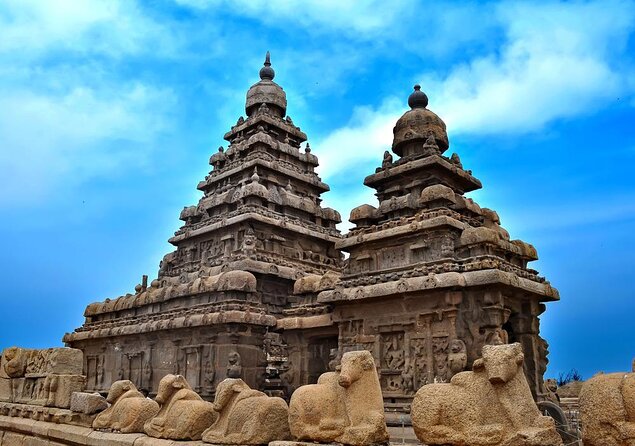
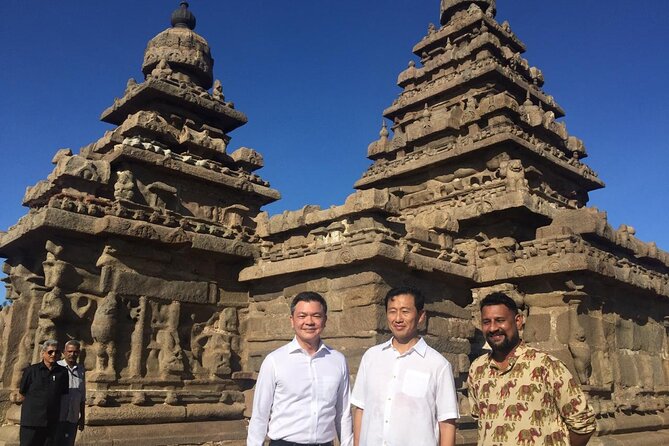
The Shore Temple is the tour’s grand closing sight. It faces the Bay of Bengal and was an important center during the Pallava period, when Mahabalipuram served as a major port.
The setting gives this monument a different mood from the inland caves. Here, the temple’s relationship with the sea is part of the experience. The coastal position also helps explain why Mahabalipuram became such an important place for the Pallavas.
You get about 20 minutes at the Shore Temple. That is enough to see the main structure and understand its place in the wider site, but you should not expect a long, unhurried visit. If this is the final stop for your group, it makes a satisfying end because it brings together the religious, artistic, and maritime themes covered earlier.
There is one practical point to confirm. The stated meeting information places the start at Shore Temple and the end at the Five Rathas, while the monument sequence begins at the Five Rathas and finishes at Shore Temple. Ask the operator to confirm the exact meeting point and direction on your chosen date.
Walking, autorickshaw, or buggy?
The experience is presented as a walking tour, but you can choose to visit on foot or by autorickshaw. That flexibility is valuable because the monuments are spread out and the heat can make a full walk tiring.
The autorickshaw is especially sensible for older visitors or anyone who wants to save energy for the monuments. A buggy ride has also been used as a thoughtful option for seniors. Since the exact vehicle arrangement may vary, confirm what is available when you book.
Walking gives you the clearest sense of how the monuments relate to one another. It also lets you pause more naturally, but you will need to manage the pace. With ten stops in roughly three hours, this is not a leisurely wander.
Is $50 a fair price?
At $50 per person, this tour is not the cheapest way to look at Mahabalipuram. You are paying for a guide, organized movement between a large number of sites, included admission according to the tour details, and the convenience of a small group.
The value is strongest if you want the monuments explained. A self-guided visit can show you the carvings, but it may not explain the Pallava period, the temple forms, the mythology, or the engineering behind the rock-cut work. The price also makes more sense if you would otherwise need to arrange several short rides between scattered sights.
For a private guide, the cost would be a different comparison. This is a shared group experience capped at 15 people, so you should not expect the same control over pace as on a private tour. Still, the group limit is more personal than a large coach excursion.
Free cancellation is available up to 24 hours before the start time. If poor weather forces cancellation, you are offered another date or a full refund. Changes or cancellations made less than 24 hours before the start are not refunded.
Who should book this Mahabalipuram tour?
I would choose this experience if you are visiting Mahabalipuram for the first time and want a clear introduction to the main monuments. It suits people who enjoy architecture, Indian mythology, ancient art, and practical local explanation.
It is also a good fit if you are traveling with older family members, since the autorickshaw and buggy options can reduce the physical strain. The small group makes it easier to ask questions than on a large sightseeing bus.
I would hesitate if you want to photograph every detail at length or spend a full morning at just one monument. Ten stops in three hours is efficient, but it is also brisk. Serious students of Pallava architecture may prefer a private arrangement or a longer visit.
Should you book it?
Book this tour if you want the main Mahabalipuram sights connected into one understandable story. The best reasons are the small group, the broad selection of monuments, the transport flexibility, and guides such as Ramesh, who explain the sculptures in a clear and engaging way.
Skip it if you already know the site well or want complete control over your pace. For most first-time visitors, though, $50 is reasonable for a guided look at the Pancha Rathas, caves, lighthouse, and Shore Temple, especially when you confirm the meeting direction before you go.
FAQ
How long does the Mahabalipuram walking tour last?
The tour lasts approximately three hours. One guide, Ramesh, has extended a tour by about an hour when needed, but extra time should not be assumed.
How many people can join the tour?
The group has a maximum of 15 participants.
What is the price?
The listed price is $50 per person.
Is the tour suitable for history and architecture enthusiasts?
Yes. The tour focuses on Pallava temples, rock-cut caves, bas-reliefs, sculpture techniques, and the development of Mahabalipuram’s major monuments.
Can I use an autorickshaw instead of walking?
Yes. You can choose to visit on foot or by autorickshaw. Buggy rides have also been used as an option for seniors.
Which monuments are included?
The route includes the Pancha Rathas, Pancha Pandava Cave, Arjuna’s Penance, Krishna’s Butter Ball, Varaha Cave Temple, Trimurti Cave, Ganesh Ratha, the Old Lighthouse, Mahishasura Mardini Cave, and Shore Temple.
Where does the tour start and finish?
The meeting information gives Shore Temple on Beach Road as the start point and Five Rathas on West Raja Street as the end point. The listed sightseeing order runs from Five Rathas to Shore Temple, so confirm the exact direction with the operator.
Are admission tickets included?
Admission tickets are listed as included for each of the ten stops.
Can I cancel for a refund?
You can cancel at least 24 hours before the start time for a full refund. Cancellations or changes made less than 24 hours before the start are not refunded. If bad weather cancels the tour, you can choose another date or receive a full refund.
Just added around India
- Wine Tasting Experience At 150 Years Old Indo-Portuguese House★ 5.0 · 269 reviews
- Fontainhas Heritage Walk At Latin Quarters of Goa★ 5.0 · 531 reviews
- The Goan Hinterland Experience in South Goa★ 5.0 · 112 reviews
- Food And Drink Walking Tour In Panjim★ 5.0 · 286 reviews
- Private Aguada Jail Heritage Walk Tour★ 5.0 · 102 reviews
- Georgetown heritage walking tour in Chennai about the founding of Chennai★ 5.0 · 144 reviews
- Gods of Mylapore walking tour- tourism ministry approved company★ 5.0 · 267 reviews
- Sowcarpet Street Food Walking Tour in Chennai with guide★ 5.0 · 83 reviews
Walking Tours, compared.

Magical London: Harry Potter Guided Walking Tour
Read our review →
Reykjavik Food Walk – Local Foodie Adventure in Iceland
Read our review →
History and Hauntings of Salem Guided Walking Tour
Read our review →
New Orleans Premier Ghost, Voodoo and Vampire Walking Tour
Read our review →
Amsterdam Anne Frank: Small-Group Walking Tour & Local Guide
Read our review →

Edinburgh Castle: Guided Walking Tour with Entry Ticket
Read our review →
Anne Frank’s Story – Guided Walking Tour through Amsterdam
Read our review →Browse the lists this tour appears in