
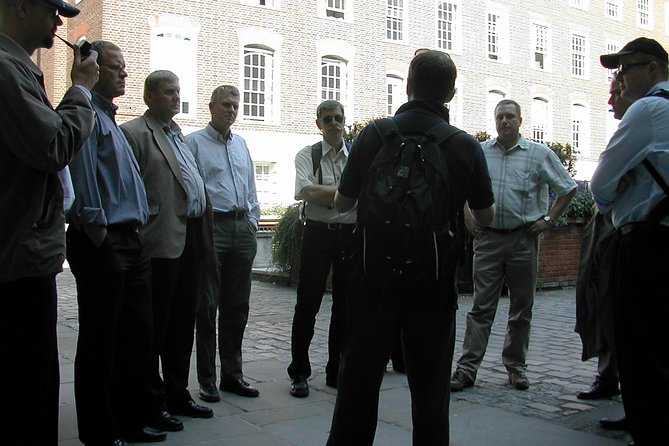
REVIEW · LONDON
London Serial Killers – The Blood and Tears Walk
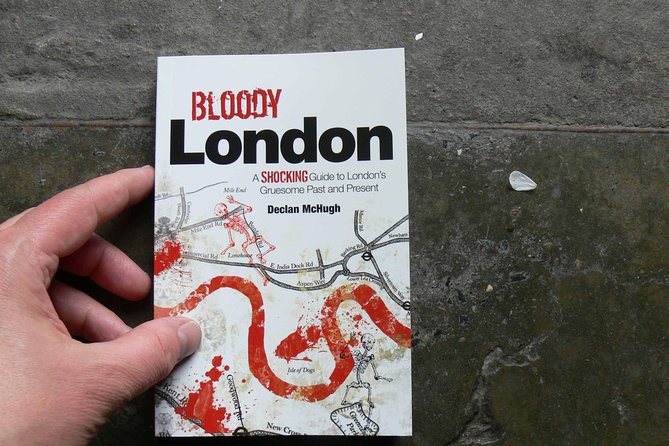
London Serial Killers: The Blood and Tears Walk puts true crime in the streets where it happened. Led by Declan McHugh, author of Bloody London, it covers ten serial killers in about two hours, with stops at old churches, courts, alleys, and pubs.
I like the unusual route, which takes you beyond the familiar Jack the Ripper circuit. I also like the mix of facts, questions, horror-film talk, and local history. The main caution is the pace: you walk about 2 miles, or 3.2 kilometers, briskly, often at night and in all weather.
Key points to know
- Ten serial killers in two hours: Expect a tightly packed evening, not a slow stroll with long breaks.
- Declan McHugh leads the walk: His book, Bloody London, covers the same dark subject and is available at the end.
- Jack the Ripper is only one part: The route also covers lesser-known killers, murder trials, grave-robbing, and forensic clues.
- The route includes genuinely unsettling places: A narrow alley near St. Dunstan in the West is used for a murder story and a psychic experiment.
- You need a steady walking pace: The tour is not recommended for people with significant mobility or health issues.
- The finish is near Holborn Underground station: The walk ends at the Princess Louise pub, about 60 seconds from Holborn station.
A true-crime walk with more than Jack the Ripper
Many London crime tours circle back to Jack the Ripper. This one gives him only one section. The larger story is London as a city of courts, hospitals, alleys, pubs, rail stations, and poor neighborhoods where crimes were investigated, misunderstood, and sometimes covered up.
That broader scope is the walk’s best feature. You hear about killers who are barely known outside Britain, along with more famous cases. The stories include murders of children, women, boys, and men, as well as false accusations, botched investigations, and the grim business of medical research in the days before modern ethics.
Declan McHugh’s style is active rather than purely lecture-based. He asks you to profile suspects, vote on horror films, and react to a location. That approach will appeal if you like to think through a case as it unfolds. If you prefer a quiet guide who simply recites dates and names, the constant questions may feel like too much.
The walk has been running for many years, and McHugh draws on his book Bloody London. He also shares details connected to forensic work, including one final story that he says came directly from the head of forensics involved in the case. That kind of first-hand professional connection gives the closing section extra weight, though the subject matter is grim.
A few more walking tours around London worth a look
- Magical London: Harry Potter Guided Walking Tour
★ 4.7 · 22,044 reviews - London: The Original Jack the Ripper Walking Tour
★ 4.7 · 7,833 reviews - Tour for Muggles The Ultimate Harry Potter Walking Tour in London
★ 5.0 · 4,684 reviews
Starting at St. Bartholomew the Great
The walk begins near Underground Ltd on Aldersgate Street, close to Barbican, at 7 p.m. Your first stop is the Church of St. Bartholomew the Great, where McHugh tells the story of an uncaught killer who murdered a six-year-old girl and, seven years later, killed a seven-year-old girl inside Barbican Station.
The point here is not simply the horror of the crimes. McHugh compares the two cases and asks you to consider what the similarities reveal about the killer. It is an early example of the walk’s main method: hear the evidence, then think about behavior and motive.
The church itself gives the opening a strong sense of place. You are not standing in a generic meeting spot while someone reads from notes. You are in one of London’s old religious quarters, close to the station and streets tied to the opening case.
Grave-robbing at Holy Sepulchre London
At Holy Sepulchre London, the subject shifts from murder to the economics of dead bodies. McHugh explains how grave-robbing and medical training created a market for human remains.
The reference to doctors at St. Bartholomew’s Hospital adds an ugly social layer. Bodies were needed for dissection, but the supply of legal cadavers was limited. That gap encouraged grave-robbing and made the bodies of poor people especially vulnerable.
This is a useful stop because it widens the definition of crime. The walk is not only about killers stalking victims. It also looks at the systems that made certain crimes profitable, tolerated, or difficult to prosecute.
Old Bailey and London’s most chilling trials
The Old Bailey, formally the Central Criminal Court, is one of the walk’s main historical anchors. McHugh discusses two serial killers whose trials took place here, then returns later to two more.
The first case involves a man who appeared at the court twice. He helped send an innocent man to his death before later confessing to multiple murders of women. That story raises difficult questions about courtroom certainty and the danger of accepting a convincing accusation too quickly.
The second case concerns a killer who murdered thirteen women and created fear for more than five years. The emphasis is not only on the number of victims, but on the long period during which the killer remained a threat.
Later, at Portugal Street, you hear about a killer who murdered fifteen boys and men, along with a woman described as possibly the most dangerous woman in the world. The structure works well because the Old Bailey is introduced early, then its cases are completed later, keeping the evening moving rather than stopping for one long court lecture.
Same streets, a different route:
- London Jack The Ripper Guided Walking Tour
★ 5.0 · 3,131 reviews - London: Harry Potter Movies Walking Tour (Kids Go Free)
★ 4.7 · 3,071 reviews - London Bridge & Borough Market Food Tour with 7 Authentic Dishes
★ 5.0 · 1,972 reviews - Changing of the Guard Guided Walking Tour in London
★ 5.0 · 1,793 reviews
A brief break with horror films

Printer Street provides a lighter pause. McHugh asks you to consider the scariest horror movies and shares a top-ten list built from more than two decades of audience votes.
This may sound like a side trip, but it serves a practical purpose. Two hours of murder stories can become emotionally heavy. A short change of subject lets you reset before the next case.
The film discussion also fits the audience. People drawn to serial-killer history often enjoy horror cinema, but McHugh’s list includes lesser-known choices rather than only the usual titles. He also gives a personal recommendation for a sixty-year-old cult film that is available free on YouTube.
If you want a strictly factual crime walk with no detours, this is the one section you might find unnecessary. If you enjoy audience participation and a bit of dark humor, it gives the tour breathing room.
Red Lion Court and a killer from two continents
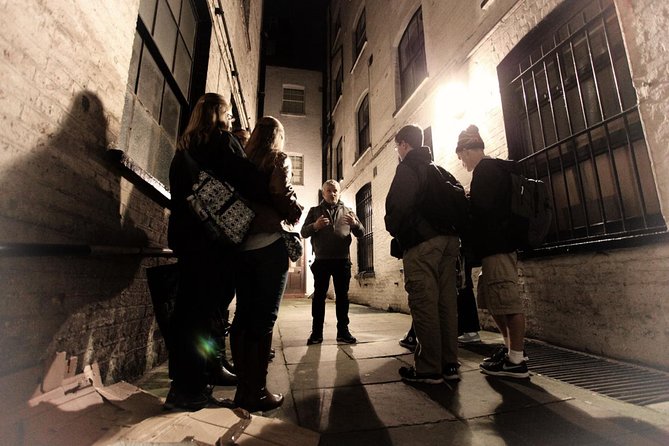
At Red Lion Court, the evening returns to a lesser-known Victorian killer who murdered on two continents and lived in the area.
The story is presented as a sequence of twists, with a final question based on the evidence you have just heard. This is one of several places where McHugh asks you to reason along with him instead of waiting for the answer.
That format can make the case easier to remember. You are not simply storing another name and date. You are weighing the facts and trying to decide what happened. The approach also explains why the pace needs to stay brisk. The walk gives you many separate cases, and each one is designed to leave you with a particular puzzle or detail.
Jack the Ripper at Hare Place
The Jack the Ripper section takes place at Hare Place, just off Fleet Street. McHugh presents his own suspect and explains why he believes this man was the killer.
This is not a broad survey of every Ripper theory. It is a focused argument built around one suspect, with a chapter devoted to that person in Bloody London. You will hear the case for the theory and be asked to assess the profile yourself.
The interactive element becomes especially strong here. McHugh includes what he calls the hardest question on the tour. Only a very small number of people answer it correctly, and those who do are added to the walk’s Roll of Honour.
That can be fun for people who like puzzles, but it is also the point where the schoolroom tone may not suit everyone. The questions are intended as games, not tests, yet some people may prefer to listen without being called on. You can still enjoy the material if you treat the questions as optional mental exercises.
The alley near St. Dunstan in the West
The stop at St. Dunstan in the West is designed to unsettle you. The group enters a narrow, isolated alley that McHugh uses as the setting for a murder scene and a story about two devious serial killers.
There is also a psychic experiment. The details are not fully given in advance, which is part of the effect. The place, especially in the darker months, is meant to create an atmosphere that feels separate from the busy streets nearby.
This is one of the strongest reasons to choose the walk at night. The setting matters more when the light is fading. In summer, however, it may still be light for much of the tour, and the atmosphere will be less intense.
The stop is not presented as pleasant or family-friendly entertainment. The minimum age is 12, and children aged 12 to 14 must be accompanied by an adult. Even older children should be comfortable with murder stories and disturbing details before you book.
Royal Courts of Justice and the final case links
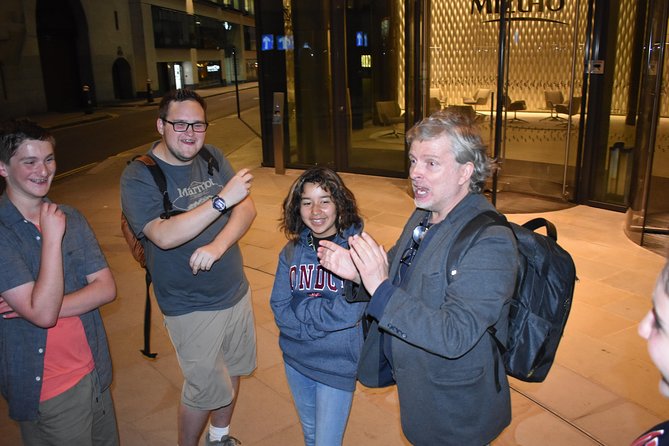
At the Royal Courts of Justice, McHugh introduces a section that he keeps deliberately vague. You become part of the subject in some way, rather than simply hearing another account.
That surprise is part of the tour’s design. The walk repeatedly moves between storytelling and participation, so you should expect to answer questions, give opinions, or react to a place. If you are shy, you can enjoy watching other people take part, but the format is not completely passive.
From there, Portugal Street brings back the two killers first mentioned at the Old Bailey. One murdered fifteen boys and men. The other was a woman whose crimes are presented as among the most dangerous in the world.
The return to earlier material helps tie the route together. You are not hearing ten unrelated stories. The courts and surrounding streets act as a thread, connecting cases to the legal system that tried them.
Finishing at the Princess Louise pub
The final stop is the Princess Louise, a Victorian pub at 208 High Holborn. Its ornate interior offers a pleasant contrast to the dark stories that come before it.
Before you settle in, McHugh tells one last story about a well-known British serial killer. The detail is described as something not commonly found in books or documentaries, and he attributes it to the head of forensics involved in the case.
The closing story is intentionally horrible, so the pub may feel like an odd ending. That contrast is part of the experience. You move from murder scenes and court cases into a beautifully decorated Victorian interior, with the final crime story still fresh in your mind.
McHugh sells signed copies of Bloody London for £10, payable in cash or through PayPal. The pub is about 60 seconds from Holborn Underground station, served by the Central and Piccadilly lines, so it is easy to continue your evening afterward.
Price, pace, and practical planning
At about $27.74 per person, the tour offers two hours of guided storytelling across ten cases. I consider that a fair price if you like true crime and want a structured evening rather than a short photo stop at one famous location.
The value comes from the amount of material and the guide’s personal research. You also see corners of London that are easy to miss on a standard sightseeing route. You are paying for the stories, the route, and the live interaction more than for admission tickets, since the stops themselves are free.
Plan to arrive early. The meeting time is 7 p.m., and you are specifically advised to allow an extra 20 minutes for Underground delays. Missing the start can be costly because late changes and cancellations within 24 hours are not refunded.
The walk covers about 3.2 kilometers at a fairly fast pace. Wear shoes suited to city streets and clothing for rain or cold. The tour operates in all weather, and summer heat can also make the two hours tiring.
The total group can reach 45 people, while individual bookings are limited to a maximum of 20. A larger group may make it harder to hear in narrow streets, so stay close to the guide and move promptly between stops.
Who should book this London walk?
I would choose this tour if you like true crime, British criminal cases, Jack the Ripper theories, and stories with a puzzle built into them. It also suits repeat visitors who have already seen the major sights and want a different side of central London.
Families with teenagers may find it works well, provided everyone is comfortable with the subject. The minimum age is 12, and the stories are not softened for younger listeners.
I would think twice if you have mobility or significant health issues. The pace is brisk, the route is about 2 miles, and there are no long rest periods built into the schedule. It is also not recommended for people in their seventies because of the speed and distance.
One final point is style. McHugh is energetic and interactive. Some people find that approach funny and engaging, while others may find the questions or repeated audience prompts too much. If you want a quiet, formal lecture, choose another walk. If you enjoy a guide who asks you to think, guess, and react, this format should suit you.
Should you book The Blood and Tears Walk?
Book it if you want a dark, story-led evening that goes beyond Jack the Ripper. The lesser-known cases, court connections, creepy alley, and horror-film interlude give the walk a clear identity.
Skip it if you dislike gruesome subjects, fast walking, audience participation, or outdoor tours in uncertain weather. For the right audience, $27.74 buys a full two hours of unusual London history, with an experienced guide and a route you are unlikely to encounter on a standard sightseeing tour.
FAQ
How long does The Blood and Tears Walk last?
The tour lasts approximately two hours.
What time does the tour start?
The tour starts at 7 p.m.
Where does the tour begin?
It begins at Underground Ltd on Aldersgate Street, near Barbican, London EC1A 4JA.
Where does the tour end?
The walk ends at the Princess Louise pub at 208 High Holborn, London WC1V 7EP. Holborn Underground station is about 60 seconds away.
How far do you walk?
The route covers about 2 miles, or 3.2 kilometers.
Is the tour suitable for children?
The minimum age is 12, and children aged 12 to 14 must be accompanied by an adult. The minimum age is strictly enforced.
Is the tour suitable for people with mobility issues?
The tour is not recommended for people with significant mobility or health issues because it uses a fairly brisk pace and covers about 2 miles.
Does the tour operate in bad weather?
Yes. The tour operates in all weather, so you should dress appropriately.
Can I cancel for a full refund?
Yes, if you cancel at least 24 hours before the start time. Cancellations or changes made less than 24 hours before the tour are not accepted for a refund.
Just added around London
- Doctor Who London Walking Tour★ 4.9 · 137 reviews
- London: Royalty Walking Tour with Changing of The Guard★ 4.5 · 187 reviews
- London: Beatles In My Life Walking Tour with Richard Porter★ 4.7 · 215 reviews
- Private London Food Tour: Classic British Eats at London Bridge★ 5.0 · 262 reviews
- Private East End Food Tour: 7 Tastings with Bagels & Fish & Chips★ 5.0 · 263 reviews
- East London Indian Food Tour with 8+ Authentic Food Tastings★ 5.0 · 585 reviews
- Private Group: Historical Pub Walking Tour of London★ 5.0 · 660 reviews
- London Sightseeing Walking Tour with 30+ sights★ 5.0 · 705 reviews
Walking Tours, compared.

Magical London: Harry Potter Guided Walking Tour
Read our review →
Reykjavik Food Walk – Local Foodie Adventure in Iceland
Read our review →
History and Hauntings of Salem Guided Walking Tour
Read our review →
New Orleans Premier Ghost, Voodoo and Vampire Walking Tour
Read our review →
Amsterdam Anne Frank: Small-Group Walking Tour & Local Guide
Read our review →

Edinburgh Castle: Guided Walking Tour with Entry Ticket
Read our review →
Anne Frank’s Story – Guided Walking Tour through Amsterdam
Read our review →Browse the lists this tour appears in