
REVIEW · BOSTON
Entire Freedom Trail Walking Tour: Includes Bunker Hill and USS Constitution
Boston’s Freedom Trail is more than a red line through downtown. It is a walk through the arguments, protests, violence, and political choices that led to American independence. This four-hour tour follows the full 2.8-mile route from Beacon Hill to Charlestown, ending at Bunker Hill and the USS Constitution.
I like the full-trail format, since you do not have to choose between the downtown churches and graveyards or the final sites across the Charles River. I also like the guide’s storytelling style. Mark uses maps, cause-and-effect explanations, humor, and lesser-known figures to make the events easier to follow.
The main drawback is simple: four hours on foot is a serious outing. You will cover roughly 2.75 miles, with plenty of standing and city walking. Most of the route is manageable and fairly level, but comfortable shoes are essential. Children under 12 may find the detail heavy unless they already enjoy history.
Key points before you book
- The complete route: You visit the principal Freedom Trail sites from the Massachusetts State House to the USS Constitution.
- A small group: The tour has a maximum of 16 people, which makes it easier to hear the guide and ask questions.
- A story with context: Mark connects the Boston Massacre, the Boston Tea Party, Lexington and Concord, and the Battle of Bunker Hill instead of treating each stop as an isolated fact.
- Bunker Hill and Old Ironsides included: Many shorter walks end downtown, but this one continues to Charlestown.
- Interior tickets cost extra: The tour visits or passes the sites, but admission to interiors is not included.
- Good value for serious history fans: At $79, the price includes four hours of guiding and no added gratuity expectation.
Why the entire Freedom Trail makes sense
Boston’s official Freedom Trail is only 2.8 miles, but the story does not unfold in one neat downtown cluster. The final section across the river matters. Bunker Hill explains the early military test of the Revolution, while the USS Constitution shows how the new country later defended itself at sea.
That is why I prefer this route to a quick downtown stroll. You begin with government, religion, protest, and burial grounds, then follow the story into military conflict. By the end, the Revolution feels less like a list of famous names and more like a chain of events.
The tour starts at 10:00 a.m. on Beacon Street near Park Street. It ends at the USS Constitution in the Charlestown Navy Yard, so you should not plan to finish where you started. The start is close to public transportation, and the mobile ticket makes arrival simple.
The group limit of 16 is useful in a busy city. You still walk on public sidewalks and gather near major landmarks, but a small group is easier to manage than a large crowd. Mark has also been praised for keeping the pace comfortable, answering questions, and helping people stay together around traffic and city activity.
A few more walking tours around Boston worth a look
- Boston: Freedom Trail History Small Group Walking Tour
★ 5.0 · 6,450 reviews - Harvard University Campus Guided Walking Tour
★ 4.5 · 3,632 reviews - Boston Freedom Trail Walking Tour with Costumed Guide
★ 4.5 · 2,531 reviews
From the State House to the Granary Burying Ground
The first stop is the Massachusetts State House, where you see the current seat of state government. The building was designed by Charles Bulfinch, an important figure in Federal architecture, and the tour places it alongside Boston’s earlier government buildings.
That comparison gives you a quick sense of how the city changed from a British colony to an American state. You spend about 10 minutes here, but interior admission is not included.
A short walk brings you to Park Street Church. When it was built, it was the tallest building in the country. Its story also reaches into the abolition movement, and the nickname Brimstone Corner refers both to fiery sermons and to a surprising former use of the church’s cellar.
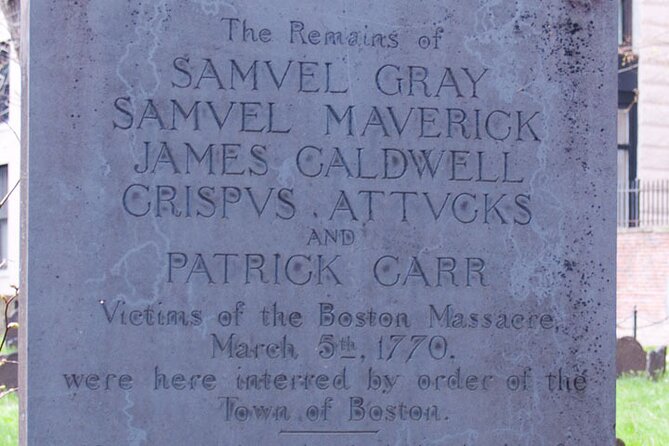
Next comes Granary Burying Ground, one of the most rewarding stops for understanding the people behind the famous events. Samuel Adams, Paul Revere, and John Hancock are buried here, along with victims of the Boston Massacre.
You are not simply shown a collection of old stones. The guide introduces the figures and explains what each person did. This is where the tour’s story-first approach begins to pay off. You can connect names from schoolbooks to actual political, military, and local roles.
Granary Burying Ground is free to enter. Allow a little extra patience here, since the group pauses while the guide explains several graves.
Churches, courts, and the arguments behind independence

King’s Chapel is one of the oldest major churches on the route. The present 1749 building reflects the religious and political tensions of colonial Boston. The tour explains how conflict over land and an unwanted Anglican church created an early clash between Puritans and the English Crown.
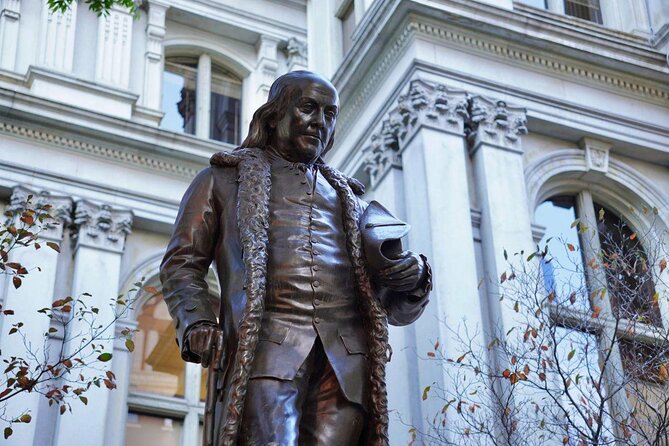
You then pass Old City Hall, where the focus shifts to Benjamin Franklin and a marker connected to the oldest still-operating school in the colony. This is a good reminder that the Freedom Trail is not only about battles and famous speeches. Education, civic life, religion, and local power all helped shape Boston’s politics.
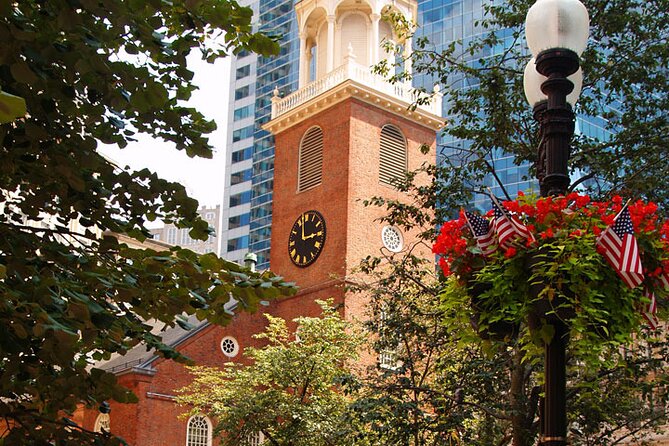
The Old South Meeting House is one of the most important locations on the route. Colonial meeting halls were places where people heard sermons, political arguments, and news. Samuel Adams used this building to help launch the Boston Tea Party, an act that pushed the dispute with Britain into a far more dangerous phase.
Admission to the interiors is not included, so check the site separately if you want to go inside. The exterior and surrounding story still make the stop worthwhile, but history fans who want to see the meeting room should budget for an additional ticket.
The Old State House follows with an even sharper political edge. It once housed the hated British government in Massachusetts and was the setting for a major 1761 court battle over colonial rights.
It is also tied to the Boston Massacre of 1770. The guide does not treat the familiar version as the whole story. Instead, you get a closer look at what happened and why the event became such a powerful piece of Patriot propaganda. That willingness to question the tidy schoolbook version is one of the tour’s strengths.
Faneuil Hall and the less famous people of the Revolution

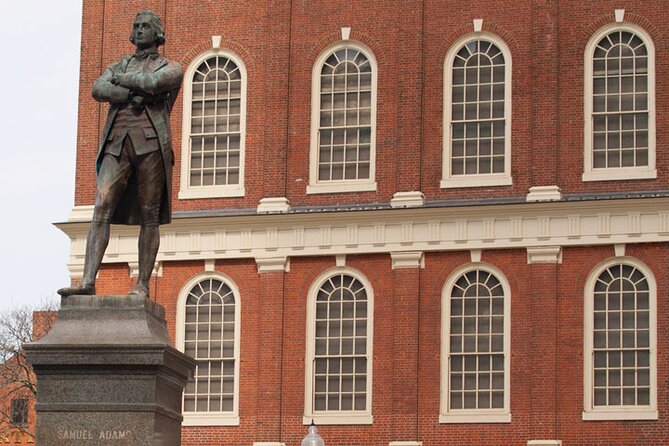
Faneuil Hall Marketplace is a lively modern stop, but the building’s political role is much older. Samuel Adams spoke here against taxation without representation, and Frederick Douglass later used the hall as an abolitionist speaker.
The tour uses the site to widen the story beyond the Revolution alone. Boston’s public meeting places continued to matter long after independence, and the same tradition of public argument carried into the fight against slavery.
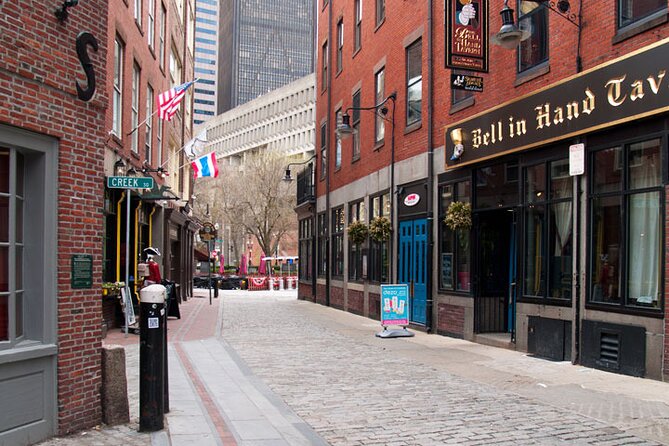
From here, you enter the Blackstone Block area. The route includes the former office area of the Massachusetts Spy, a tavern known as the Headquarters of the Revolution, and the Ebenezer Hancock House.
Ebenezer Hancock was John Hancock’s brother, and his home was used to store French money sent to support the Revolution. This is exactly the sort of detail that can disappear on a basic walk through the city. It gives you a better idea of how a revolution depended on money, communication, family connections, and ordinary buildings, not just dramatic speeches.
The guide also adds a few points outside the standard red-line stops. Those extra details are useful because they help you see Boston as a working colonial city rather than a row of monuments arranged for sightseeing.
Same streets, a different route:
- The Full Revolutionary Story Epic Small Group Boston Walking Tour
★ 5.0 · 2,356 reviews - Boston’s Freedom Trail: A Revolutionary Walking Tour
★ 4.9 · 1,748 reviews - Boston: Freedom Trail History Small Group Walking Tour
★ 4.9 · 1,590 reviews - Boston North End Food Tour of 6+ Tastings, Cannoli, Lobster Roll
★ 5.0 · 1,404 reviews
Paul Revere, signal fires, and the road to war
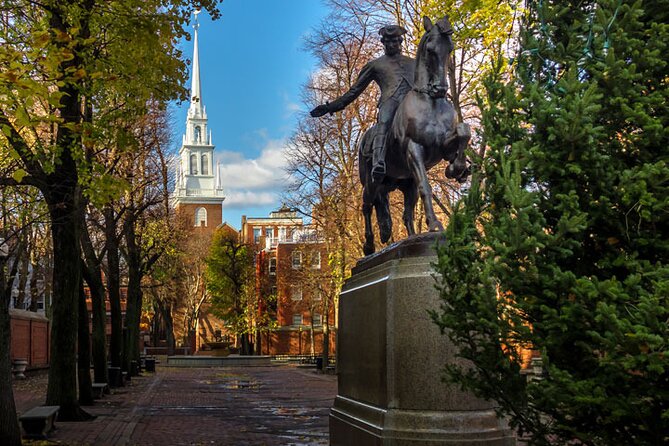
The Paul Revere House is one of Boston’s oldest surviving homes. Revere bought the 1680 house in 1770 and raised a large family there. The building is small and admission is separate, so do not expect a long interior visit as part of the walking tour.
What makes the stop valuable is the chance to place Revere in his real setting. He was not only the rider from a famous poem. He was a craftsman, father, messenger, and participant in Boston’s political network.
At Old North Church, the guide explains the signal system used to warn Patriots in Charlestown about the movement of British troops. The famous lantern message helped alert people that the Regulars were heading toward Lexington and Concord to seize military supplies.
Old North Church is another site where interior admission is not part of the $79 tour. Even so, the exterior and location make the stop important. You are now moving from political resistance to open military action.
Copp’s Hill Burying Ground prepares you for the final stretch. From this higher ground, you can better understand the geography connected with the Battle of Bunker Hill. The guide also points out a grave marker with its own unusual story.
This stop may appeal especially to people who like the physical side of history. You are no longer looking only at buildings. You are using Boston’s hills, river, and sightlines to understand how the fighting unfolded.
Bunker Hill was fought on Breed’s Hill
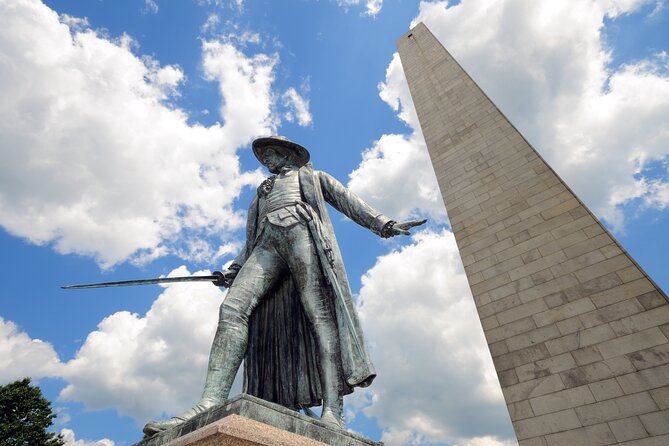
The Bunker Hill Monument is one of the tour’s biggest advantages. The battle was actually fought on Breed’s Hill, a detail that surprises many people. The British won the field, but their losses were about three times those of the Patriots.
That result mattered. The colonial forces lost the battle, yet they showed they could face regular British troops and inflict heavy casualties. The fight gave the Patriot cause credibility and made the conflict far harder for Britain to contain.
You spend about 10 minutes at the monument, and admission is listed as free. The tour does not promise a long climb or interior visit, so you should think of this as a guided outdoor stop with a clear explanation of the battle.
This is also where the four-hour format earns its keep. A shorter downtown tour can tell you that Bunker Hill exists. This one gives the site a place in the story you have been following since the State House.
Finishing at the USS Constitution
The final stop is the USS Constitution, known as Old Ironsides. It is the oldest commissioned warship in the world and served the United States in American and foreign waters.
Ending here gives the tour a useful second act. The Freedom Trail story begins with colonists challenging British authority and ends with the new United States maintaining a navy of its own. You see the country moving from protest to war, then toward a lasting national institution.
The tour ends at the USS Constitution Museum area in the Charlestown Navy Yard. Admission to the ship or museum interior is not included, so plan on paying separately if you want to explore inside. The listed tour price covers the walk and narration, not every museum or historic-house ticket along the route.
You may appreciate having the afternoon open after finishing here. The tour does not return you to Park Street, so arrange your next stop from Charlestown or use public transportation back into central Boston.
Is $79 a fair price?
At $79 per person, this is not the cheapest way to trace the Freedom Trail. You can follow the red line independently, and several outdoor sites are free.
The value comes from the four-hour structure and the guide’s ability to connect the places. If you walk alone, you will see the State House, churches, graveyards, Faneuil Hall, Paul Revere’s house, Old North Church, Bunker Hill, and the USS Constitution. You may not understand how the events connect, and you may miss the smaller stories around them.
The price also includes guide gratuity. Your guide does not expect or accept a tip, which makes the final cost easier to predict. For a small-group tour with a maximum of 16 people, that is a reasonable price if you want a full historical explanation rather than a quick orientation walk.
Keep extra money available for interior admissions. The tour passes several buildings whose interiors are not included, including King’s Chapel, Old South Meeting House, Old State House, Paul Revere House, Old North Church, and the USS Constitution or museum.
Who will enjoy this four-hour walk?
I would choose this tour for adults, older children, teenagers, couples, families with history-minded kids, and anyone visiting Boston for the first time who wants the full story in one morning.
It also suits people who prefer a calm walking pace. The route is generally manageable, and the guide makes room for questions and photographs. Several people have found the pace workable for older adults, though you still need a moderate level of fitness.
Children can enjoy it, but the amount of information matters. Mark has indicated that children under 12 should be especially interested in history to get the most from it. Teenagers may do well because the tour explains cause and effect rather than simply listing dates.
I would skip it if you want a short sightseeing loop, dislike standing outdoors, or mainly want to enter every historic building. You should also reconsider if poor weather is likely. The experience requires good weather, and a cancellation due to conditions leads to a different date or a full refund.
Wear comfortable shoes and be ready for a full morning. One person estimated the walk at around 10,000 steps, while the guide places the distance closer to 2.75 miles. The exact number matters less than the practical point: this is a real walk.
Should you book the Entire Freedom Trail tour?
Book it if you want the whole route in one organized morning, especially if Bunker Hill and the USS Constitution are priorities. Mark’s strength is making the events connect, adding overlooked people and places, and keeping a long history lesson lively without turning it into a theatrical performance.
Skip it if you prefer to explore at your own speed or plan to spend substantial time inside every museum and church. For most first-time Boston visitors with a serious interest in the Revolution, though, the combination of small group, full route, clear storytelling, and included gratuity makes $79 a sensible buy.
FAQ
How long is the Entire Freedom Trail Walking Tour?
The tour lasts approximately four hours and covers the full 2.8-mile, or roughly 4-kilometer, Freedom Trail route from Beacon Hill to Charlestown.
Where does the tour start?
The meeting point is on Beacon Street near Park Street in Boston, Massachusetts. The scheduled start time is 10:00 a.m.
Where does the tour end?
The tour ends at the USS Constitution in the Charlestown Navy Yard, near the USS Constitution Museum.
Are Bunker Hill and the USS Constitution included?
Yes. Bunker Hill Monument and the USS Constitution are included as the final major stops on the walking route.
Are admission tickets included?
No. Admission to historic-site interiors is not included. Some outdoor areas and listed stops are free, but you need separate tickets for interiors you wish to visit.
How large is the group?
The tour has a maximum of 16 participants.
Is gratuity included?
Yes. Guide gratuity is included, and the guide does not expect or accept additional gratuities.
Can I cancel for a refund?
You can cancel at least 24 hours before the scheduled start time for a full refund. Changes or cancellations made less than 24 hours in advance are not accepted for a refund. If poor weather cancels the tour, you will be offered another date or a full refund.
Just added around Boston
- Boston: North End Pizza Walking Tour with 3 Slices & Cannoli★ 4.8 · 162 reviews
- Boston: Freedom Trail Guided Walking Tour in French★ 4.9 · 106 reviews
- Boston: Salem by Boat – Witch Trials & Walking Tour★ 4.3 · 263 reviews
- Boston: Full Revolution Story Epic Small Group Walking Tour★ 4.9 · 132 reviews
- Boston: 2-Hour Historic Walking Tour★ 4.7 · 88 reviews
- Self Guided Classic Freedom Trail Location Aware (GPS) Walking Audio Tour★ 4.5 · 258 reviews
- Boston History Tour: Scenic Walk Through Time & Landmarks★ 5.0 · 627 reviews
- Boston Pizza Lovers Food and History Walking Food Tour★ 4.5 · 1,082 reviews
Walking Tours, compared.

Magical London: Harry Potter Guided Walking Tour
Read our review →
Reykjavik Food Walk – Local Foodie Adventure in Iceland
Read our review →
History and Hauntings of Salem Guided Walking Tour
Read our review →
New Orleans Premier Ghost, Voodoo and Vampire Walking Tour
Read our review →
Amsterdam Anne Frank: Small-Group Walking Tour & Local Guide
Read our review →

Edinburgh Castle: Guided Walking Tour with Entry Ticket
Read our review →
Anne Frank’s Story – Guided Walking Tour through Amsterdam
Read our review →Browse the lists this tour appears in