
REVIEW · UK
Discovering Birmingham 2 hour Walking Tour to the Jewellery Quarter
Birmingham’s best stories often sit just beyond the main roads. This two-hour walk slips from Centenary Square into the Jewellery Quarter by a little-used canal route, then returns through cathedrals and civic squares. It is a useful way to see how workshops, churches, post-war roads, and new public spaces fit together.
I like the local scale and the guides’ lively way with facts. Jonathan Berg may bring old objects and props, turning the pavement into a small street museum. I also like the supplied audio receiver, which helps you hear even when the group stretches out.
The main drawback is the pace. Two hours covers several parts of central Birmingham, so some stops are brief, and the tour runs in most weather. Bring a proper coat or umbrella, and wear shoes suited to walking.
What makes this Birmingham walk worth your time
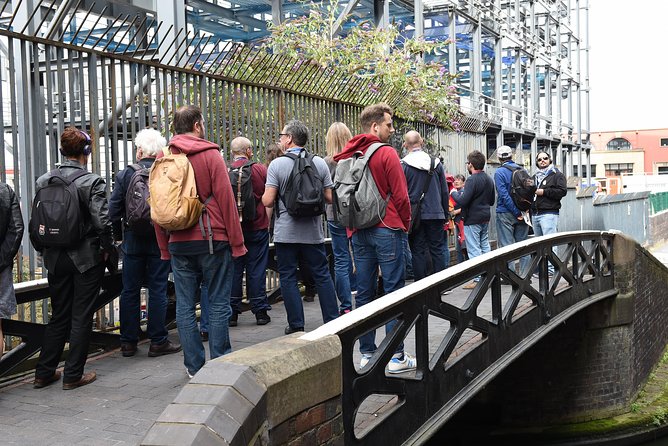
- A canal entrance into the Jewellery Quarter: You use a route that even many locals have not taken.
- Stories from Georgian Birmingham to today: The Jewellery Quarter is explained as a working district, not just a photo stop.
- Cathedral art and architecture: Birmingham Cathedral may include a look at its Edward Burne-Jones stained glass when time and events allow.
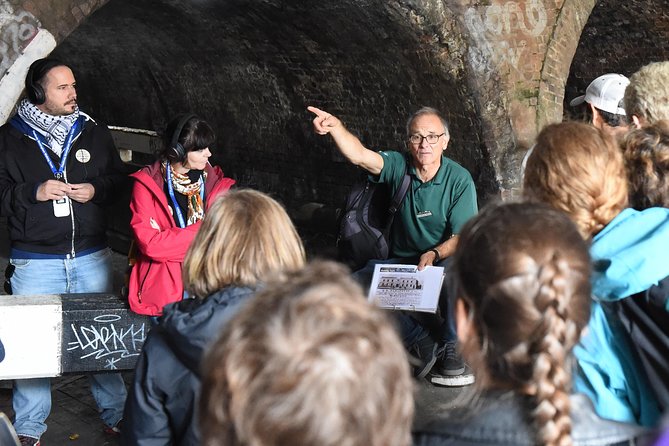
- A guide who uses props: Jonathan Berg is known for bringing objects that give the city’s past a physical connection.
- A clear route through modern Birmingham: Victoria Square, Chamberlain Square, and the Library of Birmingham show how the city is changing.
- A sensible price for a broad introduction: At $20.80 per person, the tour gives you two hours of guiding without extra entry fees.
Starting at Centenary Square at 1:30 pm
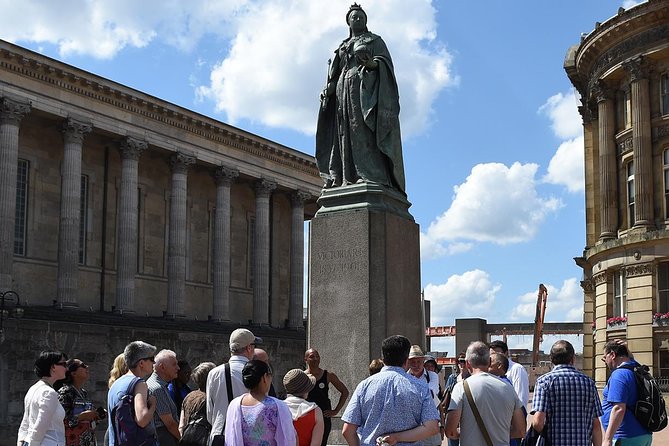
Meet outside the Library of Birmingham in Centenary Square at 1:30 pm. This is a practical starting point in the city center, close to public transport and surrounded by major civic buildings.
The opening 20 minutes use the square to set up Birmingham’s story. Instead of rushing straight toward the next stop, the guide points out features around the square and uses them to explain the city. That matters because Birmingham can seem scattered at first. A good opening helps you connect the old center, later redevelopment, cultural buildings, and surrounding streets.
The tour ends back at the same meeting point. That makes the walk easy to fit into a day of sightseeing. You can leave luggage plans and complicated transport connections for later, since you finish where you began.
Group size can reach 40 people. That is not a tiny private walk, so you should expect a social group rather than a quiet one-on-one tour. The audio receiver helps solve the usual problem of losing the guide’s voice at busy crossings or when the group spreads along a narrow path.
More Two-Hour Tours in the UK:
- London: Ghastly Ghosts 2-Hour Walking Tour
★ 4.9 · 794 reviews - James Bond Shooting Locations 2-Hour Walking Tour of London
★ 4.7 · 332 reviews - BATH: 2-Hour Bath Walking Tour of Bridgerton Filming Locations
★ 5.0 · 99 reviews
Entering the Jewellery Quarter by canal
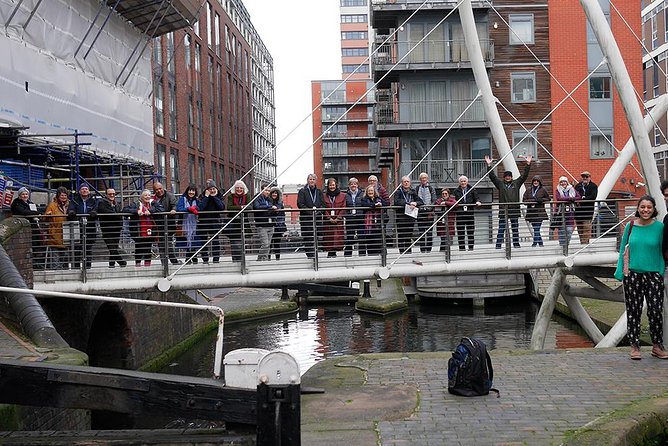
The walk’s most distinctive section comes as you enter the Jewellery Quarter by a less-used canal route. This is more interesting than simply arriving along a main street. The change in setting helps you see how waterways supported Birmingham’s work and growth.
You then spend about 30 minutes learning how the Jewellery Quarter developed from Georgian times onward. The point is not only the name of the district or the goods made there. You get a sense of how different businesses took root and how an old working area is finding a role in the modern city.
This part suits you if you like urban stories with a human scale. Backstreets, alleys, bridges, and canal edges show a side of Birmingham that a coach cannot reach. The route also gives you a chance to notice details you might otherwise pass without a second glance.
The canal section may require a little care in poor weather. Birmingham’s weather can be wet, and the company tries to operate despite rain. Pack a waterproof coat or umbrella rather than relying on a light jacket. In icy conditions, the route may change.
A Georgian church and the Jewellery Quarter’s changing identity
Within the Jewellery Quarter, the walk pauses outside a church known locally as the Jewellery Quarter church. It is a 1779 example of Georgian architecture, and the focus here is on the exterior.
That short stop adds useful balance. The district is not presented only as a place of workshops and modern businesses. Its church, streets, and older buildings show the civic and religious life that grew alongside industry.
There is no scheduled entry ticket for this stop. You should think of it as an architectural pause, not a full interior visit. If you want long periods inside historic buildings, this tour may feel brisk. If you prefer a broad introduction that keeps moving, the timing works well.
The tour also points to the way the Quarter is changing today. Old commercial areas do not remain frozen in time, and the guide connects earlier businesses with the district’s current place in Birmingham. That link between past work and present redevelopment is one of the walk’s strongest themes.
Birmingham Cathedral and St Chad’s: two different city stories
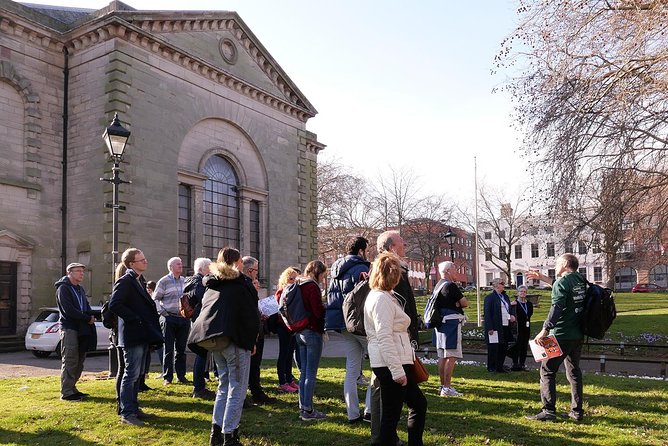
The route continues to Birmingham Cathedral, also known as St Philip’s Cathedral. You spend only about five minutes here, so expect a focused look rather than a full church visit.
The building is an example of English Baroque architecture. When time allows and no event gets in the way, the group may go inside to see the Edward Burne-Jones stained glass. That possibility is worth noting, but it is not guaranteed. Plan on seeing the cathedral from outside, with the interior as a useful bonus.
The contrast with St Chad’s is especially helpful. From the inner ring road, you look toward St Chad’s and consider the effects of post-war redevelopment, when cars shaped much of the city. The guide encourages you to judge the planning choices for yourself.
This is not just a list of buildings. You are asked to compare different periods of Birmingham’s growth: Georgian streets, Baroque worship, industrial expansion, post-war road planning, and current efforts to make the center more pleasant for people. That wider view gives the walk more substance than a quick photo circuit.
The St Chad’s section also points to one practical truth about city walks. Central Birmingham is not a single preserved old town. Roads, modern buildings, older churches, new public projects, and leftover spaces sit close together. If you want a perfectly uniform historic setting, this may not be your ideal tour. If you want to see how a real working city has been altered over time, it is a strength.
A few more walking tours around the UK worth a look
- Magical London: Harry Potter Guided Walking Tour
★ 4.7 · 22,044 reviews - Edinburgh: Harry Potter Magical Guided Walking Tour
★ 4.8 · 11,944 reviews - Edinburgh Castle: Guided Walking Tour with Entry Ticket
★ 4.7 · 11,699 reviews - Underground Vaults Walking Tour in Edinburgh Old Town
★ 4.5 · 8,506 reviews
Victoria Square and Chamberlain Square on the return route
After the cathedral areas, you return toward the Library of Birmingham through several important squares. Victoria Square receives about 10 minutes, enough to place it within the larger story of the city center.
The guide has already shown you working streets and older religious buildings. Now the setting becomes more civic and open. That shift helps explain how Birmingham presents itself as a major regional center and how public spaces guide movement through the core.
Chamberlain Square receives about five minutes. It has been renovated as part of the city’s ongoing changes, and the guide explains how Birmingham is reshaping the center for the future.
Do not expect a long rest here. These are short teaching stops, not extended breaks. You will get more from them if you pay attention to the link between buildings, paving, open space, and movement. The tour asks you to look at urban planning as part of the city’s story, not as background scenery.
The return to the Library of Birmingham gives the walk a tidy finish. You end near a major city landmark with a clearer sense of how the canal district, churches, roads, and squares relate to each other.
Guides, stories, and the value of the audio receiver
The guides are central to the experience. Jonathan Berg is named as one of the guides and is associated with witty storytelling, Birmingham public art, and physical props. Bernard is another named guide, and Ann and Maria have also led the walk.
The style is interactive rather than purely formal. You may see old objects brought along to help explain the city, a touch Jonathan calls a museum on the streets. Those props can make an otherwise ordinary corner easier to remember.
The tone also has some humor. That matters on a walking tour that may continue through rain. A guide who can keep the mood light makes the two hours easier, especially when the weather is poor or the group is large.
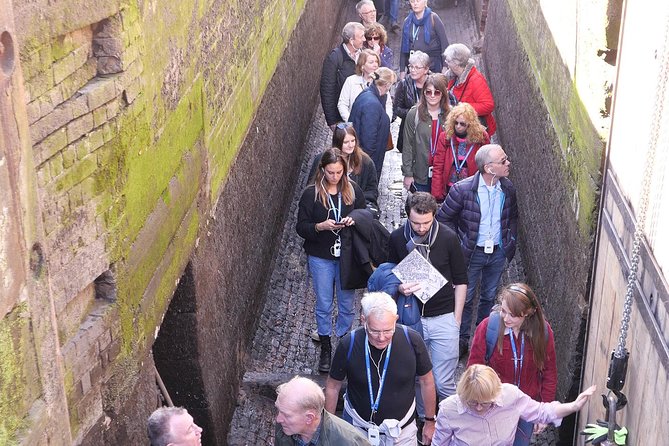
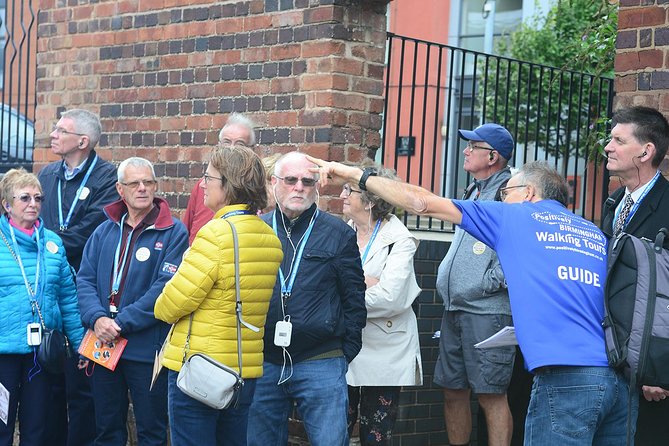
The audio receiver is a small but important inclusion. You do not need to crowd around the guide at every stop, and you can listen while looking at the building or street being discussed. For a group of up to 40, this is more than a gadget. It helps preserve the quality of the explanation.
The guides also seem comfortable speaking to people who already know Birmingham. If you live locally, you may still pass places you have never examined closely. If you are visiting from elsewhere, you get context that is difficult to pick up from signs alone.
Is $20.80 good value for two hours?

At $20.80 per person, the price is fair for a two-hour guided walk that includes an audio receiver and has no extra admission costs. The value comes from the connections between stops, not from paid access to a single major attraction.
You are paying for local interpretation, route planning, and access to less obvious streets and canal paths. The guide also does the work of explaining why the Jewellery Quarter developed, how central roads affected the city, and why the newer squares look as they do.
Some tours charge a similar amount simply to lead you around a few famous buildings. This one covers more ground in terms of ideas. You see architecture, industry, public planning, religious buildings, and current redevelopment in one compact route.
The limitation is that the price does not buy lengthy interior visits. Birmingham Cathedral entry is not guaranteed, and the Jewellery Quarter church is viewed from outside. If your priority is museum access or detailed examination of one building, use this as an introduction and plan separate visits.
Some participants have also received a book or map from the guide, but that should not be treated as a guaranteed part of every departure. The tour itself is the reliable value.
Who will enjoy this walk most?
I would choose this tour if you want a first look at central Birmingham that goes beyond the main shopping streets. It is especially useful at the start of a stay because it gives you places and themes to follow up later.
It also suits local residents and people returning to Birmingham. The route is designed to make familiar streets look different, and the canal crossing or backstreet route may reveal parts of the city you have never used.
History fans will like the mix of Georgian buildings, industrial development, churches, public squares, and post-war planning. People interested in architecture will also get a varied sample, from Georgian design to English Baroque and newer civic redevelopment.
You need moderate physical fitness for a two-hour walk. The route is not presented as a strenuous hike, but you will be on your feet and outdoors for most of the experience. Rain does not normally cancel the tour, and icy weather may bring a route change.
Families, couples, solo visitors, and small groups can all fit the format. A maximum of 40 people means the atmosphere may feel more like a public city walk than a private conversation. The receiver helps, but you should still expect a shared group experience.
Practical details before you book
The tour is offered in English and uses a mobile ticket. Confirmation arrives when you book, and free cancellation is available up to 24 hours before the 1:30 pm start time. Cancellations made less than 24 hours ahead are not refunded, and late changes are not accepted.
Service animals are allowed. The meeting point is near public transport, at the Library of Birmingham in Centenary Square, Birmingham B1 2ND. The walk finishes at the same location.
Bring weather protection all year. The company aims to run in adverse weather, so a coat or umbrella is more useful than hoping for a dry forecast. Comfortable walking shoes are a sensible choice because the route includes streets, squares, back routes, and canal areas.
The experience has a 4.9 rating from 333 reviews, with 100 percent recommending it. Those figures fit the tour’s main strengths: the guide’s humor, strong local detail, props, and ability to connect familiar places. Still, the short stop times and outdoor format are worth keeping in mind before you book.
Should you book the Discovering Birmingham walk?
Yes, if you want an upbeat introduction to Birmingham with a local voice and a route that reaches beyond the obvious center. The canal approach to the Jewellery Quarter, the Georgian church, the cathedral comparison, and the discussion of post-war roads give you a useful picture of a city that has changed many times.
Book it early in your stay if you want ideas for the rest of your visit. Choose it also if you live nearby and want to see Birmingham with fresh eyes.
Skip it if you mainly want long interior visits, a small private group, or a gentle ride instead of two hours on foot. For most people who can manage the walking and do not mind variable weather, $20.80 is a reasonable price for a lively, well-connected introduction.
FAQ
Where does the tour start?
The tour starts at the Library of Birmingham in Centenary Square, Birmingham B1 2ND, UK.
What time does the tour begin?
The start time is 1:30 pm.
Where does the tour finish?
The tour ends back at the meeting point near the Library of Birmingham.
How long does the walking tour last?
The experience lasts approximately two hours.
Is the tour offered in English?
Yes. The tour is offered in English.
Are entry tickets needed?
No entry tickets are required for the tour. The guide may sometimes take the group into Birmingham Cathedral to see the Edward Burne-Jones stained glass, if time and events allow.
Does the tour run in bad weather?
The tour normally tries to operate in adverse weather. Bring a suitable coat or umbrella, and note that the route may be adapted in icy conditions.
What is the cancellation policy?
You can cancel up to 24 hours before the local start time for a full refund. Cancellations or changes made less than 24 hours before the start are not accepted for a refund.
Just added around the UK
- Merchant City Music Walking Tour of Glasgow★ 5.0 · 94 reviews
- Stirling Castle, Loch Lomond Walk & Whisky Distillery Tour from Glasgow★ 5.0 · 79 reviews
- Walking Tour of Glasgow★ 5.0 · 96 reviews
- Gothic Glasgow Walking Tour★ 5.0 · 448 reviews
- Glasgow: Pubs & History Walking Tour with Beer Tasting★ 5.0 · 81 reviews
- Glencoe, Scenic Walk & Highlands Guided Tour starting Glasgow★ 5.0 · 121 reviews
- Gander Walking Tours in Glasgow★ 5.0 · 506 reviews
- Group Walk up Ben Nevis from Fort William★ 5.0 · 108 reviews
Walking Tours, compared.

Magical London: Harry Potter Guided Walking Tour
Read our review →
Reykjavik Food Walk – Local Foodie Adventure in Iceland
Read our review →
History and Hauntings of Salem Guided Walking Tour
Read our review →
New Orleans Premier Ghost, Voodoo and Vampire Walking Tour
Read our review →
Amsterdam Anne Frank: Small-Group Walking Tour & Local Guide
Read our review →

Edinburgh Castle: Guided Walking Tour with Entry Ticket
Read our review →
Anne Frank’s Story – Guided Walking Tour through Amsterdam
Read our review →Browse the lists this tour appears in