REVIEW · SALEM
Best Salem Witch Trials Historical Walking Tour
Salem’s witch trials are easiest to understand when you connect people to places. This 90-minute walk takes you from the memorial for the 20 victims to the former homes, jail sites, court location, and buildings tied to the accusers and judges. I like the focus on personal stories, especially those of Bridget Bishop, Giles Corey, and the families caught in the panic.
I also like the practical downtown route, which covers about a mile and returns you to the center of Salem. Guides such as Bob have been praised for bringing the 1692 story to life, while other guides have earned high marks for answering questions and keeping a steady pace. The main drawback is simple: many original buildings are gone, so several stops are places where something once stood rather than preserved historic interiors.
Key points to know before you book
- The Witch House is the only surviving structure directly tied to the 1692 trials.
- The walk covers about one mile in 90 minutes, with frequent stops for stories and explanations.
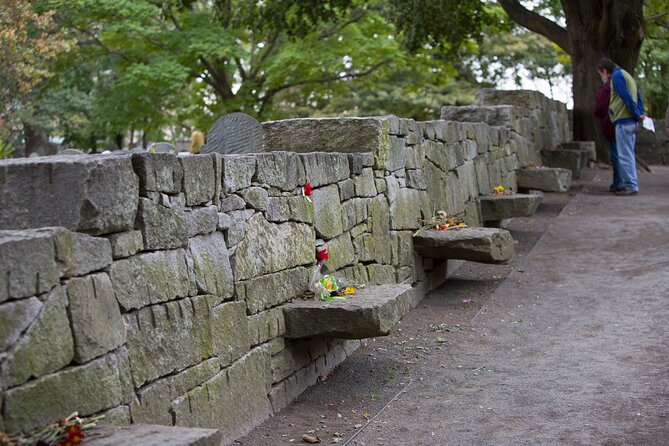
- The Salem Witch Trials Memorial honors 20 victims, with a bench for each person.
- Several stops are historical locations, not attractions you enter, including the former jail and court site.
- Bob is one guide praised for vivid storytelling, though your guide is assigned rather than guaranteed.
- October requires extra planning, since traffic, parking, crowds, and street vendors can slow you down.
What this Salem witch trials walk really covers
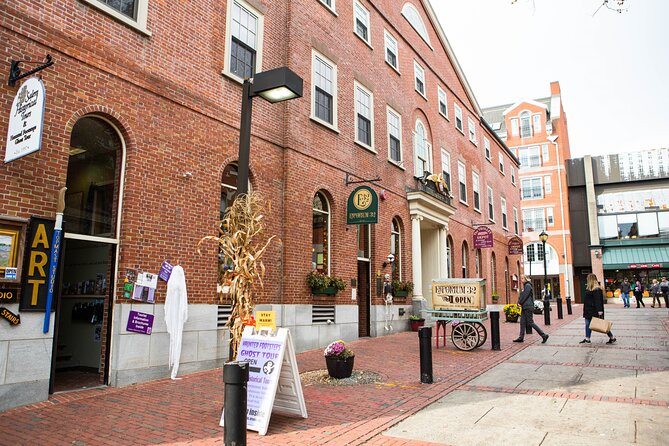
This is a history walk, not a haunted attraction. You will hear how fear, local disputes, religion, money, authority, and courtroom decisions combined to turn neighbors against neighbors in 1692.
The route is built around downtown Salem. Your guide may visit the listed sites in a different order and may cover as many as possible within the 90-minute limit. That matters because the experience is not a fixed sequence of museum visits. It is a moving talk, with short pauses at locations connected to the trials.
You will meet at the Salem Historical Tours office at 8 Central Street. Tours depart at 10 a.m., 1 p.m., and 4 p.m. Arrive 15 minutes early, since the meeting point can be easy to confuse with nearby buildings and the town becomes much harder to navigate in October.
At a maximum of 40 people, this is not an intimate private walk. A larger group can make it harder to hear on a crowded sidewalk, but the guide-led format saves you from piecing together the locations on your own. At $30 per person, the value depends on what you want. If you want a guided introduction and a clear route through Salem, the price is fair. If you expect to enter several historic buildings, it will feel less satisfying because admission fees are not included.
More Ghost Walking Tours in the USA
- New Orleans Premier Ghost, Voodoo and Vampire Walking Tour
★ 4.5 · 12,856 reviews - Chicago: Gangsters and Ghosts Walking Tour
★ 5.0 · 7,155 reviews - St. Louis Cemetery No. 1 Official Walking Tour
★ 4.5 · 3,941 reviews
The memorial gives the walk its emotional center
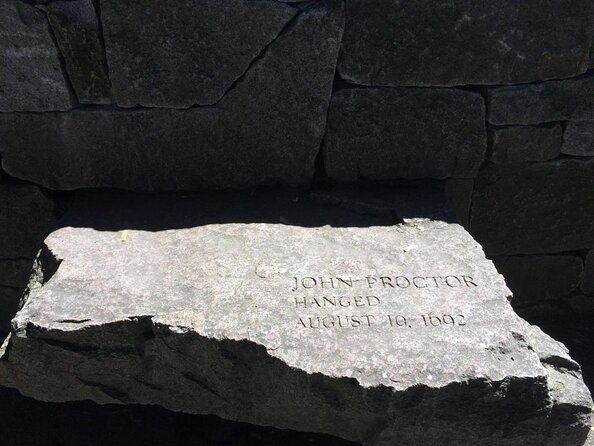
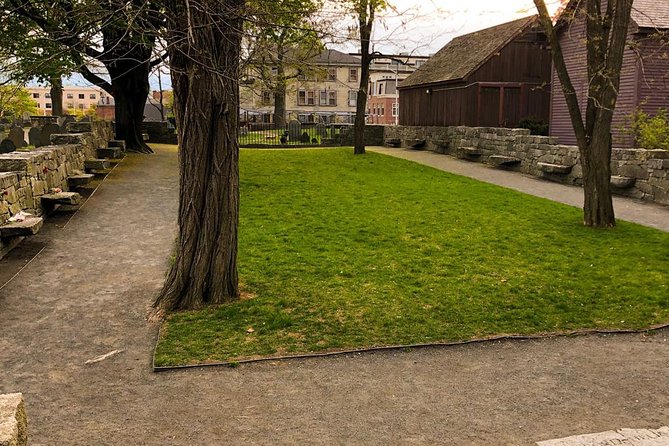
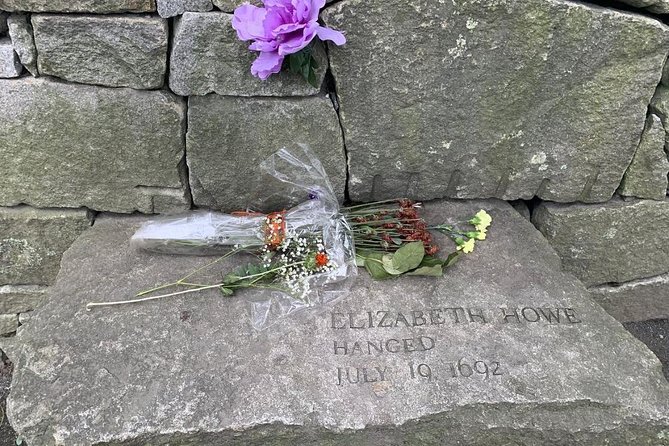
The Salem Witch Trials Memorial is one of the most important stops. Dedicated in 1992, it honors the 20 people who died during the witchcraft trials. Each bench names one victim and records how and when that person died.
The memorial is designed for quiet reflection. Your guide explains its symbolism and shares individual stories, which helps move the subject beyond the familiar label of Salem witches. You begin to see people who were arrested, jailed, condemned, or killed, not just characters in a spooky town legend.
Allow yourself time to look closely at the names. One criticism of this experience is that some guides may explain the memorial without walking guests through every part of it. If the memorial matters most to you, ask directly to see the benches and hear about the symbolism before the group moves on.
Rockafellas connects modern Salem with the 1692 meeting place
Rockafellas is now a restaurant in the Daniel Low and Company building, but the site once held Salem’s First Church and the town meeting house. That makes it a useful stop for understanding how public life and the trials overlapped.
There is no included admission here, and you should not expect a museum visit. The value comes from learning what occupied this central piece of Salem when accusations were spreading and civic decisions were being made.
This stop also shows the basic challenge of historical walking in Salem. The location remains, but the original building does not. If you want restored rooms and objects from 1692, this part of the route may feel thin. If you enjoy matching present-day streets with vanished places, it adds useful context.
George Corwin’s site shows how authority became personal
The Joshua Ward House now operates as the Merchant Hotel. It occupies the site where George Corwin’s house once stood. Corwin served as High Sheriff of Essex County in 1692 and signed arrest and execution warrants for people accused of witchcraft.
The guide also discusses Corwin’s seizure of personal property and reports that people were tortured in his home. This makes the stop less about architecture and more about the machinery of the trials. You see how an official could turn legal power into direct pressure on accused people and their families.
The original house is gone, so this is another exterior location. Still, the story gives the walk a needed focus on officials, not only on the people accused. I find that useful because Salem can otherwise become a string of victim stories without enough attention to who made the arrests, approved the proceedings, and benefited from the system.
More History Walking Tours in the USA
- New Orleans Garden District History Walking Tour
★ 5.0 · 2,879 reviews - Philadelphia Old City Historic Walking Tour with 10+ Top Sites
★ 5.0 · 2,020 reviews - Southern Flavors Food, Pub Crawl, and History Walking Tour
★ 4.5 · 1,623 reviews - New Orleans Food and History Walking Tour
★ 5.0 · 1,544 reviews
The Witch House is the route’s strongest physical connection
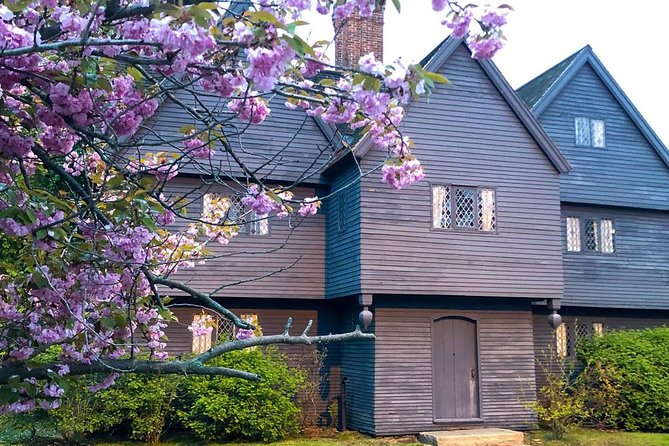
The Witch House is the only remaining Salem structure with a direct tie to the 1692 trials. It was the home of Judge Jonathan Corwin and dates to the 1660s.
Corwin met there with Judge Hathorne to discuss who might be a witch. The building is called the Witch House because of these connections, not because it was the home of a person accused of witchcraft.
This is likely the stop you most want to see in person. The tour focuses on its connection to the judges, but entry is not included. If you want to go inside, plan that as a separate visit and allow extra time beyond the 90-minute walk.
The Witch House also helps you picture the period better than modern office buildings and restaurant exteriors can. It is a real structure from the era, even though the trials themselves involved a much wider set of locations.
Betty Parris and the early panic
Near the Salem YMCA on Sewall Street, the guide discusses Judge Stephen Sewall and the home connected with nine-year-old Betty Parris. Betty was the daughter of Rev. Parris and was moved to this area in July 1692.
The house no longer exists. You will hear about Betty and her cousin, whose experiences helped start the witchcraft hysteria. This part of the walk is useful for placing the beginning of the crisis within family and neighborhood life rather than treating it as a sudden, unexplained event.
The stop also reminds you that much of Salem’s story must be reconstructed from records and mapped locations. You are not looking at a preserved room where the first accusations happened. You are standing in the right area while the guide supplies the names and sequence.
Bridget Bishop’s story is brief but powerful
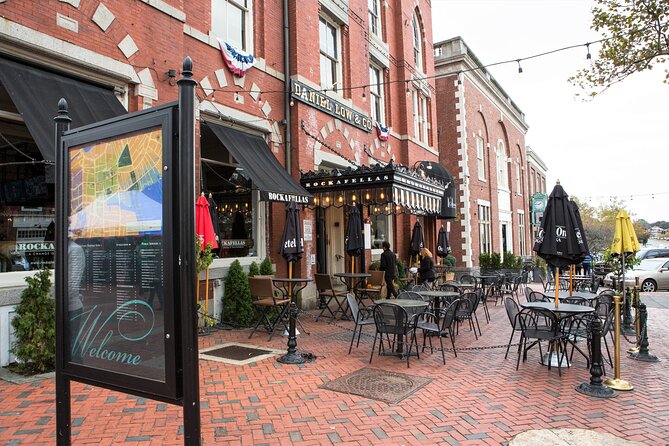
Turner’s Seafood occupies Lyceum Hall, built on land once owned by Bridget Bishop and her husband, Edward. Bridget was the first woman executed during the 1692 trials.
Her story is one of the route’s sharpest examples of how quickly the process could move. The guide explains that only eight days passed between her arrest, trial, and execution. That short timeline shows how little room accused people had to defend themselves once suspicion took hold.
This is an exterior stop with no included admission. The restaurant may be busy, and the group may pause on the sidewalk, so you should expect a short explanation rather than an extended visit.
The Witch Dungeon Museum explains jail conditions
The Witch Dungeon Museum is not directly connected to the 1692 trials, but it helps explain the jail system. Prisoners were held in cramped spaces, sometimes no larger than a phone booth or closet, and they had to pay for their own confinement.
You may also have a chance to pose in the pillories, or stocks. That photo opportunity adds a lighter moment to an otherwise grim subject, but the guide keeps the focus on the actual conditions faced by prisoners.
Admission is not included. The museum works best as an optional follow-up rather than a core part of the tour. The guide uses the location to explain how jailing worked, which is valuable because the jail buildings themselves are gone.
The Bewitched statue adds a very different Salem
The statue of Elizabeth Montgomery as Samantha Stevens, from the television show Bewitched, is a quick photo stop. Episodes of the show were filmed in Salem, and the guide explains whose land the statue occupies.
The placement is ironic, given the history surrounding it. After hearing about real people accused and executed, you see a cheerful pop-culture image of a fictional witch. The contrast is part of Salem’s identity, where serious history and Halloween-era entertainment share the same streets.
This is not a trial site, and it will not add much if you want only courtroom history. It does help explain why Salem attracts more than history students, and it gives families a short change of pace.
The court and jail sites are locations, not preserved buildings
The Salem Masonic Building marks the area where the Witchcraft Court, known as the Court of Oyer and Terminer, operated in the middle of Washington Street. Most trials took place there, with additional proceedings held in January 1693.
Your guide explains some of the court’s worst decisions. In one case, a jury found an accused person innocent, but the judges rejected the decision. That detail shows how the process could be controlled from above even when jurors hesitated.
At 50 St Peter Street, you learn where the Witchcraft Jail once stood. The guide discusses prisoners held there, including Giles Corey, who was crushed during interrogation. Some prisoners died in jail.
These are important locations, but they are also where expectations can go wrong. You will not see the original courthouse, jail, or execution structure. The guide may use old book illustrations to show what vanished buildings and locations once looked like. The execution site itself is more than a mile away, near a Walgreens, and is not included in this walking route.
What the guide’s style can mean for your experience
The strongest accounts of this tour describe guides who tell the story with energy, humor, and a clear interest in the people involved. Bob has been singled out for making the 1600s feel immediate while keeping the grim story manageable. Other guides have been praised for answering questions and making sure the group keeps together.
The quality can vary by guide. Some presentations put more weight on colorful anecdotes than on chronology. If you want a clean timeline from the first accusations through the later trials, ask questions as you go. A simple request to explain what happened next can help connect the individual stories.
Some people also find the tour repetitive because several stops are modern buildings or empty sites. I would not book this expecting constant sightseeing. The guide is the main source of information, and the places work as reference points.
Walking conditions, timing, and practical advice
The route is about one mile and lasts 90 minutes. You will walk and stand on narrow, uneven sidewalks, bricks, cobblestones, and stairs. Most people who can comfortably complete a mile within 90 minutes should manage it, but the tour can be difficult for anyone with mobility concerns.
It operates in all weather. Wear shoes suited to uneven streets and bring clothing for rain, cold, or heat. There are no public restrooms included, so use facilities before meeting the group.
Parking and traffic are especially difficult in October. Halloween season brings crowds, vendors, and slow streets, and GPS travel times may not reflect the delay. Public transportation or arriving well ahead of time may be easier, but transportation is not provided by the tour.
Service animals are allowed. Children must be with an adult, and most people can take part if they can handle the distance and standing time.
Who should book this Salem walking tour?
I would choose this tour if you want a compact introduction to Salem’s witch trials, prefer stories to self-guided reading, and are comfortable using modern streets as clues to vanished sites. It works well early in a Salem visit because the guide can point out places you may want to revisit, including the Witch House and the memorial.
It also suits families with older children and teenagers who enjoy dramatic history without needing a full-day museum program. The Elizabeth Montgomery statue gives younger visitors a familiar moment, while the stories of Betty Parris, Bridget Bishop, and Giles Corey add substance.
I would hesitate if you want every stop on the schedule visited in detail, or if you expect to enter the court, jail, or historic houses. The guide may not reach every listed location, and the route can feel like a short circle through downtown if you are expecting a large number of surviving landmarks.
Should you book it?
Book it for the guide’s storytelling, the memorial, the Witch House connection, and the chance to place the trials on Salem’s present-day streets. At $30, it is a reasonable way to get a focused introduction, especially if you ask questions and treat the walk as a history lesson with locations rather than a series of museum admissions.
Skip it if you want a fully chronological lecture, extensive interior visits, or the actual hanging site. For the best experience, arrive early, wear solid shoes, plan your own follow-up visit to the Witch House, and remember that the most important places on this route are often marked by what is no longer there.
FAQ
How long does the Salem Witch Trials walking tour last?
The tour lasts approximately 90 minutes.
How far do you walk?
The route covers about one mile, with frequent stops for information and sightseeing.
Where does the tour begin?
It begins at the Salem Historical Tours office at 8 Central Street, Salem, Massachusetts.
Where does the tour end?
It returns to the downtown Salem area. The guide can direct you to another location afterward.
What time do tours depart?
Tours depart at 10 a.m., 1 p.m., and 4 p.m. You should arrive 15 minutes before departure.
Is admission to the Witch House included?
No. Admission to the Witch House is not included in the $30 tour price.
Does the tour visit the actual hanging site?
No. The known hanging area is more than one mile away near a Walgreens and is not included in this walking route.
Are the original jail and courthouse still standing?
No. The original Witchcraft Jail and court structures are gone. The guide visits or explains their former locations.
Is the tour accessible for people with mobility concerns?
The walk includes narrow and uneven sidewalks, bricks, cobblestones, stairs, and periods of standing. Each participant must be able to complete about one mile within 90 minutes.
Can I cancel for a full refund?
Yes. You can cancel at least 24 hours before the start time for a full refund. Changes or cancellations made less than 24 hours before the tour are not accepted for a refund.
More Ghost and Haunted Walks in the USA
- Savannah History and Haunts Candlelit Ghost Walking Tour
★ 5.0 · 3,235 reviews - Ghosts of Charleston Night-Time Walking Tour with Unitarian Church Graveyard
★ 4.5 · 2,835 reviews - New Orleans Haunted Ghost, Voodoo & Vampire Walking Tour
★ 4.5 · 2,731 reviews - Arlington National Cemetery Walking Tour & Changing of the Guards
★ 5.0 · 2,566 reviews
Just added around the USA
- Fan Tribute: Taylor Swift in New York Walking Tour★ 4.9 · 147 reviews
- Explore Must-See Spots: Las Vegas Strip Walking Tour★ 4.8 · 77 reviews
- East Nashville Walking Food Tour with 5+ Tastings★ 4.7 · 178 reviews
- Las Vegas: Fremont Street Walking Tour★ 4.9 · 153 reviews
- NYC: Guided Bus and Walking Tour with Staten Island Ferry★ 4.6 · 209 reviews
- DC: Smithsonian Highlights Walking Tour with Air and Space★ 4.8 · 97 reviews
- DC: Lincoln Assassination Tour with Ford’s Theatre Entry★ 4.6 · 72 reviews
- Deep Dive into Denver: Small-Group Walking Tour★ 4.8 · 119 reviews
Ghost and Haunted Walking Tours, compared.

New Orleans Premier Ghost, Voodoo and Vampire Walking Tour
Read our review →

Ghost Walking Tour Where Legends Come To Life
Read our review →
St. Louis Cemetery No. 1 Official Walking Tour
Read our review →

Savannah History and Haunts Candlelit Ghost Walking Tour
Read our review →