
REVIEW · BATH
Best of Bath Walking Tours – Georgian Tour
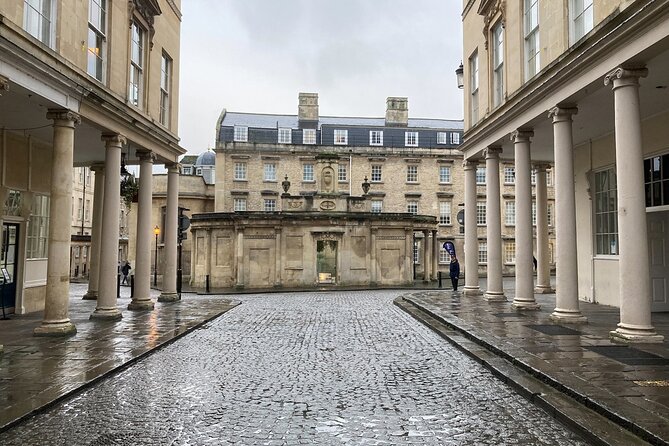
Bath’s Georgian architecture is best understood from the street, where grand facades, curved terraces, and carefully planned squares reveal how the city was built for fashionable 18th-century life. Bob leads this walk from Bath Abbey through Queen Square, the Circus, the Royal Crescent, and back toward the river.
I like the small maximum group of 15, which leaves room for questions, and I like Bob’s reported mix of facts, dry humor, and personal attention. He keeps a gentle pace and often explains the people behind the buildings, not just dates and architectural terms. The main consideration is that this is an outdoor walking tour, so you’ll need moderate fitness and sensible clothing for changeable weather.
Key points to know before you book
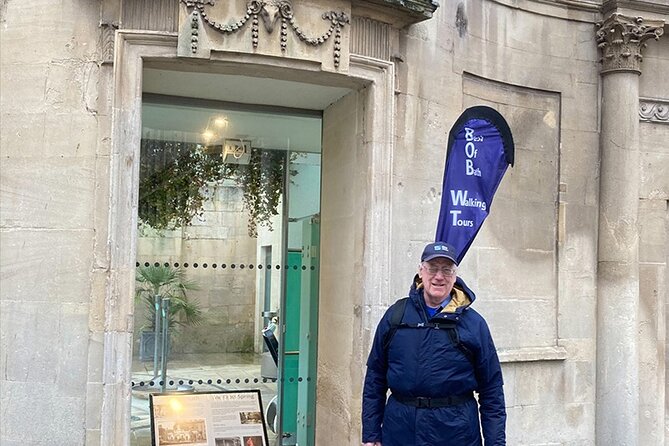
- Bob leads the walk: Expect a friendly guide who explains Bath’s architecture, characters, hot springs, and history in an informal way.
- The route covers major Georgian landmarks: Queen Square, the Circus, the Royal Crescent, Assembly Rooms, Pulteney Bridge, and more.
- The walk takes about two hours: The advertised duration is 2 to 3 hours, and questions can extend the finish.
- You see several major attractions from outside: Entry fees for the Roman Baths, Assembly Rooms, Royal Mineral Water Hospital, and No. 1 Royal Crescent are not included.
- The group is capped at 15 people: That is a useful size for hearing the guide and asking questions.
- It starts and ends at Bath Abbey: Meet in Abbey Churchyard at 1:00 pm, with convenient access to public transportation.
Bath’s Georgian story begins at the Abbey
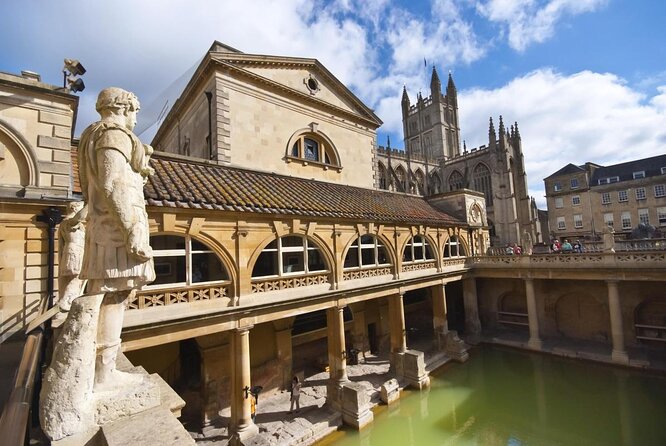
The walk starts in Abbey Churchyard, in front of Bath Abbey. This is a smart meeting point because you are immediately in the middle of Bath’s long story, with the medieval church, Roman bathing complex, and Georgian city all close together.
Bath Abbey began as a church in the 7th century. It was reorganized in the 10th century and rebuilt in later periods, including the 12th and 16th centuries. Bob uses the churchyard as a way to set the scene before moving into the city’s Georgian chapter.
I like this opening because it avoids treating Bath as a single-period city. You begin with the Abbey, then move through Roman and medieval traces before seeing how 18th-century planners reshaped the town. That layered approach helps explain why Bath feels more than a collection of pretty buildings.
The first part of the walk includes the old city wall, the hot springs, the Mineral Hospital, and other points around the center. You are not simply being led from one postcard view to the next. The route connects Bath’s water, religion, medicine, trade, and fashionable society.
A few more walking tours around the UK worth a look
- Magical London: Harry Potter Guided Walking Tour
★ 4.7 · 22,044 reviews - Edinburgh: Harry Potter Magical Guided Walking Tour
★ 4.8 · 11,944 reviews - Edinburgh Castle: Guided Walking Tour with Entry Ticket
★ 4.7 · 11,699 reviews
The Roman Baths and the power of the springs
The Roman Baths receive a short stop of about five minutes, and admission is not included. That detail matters. This walk gives you an exterior introduction and historical context, but it is not a replacement for touring the Roman Baths museum and bathing complex.
A temple was built here between 60 and 70 AD, during the first decades of Roman Britain. The natural springs made the site important long before Georgian visitors arrived, and the area around them was altered several times during the medieval period.
I would treat this stop as a useful orientation. If you plan to visit the Roman Baths inside, you can use Bob’s explanation to make more sense of what you see later. If you have already toured the complex, the walk adds the wider city context that an indoor visit cannot provide.
The same applies to the Royal Mineral Water Hospital. Construction began in 1737, at a time when people placed growing faith in the healing power of Bath’s mineral waters. Bob’s discussion helps connect the Roman use of the springs with the Georgian belief that the water could restore health.
Queen Square begins the Georgian sequence
Queen Square is one of the most useful places on the route for understanding Bath’s planning. It forms the first part of an architectural sequence that continues through the Circus and ends at the Royal Crescent.
All the buildings around the square are Grade I listed. You do not need to be an architecture specialist to appreciate the effect. The important point is how the buildings work together as a planned whole, rather than as isolated houses built at random.
This is where Bob’s approach appears especially helpful. The focus is not only on what the buildings look like, but also on why they were arranged in this way and who designed them. Questions are welcome, and the pace allows time to look up at facades without feeling rushed.
For you, Queen Square is also a good test of what kind of tour you prefer. If you want a fast checklist of sights, the pace may feel slow. If you like learning how a city was designed, the extra explanation adds real value.
The Assembly Rooms and Bath’s fashionable society
The Assembly Rooms were built for the social life that made Georgian Bath famous. The upper Assembly Rooms opened with a grand ball in 1771 and became a venue for dancing, concerts, and gambling.
The building was linked with the fashionable world of the period. Jane Austen and Charles Dickens are associated with Bath, as were members of the nobility who came to take the waters, meet friends, and be seen in the right rooms.
The stop lasts about five minutes, and admission is not included. That means you should think of it as an exterior explanation unless you arrange a separate visit. The walk is concerned with how the Assembly Rooms fitted into the larger plan between Queen Square, the Circus, and the Royal Crescent.
I like this part because it gives social meaning to the architecture. A grand facade is easier to understand when you know it was built for balls, concerts, and public display. Bath’s Georgian center was not only a residential district. It was a stage for status and leisure.
Same streets, a different route:
- Underground Vaults Walking Tour in Edinburgh Old Town
★ 4.5 · 8,506 reviews - London: The Original Jack the Ripper Walking Tour
★ 4.7 · 7,833 reviews - Oxford University Walking Tour With University Alumni Guide
★ 5.0 · 6,905 reviews - Edinburgh Castle: Guided Walking Tour with Entry Ticket
★ 5.0 · 5,540 reviews
The Circus shows Georgian design at its boldest
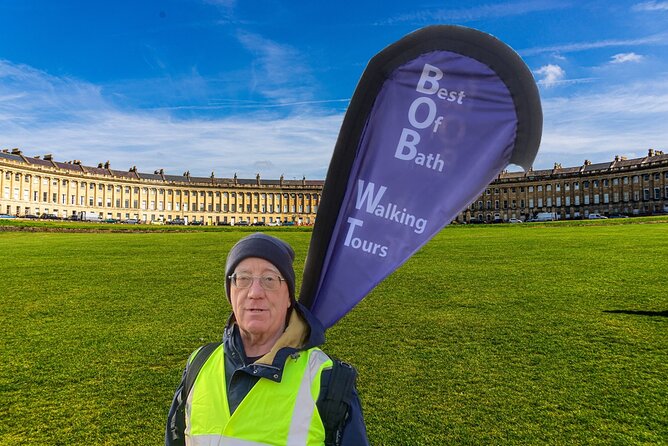
The Circus is one of Bath’s most striking spaces. It is a circular group of large townhouses with three entrances, designed by John Wood the Elder and built between 1754 and 1768.
Its design has a practical visual trick. Each section faces one of the three entrances, so a classical facade appears straight ahead as you enter. The effect is orderly, theatrical, and carefully planned.
Bob spends about ten minutes here. That is enough time to grasp the shape of the space and hear why it was built as a circle. It is also a good place to pause for photographs, though the value of the stop is in understanding the design rather than simply taking a picture.
The Circus can be difficult to appreciate on your own because you may notice the curve but miss the planning behind it. A guide gives you the reason to look up, compare the sections, and notice how the entrances frame the buildings.
The Royal Crescent and No. 1

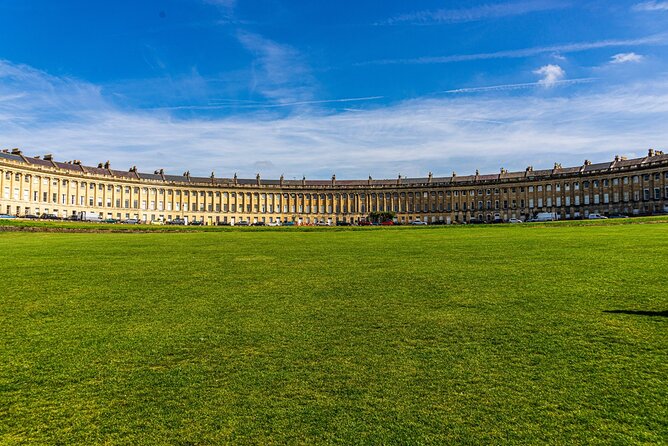
The Royal Crescent is Bath’s grandest Georgian sweep, a row of 30 terraced houses laid out in a wide curve. John Wood the Younger designed it, and it was built between 1767 and 1774.
From the front, the Royal Crescent looks like one grand palace. Behind the unified stone facade are individual homes. That contrast is part of what made Georgian architecture so effective: the residents had private houses, but the front presented a single image of wealth and order.
The walk includes about ten minutes at the crescent. Entry to No. 1 Royal Crescent is not included, so you will need a separate ticket if you want to see the recreated interiors and learn more about domestic life inside one of the houses.
The nearby Gravel Walk adds another useful angle. It helps show that Bath’s elegant center was connected by paths and routes designed for strolling and social encounters. The walk is not only about buildings. It is also about how people moved through the city and used public space.
Pulteney Bridge brings the route to the River Avon
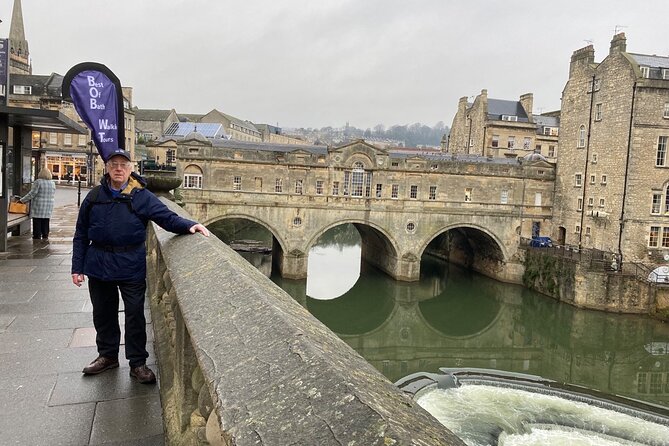
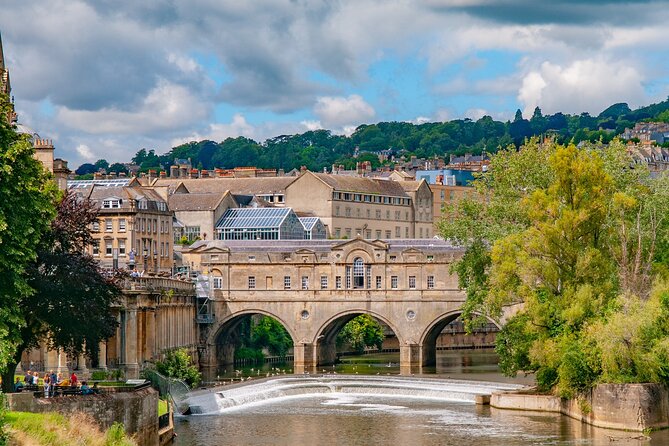
Pulteney Bridge is a short stop, but it gives the tour a change of scale. Completed by 1774, it crosses the River Avon and connects Bath with land once intended for development by the Pulteney family.
Robert Adam designed the bridge in a Palladian style. Its most unusual feature is the row of shops built across the full span on both sides. That makes it more than a crossing. It is a working piece of the city, with commerce built into the architecture.
The bridge is free to view from the outside. You may find this one of the most memorable stops because it is easy to understand at a glance, yet still has a practical story behind it.
It also gives the route a pleasant shift away from the formal Georgian squares. After the grand curves of the Circus and Royal Crescent, the bridge shows how design could serve trade as well as display.
The Guildhall Market and a relaxed finish
The final main stop is Bath Guildhall Market, housed in a beautiful indoor building. The market has operated since 1284, and its stalls offer a more everyday look at the city than the ceremonial Georgian streets.
You have about five minutes here, enough for a quick wander and a look at the building. It is not a long shopping visit, so do not expect extended time at individual stalls. Still, the market works well near the end of the route because it brings you back from grand architectural history to present-day Bath.
The walk returns to Abbey Churchyard. Bob allows time to discuss points of interest and answer questions at the end. That flexibility is useful if you want to clarify something from earlier in the walk or ask for ideas about what to see next.
Several past comments describe the tour lasting beyond the basic two hours because people kept asking questions. You should not assume an unlimited finish, but the format clearly allows for conversation rather than a hard stop the moment the main route is complete.
What makes Bob’s guiding style useful
Bob’s strongest quality is his ability to make architectural details feel connected to people. He explains who built the streets, who lived in the houses, and why certain spaces were designed in particular ways.
The style is informal rather than academic. You can expect humor, direct answers, and stories about Bath’s characters alongside the main historical points. The walk also includes small discoveries, such as a medieval path near the old city wall, and may point out filming locations associated with Bridgerton.
That last detail will appeal to viewers who want a screen connection, but it is not the main reason to book. The tour is primarily about Georgian Bath and the city’s wider development.
Bob also appears comfortable admitting when he does not know something. That is a small but valuable sign. It keeps the talk conversational and avoids turning every question into a forced lecture.
Price, timing, and physical demands
At $27.73 per person, this is a fair price for a two to three hour guided walk, especially if you want structure and local explanation rather than a self-guided stroll. The value is strongest if you are new to Bath or want to understand the relationship between the Roman, medieval, and Georgian parts of the city.
The price does not include admission to the Roman Baths, Assembly Rooms, Royal Mineral Water Hospital, or No. 1 Royal Crescent. That is not a flaw, but you should budget separately if you plan to go inside any of them.
The walk begins at 1:00 pm and ends where it starts. That makes it easy to fit around a morning visit to the Roman Baths or an onward train later in the day, though you should allow extra time if the discussion runs long.
You need moderate physical fitness. This is a city walk lasting roughly two hours or more, with no indication that it is designed for people who cannot walk for that length of time. Service animals are allowed, and the meeting point is near public transportation.
The group maximum is 15 people. That is small enough for Bob to respond to questions and check that the group is together, while still offering the social feel of a shared walk.
Who should book the Georgian Tour?
I would choose this tour if you want Bath to make sense as a designed city, not just a set of famous buildings. It is especially useful on a first visit, when Queen Square, the Circus, the Royal Crescent, and the riverfront can blur into one long walk.
It also suits repeat visitors. One person who had already walked around Bath several times still found that Bob pointed out details that were easy to miss alone. That is the mark of a useful local guide: he gives you better eyes, not just more facts.
Families with older children, couples, solo visitors, and history-minded adults should all find the format workable. The gentle pace and open questions make it less formal than a lecture, while the amount of information gives the walk enough substance for serious history fans.
You might skip it if you want extended interior visits, a private tour, or a route focused mainly on Roman Bath archaeology. You should also think twice if wet weather would make a long outdoor walk unpleasant. The experience requires good weather, and poor conditions can lead to a new date or a full refund.
Should you book Best of Bath Walking Tours?
Book it if you want an affordable introduction to Bath’s Georgian center, led by someone who can connect architecture with the people and social life behind it. Bob’s humor, patience, and willingness to answer side questions are central to the experience.
The best plan is to visit major interiors separately and use this walk to connect them. Start with Bath Abbey and the Roman Baths area, follow Bob through Queen Square, the Assembly Rooms, the Circus, Royal Crescent, Pulteney Bridge, and the Guildhall Market, then return to any site that deserves more time.
Free cancellation is available up to 24 hours before the start time. If the minimum group size is not met or weather forces cancellation, you can choose a different date or receive a full refund. For about $28, this is a sensible pick for seeing more of Bath than you would likely notice on your own.
FAQ
Where does the Georgian Tour start?
The tour starts in Abbey Churchyard, in front of Bath Abbey in Bath, England.
What time does the tour begin?
The stated start time is 1:00 pm.
How long does the walk last?
The tour lasts approximately 2 to 3 hours. The main walk is described as about two hours, with questions and discussion potentially extending the finish.
Where does the tour end?
The activity ends back at Abbey Churchyard, the starting point.
What attractions are included on the route?
The route includes Bath Abbey and Churchyard, the hot springs, the old city wall, the Royal Mineral Water Hospital, Queen Square, the Roman Baths area, the Assembly Rooms, the Circus, No. 1 Royal Crescent, Gravel Walk, Pulteney Bridge, Guildhall Market, and other points around Bath.
Are admission tickets included?
Some stops are viewed from outside and have no admission charge. Entry is not included for the Roman Baths, Royal Mineral Water Hospital, Assembly Rooms, or No. 1 Royal Crescent.
How large is the group?
The tour has a maximum of 15 people.
What happens if I need to cancel?
You can cancel up to 24 hours before the start time for a full refund. Changes or cancellations made less than 24 hours before the start time are not accepted, and poor weather or failure to meet the minimum group size may result in a different date or a full refund.
Just added around the UK
- Merchant City Music Walking Tour of Glasgow★ 5.0 · 94 reviews
- Stirling Castle, Loch Lomond Walk & Whisky Distillery Tour from Glasgow★ 5.0 · 79 reviews
- Walking Tour of Glasgow★ 5.0 · 96 reviews
- Gothic Glasgow Walking Tour★ 5.0 · 448 reviews
- Glasgow: Pubs & History Walking Tour with Beer Tasting★ 5.0 · 81 reviews
- Glencoe, Scenic Walk & Highlands Guided Tour starting Glasgow★ 5.0 · 121 reviews
- Gander Walking Tours in Glasgow★ 5.0 · 506 reviews
- Group Walk up Ben Nevis from Fort William★ 5.0 · 108 reviews
Walking Tours, compared.

Magical London: Harry Potter Guided Walking Tour
Read our review →
Reykjavik Food Walk – Local Foodie Adventure in Iceland
Read our review →
History and Hauntings of Salem Guided Walking Tour
Read our review →
New Orleans Premier Ghost, Voodoo and Vampire Walking Tour
Read our review →
Amsterdam Anne Frank: Small-Group Walking Tour & Local Guide
Read our review →

Edinburgh Castle: Guided Walking Tour with Entry Ticket
Read our review →
Anne Frank’s Story – Guided Walking Tour through Amsterdam
Read our review →Browse the lists this tour appears in