
REVIEW · USA
Walking History Tour of St. Augustine’s Historic District
St. Augustine’s story is bigger than its Spanish fort. This walking tour links the city’s colonial beginnings with its Flagler-era makeover, moving from Tolomato Cemetery and old city gates to Memorial Presbyterian Church, Flagler College, and the Castillo de San Marcos. Guide Kevin brings a local’s love of history, plenty of stories, and a good sense of humor.
I like two things right away: the tour covers both old and newer St. Augustine, and the small group, capped at 15 people, gives you room to ask questions. I also like that the walk costs only $25, making it an affordable way to get your bearings before paying for individual attractions.
The main catch is timing. It is advertised at 90 minutes, but Kevin often keeps talking for two hours or more when questions and stories get going. That is a bonus if you have an open schedule, but it can be a problem if you have a restaurant booking, attraction ticket, or driving commitment afterward.
Key points to know before you book
- The story reaches beyond the Spanish period: You’ll hear about colonial St. Augustine, the Civil War era, Henry Flagler’s building boom, and the early 1900s.
- Kevin is the main draw: He is a local guide with a strong command of the city’s past, an entertaining delivery, and a habit of welcoming questions.
- The walk covers about 1.7 to 2 miles: Comfortable shoes and bottled water are important, especially in warm weather.
- Most sights are viewed from outside: Admission to Tolomato Cemetery, the churches, Flagler College, and Castillo de San Marcos is not included.
- The group stays small: A maximum of 15 people makes it easier to hear the guide and join the conversation.
- Plan more than 90 minutes: The walk may run well past the stated time, sometimes reaching two hours or more.
Why this walk works as a first look at St. Augustine

St. Augustine can feel like several cities layered on top of one another. Narrow streets and old fortifications point to the colonial era, grand hotels and churches recall Henry Flagler’s late-19th-century campaign to remake the city, and public squares connect those periods to modern downtown life.
A standard fort visit will give you walls, cannons, and military facts. A sightseeing trolley will cover more ground with less effort. This walk offers something different: a connected story told while you move through the places where it happened.
You begin near the St. Augustine and St. Johns County Visitor Information Center at 10 S Castillo Drive. From there, the route visits seven historic spots and returns to the starting point. The stated distance is close to two miles, though the pace is easy enough for most people with moderate fitness.
I would book this early in your stay. The walk gives you useful context for later visits to the Castillo, Flagler College, and other downtown sites. It can also help you decide which places deserve a longer visit on your own.
A few more walking tours around the USA worth a look
- History and Hauntings of Salem Guided Walking Tour
★ 5.0 · 14,564 reviews - New Orleans Premier Ghost, Voodoo and Vampire Walking Tour
★ 4.5 · 12,856 reviews - Little Havana Food and Walking Tour in Miami
★ 5.0 · 8,882 reviews
Tolomato Cemetery begins the story with a darker edge
The first stop is Tolomato Cemetery, presented as the oldest cemetery in the city and a site dating to before the arrival of the Spanish in 1562. You spend about five minutes here, enough to hear why this small burial ground matters and how it fits into the city’s long past.
This is not a full cemetery tour, and admission is not included. Think of it as a brief introduction to the people and events that shaped St. Augustine rather than a detailed look at every grave.
You’ll also hear about the Love Tree, a local bit of folklore with a playful warning attached. That moment helps set the tone for the walk. The subject is serious, but the guide does not treat history as a dry list of dates.
Grace United Methodist Church shows the Flagler-era shift
Grace United Methodist Church represents a later chapter in St. Augustine’s development. The five-minute stop focuses on the Flagler era, when Henry Flagler invested heavily in the city and helped turn it into a fashionable winter destination.
This stop matters because it keeps the tour from becoming only a Spanish colonial history lesson. St. Augustine’s identity was reshaped in the late 1800s, and Flagler’s influence can be seen in the churches, hotels, streets, and public buildings that followed.
You should expect to see the church and hear its place in the city’s story rather than take a full interior tour. Admission is not included, so anyone hoping to go inside should plan that as a separate activity.
Memorial Presbyterian Church adds beauty and tragedy
The next stop lasts about 10 minutes and focuses on Memorial Presbyterian Church. It is described as one of the city’s most beautiful buildings, but the story behind it is not simply about architecture.
The church was connected to Henry Flagler and to a painful personal loss. That human detail gives the building more meaning than a quick photo stop. You hear why it was built, how it fits the Flagler period, and what its design says about the ambitions of that time.
I like this part of the route because it shows how buildings can carry private grief as well as public pride. Again, admission is not included, and the stop is primarily an exterior explanation.
Same streets, a different route:
- Chicago: Gangsters and Ghosts Walking Tour
★ 5.0 · 7,155 reviews - Boston: Freedom Trail History Small Group Walking Tour
★ 5.0 · 6,450 reviews - Historic Charleston Guided Sightseeing Walking Tour
★ 5.0 · 6,216 reviews - New Orleans Food Walking Tour of the French Quarter with Small-Group Option
★ 5.0 · 6,118 reviews
Flagler College reveals St. Augustine’s Gilded Age ambitions
Flagler College occupies the former Ponce de Leon Hotel, one of the clearest reminders of St. Augustine’s transformation in the late 19th century. The five-minute stop introduces the hotel’s role in the Gilded Age and its importance to Flagler’s plans for the city.
The contrast with Tolomato Cemetery is striking. Within a short walk, you move from an old burial ground to a building created to impress wealthy visitors with lavish design and modern comforts.
The stop is brief, so it cannot replace the college’s own interior tour. Still, it gives you a reason to pay closer attention if you return later. Admission is not included, and the activity does not promise an inside visit.
Plaza de la Constitución connects power, politics, and public life
The Plaza de la Constitución receives about 10 minutes, making it one of the longer stops. The plaza was founded in 1599 by royal decree and became a center of government for Florida for nearly 250 years.
You’ll hear about the Government House, once the seat of power, and the governors who lived and worked there. The discussion also covers how the plaza was recreated in 1933 through a Works Progress Administration project.
That last point is especially useful. It shows that historic St. Augustine is not simply a collection of untouched old buildings. Some parts were restored, rebuilt, or reshaped long after the original colonial period. The plaza is free to visit, so you can return later and spend more time there without another ticket.
For me, this is the kind of stop that makes the city easier to understand. It connects government, public space, restoration, and memory in one place.
The Castillo de San Marcos gets the longest stop
The Castillo de San Marcos National Monument is the centerpiece of the route, with about 15 minutes devoted to the fort’s exterior. A licensed fort guide explains the series of forts built in St. Augustine, the construction of the Castillo, and its role in the city’s story and the nation’s past.
This is an orientation, not a full fort visit. Admission to the monument is not included, and the tour stays outside the structure. If you want to walk through the rooms, climb inside the fort, and spend time with its exhibits, you’ll need to return separately and pay the applicable admission.
That arrangement is sensible for a walking overview. The fort can easily fill a large part of a day, while this tour uses it as the major anchor for the city’s military history. You get the basic framework first, then you can explore at your own pace later.
One practical point matters here: because the walk often runs beyond 90 minutes, the Castillo stop may arrive later than expected. If you have a fixed schedule, leave extra time. One person had to leave before reaching the fort because of another commitment, a problem that could have been avoided by treating the tour as a two-hour activity.
The Old City Gate closes the loop
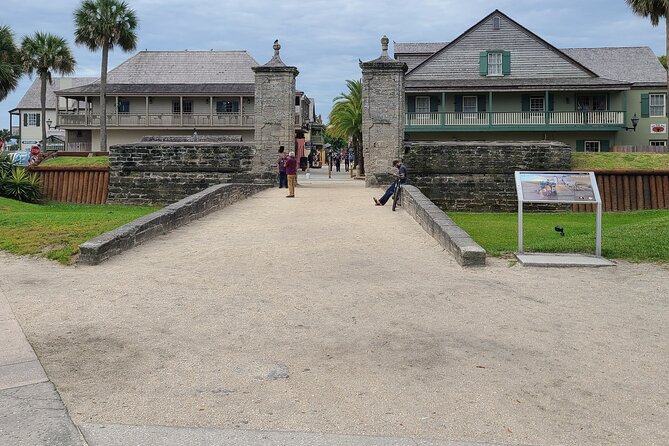
The route also visits the Old City Gate, described as the traditional entrance to St. Augustine since 1762. The five-minute stop covers the gate’s construction and the efforts that saved it from demolition.
This is a small stop, but it helps explain how people entered the old city and how later generations decided what to preserve. The gate is free to see, so you can easily return for photographs or a closer look after the walk.
The route’s sequence gives you a useful visual rhythm: cemetery, churches, grand hotel architecture, civic space, fort, and gate. You are not just standing in one square listening to a lecture. You are walking through different periods of the city.
What Kevin brings to the experience
Kevin is repeatedly described as warm, funny, well informed, and eager to answer questions. His replies to questions during the walk are a major part of the experience. He also offers suggestions for restaurants and other places to visit, which can be helpful if you are just beginning your stay.
His style is conversational rather than strictly timed. That makes the tour feel more personal, but it also explains why the walk can last more than two hours. If you enjoy stopping for extra stories, this is a plus. If you prefer a tight schedule, it is something to consider before booking.
The best fit is someone who wants context and conversation rather than a quick checklist of sights. Families can also do well here, since the delivery is described as engaging for different ages. History buffs will get the most from the layers of detail, but you do not need prior knowledge of St. Augustine to follow along.
Price, group size, and physical demands
At $25 per person, this is a strong value if you plan to visit several of the sights on your own. The tour does not include entrance fees, but it gives you a guided framework for the city at a modest price.
The group maximum is 15 people. That is small enough for questions and easier listening, though the experience still depends on staying close to the guide in public streets.
The walk covers roughly 1.7 miles to nearly two miles. You should wear comfortable shoes and bring bottled water. A moderate level of fitness is advised, and the tour takes place outdoors. Service animals are allowed, and the meeting point is near public transportation.
The activity is offered in English with a mobile ticket. Confirmation is sent within 48 hours of booking, subject to availability. It is also booked well ahead by many people, with an average booking lead time of 16 days, so I would not leave it until the final morning of a short visit.
Weather and cancellation details worth noting
This is an outdoor walk, so weather matters. If poor weather forces a cancellation, you are offered another date or a full refund. The same applies if the minimum number of people is not met.
You can cancel for a full refund up to 24 hours before the start time. Cancellations or changes made within 24 hours are not refunded or accepted. If rain is in the forecast, keep an eye on your booking messages and make sure the contact details provided at booking are correct.
That last point is practical. A cancellation may be announced by email, phone, or text, and an incorrect phone number can create confusion. If you are driving a long distance for the tour, check your messages before setting out.
Who should book this St. Augustine walking tour
I would choose this tour if you want a strong introduction to St. Augustine in a small group, especially if you enjoy history told through stories rather than dates alone.
It suits:
- First-time visitors who want an overview before exploring on their own
- People interested in both colonial St. Augustine and the Gilded Age
- Families who prefer a walk to a closed vehicle tour
- History fans who like asking detailed questions
- Visitors who want a low-cost way to understand several major sights
I would hesitate if you need the tour to end exactly after 90 minutes, want interior access to every building, or prefer a quiet walk with minimal commentary. You should also choose another day if the weather looks poor or if your schedule is packed.
Should you book it?
Book this tour if you can spare two hours and want St. Augustine explained as a connected story. The route covers more than the Spanish occupation period, Kevin brings energy and local perspective, and the $25 price makes it a practical first activity.
Skip it if you need a strict end time or want detailed interior visits. For everyone else, wear good shoes, bring water, leave room for questions, and treat the 90-minute estimate as a minimum rather than a promise.
FAQ
Where does the walking tour start?
The tour starts at the St. Augustine and St. Johns County Visitor Information Center, located at 10 S Castillo Drive, St. Augustine, Florida 32084.
Where does the tour end?
The activity ends back at the original meeting point.
How long does the tour last?
The advertised duration is approximately 1 hour and 30 minutes. In practice, the walk may last longer, sometimes more than two hours, depending on questions and the guide’s stories.
How much walking is involved?
The route covers about 1.7 miles to nearly two miles through St. Augustine’s historic district. A moderate level of physical fitness is recommended.
What sights does the tour visit?
The route includes Tolomato Cemetery, Grace United Methodist Church, Memorial Presbyterian Church, Flagler College, Plaza de la Constitución, Castillo de San Marcos National Monument, and the Old City Gate.
Are entrance fees included?
No. Admission to Tolomato Cemetery, the churches, Flagler College, and Castillo de San Marcos is not included. The Plaza de la Constitución and Old City Gate are listed as free stops.
Is the tour offered in English?
Yes. The tour is offered in English and uses a mobile ticket.
Can I cancel for a refund?
You can cancel up to 24 hours before the experience for a full refund. Changes or cancellations made less than 24 hours before the start time are not accepted or refunded. If poor weather or an insufficient number of participants causes cancellation, you are offered another date or a full refund.
Just added around the USA
- Fan Tribute: Taylor Swift in New York Walking Tour★ 4.9 · 147 reviews
- Explore Must-See Spots: Las Vegas Strip Walking Tour★ 4.8 · 77 reviews
- East Nashville Walking Food Tour with 5+ Tastings★ 4.7 · 178 reviews
- Las Vegas: Fremont Street Walking Tour★ 4.9 · 153 reviews
- NYC: Guided Bus and Walking Tour with Staten Island Ferry★ 4.6 · 209 reviews
- DC: Smithsonian Highlights Walking Tour with Air and Space★ 4.8 · 97 reviews
- DC: Lincoln Assassination Tour with Ford’s Theatre Entry★ 4.6 · 72 reviews
- Deep Dive into Denver: Small-Group Walking Tour★ 4.8 · 119 reviews
Walking Tours, compared.

Magical London: Harry Potter Guided Walking Tour
Read our review →
Reykjavik Food Walk – Local Foodie Adventure in Iceland
Read our review →
History and Hauntings of Salem Guided Walking Tour
Read our review →
New Orleans Premier Ghost, Voodoo and Vampire Walking Tour
Read our review →
Amsterdam Anne Frank: Small-Group Walking Tour & Local Guide
Read our review →

Edinburgh Castle: Guided Walking Tour with Entry Ticket
Read our review →
Anne Frank’s Story – Guided Walking Tour through Amsterdam
Read our review →Browse the lists this tour appears in