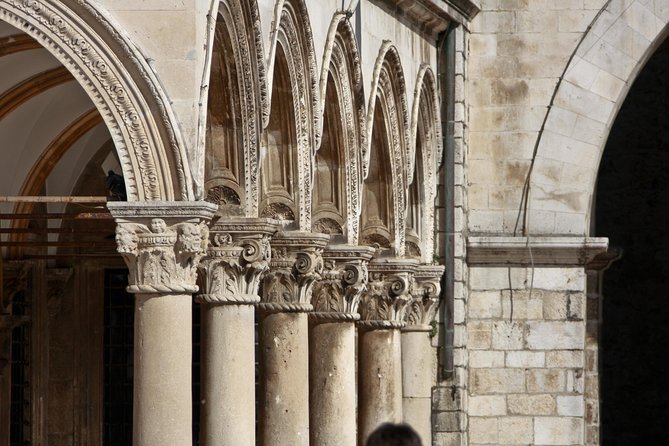
REVIEW · DUBROVNIK
Dubrovnik Old Town History Walking Tour
Dubrovnik’s Old Town is easy to admire and surprisingly easy to misunderstand. This 90-minute walk gives you the backstory behind the polished stone streets, including how a small maritime republic built its water system, managed quarantine, and survived war and disaster. Guides such as Ivana, Jelena, Sara, Joseph, and Pero are praised for mixing local stories with clear historical context.
I like the compact route, which covers the city’s main sights without swallowing your whole day. I also like the local perspective, especially the personal stories about daily life, family ties to the Old Town, and the damage caused by the 1991 to 1992 war. The tradeoff is that 90 minutes goes quickly, so most sights are explained from outside rather than visited in depth.
Key points to know before you book
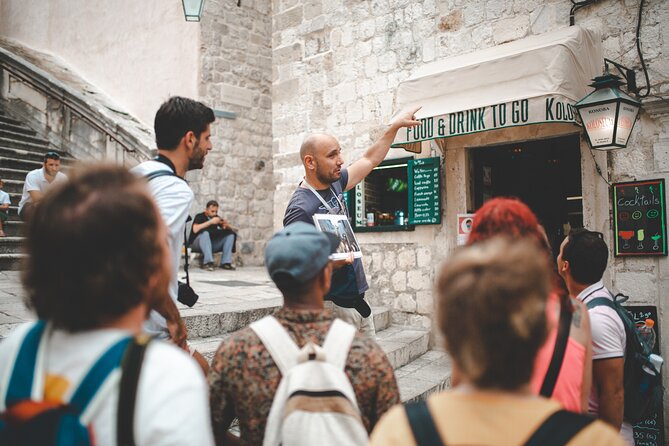
- A useful first-day orientation: The route shows you where the main streets, squares, churches, harbor, and palaces fit together.
- Strong local storytelling: Guides including Ivana, Jelena, Sara, Joseph, and Pero are known for humor, family anecdotes, and clear explanations.
- A history tour with modern context: You hear about Ragusa, Yugoslavia, and the Homeland War, not just medieval buildings.
- No major admission fees during the walk: The tour price covers the guide, taxes, and handling charges, but not hotel transport.
- A manageable 90-minute pace: It works well before an independent walk, a boat trip, or a longer visit to a museum.
- Book ahead in busy periods: The group can reach 30 people, and the activity is often reserved well before the date.
Why this short walk works so well in Dubrovnik

I think a guided walk is especially useful in Dubrovnik because the Old Town can feel like a beautiful maze. Stradun is obvious, but the meaning of the side streets, fountains, churches, harbor defenses, and government buildings is much less clear without a bit of explanation.
This tour gives you a framework. You start at the Large Onofrio’s Fountain, walk along the main street, turn into narrower lanes, reach the old harbor, and return toward the eastern end of Stradun. By the finish, you have a working map in your head.
The route also avoids treating Dubrovnik as a frozen medieval postcard. You hear about the Republic of Ragusa, but also about its decline, the later Yugoslav period, and the shelling and damage during the Homeland War. That wider view makes the city feel lived in rather than staged for sightseeing.
The price is $24.19 per person. For a 90-minute walk, that is fair value if you want orientation and context, especially in a city where independent sightseeing can turn into a string of impressive buildings without much understanding of how they connect. It is less useful if you already know Dubrovnik well or want extended time inside museums and churches.
More History Walking Tours in Croatia
- Dubrovnik: Ancient City Walls & Wars Walking Tour
★ 5.0 · 1,270 reviews - Dubrovnik: Old Town History Walking Tour
★ 4.9 · 474 reviews - Zagreb: City and WWII Tunnels Walking Tour
★ 4.9 · 1,230 reviews
Meeting at Onofrio’s Fountain
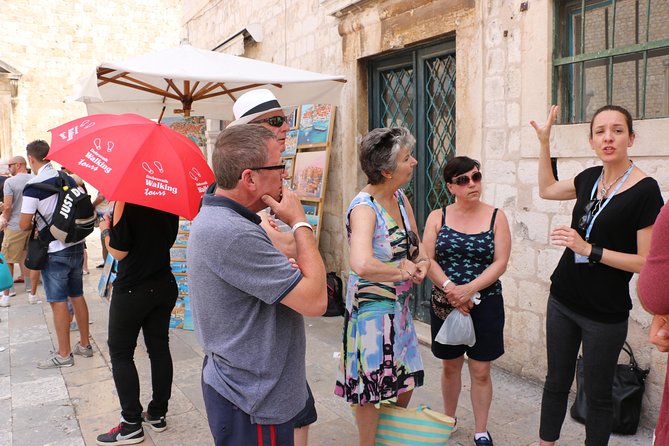
The meeting point is the Large Onofrio’s Fountain, next to the Hard Rock Cafe and the red umbrella used by Dubrovnik Walking Tours. This is a practical place to begin because it is prominent and easy to spot inside the Old Town.
Allow a few minutes to find the exact meeting point. The guide introduces the group, then sets off through the city. Groups can include up to 30 people, so staying near the guide matters, especially when the Old Town is crowded.
The fountain itself is more than a convenient landmark. It is part of Dubrovnik’s old aqueduct system, an impressive public project for a small maritime republic. This opening stop sets up the larger question the tour keeps returning to: how did Ragusa manage to function as an independent trading city on this rocky coast?
The Holy Savior and the role of religion
From the fountain, the walk moves down the main street past the small votive Church of Holy Savior. Here, the guide explains how religion shaped public life and the physical form of Dubrovnik.
This is a good early stop because it gives you something to look for as the walk continues. Churches were not simply decorative buildings. They reflected the city’s beliefs, civic life, charitable traditions, and connections with other communities.
The stop is brief, so do not expect a detailed church interior visit. Its value is in the setting and explanation. You are learning how to read the Old Town before moving on to larger landmarks.
The Franciscan Monastery and its working pharmacy

The Franciscan Church and Monastery is one of the more memorable stops. The complex includes a church, monastery, library, and pharmacy. The pharmacy dates to 1317 and is described as the third-oldest still-functioning pharmacy in the world.
You also hear about the library, built in the 17th century, with more than 20,000 books and 1,200 valuable old manuscripts. Those numbers help show the role of religious houses as centers of education and record keeping, not only places of worship.
The guide also brings in local customs that continue today. This personal, everyday angle is one of the better features of the tour. It moves the experience beyond a list of dates and gives you a sense of how old traditions can remain part of ordinary life.
The stop lasts about 10 minutes, which is enough for an introduction but not a full visit to the monastery. If you want to explore the pharmacy, library, or church in detail, plan to return on your own.
More Old Town Walking Tours in Croatia
- Dubrovnik: Old Town Walking Tour
★ 4.8 · 5,174 reviews - Dubrovnik Discovery Old Town Walking Tour
★ 5.0 · 4,458 reviews - Dubrovnik: City Walls, Old Town Walking Tour & Adriatic View
★ 4.9 · 982 reviews - Dubrovnik: Old Town Walking Tour
★ 4.9 · 792 reviews
Walking Stradun, Dubrovnik’s main public room
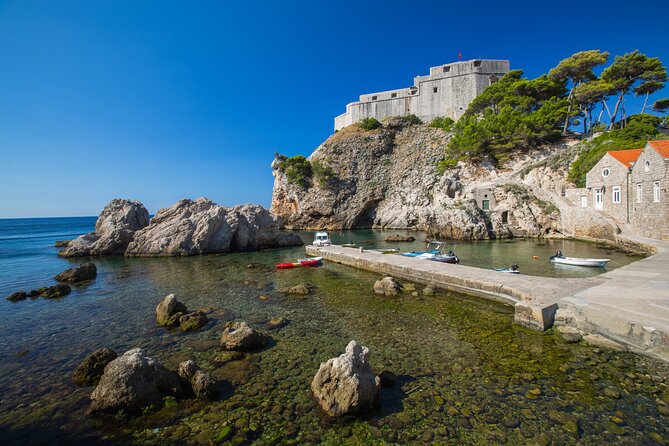
Stradun, also called Placa, is Dubrovnik’s main promenade and business street. It divides the Old Town into northern and southern sections and serves as the setting for public feasts, religious processions, and daily gatherings.
I like hearing about Stradun as a civic space rather than just a photogenic street. Its broad, orderly layout helps you understand the city’s design. The guide also explains how Dubrovnik developed as a tightly managed republic and how the city’s fortunes changed over time.
This is where the tour moves from the medieval and early modern period into more recent events. You hear about the fall of the Republic of Ragusa, the Yugoslav era, and the Homeland War of the 1990s. That shift is important. Dubrovnik’s story did not end when the old republic disappeared.
Stradun can be busy, and the smooth stone pavement may be slippery after rain. Keep your attention on the guide and your footing. The tour can continue in light weather, but it requires good weather and may be canceled if conditions are poor.
A side street and the Church of the Holy Annunciation
The route turns away from Stradun into a narrower inner street on the way toward the port. This change of scale is useful. The main street shows Dubrovnik’s public face, while the side lanes hint at how residents moved through the Old Town.
At the Orthodox Church of the Holy Annunciation, the guide discusses the Orthodox Christian, Jewish, and Muslim communities that influenced Dubrovnik. This is one of the tour’s more valuable corrections to the idea that the city had only one religious identity.
The stop is not a full survey of every community or building, but it gives you a broader view of the city’s commercial and cultural connections. Dubrovnik’s position on Mediterranean trade brought different people, beliefs, and customs into contact.
Gundulic Square and the Green Market
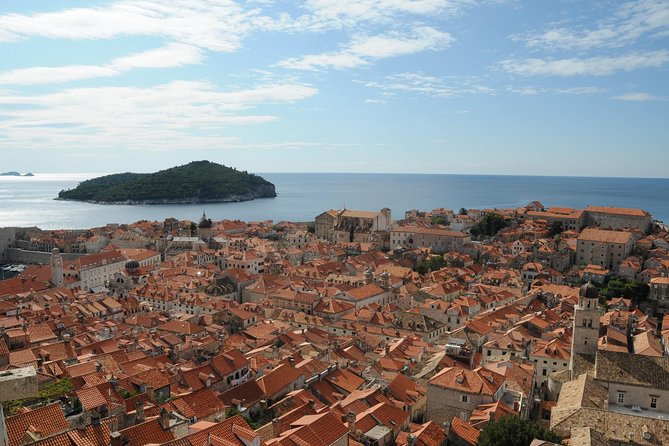
At Gundulic Square, you reach the monument to poet Ivan Gundulic and the Green Market. This is a welcome change from formal architecture. You can look at local produce while hearing about food, customs, and everyday life.
The market gives the tour a more grounded feel. Grand palaces explain government and wealth, but a market helps you picture how people shop, eat, and meet one another.
The timing here is about 10 minutes. You may not have much time to browse or buy anything, so treat it as an orientation stop rather than a market visit. If something catches your eye, note the location and return later.
Rector’s Palace and the machinery of Ragusa
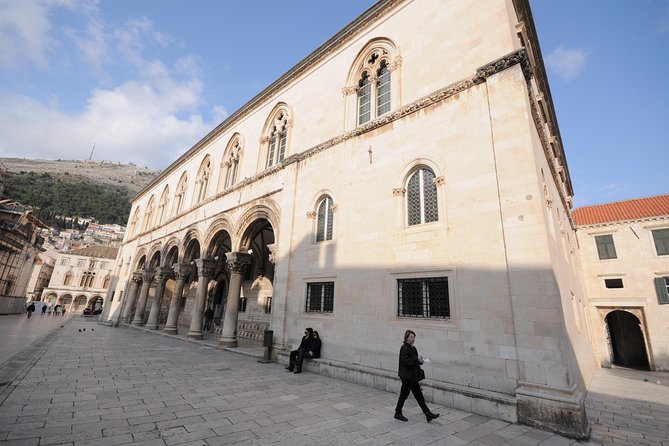
The Rector’s Palace was the seat of the Rector of the Republic of Ragusa from the 14th century until 1808. It also housed the Minor Council and state administration, along with an armoury, powder magazine, watch house, and prison.
That list tells you a great deal about Ragusa’s government. The palace was not simply a grand residence. It was a working center of power, security, law, and administration.
The guide’s explanation helps place Dubrovnik’s political system in context. The Rector served for a limited term, and the republic depended on careful rules and institutions. You will not get a full political history in a few minutes, but you will understand why this building mattered.
The tour generally discusses the palace from the route rather than providing a dedicated interior visit. If you want to see its collections, you will need to return separately.
The Cathedral and the Richard the Lionheart story
The Cathedral of the Assumption of the Virgin Mary adds another major religious landmark to the route. The guide also tells the local legend that Richard the Lionheart was shipwrecked on nearby Lokrum in 1192 while returning from the Crusades.
Stories like this are useful when handled as legends rather than hard proof. They show how Dubrovnik connects itself to wider European events and famous figures.
The cathedral stop is short, around five minutes. It is enough to understand its place in the Old Town and hear the associated story, but not enough for a detailed look at the interior, art, or treasury. Save that for an independent visit if those subjects interest you.
The Old Port, quarantine, and maritime power
At the City Harbor, the tour turns toward Dubrovnik’s life at sea. Ships from the republic sailed throughout the Mediterranean, and its galleons served in navies across Europe and beyond.
The guide explains the old Arsenal, where ships were built and loaded, then discusses the famous quarantine facilities and the nearby fortresses of St. Luke and St. John. This is one of the strongest parts of the route because it shows how Dubrovnik protected itself and made money.
Quarantine was not a modern invention. Maritime cities had to control disease while keeping trade moving, and Dubrovnik developed systems for isolating people and goods. The harbor also makes the republic’s trading role easier to picture than the inland streets do.
You spend about 15 minutes in this area. The open setting can make it easier to hear the guide than in a cramped lane, though harbor conditions and crowds can vary.
Orlando Column, St. Blaise, and Luza Square
The final section returns to the eastern end of Stradun, under the City Bell Tower, at Luza Square. Here, the guide brings together several important monuments: the Church of St. Blaise, Orlando Column, Sponza Palace, the Small Onofrio’s Fountain, and the Bell Tower.
The Orlando Column is tied to the legend of the knight Orlando. It also works as a symbol of the city’s civic identity and independence. Sponza Palace adds another piece of the republic’s commercial and administrative story.
This cluster of sights can feel like a lot in 15 minutes. The advantage is breadth. You leave knowing what each building is and where it sits. The disadvantage is that you will not receive a long explanation of every monument.
The route ends back at the starting point. That is convenient because you can continue exploring in any direction, return to a favorite square, or follow the guide’s suggestions for food, gelato, museums, or a boat trip.
What the guides do best
The strongest feature of this experience is the human delivery. The guide roster changes, but the descriptions of Ivana, Jelena, Sara, Joseph, Pero, Ermina, Helena, and others point to a consistent style: local stories, humor, personal memories, and practical advice.
Ermina, for example, connected the tour to her family, including a grandmother who still lives in the Old Town. That kind of detail gives you a sense of continuity between the historic city and modern residents.
The guides also appear to adjust their pace to the group. Some visitors describe the walk as easy and relaxed, while others praise the guide for covering the sights efficiently in 90 minutes. That balance matters for families and mixed-age groups.
English is the offered language. The tour is designed for most people to participate, and one detailed account described much of the introduction as step free. Still, Dubrovnik’s Old Town has many steps, uneven stone surfaces, and crowded areas, especially if you continue exploring after the tour.
How to plan the tour around your day
I would take this walk early in your stay, ideally on the first or second day. You will learn the layout quickly and can use the rest of your visit to return to the places that interest you most.
The tour is also easy to pair with other activities. One visitor combined it with a 45-minute boat trip around the city walls. That makes sense: the walking tour explains the streets and institutions, while a boat gives you a different view of the fortifications.
Choose a departure time that fits your schedule, but remember that the Old Town can become crowded. November was described as a particularly calm period, with smaller crowds and a peaceful atmosphere. If you visit then, carry rain protection and keep an eye on weather notices because the activity depends on suitable conditions.
You receive confirmation at booking, and free cancellation is available until 24 hours before the start time. Cancellations inside that window are not refunded. The tour does not include hotel pickup or drop-off, so you must make your own way to the Large Onofrio’s Fountain.
Who should book this Dubrovnik walk
This tour suits a first-time visitor who wants a clear introduction without committing to a half-day activity. It also works for families, couples, solo visitors, and anyone who prefers to learn the city’s basic story before exploring alone.
I would recommend it if you enjoy history but want more than dates and building names. The discussion of religious communities, quarantine, maritime trade, Ragusa’s government, and the Homeland War gives the tour a useful range.
It is less suitable if your main goal is entering every major sight. There is no hotel transport, no listed museum admission, and limited time at each stop. You are paying for a guided overview, not an all-access monument tour.
Should you book it?
At $24.19, I think this is a sensible introduction to Dubrovnik, especially if you schedule it near the start of your visit. The route is short, the sights are well chosen, and the local guides add the personal detail that is hard to find in a guidebook.
Book it if you want to understand what you are seeing, get your bearings, and collect ideas for the rest of your stay. Skip it if you already know the Old Town well or would rather spend 90 minutes inside one museum or palace. For most first-time visitors, the combination of Stradun, the Franciscan complex, Rector’s Palace, the harbor, and modern wartime context makes the price worthwhile.
FAQ
How long is the Dubrovnik Old Town History Walking Tour?
The tour lasts approximately 1 hour and 30 minutes.
Where does the tour start?
It starts at the Large Onofrio’s Fountain at Poljana Paska Miličevića, next to the Hard Rock Cafe and the red umbrella meeting point.
Where does the tour end?
The activity ends back at the meeting point at the Large Onofrio’s Fountain.
Is the tour offered in English?
Yes. English is the listed tour language.
Does the tour include hotel pickup and drop-off?
No. Hotel pickup and drop-off are not included. You must get to the meeting point on your own.
What happens if bad weather cancels the tour?
The experience requires good weather. If it is canceled because of poor weather, you will be offered another date or a full refund. You can also cancel for a full refund if you do so at least 24 hours before the start time.
More Old Town Walking Tours in Dubrovnik
- Dubrovnik Cable Car Ride, Old Town Walking Tour plus City Walls
★ 4.5 · 685 reviews - Dubrovnik: Panoramic Ride and Old Town Guided Walking Tour
★ 4.7 · 261 reviews - Dubrovnik: Old Town & City Walls Private Walking Tour
★ 5.0 · 206 reviews - Underground Vaults Walking Tour in Edinburgh Old Town
★ 4.5 · 8,506 reviews
More History Walking Tours in Dubrovnik
- Berlin: Third Reich & Cold War Guided Walking Tour
★ 4.9 · 8,378 reviews - Munich: Third Reich & WWII Walking Tour
★ 4.6 · 6,181 reviews - Berlin’s Best: 2 Hour Walking Tour Third Reich and the Cold War
★ 5.0 · 5,486 reviews - Third Reich Berlin: Hitler and WWII Walking Tour
★ 5.0 · 3,301 reviews
Just added around Dubrovnik
- Dubrovnik: Panoramic Ride and Old Town Guided Walking Tour★ 4.7 · 261 reviews
- Dubrovnik: Walls and Wars Walking Tour★ 4.8 · 501 reviews
- Dubrovnik: Game of Thrones&Lokrum Island Walking Tour★ 4.8 · 245 reviews
- Dubrovnik: Game of Thrones And Iron Throne Walking Tour★ 4.8 · 505 reviews
- Dubrovnik: Early Bird Walking Tour★ 4.9 · 123 reviews
- Dubrovnik By Night Walking Tour★ 4.8 · 208 reviews
- Dubrovnik: Legendary Game of Thrones Walking Tour★ 4.8 · 220 reviews
- Dubrovnik: Old Town History Walking Tour★ 4.9 · 474 reviews
Old Town Walking Tours, compared.

Underground Vaults Walking Tour in Edinburgh Old Town
Read our review →
3-Hour Walking Tour of Old Town & Prague Castle
Read our review →

Old Town and Jewish Quarter Guided Walking Tour
Read our review →