

REVIEW · UK
Medieval Walking Tour of Chester
Chester’s medieval story is told best through its walls, narrow Rows, old battle links, and the people who lived by them. This 90-minute walking tour adds a costumed Cheshire longbow man to the scene, with guides such as Thomas, Richard, Carl, and Edward using weapons, coins, and other period objects to make the past feel close at hand.
I like the small maximum group of 15, which makes it easier to hear the guide and ask questions. I also like the low price, about $16.67 per person, and the fact that you finish near the River Dee with much of the day still free. The main caution is that this is more a focused medieval history walk than a broad tour of every major Chester sight.
Key points to know before you book
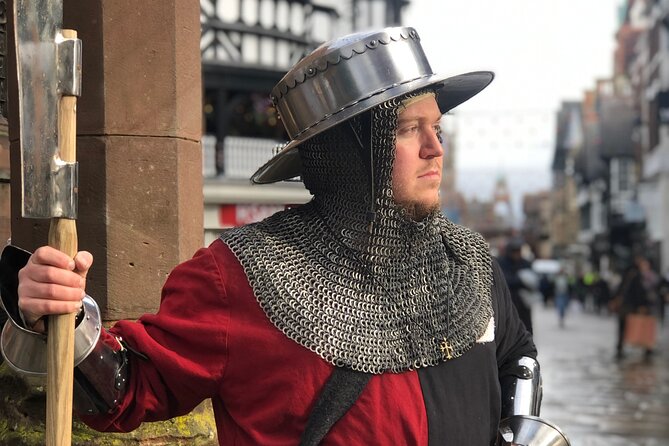
- Costumed Cheshire longbow guides: Thomas, Richard, Carl, and Edward are among the guides who have led the walk, often appearing in period clothing with swords, shields, helmets, and archery gear.
- A story-led route: The tour covers Chester’s walls, the Rows, the Roman amphitheatre, medieval trade, the city’s archers, and the Hotspur rebellion.
- Small-group value: The group can hold no more than 15 people, a useful size for a walking tour built around spoken stories and questions.
- Easy central meeting point: Meet outside Chester Visitor Information Centre at the Town Hall on Northgate Street.
- Riverside finish: The walk ends by the River Dee near Handbridge, with a final explanation of the Battle of Shrewsbury.
- A history tour first: Expect more detail about medieval Chester and its military past than a complete survey of the city’s buildings.
Chester’s medieval story begins on the city walls

The walk starts at the Chester Visitor Information Centre, outside the Town Hall on Northgate Street. That is a practical meeting point in the center, and it should be easy to locate if you are already exploring Chester on foot.
From there, the guide takes you along a section of the city walls. This opening gives you the basic framework for understanding Chester: the walls were not simply a pleasant walking route, but a defensive system that changed as the city grew and faced new threats.
I like beginning here because the walls give the tour a physical backbone. You are not sitting in a room hearing a list of dates. You are walking through the setting while the guide explains how the defenses began and developed.
The route does require a moderate level of fitness. You will be on foot for about an hour and a half, and the tour moves between several parts of the city before reaching the river. The supplied information does not promise a step-free route, so anyone concerned about mobility should ask the operator before booking.
A few more walking tours around the UK worth a look
- Magical London: Harry Potter Guided Walking Tour
★ 4.7 · 22,044 reviews - Edinburgh: Harry Potter Magical Guided Walking Tour
★ 4.8 · 11,944 reviews - Edinburgh Castle: Guided Walking Tour with Entry Ticket
★ 4.7 · 11,699 reviews
The Chester Rows reveal how medieval shopping worked
One of the most useful stops is Chester Rows, the city’s distinctive two-level shopping galleries. The guide spends about 15 minutes explaining how the Rows were used in medieval Chester and why they mattered to trade.
This is where the tour adds something beyond a standard military tale. The Rows help you picture everyday life: merchants, customers, workshops, and movement through a city built for business. Their unusual form makes more sense when you hear how people used the space.
I would pay close attention here, especially if you are interested in buildings and urban life. The stop is brief, so it cannot cover every architectural detail, but it gives you a clear explanation of why the Rows are central to Chester’s identity.
This is also the point where expectations matter. If your main goal is a full architectural tour of Chester, you may find the treatment of buildings too short. The guide’s priority is the city’s medieval role, including trade, conflict, and the people connected with those events.
The Roman amphitheatre gets a medieval second act

The next named stop is Chester Roman Amphitheatre, where the guide spends about five minutes explaining how the area was used by St. John’s Cathedral in medieval times.
That short stop is interesting because it shifts the focus from Roman Chester to medieval Chester. The amphitheatre is famous for its Roman past, but this tour asks you to consider what happened to the site later, when the city had changed and medieval institutions shaped its use.
Five minutes is enough for context, not a full archaeological explanation. If you want an extensive account of the Roman amphitheatre itself, you will need a separate visit or another city tour. Here, it functions as one piece of a wider medieval story.
Cheshire archers give the tour its strongest identity
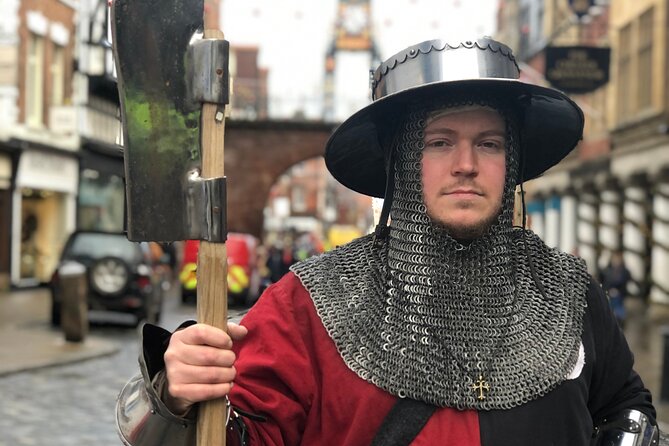
The most distinctive thread is the story of the Cheshire longbow men. Guides often appear as archers, and Thomas has been described as speaking in character while wearing the clothing of a Cheshire bowman.
That costume is not just decoration. It gives the guide a way to explain the equipment and the role of the archer in medieval warfare. Depending on the guide, you might see a shield, sword, helmet, weaponry, coins, or small objects linked to daily life.
I like this practical approach. A spoken account of medieval warfare can become hazy, but handling or seeing period-style objects gives the story a sharper edge. You can better understand what an archer carried and why Cheshire’s bowmen gained a reputation in conflicts with France.
The tour also connects military life with local identity. Chester is not treated as a backdrop for famous national events. The guide explains why the city and its people mattered, particularly during the period linked to the Crown, rebellion, and the Hotspur story.
The strongest guides appear to bring humor into the subject without losing the facts. Richard, in particular, has been praised for combining clear explanations with jokes and enthusiasm. That tone should suit you if you like history delivered as a story rather than as a lecture.
Same streets, a different route:
- Underground Vaults Walking Tour in Edinburgh Old Town
★ 4.5 · 8,506 reviews - London: The Original Jack the Ripper Walking Tour
★ 4.7 · 7,833 reviews - Oxford University Walking Tour With University Alumni Guide
★ 5.0 · 6,905 reviews - Edinburgh Castle: Guided Walking Tour with Entry Ticket
★ 5.0 · 5,540 reviews
The Hotspur rebellion brings the final part of the walk together
The tour’s historical focus includes the rebellion of Hotspur and the Battle of Shrewsbury. These events help explain why the walk ends beside the River Dee near Handbridge rather than returning to the Town Hall.
At the riverside, the guide explains the Battle of Shrewsbury and then finishes the tour. This gives the walk a defined ending, but it also means you should plan your next move from the river rather than from the original meeting point.
The route is therefore useful as a way to reach another part of Chester. You finish with the river nearby and the rest of the day open for lunch, further sightseeing, or a visit to another attraction.
The final location also reinforces the tour’s main idea: Chester’s importance came from more than attractive streets. Its position, defenses, people, and connection to wider conflicts all shaped the city’s medieval role.
What the guides do especially well
Several guides are named in the available material, including Carl, Richard, Thomas, and Edward. The exact guide you receive may vary, but the common approach is a costumed presentation with a strong focus on medieval Chester and the Cheshire archers.
Thomas is noted for making a visible effort with his outfit and for taking the group through the story point by point. Edward is described as enthusiastic and good at bringing medieval Chester to life. Richard is associated with a professional, humorous presentation and a clear interest in the subject.
Carl has been praised for explaining Chester’s importance, while other accounts point to guides counting the group in busy or windy conditions. That small practical habit matters. A walking tour can lose its shape if people are left behind, especially near roads, crowded streets, or open stretches of wall.
The best part of this format is the sense of a person telling a local story rather than reciting a standard script. You may see objects, hear acted scenes, and get answers to questions along the way.
The tradeoff is that a passionate guide may spend more time talking than walking. Some people will love the added detail. Others may prefer fewer explanations and more city sights. If you want a fast-paced photo tour, this may feel slow.
How much sightseeing do you actually get?
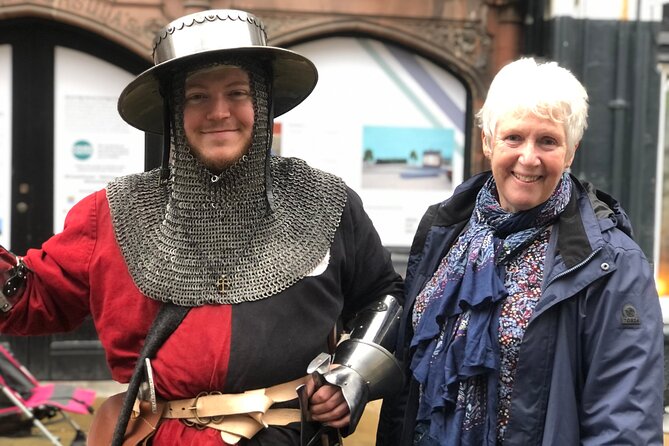
You will see part of Chester’s city walls, Chester Rows, the Roman amphitheatre, sections of the city connected with medieval life, and the River Dee near Handbridge. Those are meaningful stops, but this is not designed as a checklist of every major Chester landmark.
The route gives you context for places you might otherwise pass without understanding. The Rows become a story about trade. The amphitheatre becomes part of a later medieval setting. The walls become evidence of changing defense and power.
Still, the tour’s subject is narrow by design. It concentrates on medieval Chester, the Cheshire bowmen, warfare, and the Hotspur rebellion. If you want detailed coverage of buildings, churches, or the wider history of Chester, look for a general city tour as well.
I see this as a good first activity if you want a theme to organize your visit. It can also work well after you have wandered around on your own, since the guide may give meaning to streets and structures you have already seen.
Is $16.67 good value for 90 minutes?
At about $16.67 per person, the tour is priced as an affordable introduction rather than a full-day experience. The small group limit makes the price more appealing, since you are paying for a live guide without the cost of a private tour.
You are getting about an hour and a half of structured walking, local stories, a costumed presentation, and a clear route from the Town Hall to the river. For a first look at Chester’s medieval side, that is solid value.
The value depends on what you want from the experience. If you enjoy military history, local characters, and storytelling, the price is easy to justify. If you mainly want photographs of buildings or a broad city orientation, you may find that the historical talk takes up too much of the available time.
The rating is 4.9 from 155 ratings, with 97 percent of people recommending the experience. That points to a strong level of satisfaction, but the lower-scoring comments are useful too: communication problems around tickets have occurred, and some people wanted more sightseeing with less narration.
Your confirmation should arrive when you book. If it does not, contact the booking provider promptly rather than waiting until the meeting time. The tour operator has indicated that it can alert the guide when ticket delivery goes wrong, but it is still wise to confirm the meeting details.
Who will enjoy this walk most?
This tour is a good fit for you if you like:
- Medieval warfare and the story of the Cheshire archers
- Local history told through characters and objects
- Short walking tours that leave the rest of the day free
- Small groups rather than large coach excursions
- Chester Rows, the city walls, and the medieval use of older sites
- Family outings where children may respond to costumes and weapons
The experience can suit adults and children alike, especially if young visitors enjoy acted scenes and visible equipment. The moderate fitness requirement means you should be comfortable walking for 90 minutes.
It may be less suitable if your priority is Roman Chester, detailed architecture, or a complete survey of the city. The Roman amphitheatre receives only a short explanation, and the tour does not claim to cover every important building.
Service animals are allowed, and the meeting point is near public transportation. You should still consider the length of the walk and the outdoor setting when planning what to wear.
Practical details that make the day easier
Meet at Chester Visitor Information Centre, Town Hall, Northgate Street, Chester CH1 2HJ. The walk ends at the River Dee, Chester CH4 7JB, near Handbridge.
The advertised duration is approximately one hour and 30 minutes. Allow a little flexibility around that time, since a question-heavy group or a particularly detailed guide may affect the pace.
The experience is offered in English and uses a mobile ticket. It is available with free cancellation if you cancel at least 24 hours before the local start time. Cancellations or changes inside that window are not refunded or accepted.
The tour is capped at 15 people. That is large enough to create a social group, but small enough for the guide to keep track of everyone and respond to questions.
Since the finish is away from the start, do not leave anything at the Town Hall. Plan your route after the walk from the riverside near Handbridge.
Should you book the Medieval Walking Tour of Chester?
Book it if you want Chester’s medieval period explained through walls, trade, archers, rebellion, and local storytelling. The costume, weapons, coins, and acted scenes give the walk a clear personality, and the price is fair for a 90-minute small-group experience.
Skip it if you want a general architectural tour or a quick march between Chester’s most photographed sights. You may prefer a broader city guide, especially if buildings matter more to you than the city’s military past.
For most visitors with an interest in medieval England, this is a useful and entertaining way to spend the first part of a day. Just arrive expecting a history walk with selected sights, not a complete tour of Chester.
FAQ
Where does the Medieval Walking Tour of Chester start?
It starts at Chester Visitor Information Centre, outside the Town Hall on Northgate Street, Chester CH1 2HJ.
Where does the tour finish?
The guide finishes by the River Dee near Handbridge, at Chester CH4 7JB.
How long does the experience last?
The walk lasts approximately one hour and 30 minutes.
How much does the tour cost?
The listed price is $16.67 per person.
Is the tour offered in English?
Yes. The tour is offered in English.
How large is the group?
The tour has a maximum of 15 participants.
Is the tour suitable for anyone with limited mobility?
Participants should have a moderate level of physical fitness. The supplied details do not specify a step-free route, so contact the operator if you need accessibility information.
What is the cancellation policy?
You can cancel for a full refund up to 24 hours before the experience starts. Cancellations or changes made less than 24 hours before the start time are not accepted or refunded.
Just added around the UK
- Merchant City Music Walking Tour of Glasgow★ 5.0 · 94 reviews
- Stirling Castle, Loch Lomond Walk & Whisky Distillery Tour from Glasgow★ 5.0 · 79 reviews
- Walking Tour of Glasgow★ 5.0 · 96 reviews
- Gothic Glasgow Walking Tour★ 5.0 · 448 reviews
- Glasgow: Pubs & History Walking Tour with Beer Tasting★ 5.0 · 81 reviews
- Glencoe, Scenic Walk & Highlands Guided Tour starting Glasgow★ 5.0 · 121 reviews
- Gander Walking Tours in Glasgow★ 5.0 · 506 reviews
- Group Walk up Ben Nevis from Fort William★ 5.0 · 108 reviews
Walking Tours, compared.

Magical London: Harry Potter Guided Walking Tour
Read our review →
Reykjavik Food Walk – Local Foodie Adventure in Iceland
Read our review →
History and Hauntings of Salem Guided Walking Tour
Read our review →
New Orleans Premier Ghost, Voodoo and Vampire Walking Tour
Read our review →
Amsterdam Anne Frank: Small-Group Walking Tour & Local Guide
Read our review →

Edinburgh Castle: Guided Walking Tour with Entry Ticket
Read our review →
Anne Frank’s Story – Guided Walking Tour through Amsterdam
Read our review →Browse the lists this tour appears in