
REVIEW · WALKING TOURS
Best of Buenos Aires Private Walking Tour
Buenos Aires reveals its character through grand avenues, family fortunes, old rivalries, and buildings that look more Parisian than South American. This private walk connects the city center with Recoleta, covering at least 25 sights while explaining how immigration, British trade, the Catholic Church, and Argentina’s powerful families shaped the city.
I like the wide range of subjects, from Art Deco architecture and French-style mansions to the Falklands War and the 1992 Israeli Embassy bombing. I also like the final stop at Recoleta Cemetery, where Evita’s story and the city’s old elite give the walk a human face. The main drawback is simple: this is a lot of ground in roughly three hours, so you should expect steady walking and only brief stops at many buildings.
Key points to know before you book
- A city-to-city walk in miniature: The route links downtown Buenos Aires, Plaza San Martín, Barrio Norte, and Recoleta.
- At least 25 sights: You see major landmarks plus churches, palaces, embassies, monuments, and lesser-known architectural details.
- Strong historical storytelling: The guide covers immigration, British influence, Argentine politics, the Malvinas conflict, religion, and the rise and fall of Argentina’s wealthy families.
- Recoleta Cemetery is the longest stop: Plan on about an hour there, including Evita’s memorial and other unusual tomb stories.
- Private format: Only your group takes part, so the pace and questions can be more personal than on a large group walk.
- Good first-day orientation: The walk ends near La Biela Cafe, close to restaurants and major Recoleta sights.
From Florida Street to Recoleta in one long morning
The route begins outside Florida Garden Cafe at Florida 899, near the corner of Paraguay Street. You need to arrive by 10 a.m. and look for the small Buenos Aires Walking Tours sign held or worn by the guide.
Florida Street is a smart starting point. It runs between the founding area around Plaza de Mayo and Plaza San Martín, and your guide uses it to explain the early shape of Buenos Aires. Today it is a major shopping street, but the point of this opening section is not shopping. It is learning how the central city grew and how commerce tied different parts of Buenos Aires together.
The walk then turns toward the Basilica del Santísimo Sacramento. Built in 1916 for Lady Mercedes Anchorena and her family, this church introduces one of the tour’s recurring themes: the link between great fortunes, social status, the Catholic Church, and city architecture. You will hear stories about power and family relationships rather than simply receive a date and a name.
Next comes the Edificio Kavanagh, overlooking Plaza San Martín. Its Art Deco form is one of the city’s great pieces of twentieth-century architecture. Corina Kavanagh, a wealthy woman of Irish descent, sold two ranches at age 39 to finance the building. Construction took only 14 months, and the tower was once the tallest skyscraper in Latin America.
You should pause here for photographs, but do not expect a long interior visit. The emphasis is on the building’s design, its dramatic origin story, and the social world that made such a project possible.
More Private Walking Tours in the world:
- Private Walking Grand Tour of Copenhagen
★ 5.0 · 3,953 reviews - Vienna: Private Walking Tour with a Local
★ 4.6 · 1,446 reviews - Barcelona Helicopter, Sailboat & Old Town Private Walking Tour
★ 5.0 · 1,395 reviews
British influence, the Malvinas War, and Plaza San Martín
The Torre Monumental offers a very different kind of lesson. This British-style clock tower points to Argentina’s strong economic and cultural links with England. Across from it, the Monumento a Combatientes de Malvinas recalls the 1982 South Atlantic War, known in Argentina as the Malvinas conflict and in Britain as the Falklands War.
The pairing is particularly useful. You are not just looking at a clock tower and then a war memorial. You are seeing two physical reminders of Argentina’s long, complicated relationship with Britain. The guide explains British involvement in the economy, the political background to the war, and the continuing emotional weight of the conflict.
From there, you enter Plaza General San Martín. The park has served many purposes over time, including a fort and a bullfighting ring, and it was close to former slave depots. Its central monument honors General José de San Martín, Argentina’s leading independence hero.
This is one of the places where a private guide adds real value. The square itself is pleasant, but the surrounding stories give it weight. You learn about San Martín’s role in independence and see how the city layers colonial, military, commercial, and national history in one compact area.
Palaces that explain Argentina’s old ruling class
Palacio Paz is one of the route’s most striking buildings. José C. Paz, owner of one of Buenos Aires’ major newspapers and an aspiring president, commissioned the palace in 1914. Its materials came from France, and the building contains 120 rooms, an astonishing scale for a family residence.
Palacio San Martín, originally the Anchorena family palace, continues the story. Its present name reflects later political use, but the building remains tied to Mercedes Anchorena, whose family also funded the nearby Basilica del Santísimo Sacramento.
These stops help you understand what the tour means by the Paris of the South. The comparison is not based only on boulevards and façades. It also comes from the habits of Argentina’s upper class, which looked to France for architecture, decoration, fashion, and social models.
Palacio Estrugamou carries that theme into Barrio Norte. The neighborhood is filled with Parisian apartment buildings and former mansions, and the guide links them to the arrival of Spanish, Italian, French, and British immigrants. You are shown how European migration changed Buenos Aires, while also hearing about the country’s economic rise and later decline.
The walk is especially strong for readers who enjoy architecture but want more than a list of styles. A building becomes a clue to the people who paid for it, the countries they admired, and the political system they hoped to join.
Difficult history on embassy squares and elegant streets
The stop at Plaza de la Embajada de Israel shifts the mood. In 1992, a bomb destroyed the Israeli Embassy and killed 24 people. The guide discusses what happened, the political questions around it, and Argentina’s struggles with justice.
This is not a light sightseeing stop, and some people may find the transition from palaces to political violence abrupt. Still, it gives the walk a needed balance. Buenos Aires is not only grand architecture and romantic boulevards. Its recent history includes tragedy, contested investigations, and unresolved public memory.
Nearby, the French Embassy occupies what was originally the Ortiz-Basualdo Palace. The guide adds historical gossip involving Edward VII of England and his future American wife. These personal stories make the building easier to remember, especially after the heavier material at the Israeli Embassy site.
The route continues to Patio Bullrich, now an upscale shopping center. Its earlier life was much more unusual: it opened in 1867 as a British-designed auction house for livestock, thoroughbreds, heirlooms, and other valuable goods. The building’s change from cattle auction floor to luxury mall neatly illustrates Buenos Aires’ changing fortunes.
I like this stop because it shows British influence in a practical way. You are not merely told that England mattered. You see how British design and commercial habits entered everyday city life.
A few more walking tours around the world worth a look
- Magical London: Harry Potter Guided Walking Tour
★ 4.7 · 22,044 reviews - Reykjavik Food Walk – Local Foodie Adventure in Iceland
★ 5.0 · 18,952 reviews - History and Hauntings of Salem Guided Walking Tour
★ 5.0 · 14,564 reviews - New Orleans Premier Ghost, Voodoo and Vampire Walking Tour
★ 4.5 · 12,856 reviews
Church power, Recoleta, and Avenida Alvear
The Papal Nunciature brings religion and wealth back into focus. The guide explains why Argentina produced a pope and discusses the relationship between wealthy women such as the Anchorena, Harilaos, and Alvear families and the Catholic Church.
One particularly striking story concerns Adelia Harilaos, who donated her palace to the Vatican. The building and gardens make more sense once you understand the social and religious networks behind them.
From there, the route enters Recoleta, one of Buenos Aires’ most polished areas. The neighborhood grew around land given to Franciscan Recollect monks. Today, it is known for former palaces, French-style townhouses, expensive shops, and broad, walkable streets.
Avenida Alvear is the grandest part of this section. The avenue is lined with lavish residences and provides a clear look at the ambitions of Argentina’s wealthy families between 1880 and 1930. Your guide also connects the avenue to immigration and the country’s rise and fall.
This is an important distinction: you are not just seeing pretty façades. You are learning why so much European architecture appeared in Buenos Aires and what economic forces supported it. The polished streets are also evidence of inequality and of a national economy that once seemed destined for greater power.
The Basilica de Nuestra Señora del Pilar is a quieter stop. Completed in 1732 as part of the Franciscan Recollect monastery, it is the second-oldest church in Buenos Aires. The included admission lets you enter rather than simply view the exterior, and its colonial age contrasts sharply with the nineteenth- and twentieth-century palaces along Avenida Alvear.
Recoleta Cemetery and the stories behind the tombs
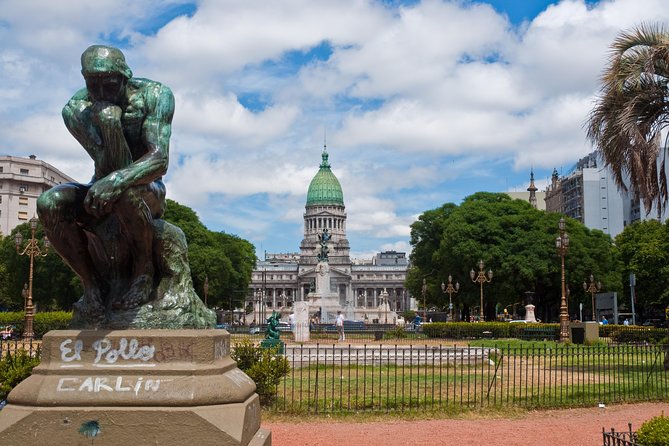
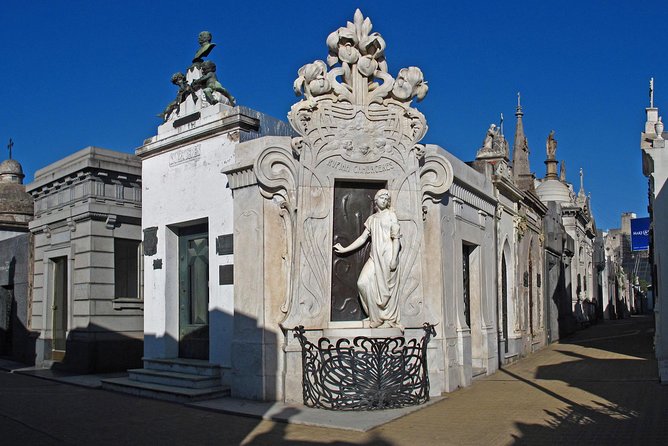
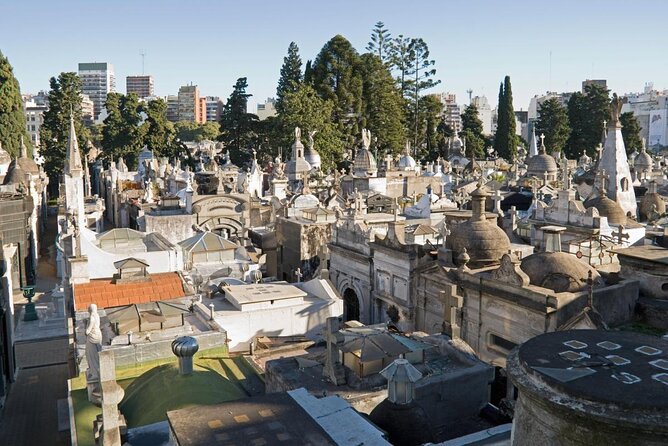
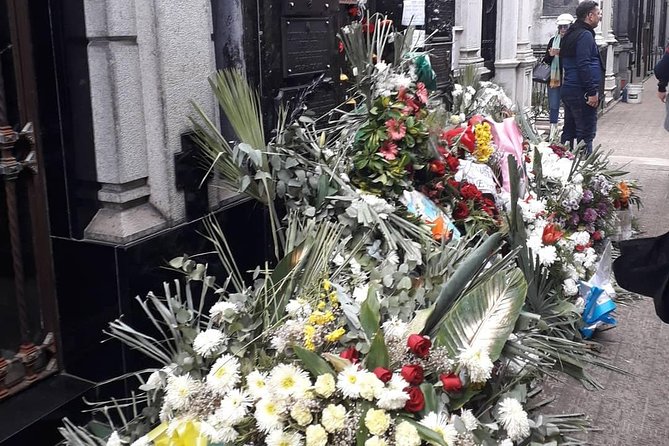
Recoleta Cemetery receives the longest part of the tour, about an hour. This is not a quick walk past Evita’s grave. The guide covers Eva Perón, her memorial, and the political story surrounding her, along with figures such as Admiral Brown, General Guido, the Leloir family, and others.
The cemetery’s unusual stories are part of its appeal. You hear about Rufina Cambaceres’ misfortune and Tiburcia Domínguez’s miserly husband, among other local tales. These stories add character to the grand mausoleums and help you see the cemetery as a record of family ambition, national politics, wealth, grief, and social rank.
The wider cemetery visit can also include the old monastery and cultural center, Bourdelle’s monument to Alvear, Palais de Glace, the history of tango and immigration, the National Fine Arts Museum, the National Library, and nearby monuments. The exact coverage depends on time, weather, city activity, and the pace of your group.
That last point matters. The advertised route is ambitious. If the group spends longer on a question or if city conditions slow the walk, the guide may need to shorten some sections. You should treat the cemetery as the essential final chapter, not assume every nearby attraction will receive equal attention.
The walk ends outside La Biela, a famous cafe on Avenida Quintana. It is a practical ending point, since you are near restaurants, museums, the cemetery, and other Recoleta attractions. You are not taken back to your hotel, so plan your onward route before you start.
Pace, guide style, and what the price buys
The cost is $109 per person. That is not a bargain if you want only a quick orientation or a few postcard views. It becomes more reasonable if you value a private guide, English-language explanations, cemetery admission, and a route that joins several districts without arranging separate transport.
The walk usually lasts about 2.5 to 3 hours. That means you cover a surprising amount of Buenos Aires on foot, but you should wear comfortable shoes and expect limited time inside most buildings. The route operates rain or shine, so bring suitable clothing and do not count on weather canceling the plan.
The private format is a major advantage for families, couples, and small groups with specific interests. You can ask about architecture, Argentine politics, immigration, religion, or the Malvinas conflict without waiting for a large group to move on. Children aged eight and under are free when accompanied by an adult.
Guide quality is central to this experience. Guides named in past feedback include Martin, Carlos, and Mariano, with particular praise for clear English, local stories, humor, and strong knowledge of Buenos Aires history. Martin was especially appreciated for making social, economic, and political subjects entertaining. One guide was also praised for keeping an easy pace, while another was criticized for spending too much time promoting additional tours and not answering questions fully.
That variation is worth keeping in mind. The subject matter is excellent, but the experience depends heavily on who leads your walk. The strongest guides turn buildings into stories and adjust their pace to the group. You should ask questions early and say if you need a short pause.
Who will enjoy this Buenos Aires walk most
I would choose this tour if you are visiting Buenos Aires for the first time and want a strong orientation without spending half a day on a bus. It is also a good fit if you care about architecture, political history, old families, church history, or the social forces behind the city’s European look.
It suits reasonably active walkers who can keep moving for several hours. One previous participant described it as solid walking and noted that the final stop left them to find their own way back, so do not book it expecting door-to-door service.
I would be more cautious if you want long interior visits, relaxed cafe breaks, or detailed time at every stop. The route covers a lot, and some sights receive only a few minutes. You may also prefer a shorter neighborhood tour if your mobility is limited, though the information provided says most people can take part.
Should you book the Best of Buenos Aires Private Walking Tour?
Book it if you want the city explained through its buildings, families, wars, churches, and political scars. The combination of Kavanagh, Plaza San Martín, Palacio Paz, Avenida Alvear, the Malvinas memorial, and Recoleta Cemetery gives you a strong first look at Buenos Aires.
I would book it early, especially since it is often reserved well ahead of the date. Start with comfortable shoes, arrive before 10 a.m., bring rain protection, and leave time after La Biela to explore Recoleta on your own.
Skip it if you prefer a slow stroll with plenty of shopping and cafe time. For most first-time visitors who want context rather than a checklist of monuments, this private walk offers a useful and unusually wide introduction to the city.
FAQ
How long does the Buenos Aires walking tour last?
The experience lasts approximately three hours, with the walking portion described as about 2.5 hours in some details. The exact length and coverage can vary with weather, city conditions, and the pace of the group.
Where does the tour begin?
The meeting point is outside the corner door of Florida Garden Cafe at Florida 899, near Paraguay Street. You should arrive no later than 10 a.m. and look for a guide with a small Buenos Aires Walking Tours sign.
Where does the tour end?
The walk ends outside La Biela Cafe at Avenida Presidente Manuel Quintana 596 in Recoleta. The area has restaurants and other attractions, but hotel transportation is not included.
Is Recoleta Cemetery included?
Yes. Cemetery admission is included, and the visit is planned for about one hour. It covers Evita’s memorial and story, notable mausoleums, local stories, and other nearby Recoleta sights, although the full coverage depends on time and circumstances.
Is this a private tour?
Yes. Only your group participates in the activity. A professional English-speaking guide leads the walk.
What happens if it rains or I need to cancel?
The tour operates rain or shine. You can cancel for a full refund if you do so at least 24 hours before the local start time. Changes or cancellations made less than 24 hours before the start are not accepted for a refund.
Just added around the world
- Vatnajökull Glacier Walk from Hali★ 5.0 · 479 reviews
- Old Hobart Pub Walking Tour★ 4.5 · 91 reviews
- Ice Cave and Glacier Walk into Blue Glacier Canyon★ 5.0 · 224 reviews
- Southwest Tasmania Wilderness Experience: Fly Cruise and Walk Including Lunch★ 5.0 · 233 reviews
- Saigon’s Hidden Flavors – Private Street Food Walk with Local Students★ 5.0 · 301 reviews
- Hobart History, People & Places – 2 hour city walk★ 5.0 · 224 reviews
- Vegan Walk Not Just Vegan Food★ 5.0 · 266 reviews
- Ho Chi Minh City: Highlights & Hidden Gems – Free Walking Tour★ 5.0 · 194 reviews
Private Walking Tours, compared.
Barcelona Helicopter, Sailboat & Old Town Private Walking Tour
Read our review →
Lyon: Private Walking Tour of “Traboules” in the Old Town
Read our review →
Browse the lists this tour appears in