
REVIEW · POLAND
Warsaw: Jewish History Guided Walking Tour in English
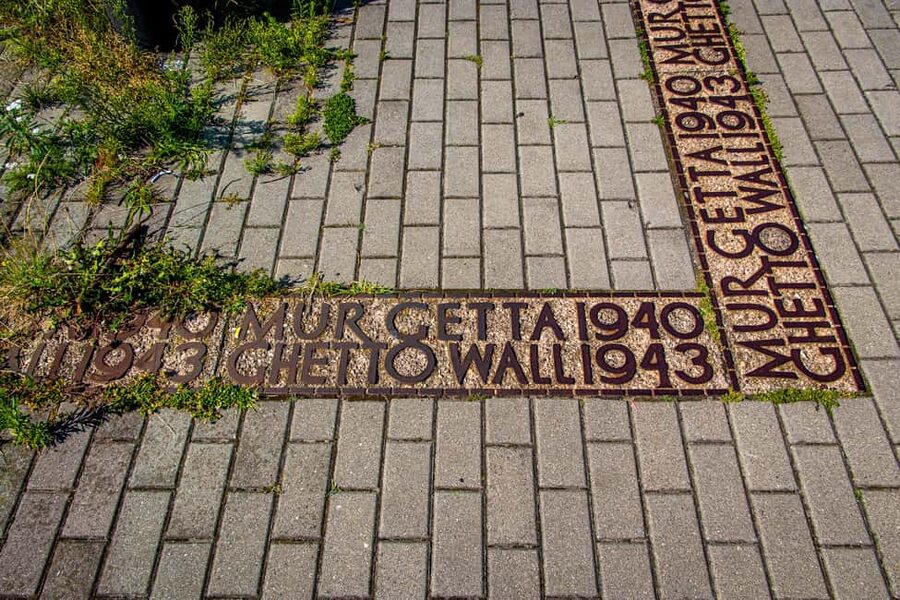
Warsaw’s Jewish past is not confined to a museum. It is under your feet, in broad streets, empty spaces, surviving walls, and places where the old city vanished. This 150-minute walking tour connects those fragments, moving from centuries of Jewish life to the Holocaust and the Warsaw Uprising.
I like the visit to Nożyk Synagogue, the only surviving pre-war synagogue in Warsaw, and the stop at the former bridge on Chłodna Street, where the two parts of the ghetto were once joined. The drawback is that you are outside for the entire tour, so cold weather can be tough, and entry into the synagogue is not guaranteed.
Key points at a glance
- Nożyk Synagogue: See Warsaw’s only surviving pre-war synagogue and place the city’s wartime story in a living religious setting.
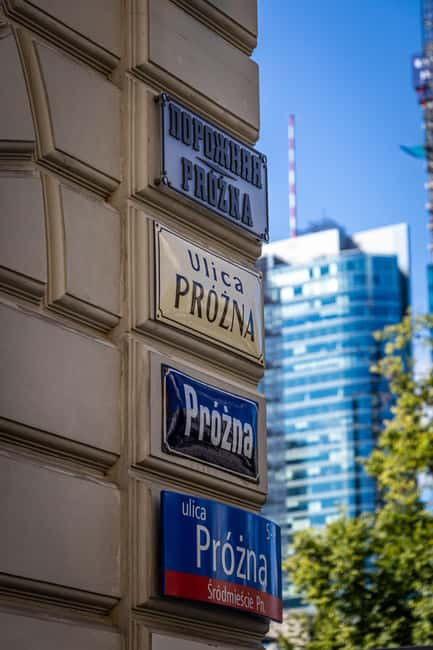
- Chłodna Street bridge: Learn how a raised footbridge once connected sections of the ghetto above the street.
- Waliców Street: Walk along a former ghetto border and hear how wartime events shaped this part of Warsaw.
- History before 1939: Understand Jewish life, politics, art, writing, and journalism before the destruction of the Holocaust.
- Guides with different strengths: Guides including Andrzej, Jacek, Aga, Anna, Christopher, Luke, and others have been praised for clear English, warmth, humor, and thoughtful handling of difficult subjects.
- Flexible booking: The $26 price includes the walking tour and guide, with free cancellation up to 24 hours before the start.
Why this walk matters in modern Warsaw
Before the Second World War, Warsaw was home to one of the largest Jewish populations in the world. The tour puts a human face on that fact. Instead of beginning with persecution alone, it explains how Jewish residents helped shape the city over many centuries.
You hear about Jewish participation in the life of Warsaw, including involvement in 19th-century struggles against occupying powers and Polish uprisings. That context matters. It shows a community that was not separate from the city, but deeply involved in its politics, culture, work, and daily life.
The interwar period receives special attention. Hundreds of Jewish artists, actors, writers, and journalists lived and worked in Warsaw, creating a cultural life unlike anything before or since. Hearing this before discussing the Holocaust gives you a clearer sense of what was destroyed. You are not simply learning how many people died. You are learning what kind of society was lost.
That is one of the tour’s strongest features. The story includes persecution, starvation, murder, resistance, and destruction, but it also includes creativity, courage, and survival. The guide’s job is difficult, and the best guides handle the subject without turning it into a dry lecture or an exercise in shock.
More Jewish Heritage Walks in Poland:
- Krakow: Kazimierz Jewish Quarter Walking Tour
★ 4.8 · 571 reviews - Krakow: Jewish Ghetto Walking Tour
★ 4.6 · 349 reviews - Krakow: Jewish Quarter Guided Walking Tour
★ 4.8 · 119 reviews
Meeting at Grzybowski Square
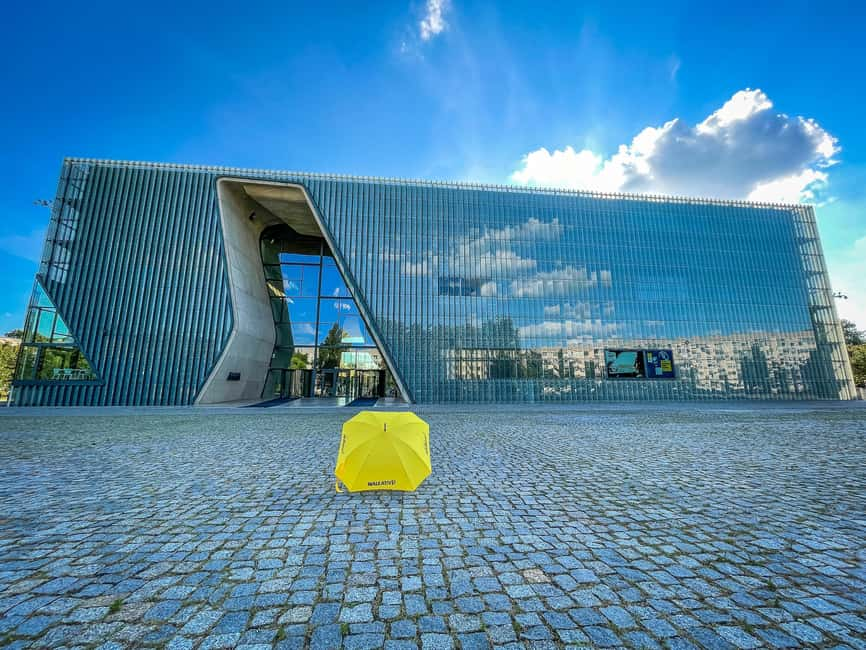
The tour begins beside All Saints Church at Grzybowski Square. Look for the yellow umbrella, an easy marker in a central part of Warsaw.
This is a general walking tour rather than a private outing. Your $26 covers the reservation fee and the guide’s payment. If you want a smaller private tour, you can contact Walkative Tours after booking and ask them to arrange one.
The meeting point is useful because Grzybowski Square itself helps set the scene. You are in an area tied closely to the history of Jewish Warsaw, yet modern Warsaw is all around you. The contrast between present-day streets and the vanished pre-war city becomes a recurring part of the walk.
Arrive ready to listen from the start. The group may include people with very different levels of background knowledge, and the guides generally explain the subject in accessible English. Guides such as Anna have been praised for speaking clearly, while Jacek, Luke, Aga, Andrzej, and Christopher have been singled out for their command of the subject and ability to answer questions.
Nożyk Synagogue and the Jewish city that survived
Nożyk Synagogue is the only surviving pre-war synagogue in Warsaw. That simple fact gives the building unusual weight. It is not just an architectural stop. It is a reminder of the religious and communal life that once filled the city.
The tour uses the synagogue as a way to discuss Jewish Warsaw before the war. You learn about a city with schools, newspapers, artists, political groups, religious institutions, and ordinary family life. The synagogue helps correct the common mistake of viewing Warsaw’s Jewish population only through the lens of the ghetto and the Holocaust.
One practical point is important: the tour includes seeing Nożyk Synagogue, but entering the building is not assured. Some people who joined the walk had hoped to go inside. If interior access matters to you, check current arrangements with the supplier rather than assuming it is part of the walk.
The surrounding streets also require imagination. Much of the pre-war Jewish quarter no longer exists in its old form. Your guide may use photographs, maps, and verbal description to show what stood where. One guide was specifically praised for bringing historical photographs and maps, which can make the missing buildings and altered streets easier to understand.
Chłodna Street and the bridge above the road
The stop at Chłodna Street explains how the Warsaw ghetto was divided. A bridge once crossed above the street, joining two sections of the ghetto while traffic continued below. Today, the physical bridge is gone. That absence is part of the lesson.
You will need to picture the structure from the guide’s explanation and any photographs or maps provided. This is not a stop where a grand monument does all the work for you. The value comes from connecting the ordinary modern street with the restrictions imposed on the people trapped there.
I find this kind of location especially useful for understanding how the ghetto functioned as a controlled space. The street was not merely a backdrop to events. It helped determine who could move, who could meet, and how separated communities remained connected.
The tour does not treat the ghetto as an abstract area on a map. It explains how the city was changed by force, how people lived under impossible conditions, and how the geography affected daily life. You may find that the lack of surviving structures makes the guide’s skill especially important here.
More Guided Tours in Poland:
- Gdańsk City Sights & History Guided Walking Tour in English
★ 4.8 · 876 reviews - Warsaw: Old Town Guided Walking Tour
★ 4.9 · 599 reviews - Krakow: Spooky Tales Guided Walking Tour
★ 4.6 · 164 reviews - Krakow: Old Town Guided Walking Tour
★ 4.6 · 94 reviews
Waliców Street and the Warsaw Uprising
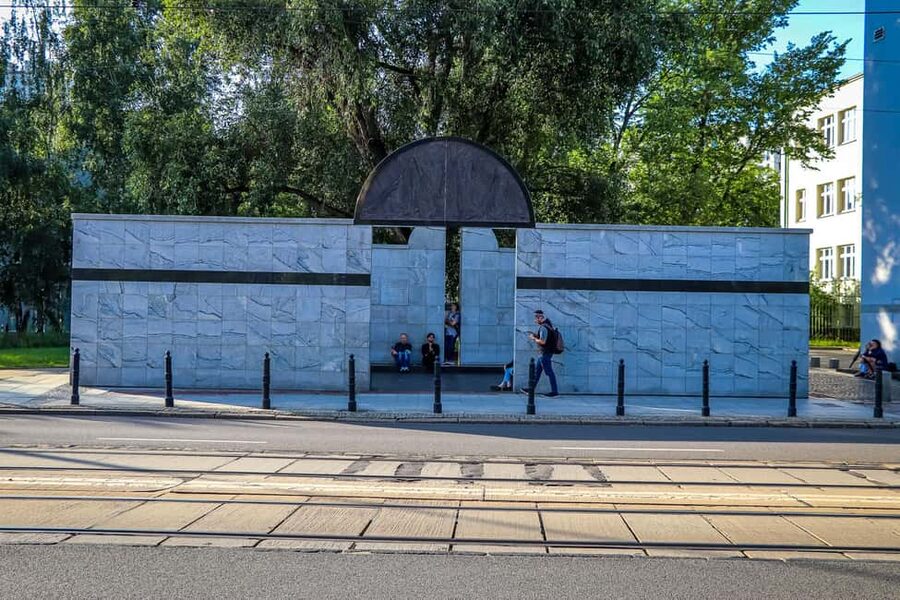
Waliców Street was once part of the ghetto border. Walking here adds another layer to the story because the street is also linked to Warsaw’s wartime resistance and the Warsaw Uprising.
The guide explains how the city’s Jewish history and Polish wartime history overlap without being identical. That distinction matters. The Holocaust, the Jewish uprising, the Warsaw Uprising, occupation, and postwar destruction are related chapters, but each has its own setting and meaning.
This section is useful if your knowledge of Warsaw begins and ends with the ghetto. You gain a wider view of the city’s wartime experience and the way different forms of resistance and suffering are remembered.
The tour also shows why a walking format works well here. You move through streets that now appear ordinary, while the guide points out how their roles changed over time. The surroundings may not offer a neat sequence of preserved buildings, but that forces you to pay attention to the city plan and to the evidence that remains.
From cultural achievement to destruction
A good guide needs to explain both the scale of Jewish life and the scale of its destruction. This walk gives the pre-war story enough space to make the later chapters meaningful.
You hear about artists, actors, writers, and journalists who made Warsaw a major center of Jewish culture during the interwar years. The point is not simply to list famous people. It is to show that Jewish Warsaw was creative, modern, argumentative, and connected to the wider life of the city.
Then the subject turns to the Second World War and Holocaust. The guides have been praised for being factual, direct, and compassionate. Several have also used humor carefully during the walking portions, helping the group stay focused during a long and difficult subject without making light of the suffering.
That balance will not suit everyone. This is an emotional tour, and the subject includes death, persecution, and brutal events. Some guides ask if the group wants to hear especially harsh details before continuing. If you prefer a gentler introduction to Warsaw, choose a different walking tour. If you want an honest account that does not soften the facts, this format is likely to suit you.
Resilience, resistance, and Jewish Warsaw today
The story does not end in 1945. The tour also considers the Jewish community in Warsaw today, presenting it as young, diverse, energetic, and hopeful about the future.
This ending keeps the walk from becoming a memorial visit only. You are encouraged to see Jewish Warsaw as a continuing part of the city, not just a vanished community. That perspective is important, especially after spending much of the tour looking at places shaped by loss.
The guides also leave room for questions. Edward noted that his guide stayed after the tour to continue answering questions, and several guides have been praised for welcoming discussion. That extra time can be valuable if you are tracing family connections, studying the history, or simply trying to sort out the different wartime events.
The experience is not a genealogy service, and you should not expect detailed family research. Still, the guides can help place personal questions within the larger story of Warsaw and Polish Jewish life.
Guide quality and the general group format
The strongest part of this experience is the guide. Names that appear in recent bookings include Andrzej, Jacek, Aga, Anna, Christopher, Luke, Tomasz, Olivia, Agnieszka, and Yatzic. The exact guide depends on the day, but the repeated strengths are clear: strong English, good command of Warsaw, a willingness to answer questions, and a serious approach to the subject.
Christopher was praised for linking landmarks across Warsaw and for explaining places that a separate ghetto tour had missed. Jacek received praise for his pace and engagement. Luke was appreciated for combining personal family experience with humor on a difficult subject. Anna used historical photographs to make vanished places easier to picture.
A large group can affect the experience. One person found it hard to hear because the guide sometimes walked ahead before finishing a sentence. Stay near the guide, especially at busy street crossings or when the group is spread out.
The tour is usually described as well paced, though some people wished it lasted longer. That is a fair criticism. Two and a half hours gives you a solid introduction, but Warsaw’s Jewish history could easily fill a full day. Think of this walk as a strong foundation, not the final word.
Weather, walking pace, and what to bring
You are outside for the entire two and a half hours. That is the main practical issue.
Winter conditions can be severe. A February group completed the walk in freezing weather, and a November group described the cold as intense. Dress for the forecast, wear comfortable shoes, and bring enough clothing to remain attentive while standing still for explanations.
There is no planned café break. One person specifically wished for a warm stop during a very cold outing. In mild weather, this is hardly an issue. In winter, it can make the difference between an absorbing experience and a physically uncomfortable one.
The pace is generally manageable. A group of four found it comfortable and said the time passed quickly. You should still expect regular walking and periods spent standing outdoors. If you want a slow, highly private visit with long pauses, ask about a private tour instead.
Is $26 good value?
At $26 per person, this is good value if you want a guided introduction rather than simply a list of locations. The price includes a live English-speaking guide and a 150-minute walk through some of the most important places connected with Jewish Warsaw.
You are paying for interpretation. Several locations no longer look as they did before the war, and some important structures are gone altogether. Without explanation, Chłodna Street or a former ghetto border can be easy to pass without understanding. A strong guide supplies the missing context.
The value is also practical. You can ask questions, learn how the pre-war community fit into Warsaw, and get suggestions for further places to see. Guides have also offered general Warsaw tips, including food and coffee recommendations.
The price is less attractive if you expect extensive museum entry, private attention, or a tour lasting most of the day. No hotel pickup is included, and synagogue entry is not guaranteed. For a focused introduction in English, though, the cost is reasonable.
Who should book this walking tour?
I would recommend it to first-time visitors who want to understand Warsaw beyond its rebuilt Old Town and modern center. It also suits people with Jewish family connections, visitors interested in the Holocaust, and anyone who wants a serious introduction before visiting other museums or memorial sites.
It works well for people with little prior knowledge because the guides explain the basic story clearly. It also has value for people who already know the subject, since the walk connects individual streets and sites in a way that books and museum exhibits cannot always do.
You should think twice if you dislike emotionally difficult history, struggle with extended outdoor walking, or need guaranteed access to synagogue interiors. You may also prefer a private tour if you want to move at your own pace or ask detailed personal questions.
Booking is flexible, with free cancellation up to 24 hours before the start and the option to reserve now and pay later. That is useful when Warsaw is only one stop on a longer trip and the weather forecast remains uncertain.
Should you book it?
Book this tour if you want a thoughtful, place-based account of Jewish Warsaw that covers both the life that existed before the war and the destruction that followed. The best guides make the missing buildings, former borders, and ordinary streets meaningful.
Choose a warmer season if you dislike cold, stay close to the guide in a large group, and do not assume that Nożyk Synagogue entry is included. At $26, it offers a strong first look at Warsaw’s Jewish past and present, especially for anyone who values clear explanation over a hurried checklist of sights.
FAQ
How long is the Jewish History Guided Walking Tour?
The tour lasts 150 minutes, or two and a half hours.
What language is the tour conducted in?
The live tour guide speaks English.
Where is the meeting point?
Meet next to All Saints Church at Grzybowski Square. Look for a yellow umbrella.
What places are included on the walking tour?
The walk includes Nożyk Synagogue, the site of the former bridge on Chłodna Street, and Waliców Street. It also covers Jewish life in Warsaw, the Holocaust, and the Warsaw Uprising.
Is hotel pickup included?
No. Hotel pickup and drop-off are not included.
Can I enter Nożyk Synagogue during the tour?
The tour includes seeing Nożyk Synagogue, but entry is not guaranteed. Check with the supplier if going inside is important to you.
Is this a private tour?
No. The tour joins a general walking tour. You can contact Walkative Tours after booking if you want to arrange a smaller private tour.
What does the $26 price include?
The price includes the local guide and walking tour. It covers the reservation fee and the guide’s payment.
Can I cancel the booking?
Yes. You can cancel up to 24 hours in advance for a full refund. You can also reserve now and pay later.
Just added around Poland
- Discover Gdansk Walking Tour★ 5.0 · 495 reviews
- Krakow: Jewish Quarter Guided Walking Tour★ 4.8 · 119 reviews
- Szczecin: Old Town Highlights Private Walking Tour★ 4.7 · 76 reviews
- Krakow: Old Town Guided Walking Tour★ 4.6 · 94 reviews
- Old Town Poznan: Guided Walking Tour in English★ 4.6 · 78 reviews
- Krakow: Old Town Highlights Walking Tour★ 4.5 · 173 reviews
- Krakow: 2h Kazimierz (Jewish Quarter) Walking Tour★ 4.5 · 75 reviews
- Krakow: Street Food Walking Tour★ 4.8 · 285 reviews
Jewish Heritage Walking Tours, compared.

Amsterdam Anne Frank: Small-Group Walking Tour & Local Guide
Read our review →
Anne Frank’s Story – Guided Walking Tour through Amsterdam
Read our review →
Jewish Quarter Walking Tour with Admission Tickets
Read our review →
Anne Frank Guided Walking Tour in DE/EN/IT/ES
Read our review →
Old Town and Jewish Quarter Guided Walking Tour
Read our review →
Anne Frank Walking Tour Amsterdam Including Jewish Cultural Quarter
Read our review →
Anne Frank’s Last Walk & See Anne Frank House in Virtual Reality
Read our review →Browse the lists this tour appears in