
REVIEW · GLASGOW
Glasgow: Gander Walking Tour
Glasgow reveals itself through jokes, old stones, grand civic buildings, and the sharp-eyed local who knows what most passersby miss. On this three-hour walk, Johnny leads you from Royal Exchange Square to Glasgow Cathedral, mixing city history with stories about food, music, ghosts, politics, and daily life.
I like the way Johnny’s love for Glasgow drives the tour without turning it into a lecture. I also like the practical follow-up: he answers questions about pubs, museums, parks, day trips, and places to eat, then can send a long list of suggestions suited to your interests and schedule.
The main consideration is pace. You cover a lot of central Glasgow in three hours, and the route includes a slightly hilly stretch. The tour is listed as wheelchair accessible, but anyone who prefers a slow, stop-and-stare walk should know this is an active city orientation.
Key points to know before you book
- Start at Royal Exchange Square: Meet outside Costa Coffee beside the Gallery of Modern Art, not at George Square.
- Johnny is the heart of the walk: His local stories connect Glasgow’s buildings with present-day city life.
- Thirteen stops cover a compact but rewarding route: Expect major sights, street art, old lanes, civic buildings, and overlooked interiors.
- The Duke of Wellington comes with a cone: You will hear why this cheeky local tradition matters to Glasgow.
- A music venue visit may be included: Entry to an antique music venue depends on whether it is open.
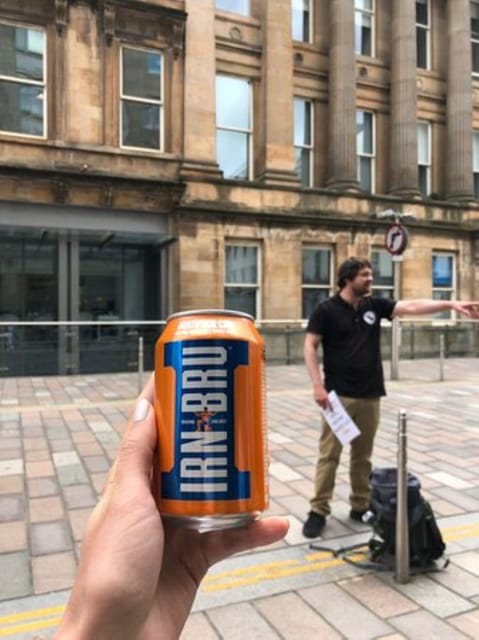
- You get useful extras: The tour includes a taste of a Scottish soft drink and practical recommendations for the rest of your stay.
Starting with Mother Glasgow in Royal Exchange Square
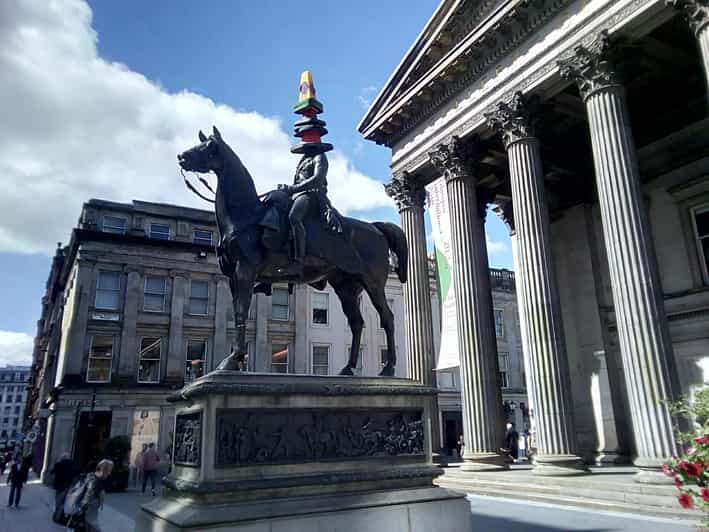
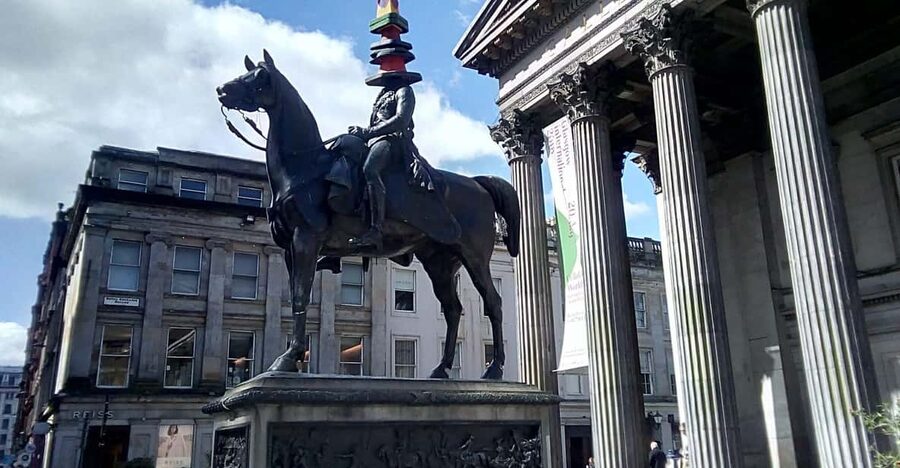
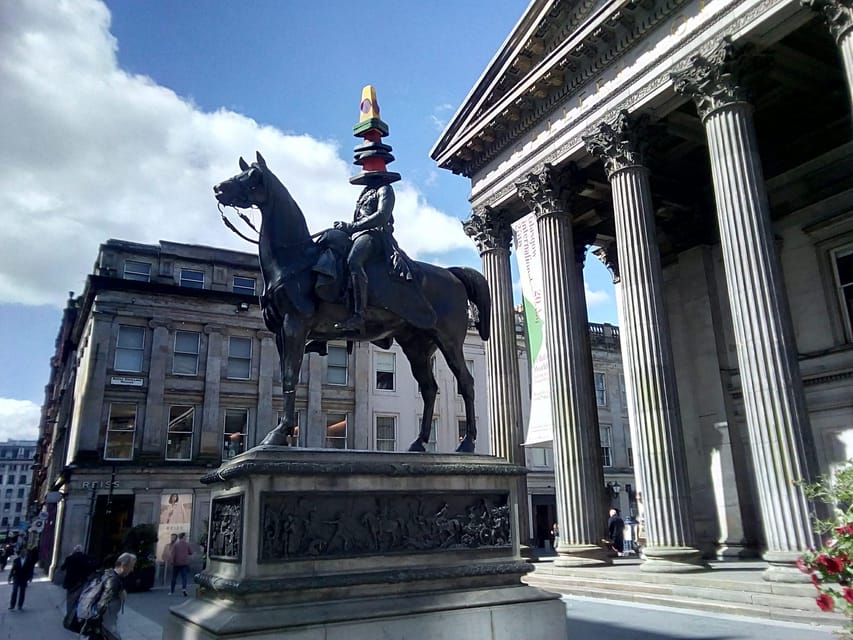
The tour begins outside Costa Coffee in Royal Exchange Square, beside the Gallery of Modern Art and the statue of the man on horseback wearing a traffic cone. Look for Johnny in a black and white Glasgow Gander shirt or jacket.
This meeting point matters because George Square is a different place. It is easy to go to the wrong square if you are following a general Glasgow map, so give yourself enough time to reach Royal Exchange Square.
Johnny introduces Glasgow as Mother Glasgow, a city with a strong personality and a habit of laughing at itself. That tone shapes the whole walk. You are not simply moving from one famous building to another. You are being shown how Glaswegians think about their city, its past, its odd habits, and its stubborn character.
A few more walking tours around Glasgow worth a look
- Glasgow City Centre Walking Tour with Local Guide
★ 5.0 · 1,326 reviews - Glasgow: City Center Guided Walking Tour
★ 4.7 · 1,076 reviews - Glasgow: Ghouls, Ghosts & Gruesome Tales Guided Walking Tour
★ 4.9 · 887 reviews
The cone-topped Duke of Wellington
The first big photo stop is the Duke of Wellington statue, one of Glasgow’s most recognizable sights. The cone on the Duke’s head is not an official decoration. It is part of a long-running local joke, and Johnny explains the story behind it and the way the city treats the tradition.
This is a small example of what makes the tour useful. You could photograph the statue in seconds and move on. Instead, you learn how a monument tied to military power became part of Glasgow’s everyday humor. The stop also gives you a quick lesson in the city’s independent spirit.
You will hear the story while standing in an active part of the city centre, so this is not a silent monument visit. The appeal is the connection between public art, local behavior, and civic identity.
Buchanan Street and Glasgow’s political voice
The walk continues along Buchanan Street, the main shopping thoroughfare often described as Britain’s best outside London. Even if shopping is not on your Glasgow list, the street helps you understand the city’s scale and confidence.
Johnny also tells the story of Glasgow’s opposition to apartheid South Africa. This adds political weight to what might otherwise seem like a standard retail street. The point is not just what shops are here, but how Glasgow used its public spaces and civic voice to take a position on a major international issue.
This section works well early in your visit. You get a sense of how modern Glasgow presents itself, while also hearing about the city’s habit of taking part in wider debates.
George Square and the rooftop ship
George Square is the formal civic centre of Glasgow, framed by monuments and the imposing City Chambers. Johnny draws your attention to the architecture, including details you might miss if you were simply crossing the square.
One playful feature is the rooftop ship. It is the sort of small visual detail that rewards looking up. The City Chambers itself is a major highlight, with an ornate exterior that reflects Glasgow’s civic ambition during its period of industrial growth.
The square can feel grand and open, which makes it a good pause after the busier shopping streets. Johnny uses the space to connect architecture with the city’s development rather than treating the buildings as isolated sights.
Same streets, a different route:
- Glasgow Street Art Daily Walking Tour: 2pm
★ 5.0 · 648 reviews - Gander Walking Tours in Glasgow
★ 5.0 · 506 reviews - Gothic Glasgow Walking Tour
★ 5.0 · 448 reviews - Glasgow: Street Art Guided Walking Tour
★ 4.8 · 385 reviews
Trades Hall and an unusual Georgian story
Glasgow’s Trades Hall receives less attention than the City Chambers, but it adds another layer to the route. This Georgian building is linked to the city’s old trade organizations and civic life.
Johnny also tells the strange story of a club where gluttony was celebrated. It is a memorable way to bring social history to life, especially if you enjoy stories about how people actually behaved rather than only hearing dates and architectural labels.
This stop also shows the tour’s balance. You get grand façades, but you also get eccentric details. The unusual story gives the building a human edge.
An Art Deco interior most people miss
The tour includes a stop at the only public Art Deco interior in Glasgow city centre. The interior adds a welcome change from the stone façades and Victorian architecture that dominate many central streets.
Access can depend on opening conditions, so do not treat this part as guaranteed in the same way as an outdoor stop. Still, the possibility of stepping inside is valuable. It gives you a look at Glasgow’s architectural variety and helps explain why the city rewards repeat visits.
The attraction here is not simply a pretty room. It is the contrast between Glasgow’s older commercial buildings and its later design styles. Johnny points out the kind of detail that is easy to miss when you are hurrying between major sights.
Hutcheson’s Hall and the making of industrial Glasgow
At Hutcheson’s Hall, Johnny explains how Glasgow changed from a commercial centre into an industrial powerhouse. The building and its setting help frame that change.
This is one of the more important historical sections because Glasgow can be misunderstood if you see only its grand civic architecture. The city’s fortunes were built through trade, manufacturing, engineering, and the work of its people. Johnny links the buildings you see with the forces that reshaped Glasgow.
The information comes with the guide’s own local connection, rather than as a detached classroom talk. Several reviews describe his delivery as lively and easy to follow, including for visitors who do not speak English as their first language.
Trongate, an old road with a surprise inside
Trongate is one of Glasgow’s ancient thoroughfares. The route here moves through a part of the centre where old stories and current city life sit close together.
Johnny shares the tale of a remarkable entertainment venue hidden within this area. Entry is subject to availability, so the inside visit may not happen every time. If it is open, it adds a memorable change of pace and offers a glimpse into Glasgow’s music culture.
The tour includes free entrance to an antique music venue when access is possible. That detail adds real value to the $16 price, although you should think of it as a bonus rather than a fixed part of the experience.
Glasgow Cross and the Tolbooth Steeple
At Glasgow Cross, you stand beneath the Tolbooth Steeple, a surviving 17th-century structure at the centre of old Glasgow. This is where the city’s earlier street plan and later growth come together.
Johnny uses the steeple to explain what Glasgow was like before its industrial expansion. The stop gives you a stronger sense of the old city, rather than presenting Glasgow as a collection of grand 18th and 19th-century buildings.
You will also notice that the route moves from the polished centre toward areas with older, more layered streets. This change helps you read the city as a place that grew over time instead of being built all at once.
High Street, street art, and a fried recommendation
High Street is one of Glasgow’s main ancient routes. Here, Johnny points out a striking face with a large story behind it and recommends a classic deep-fried Scottish food to try.
The food suggestion is one of the tour’s practical touches. You are not only collecting facts for a notebook. You are getting ideas for what to eat and do after the walk. Johnny’s recommendations cover different budgets, interests, and time limits, so you can ask for help instead of relying on a generic list.
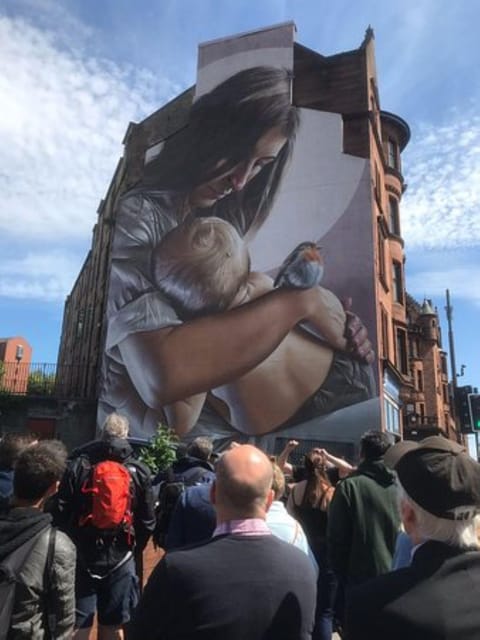
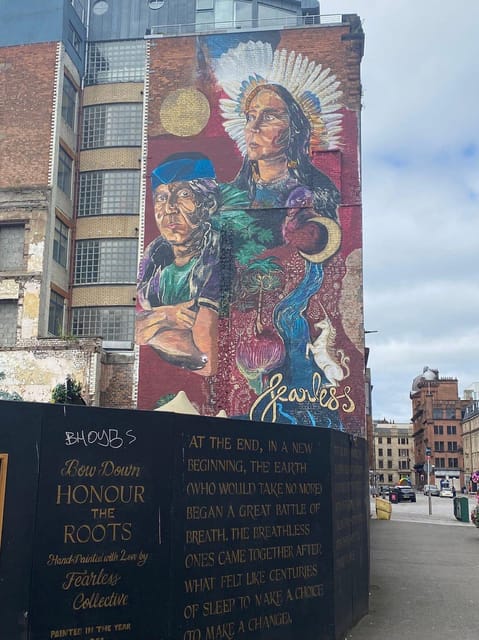
Nearby, the High Street mural features one of Glasgow’s most famous sons. The artwork is cleverly placed, and you might pass it without seeing the detail. Street art is part of what makes Glasgow feel current, and this stop keeps the tour from becoming only a march through old buildings.
Provand’s Lordship and Glasgow’s oldest house
Provand’s Lordship is Glasgow’s oldest house, dating from the 15th century. It is one of the most important surviving reminders of the medieval city.
Johnny also points out four unusual buildings nearby. One is rumored to assist with inter-dimensional travel, which gives the stop the playful edge that runs through the tour. You get serious architectural context, then a story that makes you look twice.
The surrounding area is useful for understanding how much of Glasgow’s early identity is concentrated around the cathedral precinct. If you plan to return on your own, this is an area worth allowing extra time for, since the tour gives you the orientation but does not stop for a long museum visit.
Finishing at Glasgow Cathedral and the Necropolis
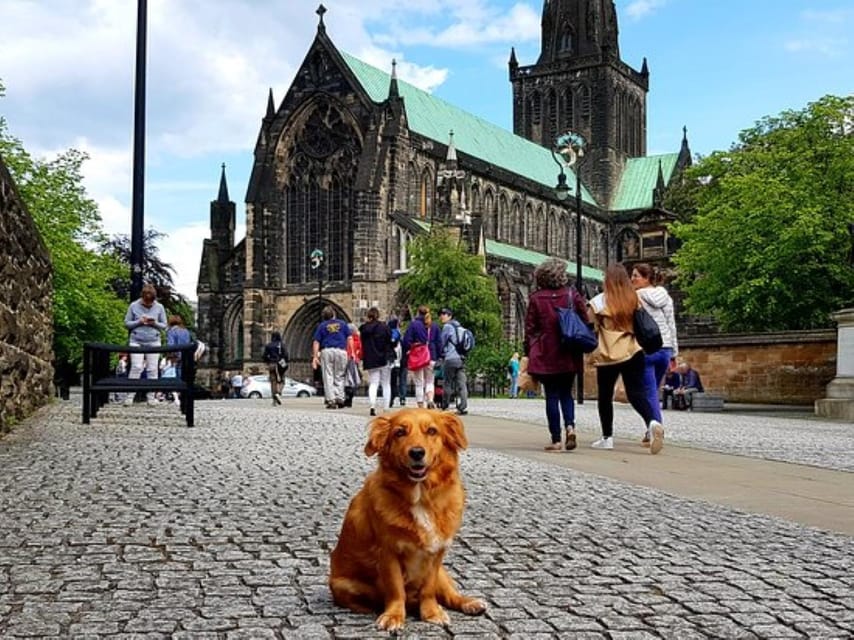
The final stop is Glasgow Cathedral, a major medieval Scottish Gothic building framed by the Victorian Necropolis, known as the city of the dead. It is a strong ending because it brings together religion, architecture, burial customs, and Glasgow’s long timeline.
The cathedral gives the walk a sense of arrival. You begin in a modern commercial square and finish among some of the city’s oldest structures. Along the way, you have seen civic buildings, shopping streets, murals, entertainment spaces, and industrial-era reminders.
The Necropolis is visible from the cathedral area, but this tour does not promise a full walk through it. If you want to explore the cemetery, plan a separate visit. The walk gives you the setting and the story, then leaves you with a clear idea of where to continue.
What Johnny adds to the three-hour format
Johnny’s strongest feature is his ability to link facts with local feeling. He talks about Glasgow’s past, but he also explains what the city is like now and where you might spend your evening.
I would book this near the start of your Glasgow stay. You can ask about museums, pubs, parks, day trips, food, and family activities, then use the advice during the rest of your visit. He has also sent detailed recommendations after the tour, including suggestions shaped around children, limited time, and specific interests.
The three-hour length is a real advantage if you want more than a quick introduction. The route keeps moving, but stops come often, so you are not walking for long stretches without context. One section is slightly hilly, and the tour can be affected by wet or cold weather, so wear suitable shoes and a waterproof layer.
The listed accessibility is encouraging, but you should still contact the provider if you have particular mobility needs. Central Glasgow includes old streets and varied surfaces, and the route is described as active rather than entirely flat.
Is $16 good value for Glasgow?
At $16 per person, this is an easy tour to justify if you want a broad introduction to the city. You receive three hours with a local guide, a route covering major sights and less obvious details, a Scottish soft drink taste, and possible entry to an antique music venue.
The biggest value comes after the tour. A good city walk saves you time by showing you what deserves a second look. Johnny’s recommendations can help you choose a museum, pub, meal, park, or day trip with more confidence.
The price is especially fair for a first visit or a short stay. If you have only 24 to 48 hours in Glasgow, the tour helps you build a plan quickly. If you already know the centre well, you may still enjoy the stories, but the practical orientation will be less essential.
Who will enjoy this Glasgow walking tour?
I would choose this tour for:
- First-time visitors who want an overview before choosing their own sights
- People with only a day or two in Glasgow
- Visitors who like architecture, local stories, politics, food, and music in one walk
- Families who want recommendations suited to children
- Returning visitors who enjoy overlooked details and city folklore
- Anyone who prefers a personal guide to a recorded audio route
You may want something else if you dislike a fast-moving itinerary or want long interior visits at each attraction. This is a city orientation with plenty of stops, not a series of extended museum tours.
The English-language commentary is the only language option listed. Several people found Johnny easy to follow, but you should be comfortable listening to English for three hours.
Booking details that matter
The meeting point is outside Costa Coffee in Royal Exchange Square, next to the Gallery of Modern Art and the cone-topped equestrian statue. Look for the black and white Glasgow Gander clothing.
The tour lasts three hours and runs at scheduled starting times shown during booking. It is led in English and is listed as wheelchair accessible. Cancellation is free up to 24 hours before departure, and you can reserve now and pay later, which helps if your Glasgow plans are still shifting.
Because the music venue visit depends on opening conditions, treat it as an added possibility. The outdoor route and city commentary are the core experience.
Should you book the Glasgow Gander Walking Tour?
Yes, if you want a friendly, story-led introduction to central Glasgow and useful advice for the rest of your stay. Johnny’s enthusiasm, humor, and local knowledge give the walk its character, while the route covers enough architecture, street art, politics, music, and food to feel substantial.
Book it early in your visit, especially if you have limited time. You will leave with a better map of the city and a long list of ways to spend your remaining hours. Just bring weatherproof clothing, expect a steady pace, and remember that the music venue stop depends on access that day.
FAQ
Where does the Glasgow Gander Walking Tour begin?
It begins outside Costa Coffee in Royal Exchange Square, beside the Gallery of Modern Art and the statue of the man on horseback with a cone on his head. It does not begin at George Square.
How long does the tour last?
The walking tour lasts three hours.
What language is the tour conducted in?
The live tour is conducted in English.
Who leads the tour?
The tour is led by Johnny, a local Glasgow guide associated with Glasgow Gander Walking Tours.
What places does the route visit?
The route includes Royal Exchange Square, the Duke of Wellington statue, Buchanan Street, George Square, Trades Hall, an Art Deco interior, Hutcheson’s Hall, Trongate, the Tolbooth Steeple, High Street, the High Street mural, Provand’s Lordship, and Glasgow Cathedral.
Is entry to a music venue included?
Free entry to an antique music venue is included when the venue is open. Access is subject to availability.
Is a drink included?
Yes. The tour includes a free taste of a quintessential Scottish soft drink, and it is non-alcoholic.
Is the tour wheelchair accessible?
The activity is listed as wheelchair accessible.
Can I cancel the booking?
Yes. You can cancel up to 24 hours in advance for a full refund. You can also reserve and pay later.
Just added around Glasgow
- Merchant City Music Walking Tour of Glasgow★ 5.0 · 94 reviews
- Stirling Castle, Loch Lomond Walk & Whisky Distillery Tour from Glasgow★ 5.0 · 79 reviews
- Walking Tour of Glasgow★ 5.0 · 96 reviews
- Gothic Glasgow Walking Tour★ 5.0 · 448 reviews
- Glasgow: Pubs & History Walking Tour with Beer Tasting★ 5.0 · 81 reviews
- Glencoe, Scenic Walk & Highlands Guided Tour starting Glasgow★ 5.0 · 121 reviews
- Gander Walking Tours in Glasgow★ 5.0 · 506 reviews
- Glasgow: The streets with a Glaswegian guide: Walking Tour★ 4.5 · 210 reviews
Walking Tours, compared.

Magical London: Harry Potter Guided Walking Tour
Read our review →
Reykjavik Food Walk – Local Foodie Adventure in Iceland
Read our review →
History and Hauntings of Salem Guided Walking Tour
Read our review →
New Orleans Premier Ghost, Voodoo and Vampire Walking Tour
Read our review →
Amsterdam Anne Frank: Small-Group Walking Tour & Local Guide
Read our review →

Edinburgh Castle: Guided Walking Tour with Entry Ticket
Read our review →
Anne Frank’s Story – Guided Walking Tour through Amsterdam
Read our review →Browse the lists this tour appears in