
REVIEW · BUDAPEST
Jewish Quarter of Budapest Walking Tour
Budapest’s Jewish Quarter is a place where painful history and modern city life share the same streets. This 90-minute walk connects the three synagogues of the Jewish Triangle with stories of Hungarian Jewish life, the Holocaust, the Righteous Gentiles, urban art, and today’s ruin-bar scene.
I like the personal storytelling and the way the tour links the past to places you can still use today. I also like the practical finish at a local ruin bar, often Szimpla, where you can continue exploring after the guide leaves. The main consideration is that you do not enter the synagogues, and the tour requires upper-intermediate English.
Key points to know before booking
- Three synagogues from the outside: The route introduces the Jewish Triangle, but synagogue entry is not included.
- Serious history with a human focus: Expect stories about Hungarian Jews, wartime persecution, and the Righteous Gentiles.
- A useful modern ending: The walk finishes at a local pub or ruin bar, giving you an easy first taste of Budapest nightlife.
- Strong guide reports: Guides including Judit, Judith, Ester, Gary, Dora, Emmy, Edith, Ursula, Andy, and others are praised for clear storytelling and thoughtful answers.
- Low booking fee, separate tip: The listed price is $2.27 per person, but guides rely on donations, with €10 per person suggested as a common tip.
- Small-group restriction: Groups of eight or more cannot book, even if they reserve separately.
Starting beside the Budapest Eye
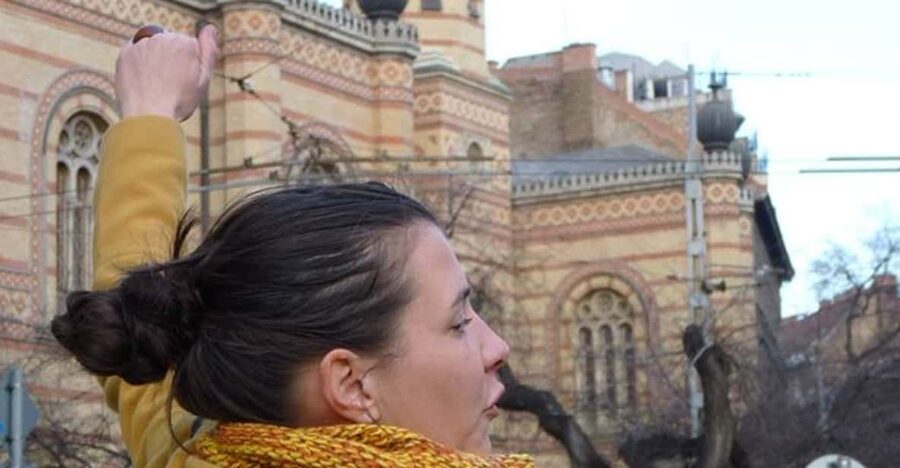
The meeting point is next to the fountain by the Budapest Eye ferris wheel. Look for the guide holding a royal blue flag. This is a central place to begin, but the open square can be busy, so arrive with enough time to spot the flag and gather with the group.
The tour returns to the same general meeting point at the end. That makes the walk simple to fit into a first day in Budapest, especially if you are staying in the central districts or planning to visit the Jewish Quarter later that evening.
The walk lasts about 1.5 hours. That is long enough to build a clear picture of the area without taking over your day. One practical point: the experience is in English, and upper-intermediate English is essential. The guide deals with difficult historical subjects, names, dates, and social context. If you usually need captions or frequent translation, this may move too quickly.
The tour is listed as wheelchair accessible. Still, this is a walking route through a busy historic district, so it is sensible to ask the operator about the exact street conditions if you need detailed accessibility information.
More Jewish Heritage Walks in Budapest:
- Budapest Jewish Heritage Memorial Walking Tour & Synagogue Entry
★ 5.0 · 568 reviews - Budapest City Walk in Jewish Quarter
★ 5.0 · 218 reviews - Budapest: Jewish History Guided Walking Tour with Historian
★ 4.8 · 205 reviews
The Jewish Triangle and three synagogues
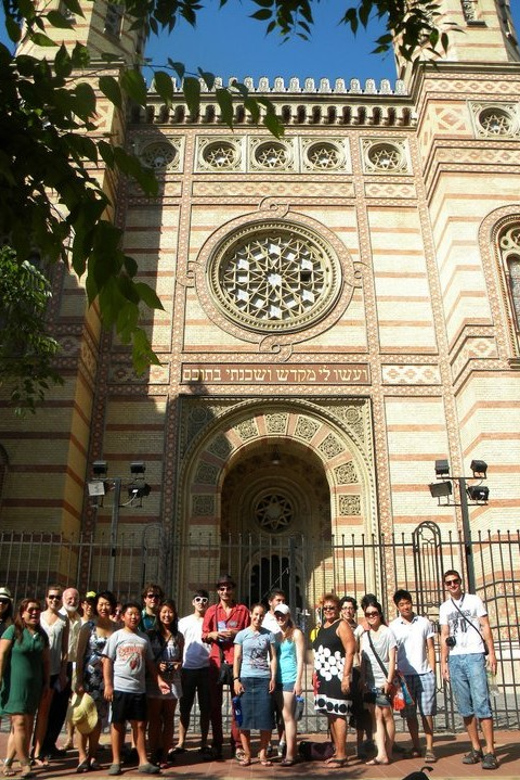
The central idea of the walk is the Jewish Triangle, formed by three synagogues in Budapest’s Jewish Quarter. You learn how these places fit into the district and the wider story of Jewish life in Hungary.
The tour does not enter the synagogues. That matters if your main goal is to see their interiors, religious objects, or architectural details. You can visit them separately, but admission is not part of this experience and any entry fee would be additional.
As a walking introduction, the outside views still have value. The guide can place each building within the streets around it, explain why the area became a center of Jewish life, and show how the district has changed over time. You are not simply ticking off three religious buildings. You are learning how faith, family, trade, war, memory, and city redevelopment shaped this part of Budapest.
I would treat this tour as a strong orientation rather than a substitute for synagogue visits. If you want to spend time inside each building, set aside another part of your schedule. The walk gives you the context that can make those later visits more meaningful.
Hungarian Jewish life before the war
A major strength of this experience is its attention to people, not only dates and monuments. The guide discusses Hungarian Jews and the role they played in the life of Budapest. The material can be serious, and at times heartbreaking, but it is presented through personal stories rather than a dry list of events.
This part is especially useful because many visitors know the broad outline of wartime persecution but have less sense of what everyday Jewish life in Budapest looked like before the Second World War. The tour gives you a starting point for understanding the community as a living part of the city, not only as a subject connected to tragedy.
One small limitation is that the 90-minute format cannot cover everything. If your main interest is detailed pre-war daily life, you may want to ask questions during the walk and continue with a museum or synagogue visit afterward. The guide can also point you toward other things to see and do in Budapest.
The best guides keep the tone balanced. Edith, for example, is praised for a clear speaking voice, careful preparation, and a compassionate manner. Judit is repeatedly singled out for explaining difficult subjects clearly while making time for questions. Those qualities matter here. A rushed or theatrical guide would weaken the subject; a calm storyteller gives it the care it needs.
The Righteous Gentiles and wartime memory
The story also includes the Righteous Gentiles, non-Jewish people who helped Jews during the Holocaust. This broadens the walk beyond victims and perpetrators and shows the moral choices individuals faced under extreme pressure.
You should expect the tone to shift between historical explanation and personal testimony. Several guides are praised for handling the difficult material with respect. Gary is described as energetic and passionate while still answering questions fully, and one guide is specifically praised for relating to the subject with care.
That combination is important. The tour is not designed as light entertainment, even though it also covers modern Budapest. It asks you to pay attention and listen. Families with older children may find it useful, but very young children could struggle with the subject matter and the need to remain quiet while the guide speaks.
The route also uses hidden symbols and lesser-known stories. The exact details can vary by guide, but you may hear about small signs, memorial references, and details that are easy to miss when walking alone. This gives the streets another layer after the tour. You begin to look more closely at walls, buildings, and small public artworks.
A few more walking tours around Budapest worth a look
- Budapest: Buda Castle Walk with Saint Stephen’s Hall
★ 4.5 · 3,012 reviews - Big Bus Budapest Hop-On Hop-Off Bus and Walking Tour
★ 3.5 · 2,206 reviews - Budapest: Buda Castle District Walking Tour
★ 4.6 · 2,108 reviews - Budapest City Landmarks Walking Tour in 2 Hours
★ 5.0 · 2,048 reviews
From wartime history to urban art
The Jewish Quarter is not frozen in the past. The walk connects its historical identity with Budapest’s modern urban-art scene and the small miniature statues scattered around the city. One guide uses these details to explain how Budapest tells stories in public spaces.
This is one of the tour’s better ideas. The city’s past is not confined to a museum, and its current creative life does not erase what came before. Street art, old buildings, nightlife, and memorials sit close together. The guide helps you read those contrasts instead of treating them as unrelated attractions.
You might find the shift from Holocaust history to street art abrupt, but it reflects the district itself. The Jewish Quarter is used, renovated, photographed, and enjoyed as a nightlife center while still carrying painful memories. A good guide makes that tension clear without turning the area into a backdrop.
The urban-art section also gives the tour a lighter rhythm. After an intense historical explanation, a story about a miniature statue or a local design detail can give the group a pause. Guides such as Emmy are praised for combining humor with clear information, which suits this change of tone.
Finishing at a Budapest ruin bar
The final stop is a local pub, usually described as a ruin bar, and several guides finish at Szimpla. This is more than a convenient place to end. It shows you how the Jewish Quarter functions today, especially after dark.
Ruin bars occupy old buildings and courtyards and are part of Budapest’s well-known nightlife. The tour introduces that culture before the evening crowds become heavy. One guide is praised for ending at the bar early enough to make a comfortable visit possible, while another helped a visitor find a place they would not have discovered alone.
You do not have to stay for a drink, but the ending is practical. You can ask the guide for suggestions about restaurants and bars, then continue on your own. Gary, Dora, and other guides are praised for offering useful recommendations beyond the route.
The contrast can feel sharp: you have just heard about persecution and survival, then you arrive at a playful, crowded ruin bar. That contrast is worth thinking about rather than treating as a flaw. The district is both a site of memory and an active neighborhood. The tour gives you a way to see both sides in one outing.
Guide quality and the style of the walk
The guide makes a large difference on this experience. Names praised in the available guide feedback include Judit and Judith, Ester, Gary, Dora, Emmy, Edith, Ursula, and Andy. The comments consistently point to clear English, strong preparation, warmth, energy, and a willingness to answer questions.
Judit is especially noted for making regular pauses, explaining the sites clearly, and sharing suggestions for food and other places to visit. Ester is praised for telling stories well and holding attention, while Gary is described as friendly, lively, and able to explain both Jewish history and wider Hungarian history.
The best fit for you is a guide-led walk rather than a self-guided audio route. You can ask about details that catch your attention, and the guide can adjust the explanation to the group. The tradeoff is that the quality and personality may vary slightly between departure times.
This is not a formal private tour. The group-size rule is important: parties of eight or more may not book, even when people try to reserve separately. That restriction helps keep the experience manageable and protects the conversational feel of the walk.
What the price really means
The booking price is listed as $2.27 per person. That is not the full amount you should budget. The fee is an administrative and marketing charge that reserves your place and does not go to the guide.
The guides depend on donations at the end. A tip of about €10 per person is suggested, though you choose the amount. At that level, the real cost is closer to a normal paid walking tour, but you are still paying after you have seen the quality of the experience.
I like this arrangement when the tour delivers clear value, because you can judge the guide first. You should also understand the tradeoff: the low advertised price can make the experience look almost free, while the guide’s income depends on your donation. Budget for the suggested tip rather than assuming the booking fee covers the tour.
For the money, the experience offers a lot if you want historical context, a central walk, and practical nightlife advice in one session. It offers less value if you mainly want synagogue interiors or a specialist architectural tour.
Who should book this walk
I would recommend it to first-time visitors who want to understand the Jewish Quarter before exploring it independently. It also suits anyone interested in Hungarian Jewish history, Holocaust memory, Budapest street art, or ruin bars, provided they are comfortable with a serious subject.
It works well early in your stay. You finish with a better sense of where to eat, drink, and walk at night, and the guide may suggest places that fit your interests. The return to the original meeting area also makes it easy to continue elsewhere in central Budapest.
You should think twice if you do not speak upper-intermediate English, need a fully indoor route, or want to see synagogue interiors during the tour. Families with toddlers may manage the walk only if children can remain quiet in a stroller, since the guide needs to speak clearly and the subject requires attention.
Cancellation is free up to 24 hours before the start, and you can reserve now and pay later. Those terms help if your Budapest schedule is still changing.
Should you book the Jewish Quarter Walking Tour?
Yes, if you want a well-paced introduction to Budapest’s Jewish Quarter that treats the past with care and also explains the district’s present-day nightlife. The strongest parts are the personal storytelling, the discussion of the Righteous Gentiles, the three-synagogue route, and the useful finish at a ruin bar.
Book it with the right expectations. You will walk past the synagogues rather than enter them, and the $2.27 booking fee is separate from the guide’s suggested €10 donation. If you can follow detailed English and want history mixed with practical local advice, this is a good-value way to get your bearings in one of Budapest’s most layered districts.
FAQ
How long does the Jewish Quarter walking tour last?
The tour lasts approximately 1.5 hours. Starting times vary, so you need to check availability when booking.
Where does the tour start?
Meet beside the fountain at the Budapest Eye ferris wheel. The guide will be holding a royal blue flag.
Where does the tour finish?
The activity returns to the meeting point area. The tour also ends at a local pub or ruin bar as part of the experience.
Does the tour enter the synagogues?
No. The tour visits the three synagogues of the Jewish Triangle from the outside. You can visit the synagogues separately.
What language is the tour in?
The tour is conducted in English. Upper-intermediate English is essential so you can follow the guide and the historical explanations.
Is the tour wheelchair accessible?
Yes, the activity is listed as wheelchair accessible.
How does the payment work?
The listed price is a $2.27 booking fee per person. This fee covers administration and marketing and does not go to the guide. Guides rely on donations, with about €10 per person suggested.
Can a group of eight or more people book?
No. Groups of eight or more are not allowed to book, even if they reserve separately.
Can I cancel the booking?
Yes. You can cancel up to 24 hours in advance for a full refund. You can also reserve now and pay later.
Just added around Budapest
- Small-Group Culinary Walking Tour in Budapest★ 5.0 · 148 reviews
- Walking Tour Budapest incl. the Shoes on the Danube Bank★ 5.0 · 387 reviews
- Walking tour in the Buda Castle incl. Fisherman’s Bastion★ 5.0 · 467 reviews
- Virtual Reality Walking Tour★ 5.0 · 434 reviews
- Budapest Ruin Bars Evening Walking Tour with Drinks & Street Food★ 5.0 · 104 reviews
- Budapest walking tour: Parliament and Shoes Memorial★ 5.0 · 387 reviews
- Essential Walking Tour★ 5.0 · 101 reviews
- Budapest Private Full Day City Sightseeing Tour Walking or by Car★ 5.0 · 299 reviews
Jewish Heritage Walking Tours, compared.

Amsterdam Anne Frank: Small-Group Walking Tour & Local Guide
Read our review →
Anne Frank’s Story – Guided Walking Tour through Amsterdam
Read our review →
Jewish Quarter Walking Tour with Admission Tickets
Read our review →
Anne Frank Guided Walking Tour in DE/EN/IT/ES
Read our review →
Old Town and Jewish Quarter Guided Walking Tour
Read our review →
Anne Frank Walking Tour Amsterdam Including Jewish Cultural Quarter
Read our review →
Anne Frank’s Last Walk & See Anne Frank House in Virtual Reality
Read our review →Browse the lists this tour appears in