REVIEW · DUBROVNIK
Dubrovnik: Old Town History Walking Tour
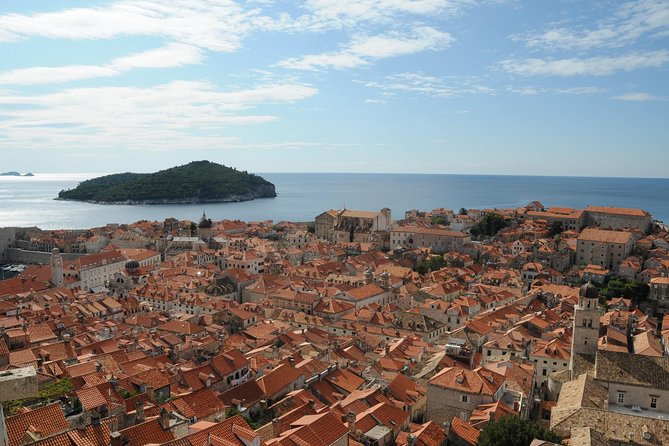
Dubrovnik is easy to admire and surprisingly easy to misunderstand. Its polished stone streets, grand churches, and thick walls can feel like a beautiful stage set until a local guide explains how the old republic built ships, handled disease, protected its citizens, and carried on daily life behind those famous façades. This 90-minute walking tour gives you that useful first layer of context.
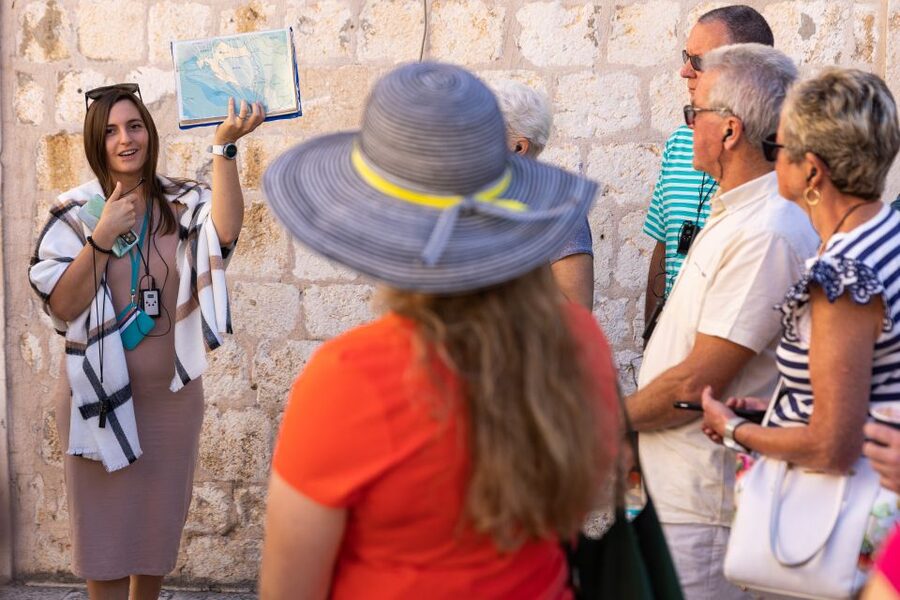
I like the way the walk mixes major sights with small details, such as old graffiti, wartime viewpoints, family stories, and the remains of Dubrovnik’s maritime past. I also like the guides’ practical touch. Ivana has moved groups from one patch of shade to another during hot July walks, and some guides use Bluetooth earpieces so you can hear clearly in crowded streets.
The main drawback is the fixed route and short running time. You see many important places, but several are viewed from outside or passed by, and there is no time for a full visit inside every church or palace. The cobbles, stairs, summer heat, and busy Old Town streets also demand sensible shoes, water, and patience.
Key points to know before you book
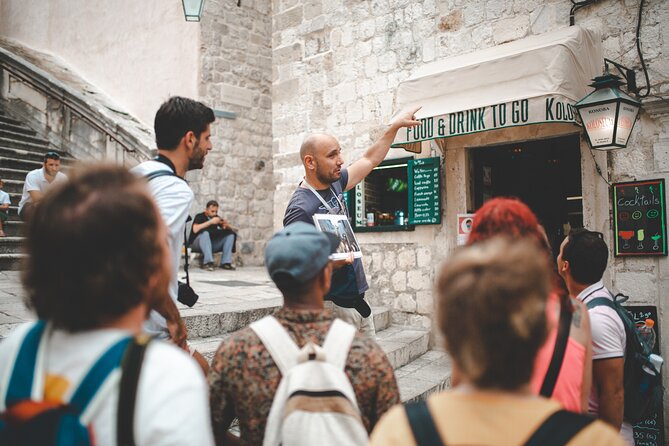
- Local stories give the monuments a human scale: Guides such as Ivana, Kim, Jelena, Josip, and Ana connect buildings with family memories, wartime experiences, customs, and everyday life.
- The route covers Dubrovnik’s essential core: You visit or pass the Large Onofrio’s Fountain, Pile Gate, Stradun, Orlando’s Column, Sponza Palace, Rector’s Palace, the Cathedral, and the Old Port.
- It is a strong first activity in Dubrovnik: The walk helps you get your bearings and gives you ideas for restaurants, shops, viewpoints, and places to explore later.
- The pace is generally easy but the surface is not: Expect cobblestones and some stairs. Comfortable footwear matters more here than fashionable footwear.
- You get history without a lecture hall: The best part is the blend of facts, humor, legends, personal stories, and questions from the group.
- The price is reasonable for a guided introduction: At $20 per person, the tour costs less than many longer sightseeing activities and covers the city center efficiently.
Why a walking tour helps you read Dubrovnik

Dubrovnik’s Old Town is compact, but its story is not. A casual walk shows you pale limestone, shutters, church towers, and narrow lanes. It does not automatically explain the political skill of the former Republic of Ragusa, the importance of its port, or the reasons the city developed such careful defenses and public rules.
That is where this tour earns its place. Your guide sets the buildings in order, from the city’s medieval foundations to its later architectural and spiritual life. You are not simply told the names of monuments. You hear why they mattered, how people used them, and what has changed.
The strongest guides make the past feel close without turning the walk into a school lesson. Josip has been praised for fitting a great deal into a short time while keeping the tone light. Jelena is known for dry humor and a clear affection for her hometown. Kim offers the unusual perspective of someone who lives inside the Old Town walls, giving you both historic background and a sense of present-day life.
That local viewpoint is especially useful in Dubrovnik, where the main streets can feel designed for photographs. A resident guide can point out a wall inscription, a building detail, or a quiet corner that you would likely pass without noticing.
More History Walking Tours in Croatia
- Dubrovnik Old Town History Walking Tour
★ 5.0 · 1,684 reviews - Dubrovnik: Ancient City Walls & Wars Walking Tour
★ 5.0 · 1,270 reviews - Zagreb: City and WWII Tunnels Walking Tour
★ 4.9 · 1,230 reviews
Starting at the Large Onofrio’s Fountain
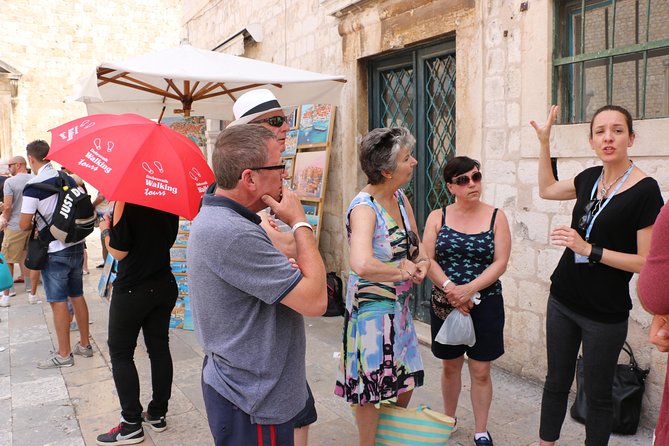
The meeting point is the Large Onofrio’s Fountain, next to the Hard Rock Cafe inside the Old Town. Look for the representative with a red umbrella.
This is a practical starting place because the fountain is near Pile Gate and close to the main pedestrian route. It is also one of Dubrovnik’s instantly recognizable public works. Your guide begins by placing the fountain within the city’s water supply and architectural story, then uses the surrounding streets to introduce the medieval city.
Allow a little extra time to find the meeting point, especially if you are arriving during a busy period. The Old Town can be crowded, and the entrance area has plenty of movement. Bring water with you from the start. The tour is not long, but the stone streets can reflect a great deal of heat.
Pile Gate and the city’s defensive character

The walk continues to Pile Gate, one of the main entrances to Dubrovnik’s walled center. Here, the guide can explain how visitors once approached a carefully controlled city rather than an open resort town.
Pile Gate is more than a grand photo stop. It helps you understand Dubrovnik’s defensive planning, layers of access, and relationship with the fortifications. It also gives you an early sense of the contrast that shapes the whole walk: elegant civic buildings inside, serious protection around them.
The drawback is that this area can be crowded, particularly when buses and day groups arrive. You may need to pause close to the guide and listen carefully. Some guides use Bluetooth earpieces, which can make a real difference when the street noise rises.
Twenty-five minutes through the Old Town
The longest portion of the tour is a general walk through the Old Town, lasting about 25 minutes. This is where the experience moves beyond a checklist of monuments.
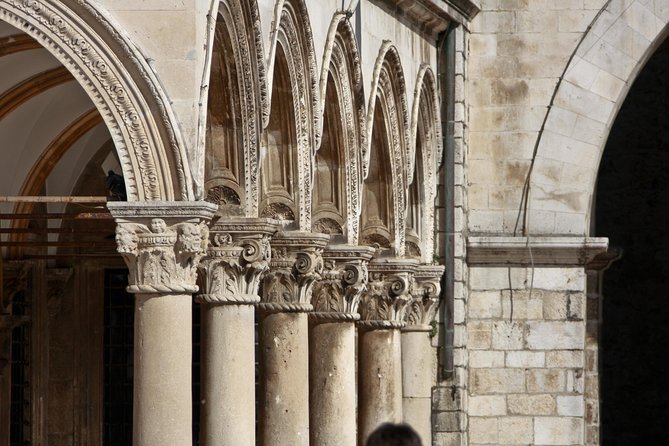
You can expect your guide to point out architectural details, old façades, palaces, churches, and traces of ordinary life. The stories may cover the city’s artistic and spiritual traditions, its maritime strength, and the rules that helped the Republic protect itself.
One memorable theme is quarantine. Dubrovnik developed ways to isolate people and goods arriving from places affected by disease. That detail gives you a better sense of the republic as a practical trading power. It was not only concerned with grand diplomacy and fine buildings. It also had to manage ships, cargo, illness, and public safety.
The walk also brings attention to centuries-old vines and less obvious marks on the walls. One guide has pointed out what was described as the first Latin graffiti on an old church wall. Another showed a viewpoint once used for shooting practice during wartime. Details like these are valuable because they interrupt the polished postcard version of the city.
More Old Town Walking Tours in Croatia
- Dubrovnik: Old Town Walking Tour
★ 4.8 · 5,174 reviews - Dubrovnik Discovery Old Town Walking Tour
★ 5.0 · 4,458 reviews - Dubrovnik: City Walls, Old Town Walking Tour & Adriatic View
★ 4.9 · 982 reviews - Dubrovnik: Old Town Walking Tour
★ 4.9 · 792 reviews
Stradun, Dubrovnik’s grand central street
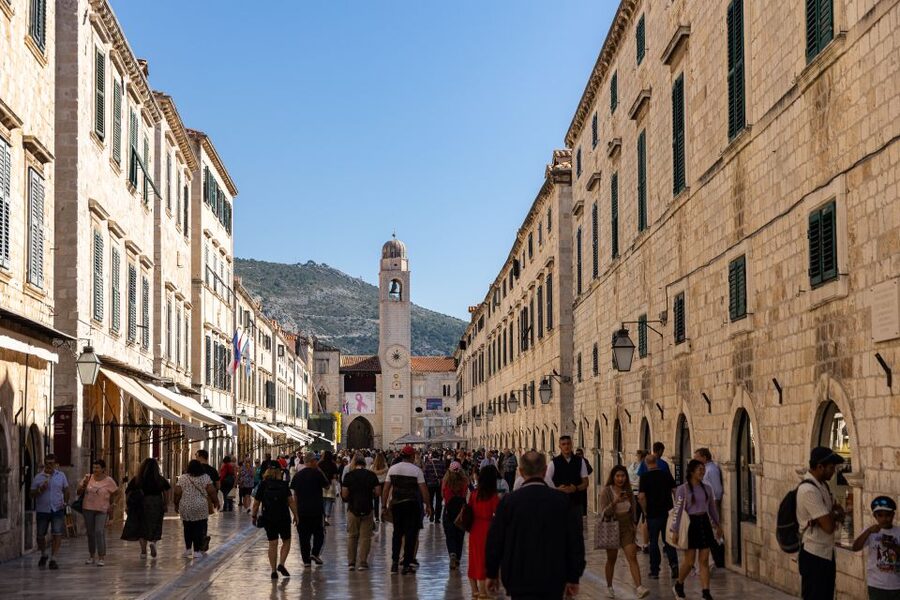
Stradun is the Old Town’s main street, and the tour allows about ten minutes here. It is broad, straight, and paved in pale stone, with important buildings and side lanes feeding into it.
Your guide explains how Stradun functions as both a public space and a route through the city. You will see why it is the natural spine of a first visit, but also why it can feel very busy. The open layout makes it easier to keep track of the city, while the crowds can make listening and photography harder.
I like this stop because it gives you an anchor. After the tour, you can use Stradun to orient yourself, then return to the side streets and smaller squares with more confidence. Guides also use this part of the walk to offer practical suggestions for the rest of your stay, including places to eat, shops to browse, and sights to explore in greater detail.
Orlando’s Column and the language of independence
The tour pauses at Orlando’s Column for about five minutes. This monument carries political meaning as well as visual appeal, and the guide explains its connection to Dubrovnik’s identity and public life.
A short stop is enough to introduce the subject, but not enough for a long discussion. That is typical of this experience. You get the essential story and then continue, which keeps the tour moving but leaves you with reasons to return for more.
The column also shows why a guide helps. Without context, it is simply a striking stone monument in a busy square. With context, it becomes part of the city’s story about liberty, authority, and civic pride.
Sponza Palace and Rector’s Palace
Sponza Palace is covered for about five minutes, mainly as a pass-by stop. Its elegant exterior reflects the commercial and administrative importance of Dubrovnik. Your guide uses it to explain how trade, records, and public business operated in the old republic.
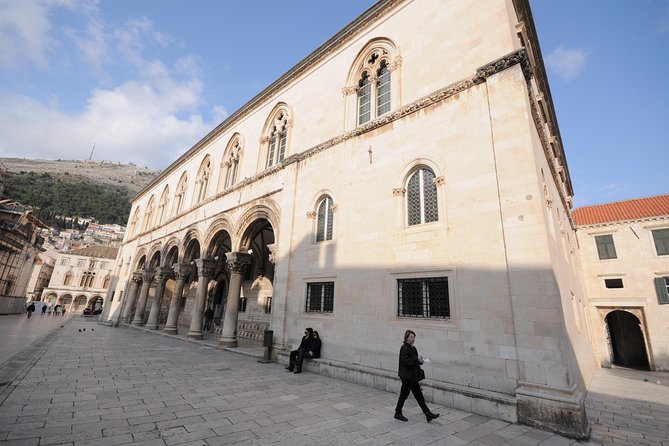
Rector’s Palace receives a similar five-minute treatment. This is one of the most important buildings on the route, but the tour does not include a full museum visit. You see the palace from the outside and hear why the rector’s office mattered to Dubrovnik’s government.
This is one place where you should set realistic expectations. If you want detailed time inside the Rector’s Palace or Sponza Palace, plan a separate visit. The walking tour gives you a useful introduction and helps you know which buildings deserve a closer look later.
That arrangement suits me. A first walk can become tiring if every landmark turns into a full interior visit. Here, you keep moving through the city and save your energy for the places you most want to explore.
The Church of St. Blaise and Dubrovnik Cathedral
The Church of St. Blaise, a major symbol of Dubrovnik, is among the landmarks highlighted during the route. The guide explains its place in the city’s religious and civic life, along with the architectural details that make it memorable.
The Cathedral receives about ten minutes of sightseeing and a guided explanation. This is a useful chance to hear how faith, art, and public identity overlap in Dubrovnik. The city’s churches were not isolated buildings. They formed part of a wider network of worship, community, ceremony, and artistic patronage.
Again, the tour is primarily a walking introduction rather than an interior-focused art visit. If you want a slow look at religious artworks or detailed architectural study, you will need extra time on your own. The guide’s role here is to give you enough context to make that later visit more rewarding.
The Arsenal and Dubrovnik’s maritime past
The route also highlights the legendary Arsenal, once central to Dubrovnik’s shipbuilding. This is one of the most useful subjects on the walk because it shifts attention away from palaces and churches.
Dubrovnik prospered through the sea. Its ships, port, trade links, and diplomatic skill helped the republic survive among stronger regional powers. The Arsenal makes that history visible. It reminds you that the city’s beauty was supported by skilled workers, merchants, sailors, officials, and strict systems of public administration.
The guide’s stories make the point without requiring a long specialist lecture. You see a modern street, then learn how it once supported a working maritime city. That change in viewpoint is one of the tour’s best rewards.
Finishing at the Old Port
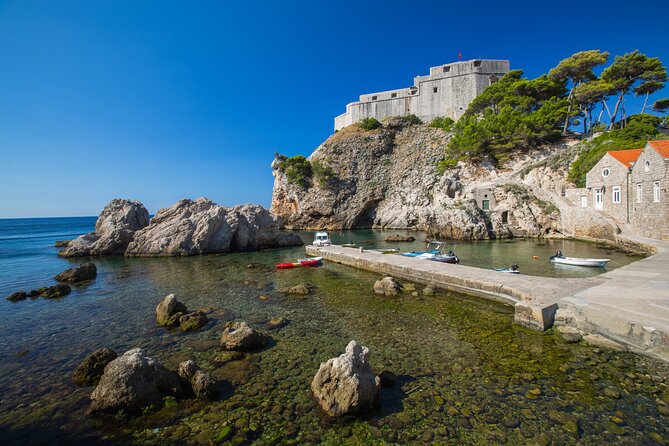
The final listed stop is Dubrovnik’s Old Port, with about ten minutes of guided sightseeing. It is a fitting ending because it brings together several themes from the walk: trade, defense, shipbuilding, quarantine, and daily movement in and out of the city.
The port also helps you understand Dubrovnik’s position. The Old Town was never only a collection of stone buildings. It was a place that depended on the sea and had to guard access to it.
From here, you are well placed to continue exploring, although the tour does not include hotel transportation or food and drinks. You can use the guide’s suggestions to shape the rest of your day, but you will need to make your own plans after the walk.
What the guides do especially well
The strongest feature is the human delivery. The guides are licensed, English-speaking professionals, but the best moments come when formal history gives way to personal connection.
Ivana has been especially praised for explaining the city through local culture, family experiences, and wartime memories. She has also adjusted the route between shaded areas during hot weather and kept the walking speed comfortable. That kind of care matters in July, when the stone streets can become punishing.
Kim brings a local perspective and has been described as someone who lives within the Old Town walls. Ana combines historical explanation with cultural curiosities and even teaches basic Croatian words. Jelena uses humor and family stories to make the city feel less distant. Josip is a good choice for anyone who likes a clear explanation with plenty of room for questions.
You should not expect to choose your guide when booking, so the exact style may vary. The consistent aim is clear storytelling, local insight, and practical advice rather than a dry recital of dates.
Price, pace, and practical value
At $20 per person, the tour offers good value if you want a structured introduction to Dubrovnik. For that price, you get 90 minutes with a professional guide and a route through the city’s most important central sights.
The value is not in the number of entrances included, because this is a walking tour and does not promise full access to every monument. The value is in saving you from wandering past significant buildings without understanding them. It also helps you decide how to spend the rest of your visit.
The pace is usually leisurely, but the Old Town itself creates the physical challenge. Expect cobbled streets and some stairs. Wear shoes with a firm grip, bring water, and use sun protection. Swimwear, smoking, and noisy behavior are not allowed, and respectful clothing and conduct are appropriate around churches and public sites.
The booking terms are flexible: you can reserve now and pay later, and cancellation is free up to 24 hours before the tour for a full refund. Starting times vary, so check availability when choosing a date.
Who should book this walk
I would choose this tour for a first visit to Dubrovnik, especially if you want an overview before spending time on the city walls, museums, churches, or restaurants. It also suits cruise visitors and short-stay visitors who need a focused introduction in 90 minutes.
Families and older visitors should be comfortable with uneven stone streets and stairs. The walk is not described as accessible, so anyone with mobility concerns should check the physical demands before booking.
History fans will appreciate the mix of government, religion, ships, quarantine, and war years. People who prefer architecture will get plenty of façades and landmark explanations, but not long interior visits. If you dislike group walking tours or already know Dubrovnik well, you may prefer to explore independently.
Should you book the Dubrovnik Old Town History Walking Tour?
Book it if you want Dubrovnik to make sense before you start exploring on your own. The walk covers the key center, gives you useful orientation, and adds the kind of local details you are unlikely to notice from a map alone.
Skip it if your priority is entering every major building, walking the full city walls, or moving at your own pace without a guide. For most first-time visitors, though, $20 is a fair price for a clear introduction, especially when the guide adds personal stories, humor, and practical advice. Schedule it early in your stay, then use the rest of your time to return to the places that caught your attention.
FAQ
How long does the Dubrovnik Old Town History Walking Tour last?
The tour lasts 90 minutes.
How much does the tour cost?
The price is $20 per person.
What language is the tour conducted in?
The tour is conducted in English by a live, licensed English-speaking guide.
Where does the tour begin?
Meet at the Large Onofrio’s Fountain next to the Hard Rock Cafe in Dubrovnik’s Old Town. Look for the representative holding a red umbrella.
Which major sights are included?
The route includes the Large Onofrio’s Fountain, Pile Gate, the Old Town streets, Stradun, Orlando’s Column, Sponza Palace, Rector’s Palace, Dubrovnik Cathedral, and the Old Port. The Church of St. Blaise and the Arsenal are also highlighted.
Does the tour include hotel pickup?
No. Hotel pickup and drop-off are not included.
Are food and drinks included?
No. You should bring your own water, and food and drinks are not included in the tour price.
What should I bring?
Bring comfortable shoes and water. Sun protection is also useful because parts of the route are exposed and the stone streets can become hot.
Can I cancel the tour?
Yes. You can cancel up to 24 hours in advance for a full refund. You can also reserve now and pay later.
More Old Town Walking Tours in Dubrovnik
- Dubrovnik Cable Car Ride, Old Town Walking Tour plus City Walls
★ 4.5 · 685 reviews - Dubrovnik: Panoramic Ride and Old Town Guided Walking Tour
★ 4.7 · 261 reviews - Dubrovnik: Old Town & City Walls Private Walking Tour
★ 5.0 · 206 reviews - Underground Vaults Walking Tour in Edinburgh Old Town
★ 4.5 · 8,506 reviews
More History Walking Tours in Dubrovnik
- Berlin: Third Reich & Cold War Guided Walking Tour
★ 4.9 · 8,378 reviews - Munich: Third Reich & WWII Walking Tour
★ 4.6 · 6,181 reviews - Berlin’s Best: 2 Hour Walking Tour Third Reich and the Cold War
★ 5.0 · 5,486 reviews - Third Reich Berlin: Hitler and WWII Walking Tour
★ 5.0 · 3,301 reviews
Just added around Dubrovnik
- Dubrovnik: Panoramic Ride and Old Town Guided Walking Tour★ 4.7 · 261 reviews
- Dubrovnik: Walls and Wars Walking Tour★ 4.8 · 501 reviews
- Dubrovnik: Game of Thrones&Lokrum Island Walking Tour★ 4.8 · 245 reviews
- Dubrovnik: Game of Thrones And Iron Throne Walking Tour★ 4.8 · 505 reviews
- Dubrovnik By Night Walking Tour★ 4.8 · 208 reviews
- Dubrovnik: Early Bird Walking Tour★ 4.9 · 123 reviews
- Dubrovnik: Legendary Game of Thrones Walking Tour★ 4.8 · 220 reviews
- Tour The Game of Thrones – Private Walking Tour★ 5.0 · 464 reviews
Old Town Walking Tours, compared.

Underground Vaults Walking Tour in Edinburgh Old Town
Read our review →
3-Hour Walking Tour of Old Town & Prague Castle
Read our review →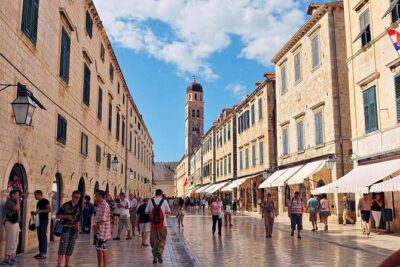

Old Town and Jewish Quarter Guided Walking Tour
Read our review →