
REVIEW · SPAIN
Tarragona: Roman Heritage Guided Walking Tour
Tarragona’s Roman past is not shut away in one museum. It is woven into the city itself, with ancient walls beside modern streets, Circus remains beneath the old town, and an amphitheater facing the Mediterranean. This two-hour walk gives you a useful first look at all three.
I like the Roman walls, among the oldest Roman walls outside Italy, and the way the guide uses a large city model to show how ancient Tarraco once worked. I also like the audiovisual 3D presentation before the amphitheater, which helps you picture the site before hearing about gladiators and animal hunts.
The main drawback is time. Two hours is enough for a brisk introduction, but the schedule can feel tight, especially in bad weather or when several groups gather at once. You will also need to follow the tour in Catalan or Spanish.
Key points to know before booking
- The Roman walls are the opening lesson: You learn why Rome chose this hill beside the Mediterranean as its base for the peninsula.
- The Circus vaults bring ancient racing to life: Your ticket includes entry to this important Roman site.
- The city model makes Tarragona easier to understand: It shows how Roman buildings once fit into the modern center.
- The amphitheater sits directly by the sea: The views are one of the tour’s most memorable parts.
- Adrià has received especially warm praise: His clear explanations and pride in Tarragona make a strong impression.
- The pace is brisk: Bring comfortable shoes, leave large bags behind, and allow for crowds or rain.
Why Tarragona’s Roman remains feel different
Tarragona was ancient Tarraco, a major Roman base on the Iberian Peninsula. This tour begins with the practical reason for its location: a hill beside the Mediterranean, useful as a gateway for Rome’s reach across the peninsula.
That setting helps explain the city better than a simple list of dates. Tarragona was not just a collection of temples and arenas. It was a working Roman center, shaped by defense, trade, public life, and its position near the sea.
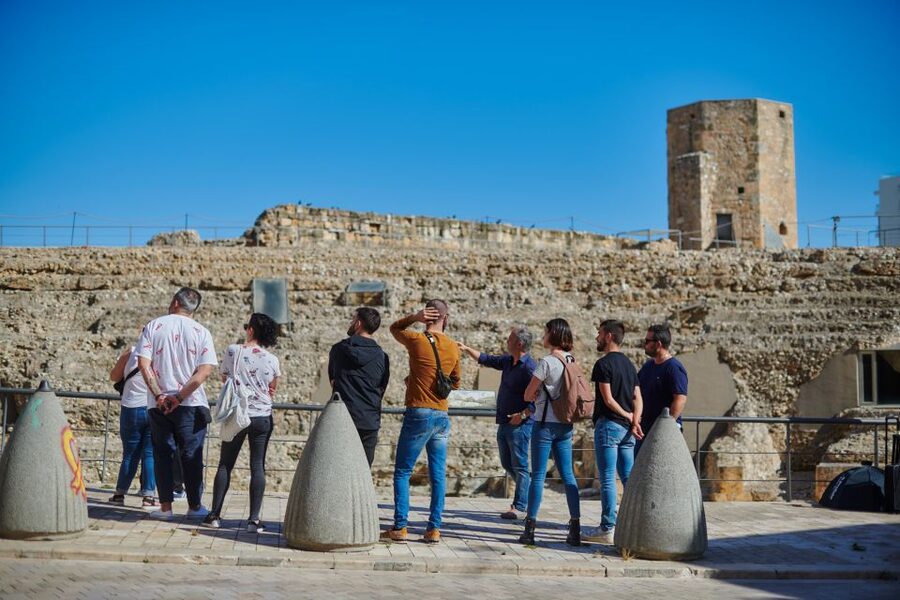
I like starting at the walls because they give you an immediate sense of scale. These are not small fragments tucked behind glass. They mark the edge of the old city and help you understand the high ground on which Tarragona developed.
The tour identifies them as the oldest Roman walls outside Italy. That claim alone makes this first stop important, but the guide’s explanation of the location is just as useful. You are not only looking at stones. You are learning why Rome put its city here.
The walls also set the tone for the rest of the walk. Tarragona’s Roman remains are mixed into the current city, so you will move between ancient masonry, homes, streets, and squares rather than spending the entire visit in a separate archaeological park.
More Guided Tours in Spain:
- Granada: Albaicín and Sacromonte Guided Sunset Walking Tour
★ 4.9 · 2,962 reviews - Madrid: Tapas & Wine Tasting Tour with Local Guide
★ 4.8 · 2,171 reviews - Madrid: Royal Palace Skip-the-Line Guided Tour
★ 4.5 · 2,140 reviews
Walking from the walls into modern Tarragona
From the walls, the route moves through Tarragona’s historic center. This is where the tour’s local guide matters most. Without some explanation, Roman foundations incorporated into modern buildings can be easy to miss or hard to interpret.
The guide explains the purpose of the ancient buildings and how they related to one another. That context turns a walk through ordinary-looking streets into a lesson in urban design. You begin to see that the current city is built around, over, and alongside the Roman one.
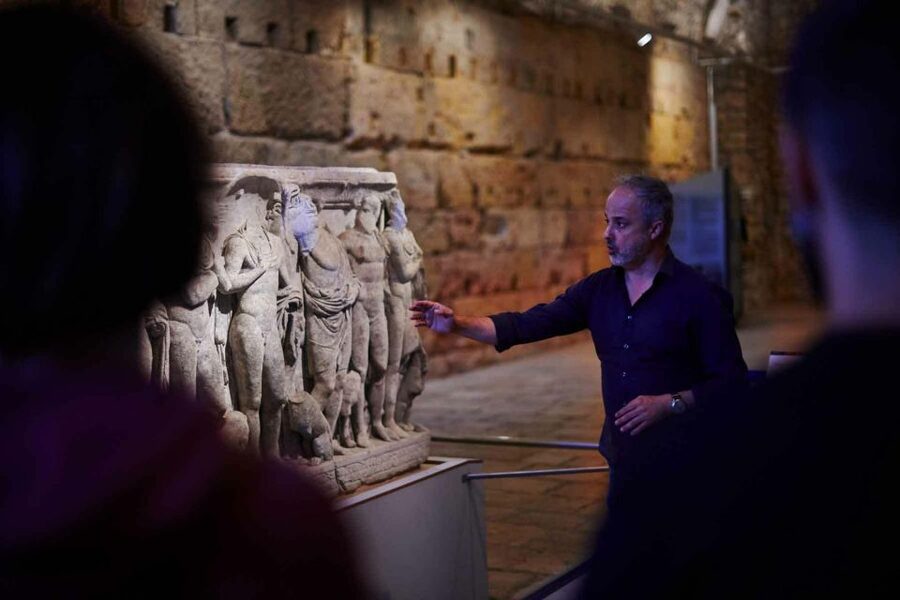
The large city model is a particularly useful stop. It gives you a picture of Tarragona as it once looked, with its major structures arranged across the hill. I find this kind of model more helpful than a long spoken description because you can see the relationships at once.
You can use it to place the walls, Circus, and amphitheater in the wider city. That matters because Roman ruins often make more sense when you know their position and purpose. A partial wall or underground vault becomes part of a larger plan instead of an isolated relic.
The guide also uses the model to describe what different buildings were used for. The tour is not limited to the most dramatic ruins. It tries to explain how the city functioned, which gives the visit more substance than a quick photo stop.
Still, keep your expectations realistic. The route covers several Roman sites in two hours, so you should expect a focused overview rather than a slow archaeological study. If you want to examine every surviving detail, you will need additional time in Tarragona after the walk.
Entering the Circus vaults beneath the old town
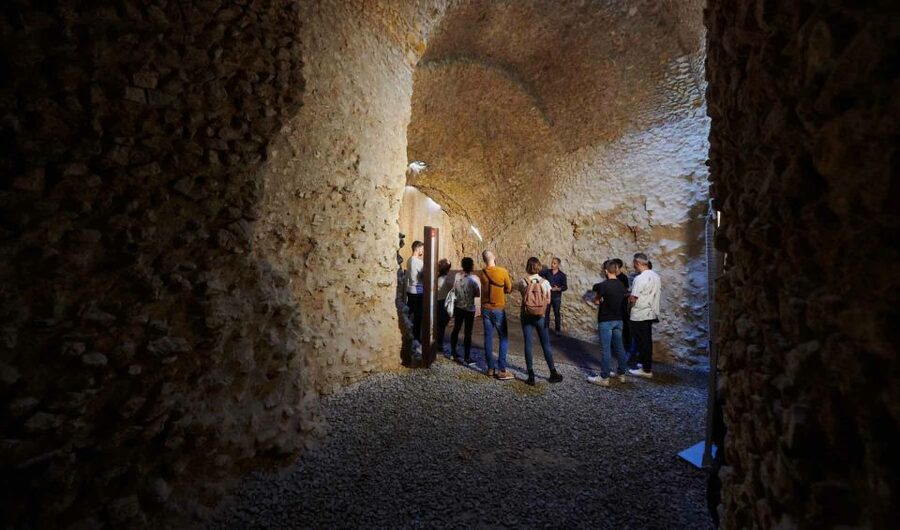
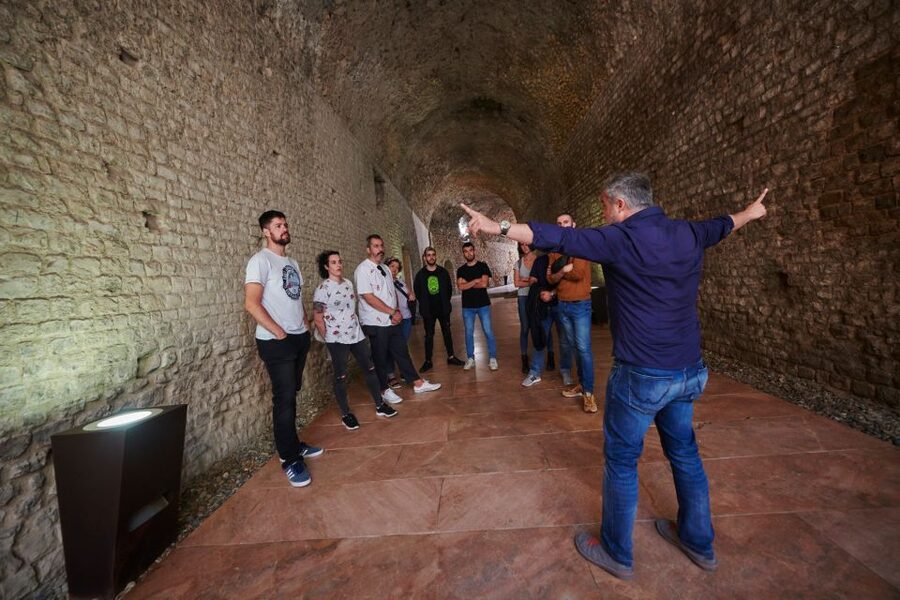
The Circus is one of the tour’s most distinctive stops. Your admission includes entry to its vaults, where you can get a closer look at the structure once connected with Roman chariot racing.
The vaults are valuable because they show how the Circus occupied space within the city. The experience is not simply about imagining a race. You are also seeing the supporting architecture that helped hold this huge public venue together.
The highlight description invites you to picture the excitement of chariot races, and that is the right way to approach the stop. Roman public entertainment was loud, competitive, and risky. The Circus was designed for spectacle, and the vaults give you a physical link to that world.
I like this part of the route because it differs from the wall and the amphitheater. The walls are defensive. The amphitheater is tied to gladiatorial contests and animal hunts. The Circus brings in another side of Roman public life, with racing and mass entertainment.
The route through the Circus also shows how Tarragona’s ancient remains are folded into the present-day city. You are not walking through a perfectly preserved Roman complex with every feature in place. You are seeing surviving parts within a living urban center.
That can be exciting, but it also means the stop may require imagination. The guide’s explanation and the city model help fill in what time has removed. If you prefer large, fully reconstructed ruins, this may feel less immediately clear. If you enjoy piecing together a city from fragments, it is one of the tour’s stronger moments.
Using 3D images before the seaside amphitheater
Before reaching the amphitheater, the tour includes an audiovisual presentation with 3D images. This is a smart bridge between the remains you have seen and the arena ahead.
Roman ruins can be difficult to read when walls are low, surfaces are worn, or later construction has changed the site. A visual reconstruction gives you a better idea of how the buildings may have looked and how they were used. It also prepares you for the amphitheater without asking you to rely only on imagination.
The presentation is especially useful if Roman architecture is new to you. It can help you picture the stadium as an active public venue rather than an empty oval of stone.
One person who received repeated praise in the supplied feedback is Adrià, a guide noted for clear explanations and a strong sense of pride in his region. If he leads your visit, expect an engaged presentation style. His explanations are described as easy to follow, and the video was a particular highlight for one German-speaking participant, even though the tour itself operates in Catalan or Spanish.
The presentation is not a replacement for standing at the site. It works because it comes before the amphitheater, when you can immediately compare the visual reconstruction with what remains.
A few more walking tours around Spain worth a look
- Barcelona Tapas and Wine Experience Small-Group Walking Tour
★ 5.0 · 5,804 reviews - Barcelona: Tapas Walking Tour with Food, Wine, and History
★ 4.8 · 4,261 reviews - Madrid Tapas & Wine Tasting Walking Tour – Small Group Local Bars
★ 5.0 · 3,644 reviews - Toledo Tour & Vineyard Walk with Wine Tasting from Madrid
★ 5.0 · 2,546 reviews
Seeing the amphitheater beside the Mediterranean
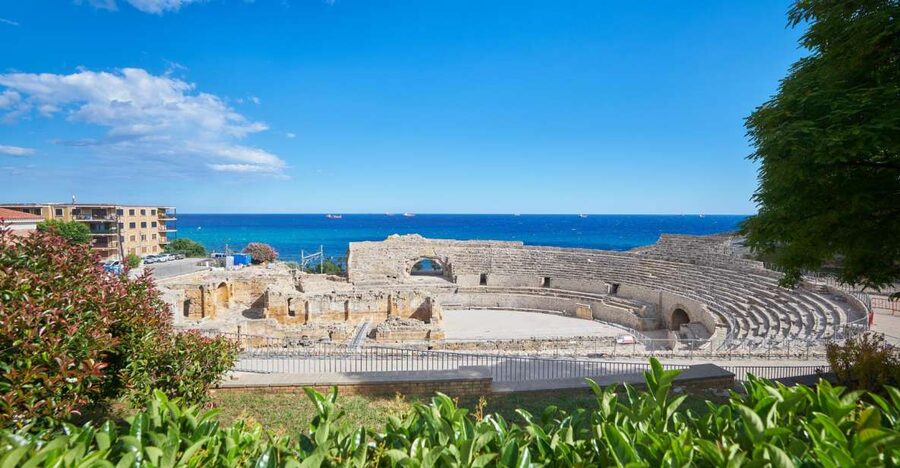
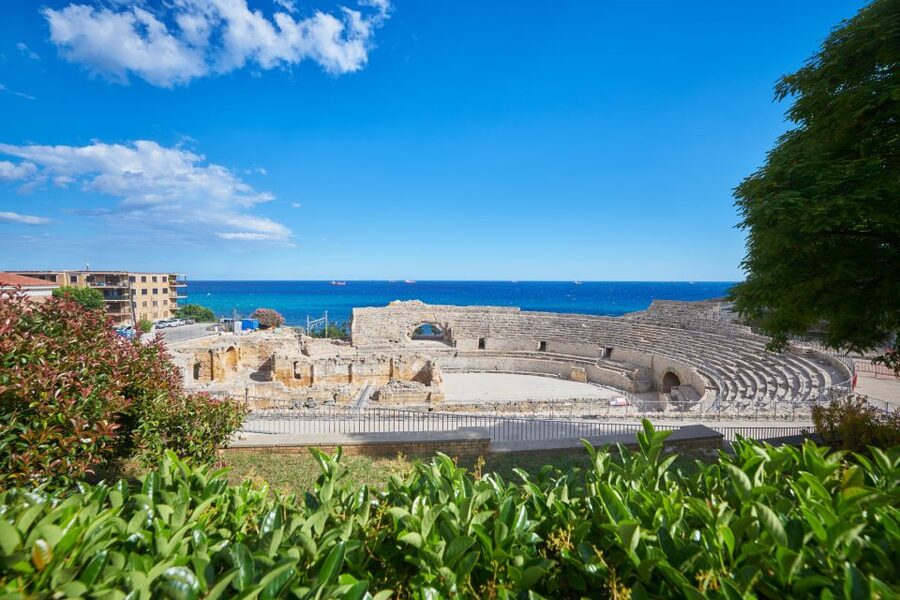
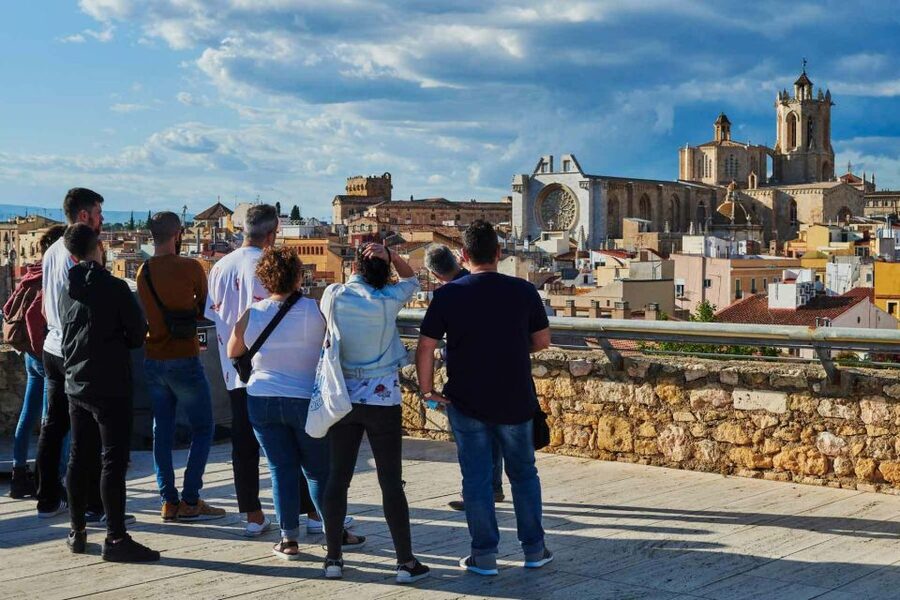
The amphitheater is the tour’s big finish. It sits beside the sea, and the setting gives the visit a strong visual ending. You get views across the Mediterranean while standing in a place built for public combat and spectacle.
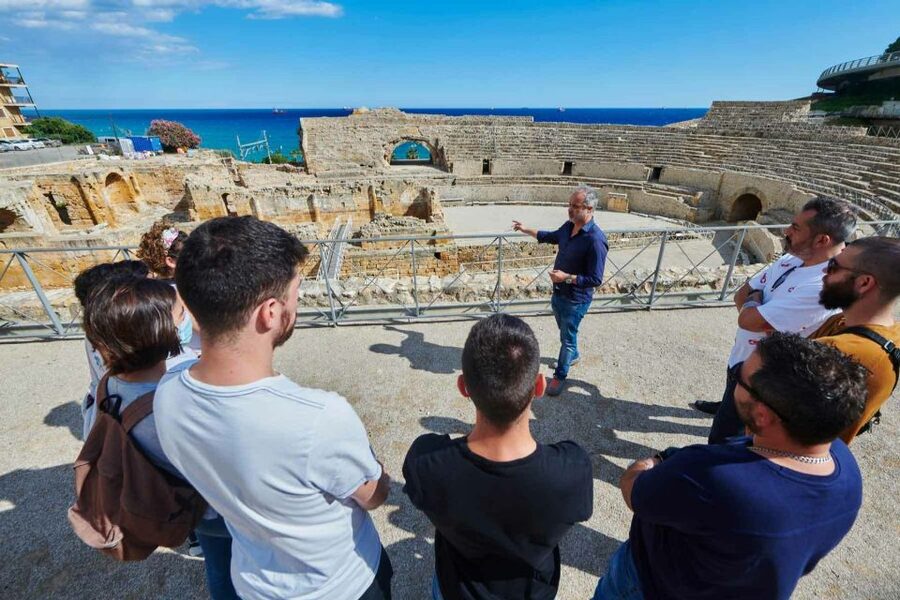
Here, the guide explains gladiator fights and the hunting of wild animals. These subjects can easily become a string of dramatic facts, but the location gives them weight. The arena’s position by the water, the surviving structure, and the sense of the old seating area help you understand why this was such a powerful public space.
The sea view is not just decoration. It reminds you that Tarragona’s Roman identity was tied to its coastal position from the beginning. The city was chosen as a route into the peninsula, and the amphitheater returns you to that relationship with the Mediterranean.
The guide also reviews the site’s story up to the present day. That final step is useful because it connects ancient use with later changes and modern preservation. You are not being asked to treat the amphitheater as frozen in one moment.
For photographs, this is likely your best stop. The open setting provides a wider view than the Circus vaults or the urban wall remains. On a clear day, the combination of stone, sky, and sea should be memorable. On a wet day, the experience can be less comfortable, so sensible clothing and firm shoes matter.
One January visit took place during heavy rain and was still judged acceptable, but weather clearly affected the experience. That is a fair warning: the tour is primarily outdoors and on foot, so Tarragona’s forecast can make a real difference.
What the two-hour schedule really allows
Two hours is a reasonable length for a first orientation. You can see several major Roman sites without giving up an entire morning or afternoon. At $17 per person, the price is also modest for a guided visit that includes admission to the Circus.
The value depends on what you want. If you mainly need a quick introduction, the tour offers a good deal: an official city guide, a clear route, the city model, the audiovisual presentation, and Circus entry all fit into one booking.
If you want long periods at each monument, two hours may feel short. One Spanish-speaking participant described the tour as complete but wished it lasted three hours. That criticism makes sense. The route covers the walls, historic center, Circus, model, presentation, and amphitheater, so the guide must keep things moving.
Crowds can also affect the pace. A report of several groups leaving at the same time, with roughly 20 people in each group, points to a possible problem during busy periods. Noise makes it harder to follow a guide, especially in the old streets or at indoor sites.
You can improve your odds by arriving 10 minutes early at the Itinere office beside the Roman walls. The meeting point is easy to connect with the first stop, and an early arrival gives you time to find the office without rushing.
Bring comfortable shoes. Large bags and luggage are not allowed, so this is not a good activity to schedule while carrying suitcases or bulky belongings.
Language, access, and guide quality
The tour is offered in Catalan and Spanish. You should book it only if you can comfortably follow one of those languages. The available information does not list English as a tour language, so English-speaking visitors should not assume that an English guide will be available.
The official city guide format is a strength. You are not simply following a route between monuments. The guide explains Tarragona’s history, describes the function of its buildings, and helps you interpret the model and audiovisual material.
Guide quality can shape the visit. Adrià receives the strongest praise in the supplied comments, with particular attention to his clear explanations, enthusiasm, and connection to Tarragona. That does not guarantee he will lead every departure, but it gives you a useful sense of the kind of local expertise the provider aims to offer.
There is also a more mixed note about one guide losing the thread while explaining things. The same account describes heavy noise and several groups starting together. This suggests that organization and crowd levels can affect clarity, not just the guide’s speaking style.
The tour is listed as wheelchair accessible, which is important for anyone checking access before booking. The route includes historic sites, vaults, streets, and the amphitheater, so you should still confirm any personal mobility concerns with the provider before arrival if you need specific assistance.
Who will get the most from this walk
I would choose this tour for a first visit to Tarragona, especially if you want the main Roman sights explained in one compact outing. It suits you if you enjoy history but do not want to plan the route or work out how the monuments fit together.
It is also a good choice for visitors arriving with limited time. The two-hour format leaves room for lunch, additional sightseeing, or a visit to other parts of the city.
Families and mixed-age groups may like the variety. The walls offer a clear opening point, the model gives visual help, the Circus adds a more unusual setting, and the amphitheater supplies the dramatic finish. The 3D presentation can make the ancient sites easier for younger visitors to picture.
I would think twice if you need an English-language tour, dislike outdoor walking, or want a slow scholarly study of Roman architecture. You may also prefer a quieter departure if you find it hard to hear in a large group.
The overall rating of 4.7 from 261 ratings suggests strong satisfaction, but the detailed comments show the sensible limits: weather, noise, language, and a fast schedule can change the feel of the visit.
Practical verdict: a good-value Roman introduction
At $17, this is an easy recommendation for a short, guided introduction to Tarragona’s Roman core. I like that the price includes Circus admission and that the route combines major monuments with tools that make them easier to understand.
Book it if you want clear orientation, a local guide, the Roman walls, Circus vaults, and the amphitheater in one outing. Arrive early, wear comfortable shoes, carry no large bag, and check that Catalan or Spanish works for you.
Skip it if you want a long, unhurried archaeological visit or need English commentary. For everyone else, this is a practical way to meet Tarragona’s Roman past before exploring the city on your own.
FAQ
How long does the Tarragona Roman Heritage Guided Walking Tour last?
The tour lasts two hours.
What sites are visited?
The route includes the Roman walls, parts of Tarragona’s historic center, the Circus vaults, and the seaside Amphitheater. It also includes a large city model and an audiovisual presentation with 3D images.
Is entrance to the Circus included?
Yes. Entrance to the Circus is included in the tour price.
What languages are available?
The live tour is offered in Catalan and Spanish.
Where is the meeting point?
Meet at the Itinere office next to the Roman walls. You should arrive 10 minutes before the activity begins.
Is the tour wheelchair accessible?
Yes, the activity is listed as wheelchair accessible. Large bags and luggage are not allowed, and comfortable shoes are recommended.
Just added around Spain
- Walking tour in Alhambra, Nasrid Palaces and Generalife★ 3.0 · 135 reviews
- Sunset Walking Tour in Albaicín & Sacromonte★ 5.0 · 95 reviews
- Granada’s Hidden Treasures: Albayzin and Sacromonte Walking Tour★ 4.5 · 575 reviews
- Albayzin and Sacromonte Guided Walking Tour in Granada★ 4.5 · 98 reviews
- Albaicín & Sacromonte Walking Tour★ 4.5 · 87 reviews
- Girona History, Legends, and Food Walking Tour with food tasting★ 5.0 · 195 reviews
- Game Of Thrones Walking Tour in Girona★ 5.0 · 406 reviews
- Cordoba Walking Tour with Arabian Baths Experience★ 4.0 · 93 reviews
Walking Tours, compared.

Magical London: Harry Potter Guided Walking Tour
Read our review →
Reykjavik Food Walk – Local Foodie Adventure in Iceland
Read our review →
History and Hauntings of Salem Guided Walking Tour
Read our review →
New Orleans Premier Ghost, Voodoo and Vampire Walking Tour
Read our review →
Amsterdam Anne Frank: Small-Group Walking Tour & Local Guide
Read our review →

Edinburgh Castle: Guided Walking Tour with Entry Ticket
Read our review →
Anne Frank’s Story – Guided Walking Tour through Amsterdam
Read our review →Browse the lists this tour appears in