
REVIEW · OSLO
Oslo: Best of Oslo Walking Tour
Oslo’s best feature is how much history fits into a compact, walkable center. In two hours, this tour links royal streets, medieval Christiania, the Nobel Peace Center, harbor redevelopment, and modern landmarks such as the Opera House. It gives you a useful first map of the city rather than sending you into one museum for the whole morning.
I like the broad mix of old and new, from the Norwegian Parliament and Grand Hotel to the Opera House and Aker Brygge. I also like the practical local guidance: guides such as Amelia, Anastasia, Olaf, Oliver, Minji, and Judit have been praised for clear history, good pacing, restaurant and café tips, and answers to questions. The main drawback is that nearly every sight is viewed from outside, so you should not book this expecting museum admission or a detailed fortress tour.
Key points at a glance
- Two-hour city orientation: Cover Oslo’s central sights at a steady walking pace, useful on your first or second day.
- Christiania explained: Learn why Oslo changed its name and how the old city center fits into modern Oslo.
- Nobel Peace Prize connection: Hear the story behind the award ceremony held in Oslo, the only Nobel award presented outside Sweden.
- Harbor-to-palace route: Connect the Opera House, Akershus Fortress, City Hall, Aker Brygge, Tjuvholmen, and the Royal Palace.
- English or German commentary: Choose your language when booking, with the meeting point changing by language.
- Extra exploring included: Scan the QR code on your voucher for a sightseeing app with an audio route through more of Oslo.
Why this two-hour walk works so well in Oslo
A first visit to Oslo can feel scattered. The city has a formal central avenue, an old quarter, waterfront districts, museums, parks, and a fortress, but the connections are not always obvious from a map. This walk helps you see how those pieces fit together.
The tour moves through Sentrum, Oslo’s central district on the Skagerrak strait. You get a quick introduction to public life, royal power, religion, trade, wartime defenses, and the city’s newer waterfront. That range is the real value. You are not just ticking off buildings. You are learning why each area looks and feels different.
The guides have drawn especially strong praise for making facts easy to absorb. Amelia is noted for answering questions and keeping communication clear. Anastasia has been described as a warm storyteller who explains the city’s history without rushing. Olaf brings humor and plenty of stories, while Oliver has been praised for local suggestions and a friendly manner.
Those details matter because a central-city walk can easily turn into a string of dates and building names. The better guides connect the places to Norwegian culture, government, daily life, and the people who shaped Oslo. That is what makes this a useful introduction rather than a simple photo stop.
A few more walking tours around the world worth a look
- Magical London: Harry Potter Guided Walking Tour
★ 4.7 · 22,044 reviews - Reykjavik Food Walk – Local Foodie Adventure in Iceland
★ 5.0 · 18,952 reviews - History and Hauntings of Salem Guided Walking Tour
★ 5.0 · 14,564 reviews
Starting at University Square or the Nobel Peace Center
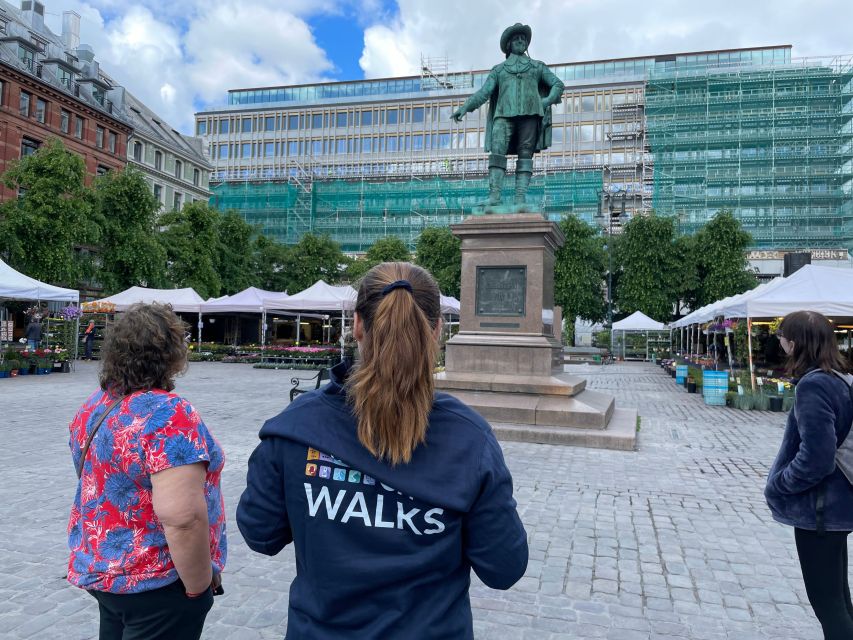
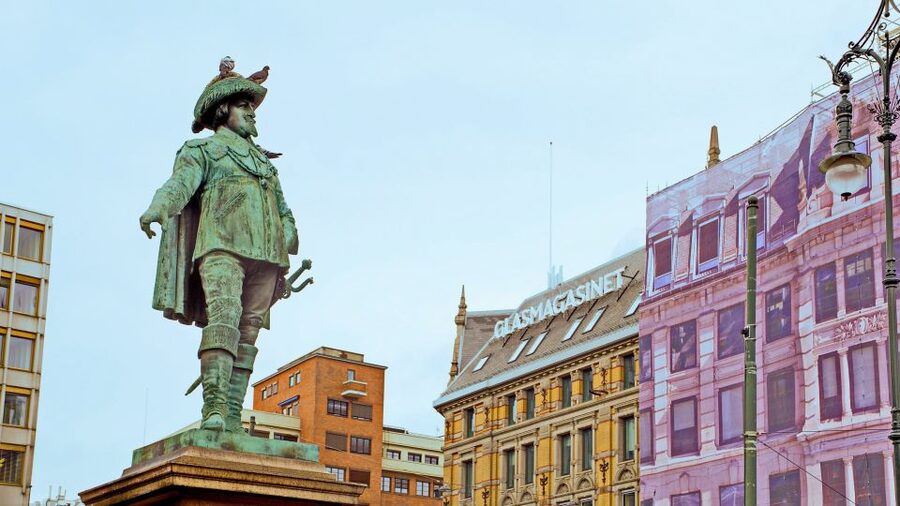
The meeting point depends on your language and booking choice. English tours meet near the statue of P.A. Munch by the entrance to the Faculty of Law building at University Aula, Karl Johan Street 47. German tours meet at the Nobel Peace Center at Brynjulf Bulls plass 1.
Arrive about five minutes early. This is a city walk, not a bus tour, so a late arrival can mean trying to catch up with the group. The tour finishes at either Universitetsplassen or the Nobel Peace Center, depending on the option booked.
The starting areas put you close to important Oslo themes right away. University Square connects to Karl Johan Street and the civic heart of the city. The Nobel Peace Center introduces one of Norway’s best-known international roles. The Nobel Peace Prize is awarded in Oslo, while the other Nobel awards are presented in Sweden, giving the tour a useful point of departure for understanding Norway’s place in the world.
Karl Johan Street and the public face of Oslo
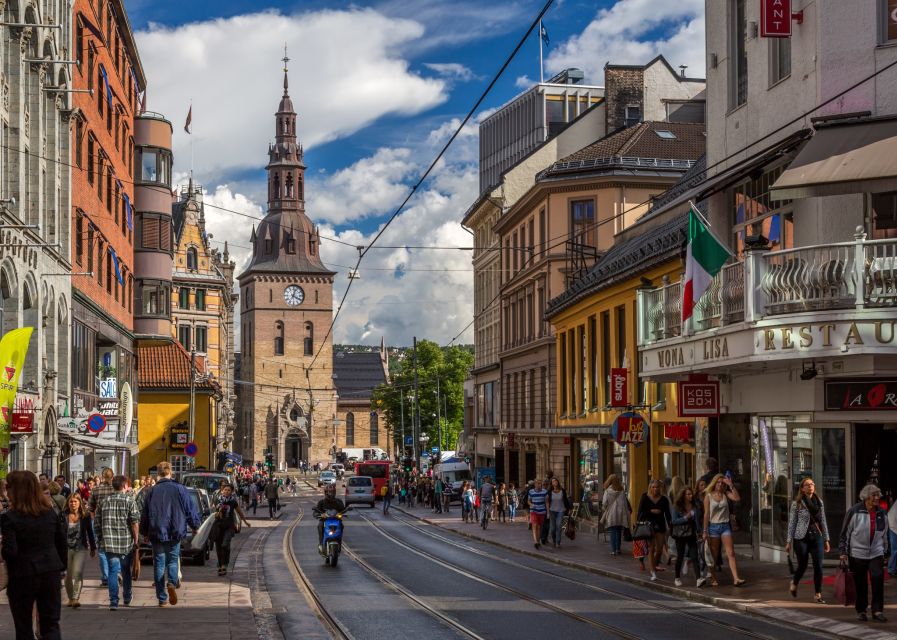
The walk passes Paleet, the Norwegian Parliament, the Grand Hotel, the National Theater, the University of Oslo, and Karl Johan’s monument. This is Oslo’s grand central corridor, where government, commerce, hotels, education, and national ceremony meet.
The Norwegian Parliament is a key stop for understanding the country’s political system. The guide explains the building and its place in Norwegian public life, while the Grand Hotel adds a more ceremonial note. The Nobel Peace Prize laureate traditionally appears at the hotel during the award period, so the building has a link to the annual event beyond its handsome facade.
Karl Johan Street is also practical for you. It gives you a central reference line for later sightseeing. From here, you can orient yourself toward the palace, cathedral, theater, and waterfront instead of treating each district as a separate destination.
The route also passes the National Theater and the University of Oslo. These stops help fill in the civic picture, but do not expect to go inside. The focus is on exterior architecture and explanation as the group continues along the street.
Bazaars, the cathedral, and old city details

The Oslo Bazaars, GlasMagasinet Stortorv, and Oslo Cathedral bring the walk into a more traditional central-city setting. The contrast with the polished waterfront is useful. You see the older commercial and religious core before moving toward the harbor.
Stortorvet Gjestgiveri is included among the sights, adding another link to Oslo’s long dining and meeting-place tradition. The guide may also point out small details you could easily miss if you were walking alone. This is one of the tour’s strongest features: it puts context around ordinary-looking streets and buildings.
Oslo Cathedral is a natural pause in the route. You will learn about its role in the city, but entry is not included. If you want to see the interior, plan a separate visit and check opening times for your date.
The walk then continues toward Kvadraturen, the district whose name refers to its regular, grid-like street plan. This is one of the clearest places to see the city’s older urban structure. It also leads naturally to Christiania Torv, where the story of Oslo’s earlier name and city center becomes more concrete.
Same streets, a different route:
- New Orleans Premier Ghost, Voodoo and Vampire Walking Tour
★ 4.5 · 12,856 reviews - Amsterdam Anne Frank: Small-Group Walking Tour & Local Guide
★ 4.8 · 12,789 reviews - Edinburgh: Harry Potter Magical Guided Walking Tour
★ 4.8 · 11,944 reviews - Edinburgh Castle: Guided Walking Tour with Entry Ticket
★ 4.7 · 11,699 reviews
Christiania Torv and the city’s changing name
Christiania is not just a historical label on a map. It reflects a major change in Oslo’s identity after the city was rebuilt and renamed. The tour explains why the capital has carried different names over the past 300 years and how the original city center developed.
This part will appeal to you if you like history told through streets rather than behind glass. The route gives you a sense of how the city shifted, rebuilt, and expanded. You are walking through the old core while hearing how modern Oslo grew around it.
Anatomigården is another unusual stop along the route. It is the sort of place that benefits from explanation, since its significance is not obvious from a quick look. A live guide can point out why it belongs in the city’s story, while a solo walk might pass it by without a second glance.
The Opera House and Oslo’s modern waterfront
The Norwegian Opera House offers one of the tour’s clearest changes in mood. Its pale, sloping form is designed to meet the harbor like a piece of the shoreline, and the guide explains why it has become such a strong symbol of newer Oslo.
The tour passes the building rather than providing admission. You will have time to see its exterior and understand its place in the city’s modern development, but you should return later if you want an opera performance or a longer architectural visit.
KOK Oslo Sauna at Langkaia adds a distinctly contemporary Oslo detail. The waterfront is not presented only as a postcard view. It is also a place where public space, leisure, and new city life meet. This stop helps explain why the harbor feels different from the older streets around Christiania Torv.
The route is especially good for showing Oslo’s range within a short distance. One moment you are hearing about old city walls and civic buildings, and shortly after you are looking at a modern cultural structure and floating sauna culture. That contrast gives the city its character.
Akershus Fortress and the route toward City Hall
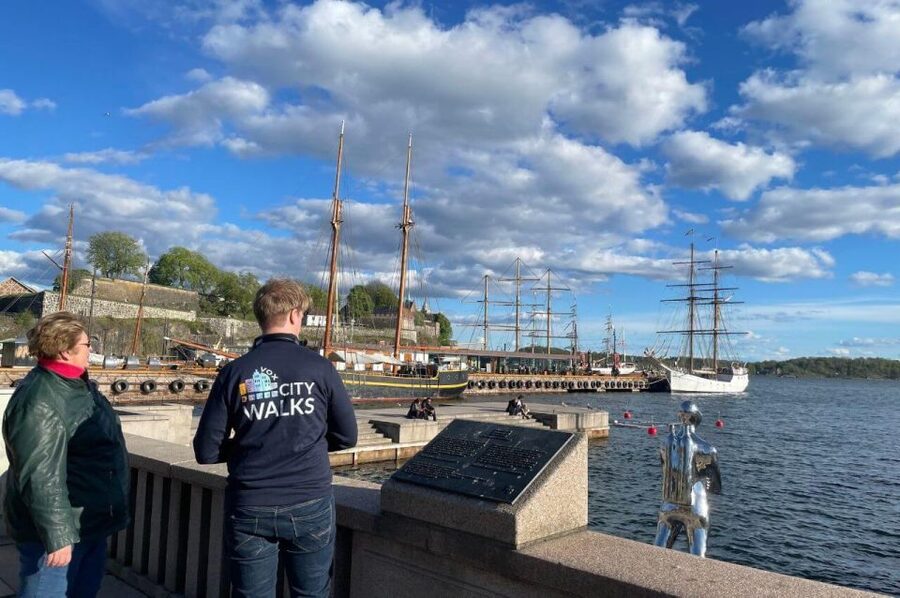
Akershus Fortress is one of the main historical anchors of the walk. The tour passes the fortress and explains its importance, but admission is not included and the schedule does not promise an interior visit or a full fortress circuit.
You should think of this as an introduction. If military history or medieval Oslo interests you, return later with enough time to explore the grounds and any open areas at a slower pace. During the tour, the fortress works as a visual link between the old city and the harbor.
From there, the walk continues past Oslo City Hall and the Ceremony Pier. City Hall is central to Oslo’s civic identity and is closely linked to the Nobel Peace Prize ceremony. The Ceremony Pier places that international event beside the water, making the award’s connection to Oslo easier to picture.
The route also includes the second city hall and Gamle rådhus among its named sights. You get a layered view of municipal Oslo, from earlier government buildings to the current civic center. Again, the emphasis is on seeing and understanding, not entering every building.
Aker Brygge, Tjuvholmen, and the final stretch
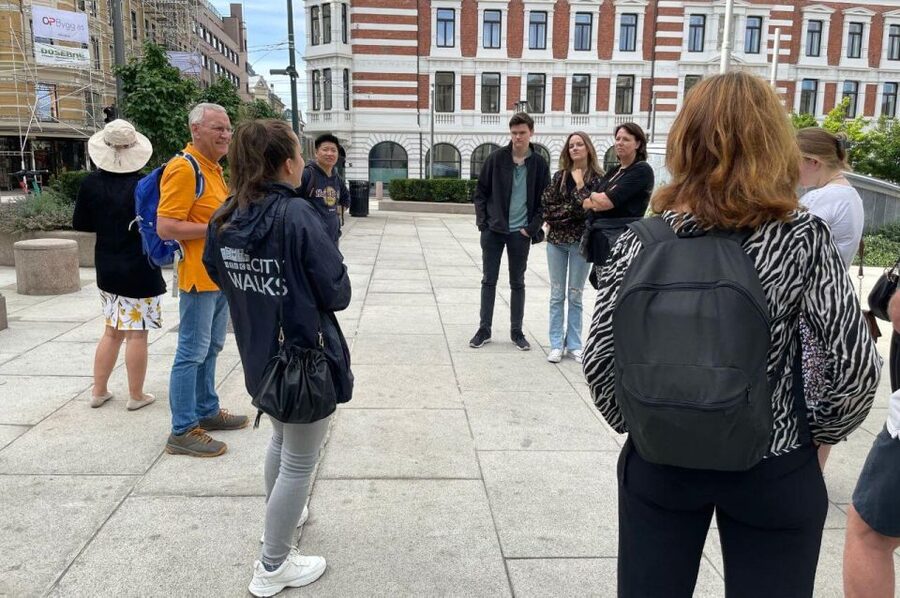
Aker Brygge is described as Oslo’s alternative quarter, and it gives the walk a more relaxed harbor-side finish. Former industrial waterfront areas have become associated with restaurants, bars, shops, and public space. The tour helps you distinguish this district from the older civic center.
Tjuvholmen continues that newer waterfront story. It is a good place to notice how Oslo uses the edge of the fjord for more than shipping and port work. The route passes through the district but does not include admission to attractions.
This is also where practical advice can be most useful. Guides have suggested cafés, restaurants, and places for a good coffee, with W.B. Samson and its cinnamon buns specifically singled out as a worthwhile stop. Take those tips as starting points rather than a fixed food itinerary. The tour itself does not include meals or drinks.
The walk then returns toward the central area, with the Royal Palace, the National Theater, and Karl Johan’s monument included among the stops. The palace is viewed from outside. Its position at the end of the main avenue helps complete the picture of Oslo as a compact capital, with government, culture, commerce, monarchy, and waterfront districts connected by foot.
What the included app adds
After the guided walk, scan the QR code on your voucher to access the sightseeing mobile app. It includes an audio-guided route through additional parts of Oslo, with sights such as Frogner Stadion, Trinity Church, Grensen, Aamodt Bridge, the Norwegian Parliament, and Karl Johan’s monument.
This is a useful extra because the live tour cannot cover every quarter in two hours. You can use the app to keep exploring after the guide has left, particularly if you want a self-guided follow-up rather than another paid activity.
The app does not replace the guide’s ability to answer questions or explain what you are seeing in real time. Its value is flexibility. You can continue at your own pace and choose which additional route sections fit your plans.
Pace, weather, and mobility
The walk is approximately two hours and is designed to keep moving through the central city. Several people have praised the timing and pacing, including one guide who finished exactly on schedule while still allowing questions and recommendations.
The route is generally manageable, but Oslo weather can change quickly. Rain, hail, and snow have not stopped the walk, so bring waterproof layers and shoes with a good grip. A winter visit needs extra thought. Snow and ice may make sidewalks difficult, and one report describes a wheelchair user cutting the walk short because paths were not fully cleared.
The guide can try to accommodate different needs, but this is still an outdoor walking tour across city streets and public spaces. If you use a wheelchair or have limited mobility, contact the provider before booking to ask about current conditions and the route on your date.
Is $38 a fair price?
At $38 per person, the tour is not the cheapest way to see Oslo’s exteriors. You can walk Karl Johan Street and the harbor alone without paying an admission fee. The price makes more sense if you value a live guide who can explain the Nobel connection, Christiania, Norwegian government, city planning, and local customs as you go.
You also receive the sightseeing app, which extends the experience beyond the two-hour walk. That improves the value, especially if you are visiting for a short time and want both a guided introduction and a self-guided option afterward.
The tour does not include public transportation, food, or attraction entry. Keep those costs separate when planning your day. You should also remember that the route passes many buildings rather than taking you inside them.
Who should book this Oslo walking tour?
I would book this for a first or second day in Oslo. It gives you a useful map, helps you decide which museums or neighborhoods deserve more time, and leaves you with café and restaurant suggestions from someone who knows the city.
It suits history fans, first-time visitors, cruise passengers with a short stay, and anyone who prefers a human explanation to a phone map. Families and older visitors may like the steady two-hour format, though winter surfaces require care.
It is less suitable if you want long museum visits, a detailed fortress tour, or a food-focused outing. You should also skip it if you dislike walking in uncertain weather or prefer exploring entirely alone.
At 4.5 out of 5 from 458 ratings, it has a strong record, with the most consistent praise going to the guides’ storytelling, clear English, friendliness, and useful suggestions. The guide can shape the experience, so names such as Minji, Anastasia, Olaf, Oliver, Amelia, Judit, Csilla, and Ihor recur in especially warm feedback, but guide assignments can change.
Final verdict: book it for your first look at Oslo
Book this tour if you want a clear, story-led introduction to central Oslo in two efficient hours. The strongest parts are the links between Christiania, Karl Johan Street, the Nobel Peace Prize, the fortress, and the new waterfront.
Do not book it expecting entry to the Opera House, Cathedral, Akershus Fortress, or other attractions. Instead, use the walk to choose where you want to return. At $38, I think the tour earns its price through the guide’s context, local tips, and the added audio route, especially when Oslo is new to you.
FAQ
How long does the Best of Oslo Walking Tour last?
The guided walking tour lasts approximately two hours.
What languages are available?
The tour is offered in English or German. You select the language when booking.
Where does the English tour meet?
The English tour meets near the statue of P.A. Munch by the Faculty of Law building entrance at University Aula, Karl Johan Street 47.
Where does the German tour meet?
The German tour meets at the Nobel Peace Center at Brynjulf Bulls plass 1.
Where does the tour finish?
The listed drop-off locations are Universitetsplassen and the Nobel Peace Center. The exact finish depends on the option booked.
Does the price include entry to museums or attractions?
No. The tour passes the listed sights, but attraction entry is not included.
Are public transportation tickets included?
No. Public transportation tickets are not included.
Is the sightseeing app included?
Yes. You can scan the QR code on your voucher to access the sightseeing mobile app and its audio-guided route.
What does the app route include?
The self-guided route includes sights such as Frogner Stadion, Trinity Church, Grensen, Aamodt Bridge, the Norwegian Parliament, and Karl Johan’s monument.
How early should I arrive?
You should arrive about five minutes before departure so you do not miss the group leaving.
Just added around the world
- Fira: Guided Foodie Walking Tour with Tastings★ 4.9 · 474 reviews
- Fez: Guided Walking Tour of the Historic Medina★ 5.0 · 359 reviews
- Fez: Walking Tour in the Ancient City of Fez★ 4.8 · 73 reviews
- Faro: Old Town Guided Walking Food Tour★ 4.9 · 94 reviews
- Feel like a local – Walking Tour in Mykonos Town 2hours★ 4.4 · 77 reviews
- Fes: A Guided Walking Tour Through the Historic Medina★ 4.4 · 97 reviews
- Fez: Half-Day City Private Walking Tour with a Guide★ 4.6 · 114 reviews
- Fanal / Assobiadores – Levada Walk★ 4.6 · 93 reviews
Walking Tours, compared.

Magical London: Harry Potter Guided Walking Tour
Read our review →
Reykjavik Food Walk – Local Foodie Adventure in Iceland
Read our review →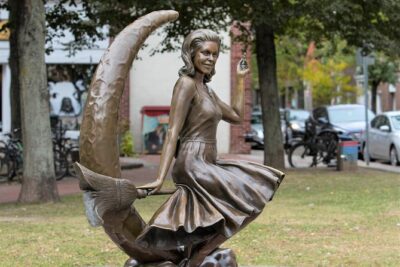
History and Hauntings of Salem Guided Walking Tour
Read our review →
New Orleans Premier Ghost, Voodoo and Vampire Walking Tour
Read our review →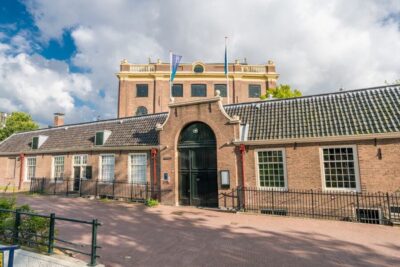
Amsterdam Anne Frank: Small-Group Walking Tour & Local Guide
Read our review →

Edinburgh Castle: Guided Walking Tour with Entry Ticket
Read our review →
Anne Frank’s Story – Guided Walking Tour through Amsterdam
Read our review →Browse the lists this tour appears in