

REVIEW · WALKING TOURS
Jerusalem: Guided Walking Tour of the Old City
Jerusalem’s Old City is best understood on foot, one crowded lane and sacred site at a time. This four-hour walk takes you from Jaffa Gate through all four quarters, linking the Western Wall, Temple Mount, Via Dolorosa, and Church of the Holy Sepulchre to the beliefs and events that give them meaning.
I like the clear religious context and the way the tour brings together Jewish, Muslim, and Christian sites rather than treating them as separate attractions. I also like the steady pace: guides such as Tania, Shahar, Yoni, and Nimrod have been praised for answering questions, telling stories, and keeping groups moving without rushing.
The main drawback is physical: this is a long walk through uneven lanes, stairs, crowds, and heat. Temple Mount access is also restricted on Fridays, Saturdays, and some holidays, so your visit may use a viewpoint instead of entering the Dome of the Rock and Al-Aqsa Mosque.
Key points to know before you book
- Four hours on foot: You cover a lot of ground in the Old City, with little sitting time.
- Three faiths in one walk: Jewish, Muslim, and Christian traditions are explained side by side.
- Major sacred sites: The route includes the Western Wall, Via Dolorosa, Church of the Holy Sepulchre, and Temple Mount area.
- English-speaking guides: Guides including Tania, Shahar, Yoni, Alex, and Nimrod are praised for clear explanations and patient answers.
- Dress matters: Bring covered clothing, a scarf, comfortable shoes, water, and sun protection.
- Temple Mount access varies: On certain days and holidays, you visit an overlook rather than the compound itself.
Starting at Jaffa Gate, where the Old City opens up
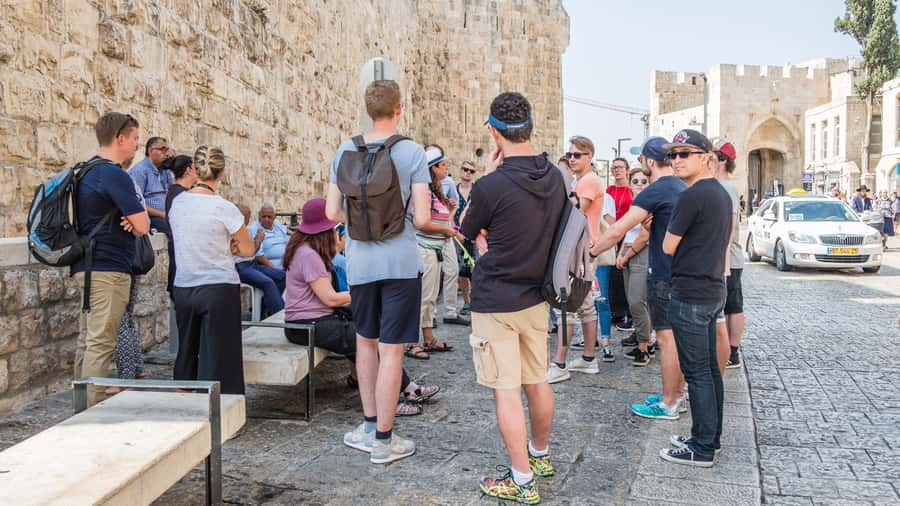
The meeting point is the stone bench just outside Jaffa Gate. Look for a guide in a green shirt with Guide written in yellow on the back.
This is a sensible place to begin. Jaffa Gate is one of the Old City’s main entrances, and it gives you an immediate sense of Jerusalem’s layers. From here, the route moves into the walled city and through its four quarters, with narrow passages replacing ordinary city streets.
You should arrive ready to walk. Four hours may sound manageable, but the Old City has uneven paving, steps, tight lanes, and sudden crowds. Wear shoes with good support, carry water, and bring a hat. Summer heat can make the route feel demanding, although guides have been praised for seeking shade when possible and setting a steady pace.
The tour is in English. The exact guide changes, but the names attached to especially strong tours include Tania, Shahar, Yoni, Alex, Nimrod, Tanya, and others. The best part of the guiding style is not just the number of facts. It is the effort to explain why a place matters to different communities and how one site can carry several meanings at once.
More Old Town Walking Tours in the world:
- Underground Vaults Walking Tour in Edinburgh Old Town
★ 4.5 · 8,506 reviews - Prague: 3-Hour Walking Tour of Old Town & Prague Castle
★ 4.7 · 5,696 reviews - Dubrovnik: Old Town Walking Tour
★ 4.8 · 5,174 reviews
The Jewish Quarter and the Western Wall
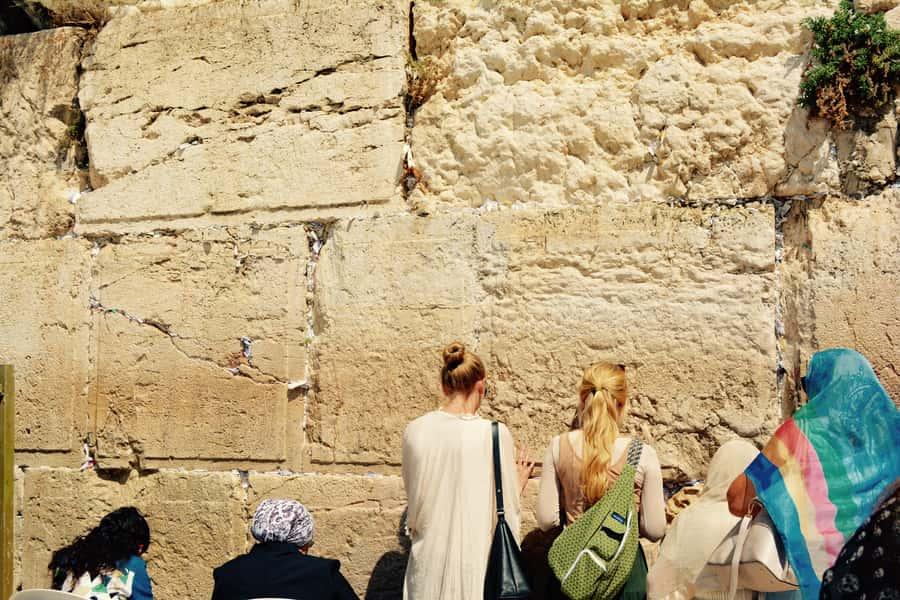
One of the central stops is the Western Wall, also called the Wailing Wall. It is the remaining retaining wall associated with the ancient Jewish Temple complex and one of the most important places in Judaism.
The value of seeing it with a guide is the explanation around the stones. On your own, you can visit the wall, watch people pray, and take in the setting. A guide helps connect the site to the foundations of the Jewish nation, the history of the Temple, and the continuing role of the wall in Jewish life.
The route may also include King David’s Tomb. The tour description places this within the Jewish part of the story, alongside the Western Wall. You will hear how biblical tradition, national identity, and later religious practice meet in Jerusalem.
The Western Wall area is not just a photo stop. It is an active place of prayer, so you should behave quietly and follow local signs and instructions. Clothing should be respectful and cover your shoulders and legs. The stated requirements rule out shorts and sleeveless shirts, so dress with the most conservative sacred sites in mind from the start.
A useful strength of the tour is the chance to ask questions. Guides such as Shahar and Tania have been praised for patient explanations, while Yoni has been singled out for showing visitors a special spot near the wall. The exact route and access can change, but a good guide can make this stop far more meaningful than a quick look and a photograph.
Temple Mount, the Dome of the Rock, and Al-Aqsa Mosque
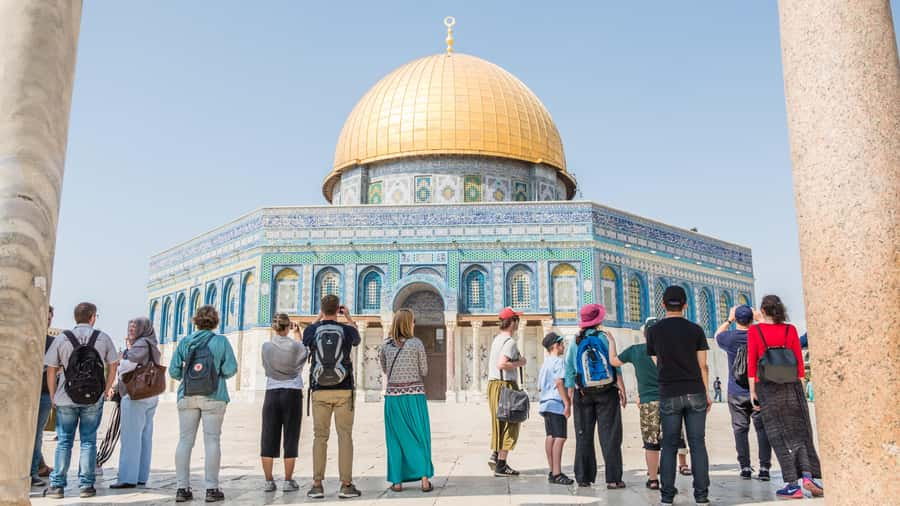
Temple Mount is the point where Jerusalem’s religious and political meaning becomes especially intense. For Muslims, the compound includes the Dome of the Rock and Al-Aqsa Mosque, and it is connected to the Prophet Mohammed’s ascent to heaven. For Jews, the same area is tied to the ancient Temple. The site is also central to the city’s wider religious story.
The tour explains the Muslim traditions connected to the area, including the Five Pillars of Islam. That broader context matters because the Dome of the Rock is not simply an impressive building. Its meaning reaches into Islamic belief, Jewish history, and the long contest over Jerusalem’s holy places.
Here you need to read the conditions carefully. Temple Mount, including the Dome of the Rock and Al-Aqsa Mosque, is closed to visitors every Friday and Saturday, as well as during various Muslim and Jewish holidays. On those days, the tour includes a viewpoint overlooking the compound instead.
That change is not a minor detail if entering the site is a priority for you. The viewpoint still helps you understand the layout and see the buildings, but it is not the same experience as being inside the compound. Check the available date and current access conditions before booking if this is one of your main reasons for taking the tour.
The area also calls for modest clothing. Bring a scarf, and do not rely on being able to borrow or buy suitable clothing at the last minute. The tour is not designed for visitors with mobility impairments or wheelchair users, and Temple Mount access rules can add another layer of practical difficulty.
Walking the Via Dolorosa
The Via Dolorosa is one of the most emotionally charged parts of the walk for Christian visitors. This is the route associated with Jesus carrying the cross toward crucifixion, and it passes through the Old City’s lanes rather than a quiet museum setting.
That is part of its power. Shops, residents, worshippers, stone walls, and groups moving in both directions all share the same narrow streets. The experience can feel crowded and intense, but that is also what makes the route feel connected to daily Jerusalem rather than sealed away for display.
Your guide puts the biblical stories into place as you walk. Instead of hearing only a general account, you are shown where the traditions are located and how the route leads toward the Church of the Holy Sepulchre. The tour also discusses the discovery of the True Cross, one of the Christian subjects included in the wider explanation.
This section may be especially rewarding if you are visiting Jerusalem for religious reasons. It also works for nonreligious visitors because the guide explains the cultural and historical weight of the route rather than assuming that everyone shares the same beliefs.
Weather can change the mood quickly. In hot weather, the walk may be tiring, though shade is sometimes used for stops. In wet weather, the lanes can become slippery and difficult. One group completed the route during a severe storm, which sounds dramatic, but it also underlines the practical point: bring suitable shoes and do not expect the Old City to pause for bad weather.
More Guided Tours in the world:
- Magical London: Harry Potter Guided Walking Tour
★ 4.7 · 22,044 reviews - History and Hauntings of Salem Guided Walking Tour
★ 5.0 · 14,564 reviews - Amsterdam Anne Frank: Small-Group Walking Tour & Local Guide
★ 4.8 · 12,789 reviews - Edinburgh: Harry Potter Magical Guided Walking Tour
★ 4.8 · 11,944 reviews
Inside the Church of the Holy Sepulchre
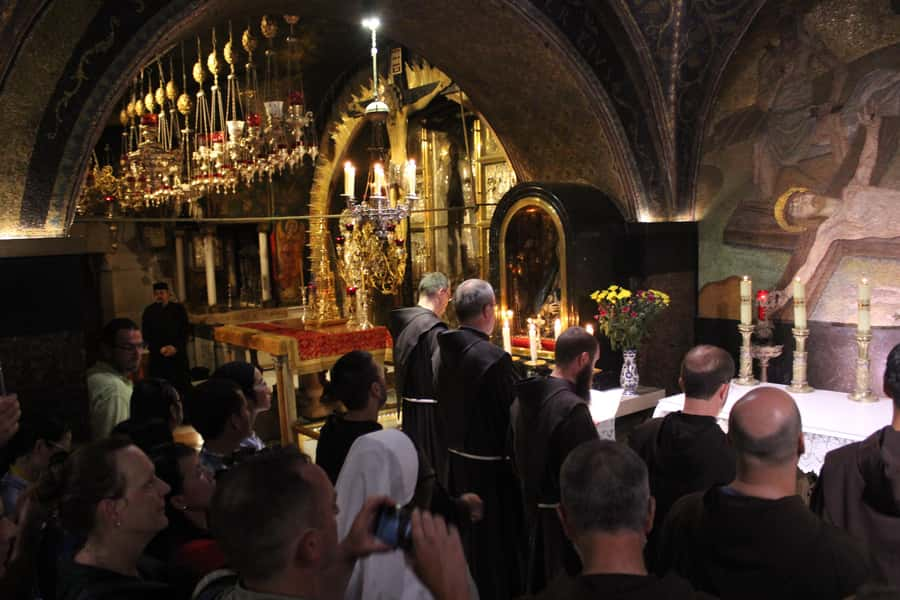
The Church of the Holy Sepulchre is a major highlight and one of the places where the tour’s religious focus comes together. It is associated with the crucifixion, burial, and resurrection of Jesus, and it contains several important areas within one complex.
The visit may include the slab where Jesus’s body was laid after the crucifixion. The guide explains the traditions connected with the church and helps you understand why different Christian communities care for different parts of the building.
This is not a polished, single-story attraction. The church can feel complicated, crowded, and visually dense. That makes a guide useful. Without context, you may see chapels, altars, stone surfaces, and worshippers without knowing how the pieces fit together. With an explanation, the building becomes easier to read.
Allow yourself to be patient here. Entry, movement, and viewing conditions can depend on activity inside the church. The tour gives you an introduction, but four hours cannot provide unlimited time at every site. If you want long periods for private prayer or detailed photography, you may need to return on your own later.
Why the four-quarter route works
The Old City is often described through its Jewish, Muslim, Christian, and Armenian quarters. This walk is useful because it gives you a broad first look rather than confining you to one religious route.
The transitions between quarters are part of the experience. You move from one community’s sacred places to another’s, often within a short distance. That physical closeness helps explain why Jerusalem can feel so compelling and so difficult to summarize.
The guide’s role is to keep the route from becoming a list of disconnected buildings. Strong guides have been praised for balancing history with religion, avoiding political speeches, and making the information understandable to a mixed group. That balance matters here. Jerusalem can quickly become overwhelming if every stop is presented as a separate argument. The better approach is to explain the different traditions clearly and let you think about the relationships between them.
This is also a useful first-day activity. It gives you a map of the Old City and introduces the places you may want to revisit. You can then return to the Western Wall, Church of the Holy Sepulchre, markets, or other areas with a better sense of direction.
What the guides do best
The guide can make or break a history-heavy walk, and this experience has a strong record in that area. Tania is repeatedly praised for clear English, calm delivery, and the ability to answer unexpected questions. Shahar is noted for humor, energy, and careful attention to the group. Yoni is praised for his command of Jerusalem’s sites and for keeping the tour interesting.
Other guides, including Alex, Nimrod, Tanya, Shimon, Nirit, Orna, Hagar, and Dror, have also led highly rated walks. The common thread is a style that mixes facts with stories and leaves room for questions.
You should still expect a group tour, not a private lesson. The pace must suit several people, and time at each site is limited. Some guides may spend more time on Christian subjects because the Via Dolorosa and Holy Sepulchre form a major part of the route. The tour does visit all four quarters, but the balance may feel more Christian-focused to some visitors.
The strongest fit is someone who wants orientation, context, and a lively introduction. If you already know the Old City well or want an academic study of one tradition, a shorter private visit to a particular site may suit you better.
Is $57 a fair price?
At $57 per person, the tour is priced as a midrange half-day introduction. You are paying for four hours of guiding, route planning, site context, and the ability to ask questions while moving through an area that can be confusing on your own.
There is no food or drink included. That is easy to manage, but carry water and plan to eat before or after the walk. The activity does not include transport, and the meeting point is at Jaffa Gate, so you need to make your own way there.
I see the value in booking this early in a Jerusalem visit. The Old City is compact on a map but not always easy to follow in person. A capable guide can save you time, explain what you are seeing, and help you avoid treating major sacred sites as quick photo stops.
The value is lower if your main goal is simply to enter Temple Mount on a particular date. Access is not guaranteed because of the closure schedule. It is also lower if you cannot comfortably walk for four hours or need wheelchair access.
Free cancellation up to 24 hours before the start and reserve-now, pay-later booking make it easier to fit the activity into a changing itinerary. Check the starting time when booking, since availability determines the schedule.
Who should book this Old City walk?
I would choose this for a first visit to Jerusalem, especially if you want the major sites explained in one organized route. It suits history-minded visitors, religious pilgrims, families with older children who can manage the walking, and anyone who prefers asking questions instead of reading signs alone.
It is also a good match for visitors who want to see how the city’s communities and traditions overlap. The tour does not promise a quiet or polished experience. It gives you crowded lanes, active places of worship, strong emotions, and a lot of information in four hours.
I would think twice if you dislike walking on uneven ground, need frequent rest, or want extended time inside each church or shrine. The Old City is demanding under the best conditions, and the clothing rules and Temple Mount restrictions require some planning.
Should you book it?
Book this tour if you want a well-paced introduction to Jerusalem’s Old City and the chance to connect the Western Wall, Temple Mount, Via Dolorosa, and Church of the Holy Sepulchre in one morning or afternoon. The guide’s explanations are the main value, with Tania, Shahar, Yoni, and other named guides earning praise for clear English, patience, humor, and strong command of the subject.
Before booking, check the date against Temple Mount closure days, pack water and modest clothing, and be honest about your ability to walk for four hours. If those points work for you, this is a practical way to get your bearings and understand why Jerusalem’s most important sites sit so close together.
FAQ
How long is the Jerusalem Old City walking tour?
The tour lasts four hours.
Where does the tour meet?
Meet at the stone bench just outside Jaffa Gate. Look for a guide wearing a green shirt with Guide written in yellow on the back.
What language is the tour in?
The live guided tour is conducted in English.
What sites are included?
The route includes the Western Wall, Temple Mount or a viewpoint overlooking it, the Via Dolorosa, and the Church of the Holy Sepulchre. The wider walk covers the Old City’s four quarters and includes other religious and historic sites.
Can I visit the Dome of the Rock and Al-Aqsa Mosque?
Access is not available every day. Temple Mount, including the Dome of the Rock and Al-Aqsa Mosque, is closed to visitors every Friday, Saturday, and during various Muslim and Jewish holidays. A viewpoint is used instead on those dates.
What should I bring?
Bring comfortable shoes, a sun hat, water, a scarf, and your passport. A copy of your passport is accepted.
Is food or drink included?
No. Food and drinks are not included.
What clothing is required?
Shorts and sleeveless shirts are not allowed. Wear modest clothing suitable for visiting Jewish, Muslim, and Christian holy sites.
Is the tour suitable for wheelchair users?
No. The activity is not suitable for wheelchair users or people with mobility impairments.
Can I cancel the booking?
Yes. You can cancel up to 24 hours in advance for a full refund. You can also reserve now and pay later.
Just added around the world
- Nahargarh Water Walk – Guided 2-Hour Heritage Tour in Jaipur★ 5.0 · 89 reviews
- Downtown Fernandina Historical Walking Tour★ 4.5 · 119 reviews
- Cultural Walk and Food Tasting In Jaipur★ 5.0 · 118 reviews
- Local Food, History and Hidden Places Walking Tour in Istanbul★ 4.5 · 81 reviews
- Old Town Of Istanbul Orientation – Tip Based Walking Tour★ 5.0 · 181 reviews
- Istanbul Private Walking Highlights Tour★ 5.0 · 102 reviews
- Full Day Historical Walking Tour of Istanbul Old City from Hagia Sophia★ 4.5 · 114 reviews
- Half day Fener-Balat Walking Tour in Turkiye★ 5.0 · 308 reviews
Old Town Walking Tours, compared.

Underground Vaults Walking Tour in Edinburgh Old Town
Read our review →
3-Hour Walking Tour of Old Town & Prague Castle
Read our review →


Old Town and Jewish Quarter Guided Walking Tour
Read our review →
Marrakech: Ben Youssef, Secret Garden, & Souks Walking Tour
Read our review →Browse the lists this tour appears in