
REVIEW · SEVILLE
Cultural Walking Tour of Seville Monumental
Seville’s grandest sights line up neatly on this two-hour walking route, from Plaza Nueva to Plaza de España. You’ll get the story behind the Cathedral, Giralda, Alcázar, Torre del Oro, and the city’s grand 1929 exhibition grounds without paying entry fees at every stop. Guides such as Fernando, Lydia, Francisco, and Valentin are praised for making the past clear, lively, and easy to follow.
I like the very low $8.45 price and the way the tour helps you choose where to spend more time later. I also like the finish at Plaza de España, where you can keep exploring after the guide leaves. The main drawback is that admission to the Cathedral, Giralda, Alcázar, Archivo de Indias, Torre del Oro, and other paid sights is not included, and a large group may make the guide hard to hear.
Key points to know before you book
- Starts in Plaza Nueva: Meet at Seville’s City Hall before groups are divided by language and guide.
- Covers the major monumental zone: The route includes the Cathedral, Giralda, Alcázar, Archivo de Indias, Torre del Oro, Plaza de España, and several important squares and buildings.
- English guide, about two hours: Guides including Fernando, Lydia, Francisco, and Valentin have been singled out for humor, energy, and strong local knowledge.
- A sightseeing walk, not an entry tour: You learn about the monuments from outside, with admission tickets not included at most stops.
- Easy orientation for a first day: The route is not demanding, and it gives you a useful plan for returning to the places that catch your eye.
- Small price, potentially large group: The maximum is 35 people, though language splits can sometimes create a smaller English group.
Why this works well as a first Seville walk
Seville can feel like a puzzle of courtyards, old walls, broad avenues, and sudden grand squares. This tour gives you the outline quickly. In two hours, you move from the central Ayuntamiento to the Cathedral quarter, along the old riverfront, past landmarks tied to Spain’s overseas empire, and finally into María Luisa Park and Plaza de España.
That order matters. You are not simply ticking off monuments. You are following the city’s political, religious, commercial, and architectural story. Islamic Seville appears in the Giralda. Royal Seville appears at the Alcázar. Imperial Seville appears in the Archivo de Indias. River trade comes into view at the Torre del Oro. The final stop shows the city presenting itself to modern Spain at the 1929 exposition.
I would take this walk near the beginning of a stay. Several guides give practical suggestions for what to do after the tour, and the route lets you mark the places worth a longer visit. One person who joined near the end of a stay still found it useful, but the value is greater when you can act on those first impressions.
The route is also a good fit if you are not looking for a strenuous outing. The walk itself is described as comfortable and manageable for people with lower fitness levels. Seville’s heat can still make any daytime walk tiring, so check the forecast and bring water, especially in warmer months.
More Cultural Walking Tours in Spain:
- Savannah First Squares Culinary & Cultural Walking Food Tour
★ 5.0 · 3,229 reviews - Tokyo Tsukiji Fish Market Food and Culture Walking Tour
★ 5.0 · 3,184 reviews - New Orleans French Quarter, Voodoo and Culture Walking Tour
★ 4.5 · 2,961 reviews
Plaza Nueva sets the tone
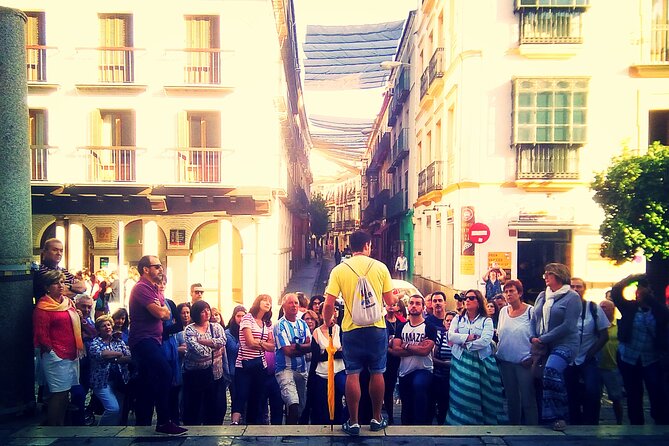
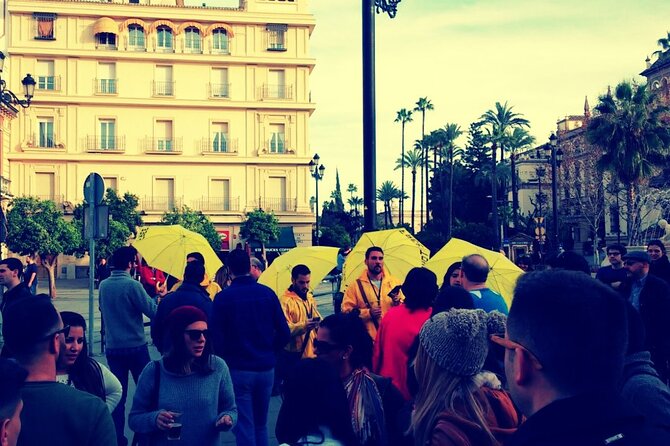
The meeting point is Plaza Nueva, in front of Seville’s City Hall. This is where the guide introduces the visit, explains what you will see, and divides the group by language and guide.
That opening is more useful than it may sound. It gives the guide a chance to set the city’s timeline before you reach the main monuments. It also helps sort out the practical matter of who is following which guide. English is offered, and the maximum group size is 35 people, though the English section may be smaller when several languages run at once.
Look for the exact meeting instructions supplied with your booking. The stated start point is Ayuntamiento de Sevilla, Plaza Nueva 1. Arrive with enough time to find the group, since a central square can be crowded and the tour begins with introductions rather than a long wait.
The Cathedral and Giralda: Seville’s layered center
The Cathedral is the first major stop, with about 20 minutes devoted to its story. It is presented as the world’s largest Gothic cathedral, and its scale is hard to grasp from a quick glance. The guide helps explain why this building became such a powerful symbol of Seville.
The important point for your budget is that entry is not included. The walking tour gives you an introduction from outside, but you need a separate ticket if you want to go inside the Cathedral.
The nearby Giralda receives about 10 minutes. This is the former Islamic section of the Cathedral complex and one of Seville’s most familiar symbols. The contrast between the tower’s Islamic origins and its later Christian role gives the guide a natural way to explain how Seville changed hands and faiths over time.
You should not confuse seeing the Giralda on this tour with climbing or entering it. The itinerary lists admission as not included. If the tower or Cathedral becomes a priority, note it for a separate visit.
The walk also pauses in one of the busy squares near the Cathedral, where the guide explains the wider setting of the religious complex. This is a useful moment to stop looking only at the façade and understand how the Cathedral, Giralda, Alcázar, and surrounding squares work together as Seville’s historic core.
The Alcázar and Archivo de Indias
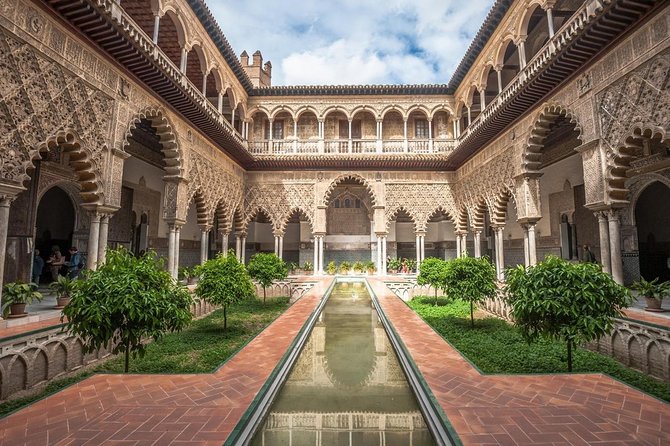
The Real Alcázar gets around 15 minutes. It is described as Seville’s oldest and most visited monument, and even a short exterior explanation can help you understand why it deserves more time. The Alcázar is part of the same monumental cluster as the Cathedral and Archivo de Indias, so the tour gives you the essential geography before you decide how to arrange your own visit.
Again, admission is not included. If you want the palace interiors and gardens, plan a separate paid visit. The walking tour is best viewed as a preview and orientation, not a substitute for entering.
The guide then places you in the city’s most important historic square, the setting where much of old Seville’s public life developed. From here, you can see the Real Alcázar, Cathedral, and General Archive of the Indies connected within one compact area.
The Archivo General de Indias receives about 15 minutes. Its importance comes from the documents held inside, more than four centuries of material connected with the colonization of the Americas. This stop adds an international scale to the story. Seville was not only a royal and religious center. It was also tied to shipping, administration, money, and Spain’s control of overseas territories.
The archive’s admission is not included either. I like this part of the route because it stops the tour from becoming a procession of pretty façades. You get a sense of the machinery behind Seville’s power, even if you do not enter the building.
A few more walking tours around Spain worth a look
- Barcelona Tapas and Wine Experience Small-Group Walking Tour
★ 5.0 · 5,804 reviews - Barcelona: Tapas Walking Tour with Food, Wine, and History
★ 4.8 · 4,261 reviews - Madrid Tapas & Wine Tasting Walking Tour – Small Group Local Bars
★ 5.0 · 3,644 reviews - Granada: Albaicín and Sacromonte Guided Sunset Walking Tour
★ 4.9 · 2,962 reviews
Puerta de Jerez and the riverfront
The route continues toward Puerta de Jerez, the site associated with one of the old access points through Seville’s walls. The gate led toward Jerez de la Frontera and marked an important route into and out of the city.
This is the kind of stop that can be easy to miss on your own. There may not be a single interior attraction to visit, but the location helps you read Seville as a walled city with controlled entrances. It also marks the shift from the Cathedral quarter toward the river and the newer ceremonial parts of the city.
At the Torre del Oro, the focus turns to the Guadalquivir River. The tower is linked with the Puerta and Puerto de Indias, navigation, control, and surveillance. In plain terms, this is where the guide connects Seville’s waterway to trade and defense.
The tower’s admission is not included. You will have time to see it as part of the walk, but the tour does not provide the museum visit inside. If river traffic, military buildings, or Seville’s overseas connections interest you, this is another place to mark for later.
The Alfonso XIII Hotel and former tobacco factory
The Hotel Alfonso XIII is a brief 10-minute stop. It is one of the city’s best-known luxury hotels and a striking example of Seville’s grand public image. The building is connected with the city’s ceremonial side, where architecture was designed to impress visiting royalty and important public figures.
You will not be checking into the hotel as part of this walk, and admission is not included. The value here is in understanding the building’s place within Seville’s collection of grand landmarks. One person who took the tour specifically appreciated learning more about the costly hotel and its royal suites.
Next comes the Real Fábrica de Tabacos, with about 10 minutes. The former tobacco factory was an economic engine for Seville in the 18th century. This stop adds working life to a route otherwise dominated by palaces, churches, archives, and formal squares.
The building’s story also shows how tobacco, labor, and international trade shaped the city. You get a quick look at the economic side of Seville before the tour reaches its most theatrical architectural stop.
Plaza de España is the grand finish
The tour ends at Plaza de España, with about 10 minutes set aside for the monument. Admission is free, and the setting gives the walk a satisfying finish. Built as Spain’s pavilion for the 1929 exposition, the plaza presents a highly staged version of the country, with tiled details and regional references arranged around a broad architectural curve.
This is not just a final photo stop. It is also a good place to continue on your own. The route ends here rather than sending you back to Plaza Nueva, so you can remain in the area and explore the surrounding park.
I especially like that the tour ends at a location worth lingering over. You are not rushed onto public transport or dropped beside a plain street. The final stop gives you a clear next step: walk around the plaza, spend time in the park, or return later for a quieter look.
The guides make the difference
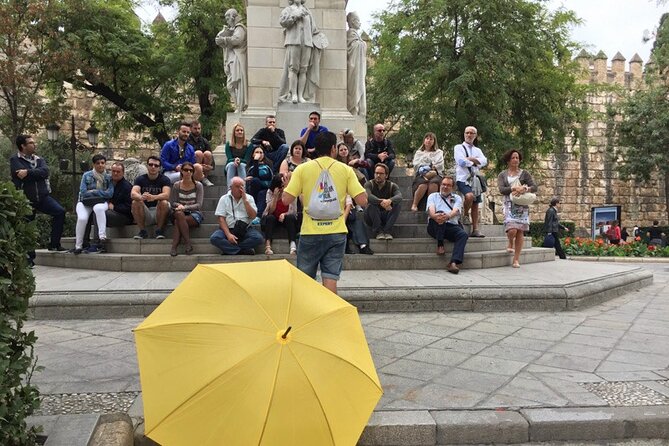
The strongest part of this experience is the guiding. Fernando is repeatedly praised for clear explanations, energy, and a playful way of presenting history. Lydia is described as enthusiastic and friendly, while Francisco is noted for combining information with humor. Valentin is especially effective with families, keeping teenagers engaged through history, local culture, and personal stories.
That does not mean every departure will feel identical. The guide is a major part of the experience, and delivery can vary. Several people found the pacing comfortable, with the guide waiting for the group to gather before speaking. One person felt the explanations became too long at times, so you should expect a talk-led walk rather than a fast photographic circuit.
Sound is the practical weakness to watch. City noise and a group of up to 35 can make it hard to hear, and more than one person suggested that a microphone would help. Stay near the guide when possible, especially at busy squares and along the river.
Some guides use photographs on a phone to explain how places looked or what details matter. That can be useful, but it works best when the group is small enough for everyone to see. If the English group is split down to only a few people, the experience can feel almost personal. If all language groups are large, hearing every word may take more effort.
What $8.45 really buys you
At $8.45 per person, this is unusually inexpensive for a two-hour guided introduction to Seville’s main monumental district. The price is not buying entry to the Cathedral, Alcázar, Giralda, archive, or Torre del Oro. It is buying a route, a historical framework, and a guide who helps you decide where your paid time should go.
That is good value if you are arriving in Seville without a plan. You can see the outside of many major sights in one morning and avoid spending your first day working out the city’s layout. The cost is also low enough that the tour works well as a starting point before booking separate admission visits.
The value is weaker if you want long interior visits or detailed art commentary. Two hours cannot cover the Cathedral, Alcázar, and archive from inside, and this experience does not pretend to do so. You will need additional time and admission money for the monuments that interest you most.
The tour is booked, on average, about 15 days ahead. That does not guarantee every departure will sell out, but it is a sensible reason to reserve before arriving if the schedule matters to you.
Who should take this walking tour?
I would choose it for a first morning or first afternoon in Seville, especially if you want a broad picture before committing to individual monuments. Families can benefit from the movement between landmarks, and Valentin’s style has worked well with children and teenagers. People who prefer a gentle pace should also find the walk manageable.
It suits history-minded visitors particularly well. The route links Islamic Seville, Christian power, royal administration, overseas colonization, river trade, industry, luxury hospitality, and modern national display. You get more than a string of famous buildings.
It is less suitable if you already know Seville’s center well or have already visited every stop. It may also disappoint you if you expect to enter the Cathedral or Alcázar during the two hours. Treat it as a guided introduction, then build your own visits around it.
You receive confirmation when booking. Service animals are allowed, public transport is nearby, and most people can participate. Free cancellation is available up to 24 hours before the start time. A full refund is offered if poor weather or an insufficient number of participants causes the tour to be canceled.
Should you book the Seville Monumental Walking Tour?
Book it if you want a low-cost orientation with a real historical thread. The route covers an impressive number of major sights, ends at Plaza de España, and gives you practical clues about where to return. The best guides, including Fernando, Lydia, Francisco, and Valentin, add humor and clear explanations that can turn a quick walk into a useful introduction.
Skip it if your main goal is interior access or specialist detail. You will pay separately for the major monuments, and a large group may make the guide difficult to hear. For most first-time visitors, though, $8.45 is a small price for seeing Seville’s monumental center in context and deciding what deserves the rest of your time.
FAQ
Where does the Cultural Walking Tour of Seville Monumental begin?
It begins at Ayuntamiento de Sevilla, Plaza Nueva 1, in Seville’s historic center.
Where does the tour finish?
The tour ends at Plaza de España.
How long does the walking tour last?
It lasts approximately two hours.
Is the tour offered in English?
Yes. The experience is offered in English, and groups are divided by language and guide at the start.
Are monument admission tickets included?
No. Admission is not included for the Cathedral, Giralda, Real Alcázar, Archivo General de Indias, Torre del Oro, Hotel Alfonso XIII, or Real Fábrica de Tabacos. Plaza Nueva and Plaza de España are listed as free stops.
What happens if I need to cancel?
You can cancel up to 24 hours before the start time for a full refund. Changes or cancellations made less than 24 hours in advance are not accepted for a refund.
Just added around Spain
- English Cádiz Tour: Walking Tour with Local Guide★ 4.7 · 431 reviews
- Corralejo: Walking tour with tastings of local products★ 4.9 · 237 reviews
- Patios of Cordoba Walking Tour★ 4.4 · 199 reviews
- Cordoba: Monuments Walking Tour★ 4.8 · 479 reviews
- Cartagena: Ancient Roman Walking Tour with Entry Tickets★ 4.5 · 89 reviews
- Cartagena: Guided Walking Tour with Tapas and Drinks★ 4.6 · 143 reviews
- Cáceres: City Highlights Walking Tour with Local Guide★ 4.9 · 72 reviews
- Bilbao: San Juan de Gaztelugatxe and Walk along Basque Coast★ 4.9 · 114 reviews
Cultural Walking Tours, compared.

Savannah First Squares Culinary & Cultural Walking Food Tour
Read our review →
Tokyo Tsukiji Fish Market Food and Culture Walking Tour
Read our review →
New Orleans French Quarter, Voodoo and Culture Walking Tour
Read our review →
Southernmost Food & Cultural Walking Tour by Key West Food Tours
Read our review →
Valletta: Street Food and Culture Walking Tour
Read our review →
Lisbon Roots – Small group Food & Culture Walking Tour w/tastings
Read our review →

Nice Old Town and Castle Hill: Guided Cultural Walking Tour
Read our review →Browse the lists this tour appears in