
REVIEW · BORDEAUX
Bordeaux: Guided Walking Tour
Bordeaux reveals its character through contrasts: grand neoclassical squares open into narrow Saint-Pierre lanes, while elegant façades give way to small shops and lively streets. This walking tour connects those pieces with the story of a city shaped by trade, Enlightenment ideas, wine, and a major urban makeover.
I like the route for two reasons. First, it gives you the key sights without turning the morning into a museum marathon. Second, guides such as Bruno, Alcide, Christine, and Véronique have been praised for explaining balconies, statues, street plans, and local food and wine in a friendly way. The main drawback is the bilingual format. If French and English are mixed in one group, every explanation takes longer and you may hear less detail than on an English-only walk.
Key points at a glance
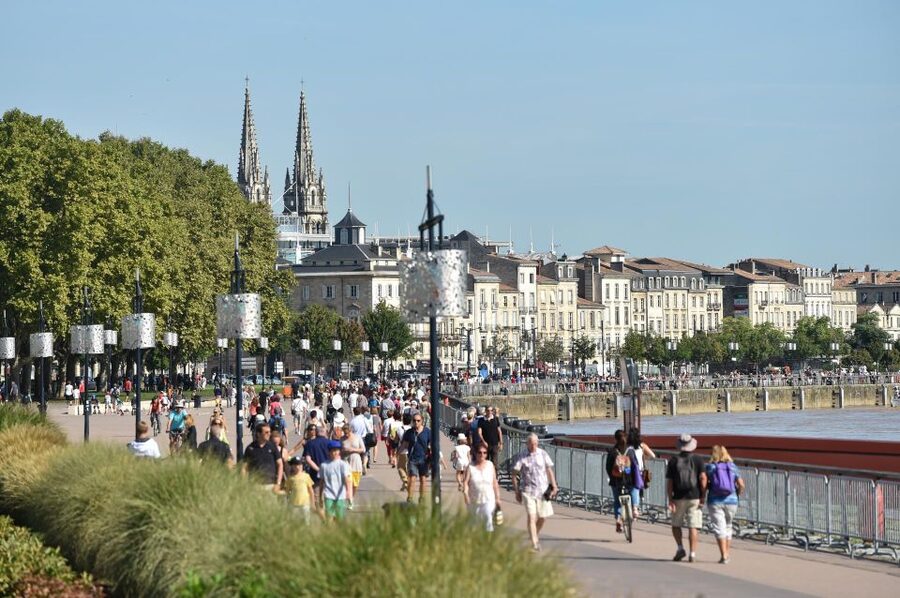
- Place des Quinconces: See one of Europe’s largest public squares and the Monument aux Girondins.
- From grand avenues to old lanes: Follow Bordeaux’s shift from planned 18th-century elegance to the intimate Saint-Pierre district.
- Miroir d’eau: Visit the reflecting pool beside Place de la Bourse, one of the city’s most recognizable scenes.
- Architecture with meaning: Learn to read balconies, carved figures, window details, fountains, and façades.
- Bilingual timing matters: Morning departures are in French and English, while Saturday afternoon departures are French only.
- Good first-day orientation: The tour covers major central sights and often includes practical food, wine, and sightseeing advice.
Starting beside the Bordeaux Tourist Office
The meeting point is outside the Bordeaux Tourist Office on Cours du 30 Juillet. Arrive at least 10 minutes early, with your printed or downloaded ticket ready for each person in your party.
The location is useful because you begin near Bordeaux’s formal center rather than at a distant attraction. From here, the route can quickly introduce you to the broad avenues, grand public buildings, and carefully planned squares that give central Bordeaux its distinctive look.
The walk lasts between 105 minutes and two hours. That is long enough to build a clear picture of the city, but short enough to fit before lunch, a museum visit, or a wine tasting. You are on foot the entire time, so wear comfortable shoes. Large bags and luggage are not allowed, which matters if you are arriving directly from a train or checking out of a hotel.
The exact stop order can vary, but the walk moves between large public spaces and the older street network. That change of scale is the key to understanding Bordeaux. One minute you are looking across an enormous square; soon after, you are following a paved lane where the buildings sit close together.
More Guided Tours in France:
- Paris Top Sights Half Day Walking Tour with a Fun Guide
★ 5.0 · 2,893 reviews - Paris: Montmartre Highlights Walking Tour with a Local Guide
★ 4.9 · 2,318 reviews - Paris: Montmartre Cheese, Wine & Pastry Guided Walking Tour
★ 4.8 · 2,255 reviews
Place des Quinconces and Bordeaux’s grand scale
Place des Quinconces is one of the first major sights to put Bordeaux in perspective. It is one of the largest squares in Europe, with broad open space and a strong connection to the city’s 18th-century planning.
The square is also home to the Monument aux Girondins, a dramatic memorial and fountain complex. The guide uses this area to explain Bordeaux’s civic identity and the events that shaped its public spaces. It is not simply a photo stop. The monuments and surrounding avenues help show how Bordeaux presented itself as a powerful, orderly port city.
The size of the square can make a group feel scattered, especially if the guide is speaking without an audio system. Some departures have used a Bluetooth listening system, which can help you hear while standing at the rear. Still, rain, traffic, and a large group can make listening harder.
Give yourself a few minutes to look around between explanations. Place des Quinconces works best when you notice the distance between the monument, the trees, the avenues, and the buildings beyond. The guide adds the detail that turns a wide open space into a readable part of Bordeaux’s story.
The Grand Théâtre and the city of the Enlightenment
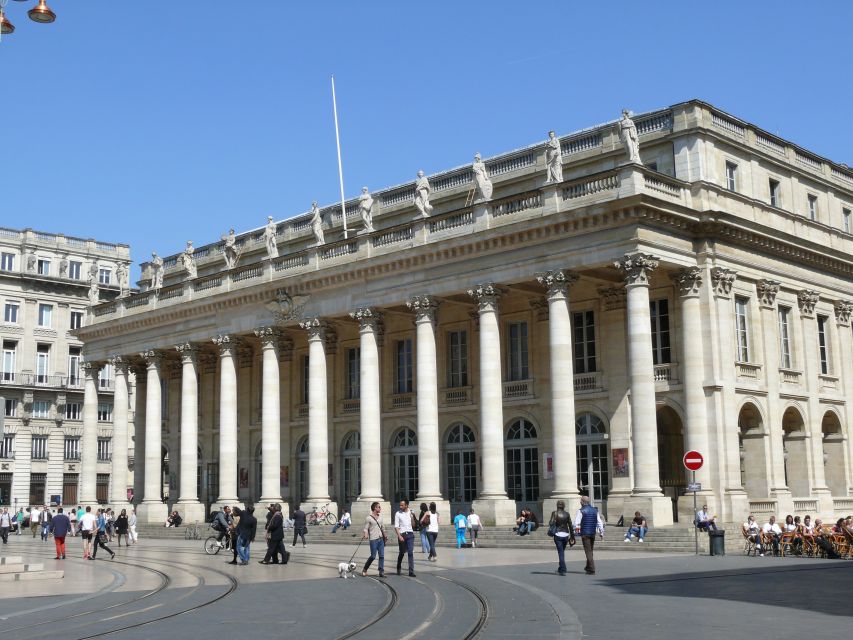
From the open scale of Place des Quinconces, the route leads toward the Grand Théâtre and the more formal heart of the city. This section focuses on Bordeaux’s classical architecture and the planners who reshaped the city during the Enlightenment.
The value here is not only seeing an impressive theater façade. You begin to understand the urban plan around it: wide streets, orderly façades, public squares, parks, and fountains arranged to create a sense of confidence and control.
The tour also links the physical city to the philosophers and political thinkers who influenced Bordeaux. You may hear how Enlightenment ideas affected public life and urban design, rather than receiving only a list of dates and famous names.
This is one of the better reasons to take the walk early in your stay. A guide can point out patterns you might miss on your own, including the relationship between private mansions, civic buildings, and public space. Afterward, you can return to the same streets with a clearer eye.
Reading balconies, façades, and private mansions
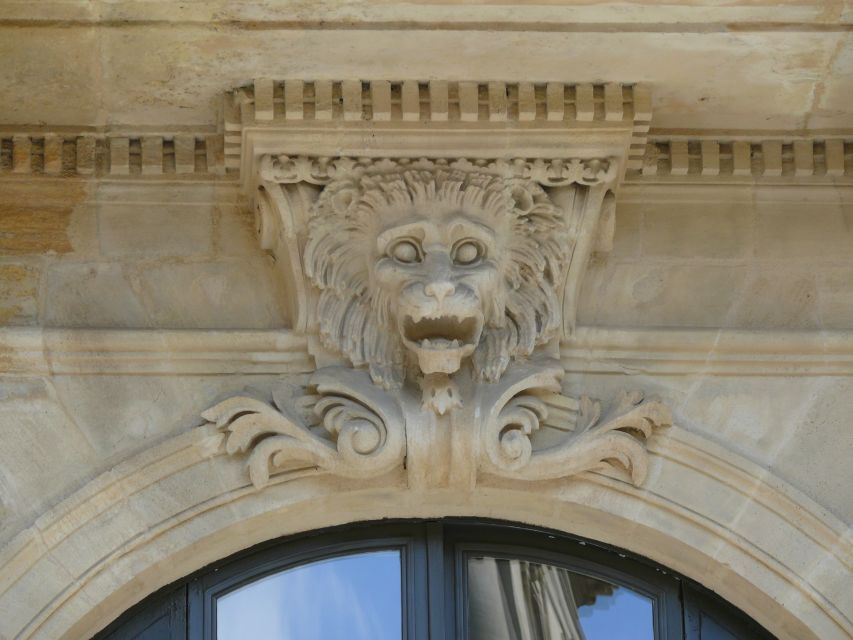
Bordeaux rewards slow looking. The stone buildings may seem uniform at first, but details reveal differences in status, period, and purpose.
Guides on this walk have explained why balconies use different designs and what carved figures and symbols around windows represent. Those details give you a practical way to read the city. Instead of seeing a row of handsome façades, you can start asking why one building has a grand entrance, why another has a simpler balcony, or how decorative features signal wealth and taste.
The walk passes theaters, town halls, and private mansions, with squares and fountains breaking up the streets. You are not going inside every building, so this is not the right choice if you want lengthy interior visits. Its strength is the street-level view, with explanations delivered where the architecture makes sense.
I especially like this approach for a short stay. A guide can cover many details in two hours without asking you to commit to a full-day architectural program. The tradeoff is that the information comes quickly. If you want to photograph every façade or take notes, you may need to catch up with the group.
A few more walking tours around France worth a look
- Montmartre Hidden Gems and Scenic Highlights Walking Tour
★ 5.0 · 2,684 reviews - Montmartre Hill French Gourmet Food and Wine Tasting Walking Tour
★ 5.0 · 2,588 reviews - Paris Île de la Cité and Notre-Dame Walking Tour With Crypt
★ 5.0 · 2,272 reviews - Paris in a Day: Louvre or Orsay, Eiffel Tower, City Walk & Cruise
★ 5.0 · 1,956 reviews
Saint-Pierre and the narrow streets of the Old Town
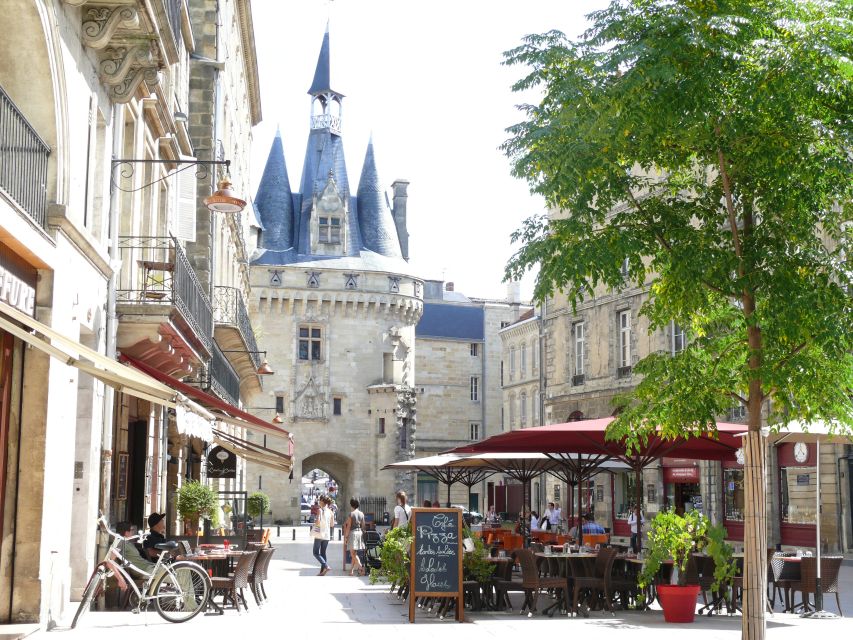
The move into Saint-Pierre changes the mood. Wide avenues give way to narrow paved streets, older buildings, small shops, and a more intimate sense of the city.
This is often the most enjoyable part of the walk because Bordeaux feels less formal here. You see how the historic center works at street level, not just how it looks from a grand square. The guide places the lanes in context, explaining how the old district fits into the city’s wider development.
You should expect a guided introduction rather than free time to browse. The group keeps moving, and the guide may stop in suitable spots to explain the street layout or point out architectural details. Mark down places that interest you, then return later at your own pace.
The Saint-Pierre section also makes the tour useful for planning meals and evening walks. Guides have offered food recommendations and suggestions for other places to visit. Those tips can be more useful than a long restaurant list because they come while you are already standing in the part of town you may want to explore later.
Place de la Bourse and the Miroir d’eau
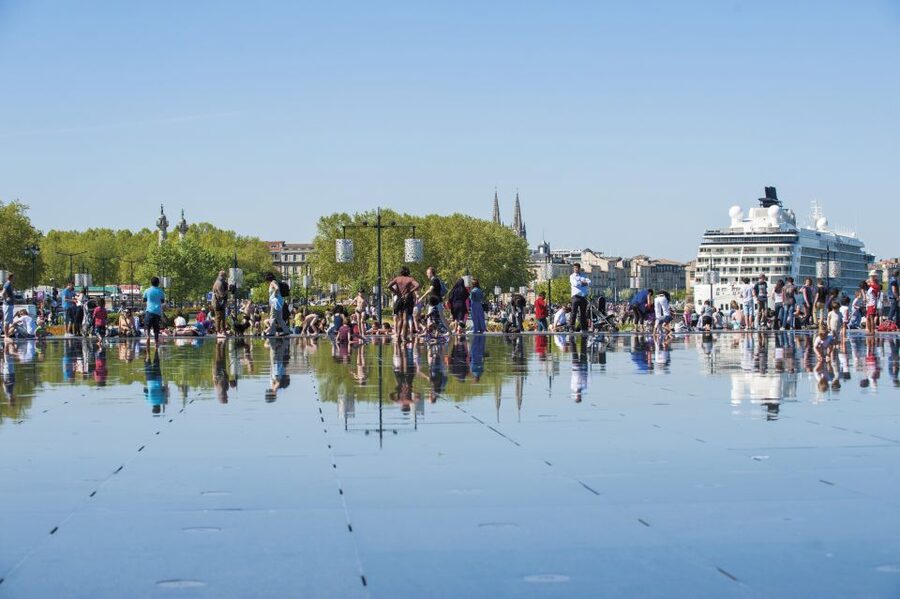
Place de la Bourse is one of Bordeaux’s essential sights, and the reflecting pool known as the Miroir d’eau gives it a memorable finish. The shallow water mirrors the grand façades, creating the soft, doubled view that appears in so many photographs of the city.
The guide explains how the square fits into Bordeaux’s architectural plan and why this riverside setting became such an important public space. You get both the postcard view and the urban context behind it.
This stop can be busy and weather-sensitive. Rain may make it harder to hear, and the reflecting pool may not look the same in every condition. Even so, the square is worth seeing because it connects Bordeaux’s formal architecture with the open riverfront.
Take a moment to look beyond the water. The important feature is the relationship between the square, the façades, the river, and the public space in between. A short guided explanation helps you notice that design rather than simply taking a quick photograph and moving on.
Romantic bridges and the Garonne
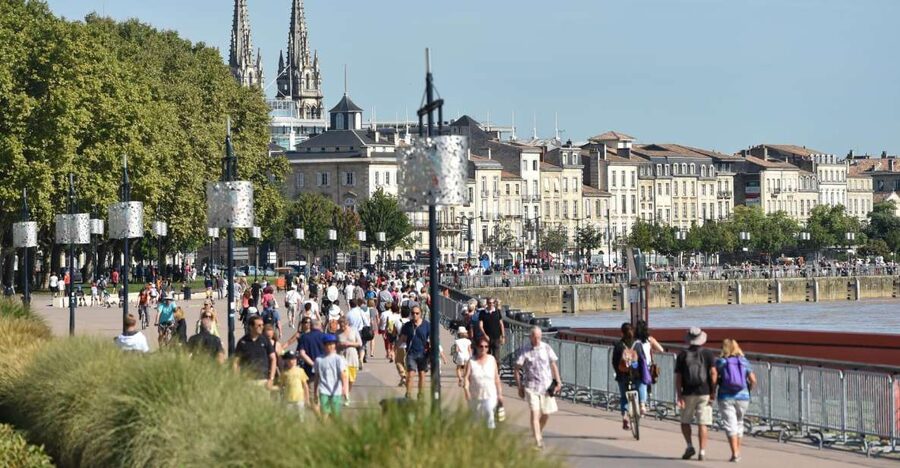
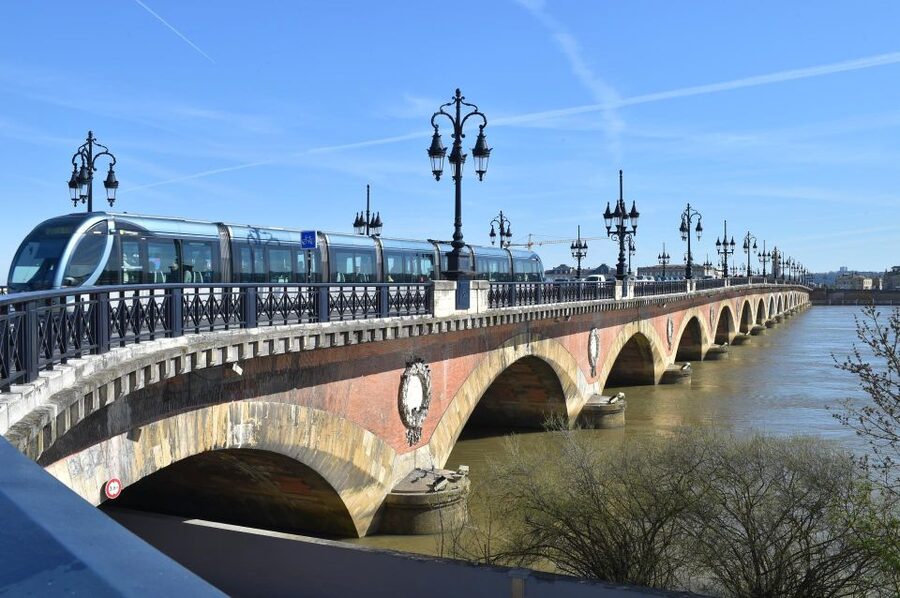
The tour also brings you toward views of the Garonne River and Bordeaux’s bridges. These crossings give the city a different mood from the stone avenues and enclosed old streets.
The river has long been central to Bordeaux’s growth, so the views help connect the city’s architecture to its commercial past. The bridges also offer some of the more open, scenic moments on the route. If the weather is clear, this can be a welcome change after several stops among buildings.
Do not expect a river cruise or a long riverside walk. The activity is a walking tour of the historic center, and the river views form part of the broader route. The emphasis remains on seeing how the city fits together.
New projects and Bordeaux’s changing identity
The tour is not locked in the past. It also points out new economic and artistic projects that form part of Bordeaux’s urban change.
That matters because Bordeaux is more than an old center preserved for sightseeing. The guide presents a city that is adapting its public spaces and cultural identity while keeping its historic core intact. This helps you see the renovation and new projects as part of an ongoing story rather than a sharp break with the past.
The balance between old and new is one of the walk’s useful features. You get the classic squares and façades, but also some explanation of the city’s current direction. The treatment will depend on the guide and the day’s route, so do not expect a detailed tour of every new project.
The bilingual format: useful, but not always efficient
Morning departures are bilingual in French and English. Saturday afternoon departures are listed as French only, so check the language before booking.
A bilingual walk can work well if you enjoy hearing both languages or if your group includes French and English speakers. Some guides have handled the format smoothly, giving clear explanations in both languages. A bilingual tour can also give you time to look closely at the buildings while the guide repeats the information.
But the limitation is clear: two languages mean less time for each language. Some English-speaking participants have found that the French section took up most of the explanation, while others had a fully English or well-balanced tour. Group size and the guide’s speaking style make a difference.
If English is your only language, a morning departure may still be worthwhile, but ask yourself how much detail you want. For a fast orientation, the bilingual setup is fine. If you want a long architectural discussion, a separate English tour would be better, if available.
Listening equipment can help, but it is not perfect. One departure had an audio connection that cut in and out, and rain made another tour harder to hear. Stay near the guide, especially at busy squares, and tell the guide if you are having trouble following.
Guide style and the value of local detail
The guide is the heart of this activity. Bruno has been praised for patient storytelling and for making sure English speakers received the key information, even when they were a small minority. Alcide, also referred to as Al in one account, has been noted for clear bilingual explanations, wine advice, and restaurant suggestions.
Christine has led fully English tours and has been described as attentive and well informed. Véronique, a Bordeaux local, brought a particularly personal sense of place to the walk. Hugo and other guides have also led informative introductions to the city.
Do not book expecting one specific guide unless the booking system confirms it. Names and group language can vary by departure. What you can expect is a guide-led tour focused on history, architecture, public spaces, and practical advice.
The strongest guides do more than recite facts. They explain why the city looks the way it does, point out small details, answer questions, and adjust the pace for the group. Several departures have managed hot weather or heavy rain with sensible pauses and shade when possible.
Is $17 a fair price?
At $17 per person, this is a strong value if you want a broad introduction to Bordeaux. You are paying for a local guide and roughly two hours of orientation through the historic center, with no extra transport or admission fee involved.
The value is highest during a short visit. You can see Place des Quinconces, the Monument aux Girondins, the Grand Théâtre area, Saint-Pierre, Place de la Bourse, and river views in one compact walk. You also gain a list of places to revisit and ideas for food and wine afterward.
The price is less compelling if you already know Bordeaux well or want to spend most of your time inside monuments. The tour does not replace a museum visit, a dedicated wine tasting, or an in-depth architectural program.
Free cancellation up to two days before the activity gives you some flexibility. Check the exact starting time when booking, since departures vary. Bring only what you need, keep your ticket accessible, and arrive early.
Who should book this Bordeaux walk?
I would choose this tour for a first visit, especially if you have one to three days in Bordeaux. It gives you a useful mental map and helps you decide which squares, streets, shops, and food stops deserve a second look.
It also suits you if architecture interests you but you prefer seeing a city through its streets rather than sitting through a lecture. The route includes enough history to add meaning without spending the whole time inside churches or museums.
Families and older visitors should consider the walking surface and duration. The route uses paved streets, and comfortable shoes are essential. Anyone carrying luggage should make other arrangements before joining.
French speakers can book the Saturday afternoon option listed as French only. English speakers should look for a morning departure and confirm the language arrangement. If you dislike repeated explanations, ask about an English-only option before paying.
Should you book it?
Book this Bordeaux walking tour if you want a well-priced first look at the city, strong architectural context, and practical suggestions for exploring on your own. The best moments are the changes in scale, from Place des Quinconces and the Grand Théâtre to the tight Saint-Pierre streets and the Miroir d’eau.
Think twice if you need an English-only tour, a small group, or uninterrupted detail. The bilingual format can reduce the amount of English information, and larger groups can make hearing difficult. For most first-time visitors, though, the route offers a sensible introduction at a modest price, especially when led by a guide with the warmth and local knowledge shown by Bruno, Alcide, Christine, or Véronique.
FAQ
Where does the Bordeaux walking tour begin?
The tour begins by the Bordeaux Tourist Office on Cours du 30 Juillet.
How long does the tour last?
The stated duration is between 105 minutes and two hours.
What languages are available?
Live guides speak French and English. Morning tours are bilingual in French and English. Saturday afternoon tours are listed as French only.
What sights are included?
The route includes Place des Quinconces, the Grand Théâtre area, the Saint-Pierre Old Town, Place de la Bourse and its reflecting pool, and views of the Garonne River and bridges.
What should I bring?
Wear comfortable shoes and bring your downloaded or printed ticket. You should arrive 10 minutes before departure.
Can I bring luggage or a large bag?
No. Luggage and large bags are not allowed on the tour.
How much does the tour cost?
The listed price is $17 per person.
Can I cancel for a refund?
Yes. You can cancel up to two days in advance for a full refund.
Just added around France
- Exclusive! Bordeaux: Nighttime Highlights Walking Tour★ 4.9 · 85 reviews
- Discovery Walking Tour of La Rochelle★ 4.9 · 72 reviews
- Colmar: Unusual Walking Tour with a local guide★ 4.9 · 194 reviews
- Colmar: Highlights Walking Tour and Wine Tasting★ 4.9 · 209 reviews
- Bordeaux: Private Walking Tour with a Local★ 4.3 · 117 reviews
- Bordeaux: Mystery and Myths Walking Tour★ 4.8 · 187 reviews
- Paris: Early Access Notre Dame Cathedral Walking Tour★ 4.2 · 80 reviews
- Boat walk in Sete on the singular island 1 hour★ 4.8 · 212 reviews
Walking Tours, compared.

Magical London: Harry Potter Guided Walking Tour
Read our review →
Reykjavik Food Walk – Local Foodie Adventure in Iceland
Read our review →
History and Hauntings of Salem Guided Walking Tour
Read our review →
New Orleans Premier Ghost, Voodoo and Vampire Walking Tour
Read our review →
Amsterdam Anne Frank: Small-Group Walking Tour & Local Guide
Read our review →
Edinburgh Castle: Guided Walking Tour with Entry Ticket
Read our review →
Anne Frank’s Story – Guided Walking Tour through Amsterdam
Read our review →Browse the lists this tour appears in