
REVIEW · AMSTERDAM
Amsterdam: Anne Frank Guided Walking Tour in DE/EN/IT/ES
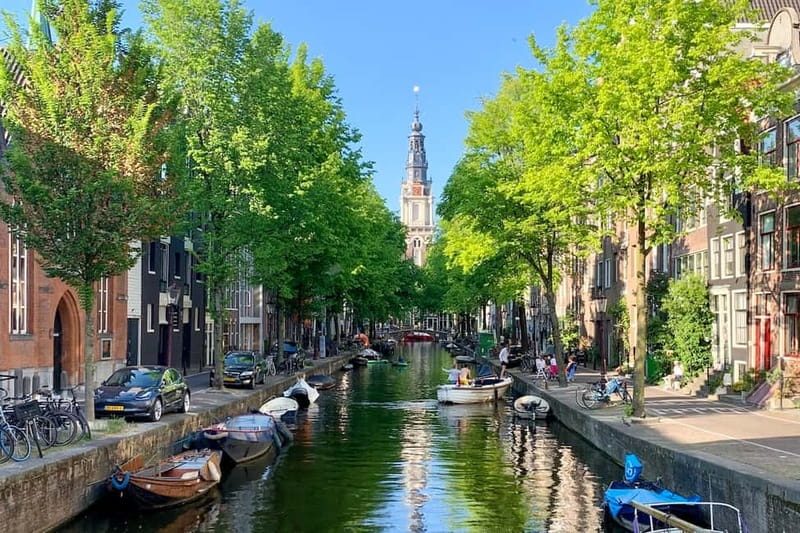
Amsterdam’s Jewish Quarter is best understood on foot, where old homes, memorial stones, synagogues, and memorials sit beside ordinary city streets. This two-hour Anne Frank walking tour links those places with passages from Anne’s diary and the wider story of Jewish life before, during, and after World War II.
I like the route’s balance of personal story and city history. You learn about Anne Frank, but also about the Jewish community that helped shape Amsterdam, the 1941 February Strike, and the Jews and non-Jews who resisted Nazi rule. I also like the guides’ warm, careful delivery. Guides such as Lilly, Zoe, Francesco, Valentina, Josh, and Emilia have been praised for making a painful subject clear without turning it into a lecture.
The main catch is simple: you do not visit or see the Anne Frank House. Some stops are viewed from outside rather than entered, including the Portuguese Synagogue and Jewish Historical Museum. If you want museum interiors or the Secret Annex, book those separately.
Key points to know before you book

- Anne’s diary shapes the walk: Your guide reads selected passages as the route unfolds, tying the words to Amsterdam’s wartime streets.
- The tour covers about 2 to 3 kilometers: The pace is generally easy, but comfortable shoes matter.
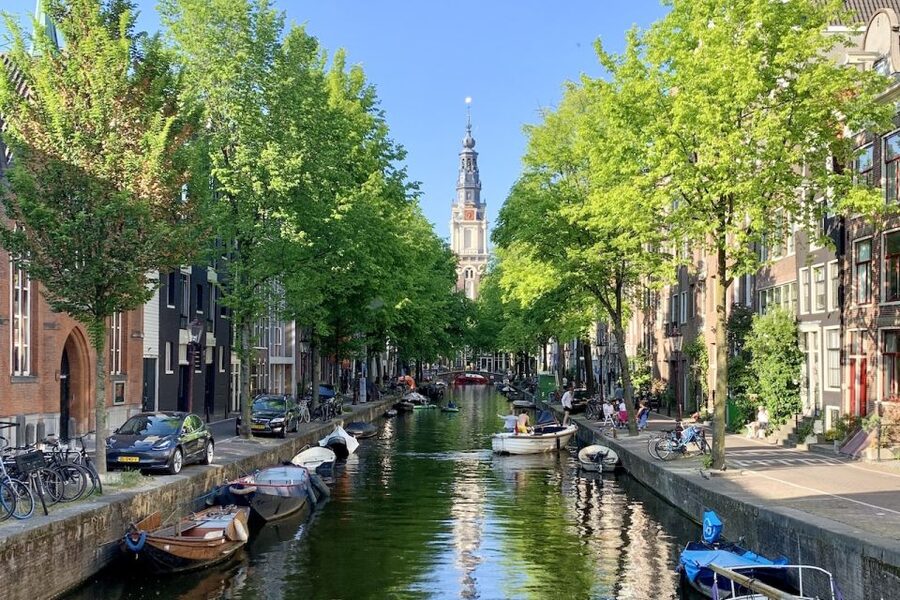
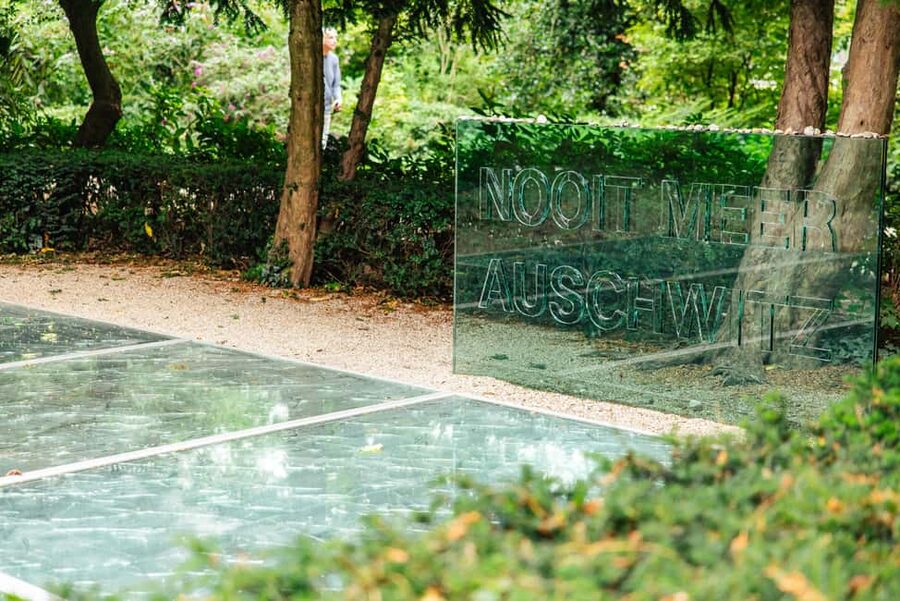
- You visit major memorial sites: The route includes the Auschwitz Monument, the Dokwerker, and the National Holocaust Names Monument.
- It is a history tour, not an Anne Frank House substitute: The Secret Annex is not part of the experience.
- Choose one language: Tours are offered in English, German, Italian, or Spanish and are not bilingual.
- The $28 price is good for a guided introduction: You pay for the guide and interpretation, while the outdoor stops do not require admission fees.
Starting at Waag in Nieuwmarkt

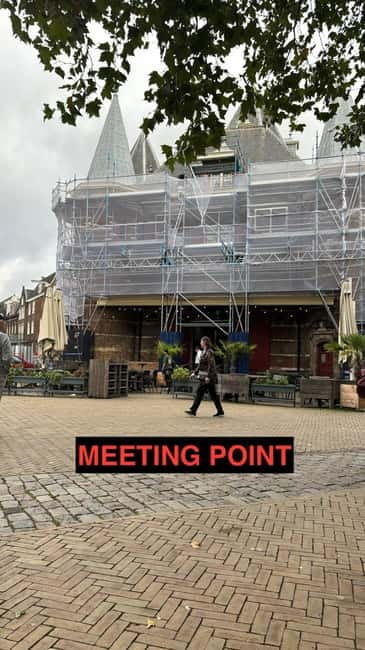
Meet your guide at the entrance to De Waag, the old, castle-like building in the middle of Nieuwmarkt. Look for a red name tag around the guide’s neck. This is a useful meeting point because Nieuwmarkt is easy to recognize, and the square quickly places you in one of Amsterdam’s older urban areas.
The tour begins with orientation rather than a rush to Anne Frank. That matters. The Jewish Quarter was not simply a backdrop to Anne’s story. Jewish residents had shaped Amsterdam for centuries, and their homes, businesses, religious buildings, and civic life helped form this part of the city.
Your guide sets up that longer story before turning to the Holocaust. Jews expelled from the Spanish Inquisition came to Amsterdam and helped develop its commercial life. The result was a major Jewish community centered around the Jodenbuurt, or Jewish Quarter, including the area known as the Jewish Triangle.
This opening gives the tour a needed sense of proportion. Anne Frank’s story is central, but it is not the whole story of Amsterdam’s Jews.
More Jewish Heritage Walks in Amsterdam:
- Amsterdam Anne Frank: Small-Group Walking Tour & Local Guide
★ 4.8 · 12,789 reviews - Anne Frank’s Story – Guided Walking Tour through Amsterdam
★ 5.0 · 11,619 reviews - Amsterdam: Anne Frank Guided Small Group Walking Tour
★ 4.8 · 2,722 reviews
Nieuwmarkt and Zuiderkerk: a city shaped by many communities
At Nieuwmarkt, your guide spends about ten minutes explaining the area and its connection to the old Jewish neighborhood. The square is busy with daily city life, which can feel jarring beside the subject matter. That contrast is part of the point: these were living streets, not a sealed museum exhibit.
The walk continues to Zuiderkerk, where another short stop adds detail about Amsterdam’s urban development and religious communities. You are still outdoors, so your experience depends somewhat on your guide’s ability to point out details and keep the group together around passing bicycles and city traffic.
This is also where the tour begins to show that Jewish Amsterdam was not isolated from the rest of the city. Jewish and non-Jewish residents lived near one another, worked together, and sometimes shared the same streets and public spaces. The story is more complicated than a simple division between one community and another.
Huis de Pinto and Rembrandt’s neighborhood

Huis de Pinto receives a brief stop of about five minutes. It is not a long visit, but it helps show the kind of stately homes associated with the area’s prosperous residents.
The next major stop is the Rembrandt House, with about fifteen minutes of explanation. Rembrandt van Rijn lived in the middle of the Jewish Quarter, and his presence helps you picture the neighborhood as a mixed urban community rather than a sealed Jewish enclave.
I like this part because it moves beyond wartime suffering. Jewish Amsterdam had homes, artists, merchants, religious life, family life, and civic influence long before the Nazi occupation. You get a clearer idea of the people and culture that were later attacked and destroyed.
The guide may use historical photographs or visual material during the walk. This can be especially useful at outdoor stops, where a photograph helps you compare the present street with the wartime setting.
Sint Antoniesluis and the Portuguese Synagogue
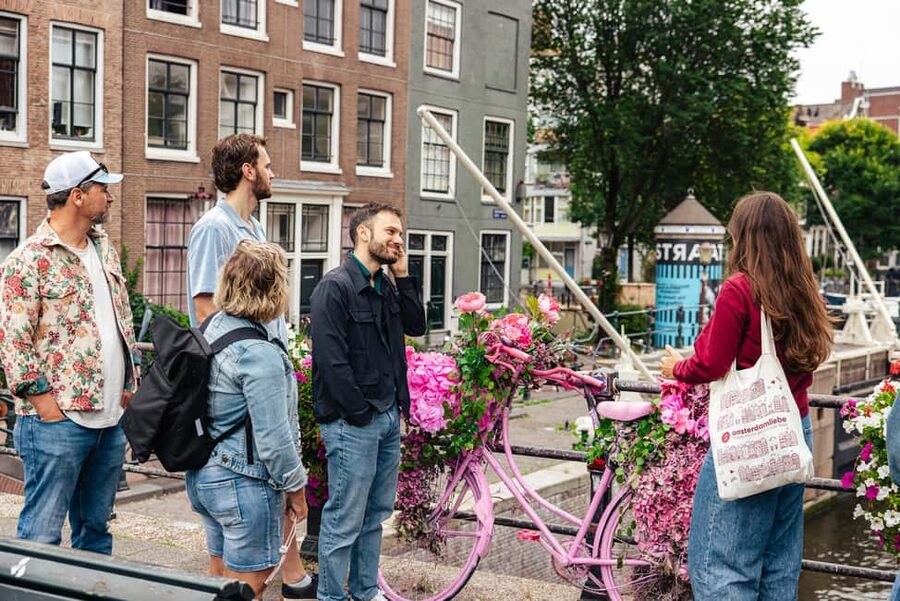
At Sint Antoniesluis, your guide continues through the old Jewish Quarter and explains why Jewish residents settled in this part of Amsterdam. The route is compact, but it is not a straight march from one famous site to another. You move through the streets where the story took place.
The Portuguese Synagogue is a ten-minute photo stop and outdoor explanation. The building is one of the most important Jewish landmarks on the route, but you should be clear about what is included: the walking tour does not provide an interior visit.
That distinction is worth stressing because the wording of some tour descriptions can sound as if you will enter the synagogue, museum, or Holocaust sites. You will generally pass them, pause nearby, and hear the historical background. If you want to see the interiors, plan separate admission and time.
Still, the synagogue is an important sight from the street. It gives physical form to the scale and confidence of Amsterdam’s historic Jewish community, before the tour turns toward persecution and destruction.
More Guided Tours in Amsterdam:
- Amsterdam: Guided Anne Frank Small-Group Walking Tour
★ 4.2 · 485 reviews - Amsterdam: Small-group Guided Walking Tour (French/English)
★ 5.0 · 289 reviews - Magical London: Harry Potter Guided Walking Tour
★ 4.7 · 22,044 reviews - History and Hauntings of Salem Guided Walking Tour
★ 5.0 · 14,564 reviews
Jewish Historical Museum and the wartime turn
The Jewish Historical Museum is another brief stop, lasting about five minutes. The tour does not include museum entry. Instead, your guide uses the location to explain Jewish culture and the community’s place in Amsterdam.
From here, the tone shifts more firmly toward World War II. The guide explains the discrimination imposed by Nazi Germany, the deportation of thousands of Amsterdam’s Jews, and the fact that very few returned.
Anne Frank’s diary becomes especially important at this point. Rather than treating Anne as a distant symbol, the guide uses selected passages to show her voice, fears, hopes, and daily life while hiding. The readings give an emotional thread to the historical material, but the tour does not rely on Anne alone. It places her family within the much larger experience of Amsterdam’s Jewish population.
Guides have handled this section in different but consistently careful ways. Lilly has been praised for thoughtful diary readings, while Marie used historical photographs to make the people and places easier to picture. That kind of presentation helps you connect a personal account with the broader facts.
The Auschwitz Monument and the cost of silence
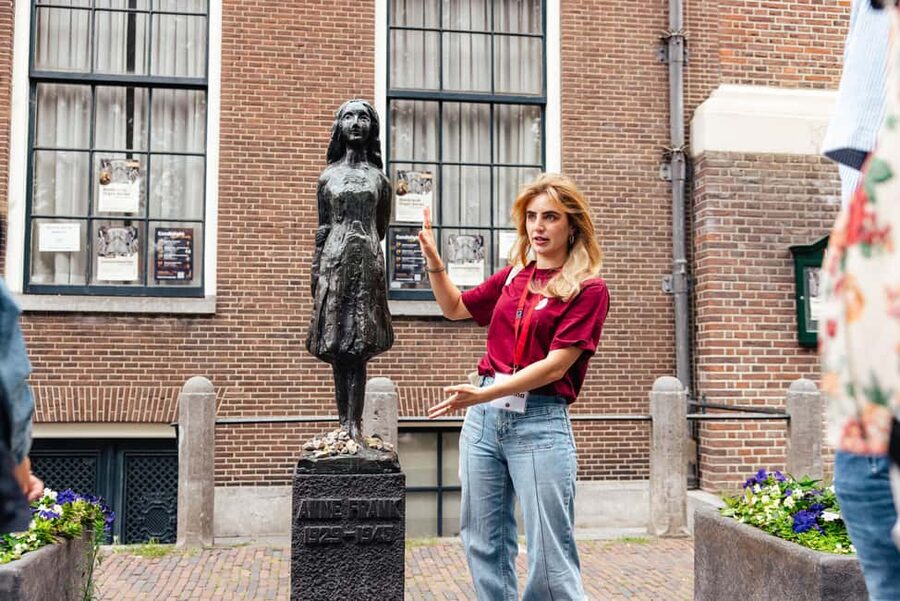
The Auschwitz Monument is one of the most serious stops on the route, with about ten minutes for explanation. It commemorates the Jews of the Netherlands who were murdered at Auschwitz.
This is not a place for hurried sightseeing. The monument carries a different weight from the earlier architectural stops, and your guide may allow the group a quieter moment. The tour’s subject is painful, and you should expect an emotional experience rather than a light city stroll.
The route also explains how ordinary systems of discrimination became deportation and mass murder. That connection is important. The Holocaust did not begin with the camps alone. It developed through exclusion, registration, confiscation, forced movement, and the destruction of civil rights.
At the same time, the guide discusses resistance. The February Strike of 1941 is a key example of public opposition to Nazi persecution in Amsterdam. You also hear about Jews and non-Jews who hid people, helped them escape, or otherwise resisted while putting their own lives at risk.
The Dokwerker and the story of resistance

The Dokwerker is a smaller stop, about five minutes, but it carries major symbolic value. The monument commemorates the February Strike, when Amsterdam workers protested against the persecution of Jewish residents.
This part of the tour keeps the story from becoming only one of helplessness. The Nazis caused enormous damage, and many people were forced into impossible choices, but resistance existed. Some acts were public, like the strike. Others were private and dangerous, involving hiding, false papers, food, or transport.
Your guide’s storytelling matters most here. Josh, Valentina, Zoe, and other guides have been praised for treating the subject with warmth and restraint. A strong guide will not turn resistance into a feel-good ending. Instead, you see it as one part of a frightening period, carried out by people who understood the risks.
National Holocaust Names Monument: the final stop
The tour ends at the National Holocaust Names Monument, where the group spends about fifteen minutes. This is the longest stop on the latter part of the route and an appropriate place to finish.
The monument names Dutch Holocaust victims. After walking through streets, past buildings, and alongside memorials, the names give the history a direct human scale. The tour’s movement from community life to persecution, resistance, and remembrance comes together here.
Because the tour ends at the monument rather than returning to Waag, you should allow a little time afterward before making another appointment. The experience may leave you wanting quiet, a museum visit, or simply a slower walk through the city.
The ending also gives you a practical advantage. You are positioned in the heart of Amsterdam’s Jewish Quarter and can continue exploring on your own. The Jewish Historical Museum, Portuguese Synagogue, and other sites may be worth returning to if you want more time indoors.
What the two hours feel like
The route covers about 2 to 3 kilometers, so it is manageable for most people who can walk steadily for two hours. The pace has generally been described as comfortable, and guides have adjusted to the group when needed. You should still wear good walking shoes. Amsterdam’s streets can be uneven, and you may stop standing for several minutes at a time.
Bring water and dress for the weather. The tour runs in rain and other conditions, so pack an umbrella if rain is possible. There are no included food or drink breaks, although one group was able to make an unplanned bathroom stop. Do not count on that as a formal part of the schedule.
The tour is wheelchair accessible, but the city streets and the standing format may still affect comfort. If mobility is a serious concern, a private group could make it easier to discuss pacing and practical needs in advance.
Language choice also matters. Select English, German, Italian, or Spanish when booking. The tour is conducted in one language, not as a bilingual presentation. A clear choice helps the guide tell the story naturally and keeps the diary passages easy to follow.
How much value do you get for $28?
At $28 per person, this is a reasonably priced introduction to Amsterdam’s Jewish Quarter. You are not paying for museum entry, transportation, or a meal. You are paying for two hours of route planning, historical explanation, diary readings, and help interpreting places that can be easy to miss on your own.
The value is strongest if you want context. You could walk past the Portuguese Synagogue, Stolpersteine, monuments, and old homes without understanding how they fit together. A guide connects the pieces and explains why this part of Amsterdam matters.
The value is weaker if you expect access to major buildings. The tour does not include the Anne Frank House, Jewish Historical Museum, or Portuguese Synagogue interiors. You should think of it as an outdoor history lesson and orientation walk, then add museum visits separately.
Small groups can make the experience more personal, and a private option is available. Group size is not specified, so do not assume every departure will be tiny. Still, the guide-led format gives you a chance to ask questions, and guides such as Emilia, Francesco, Sarah, and Deborah have been praised for welcoming questions and keeping the story clear.
Free cancellation up to 24 hours before departure and reserve-now, pay-later booking add flexibility, but the main booking decision is still the subject matter. This is a serious tour. Choose it because you want to learn and reflect, not because you expect a cheerful sightseeing loop.
Who should book this Amsterdam walk?
I would recommend it to you if Anne Frank’s diary has shaped your interest in Amsterdam, but you want more than one family’s story. It is also a good first-day activity because it explains the Jewish Quarter and the occupation, giving later sights more meaning.
It suits adults, older children, students, and anyone interested in Jewish life, World War II, public memory, or Amsterdam’s urban history. The guides use diary passages and stories rather than only dates, which helps younger visitors follow the material.
You should pause before booking if you want a museum-heavy tour, a visit inside the Anne Frank House, or a fast list of landmarks. You should also allow emotional space afterward. The Holocaust memorials and diary readings can be difficult, even when presented with care.
Should you book it?
Book this tour if you want a thoughtful walking introduction to Jewish Amsterdam, wartime persecution, resistance, and Anne Frank’s world. The strongest feature is the connection between real streets and diary passages. The best guides, including Lilly, Zoe, Valentina, Josh, Emilia, and Francesco, make that connection personal without losing the wider history.
Do not book it as a replacement for the Anne Frank House. It does not visit the Secret Annex, and several important buildings are explained from outside. Book it as a companion experience, especially if you want to understand the community and city surrounding Anne’s story.
At $28, the cost is fair for two hours of focused guiding. Bring comfortable shoes, prepare for all weather, choose your language carefully, and expect a serious but worthwhile walk.
FAQ
Does this tour visit the Anne Frank House?
No. The Anne Frank House is not visited or seen during the tour.
How long is the walking tour?
The tour lasts two hours and covers about 2 to 3 kilometers.
Where does the tour begin?
It begins at Waag, at the entrance to the De Waag restaurant in the middle of Nieuwmarkt Square.
Where does the tour end?
It ends at the National Holocaust Names Monument.
What languages are available?
The tour is available in English, German, Italian, and Spanish. It is conducted in one selected language, not bilingually.
Does the tour enter the Portuguese Synagogue?
No. The Portuguese Synagogue is an outdoor photo stop and guided explanation. Interior admission is not included.
Does the tour include museum admission?
No. The tour visits and explains locations from outside, and there are no admission fees included or required during the walk.
What should I bring?
Bring comfortable shoes, water, and clothing suited to the weather. An umbrella is useful because the tour runs in rainy conditions.
Can I cancel the booking?
Yes. You can cancel up to 24 hours in advance for a full refund. Reserve-now, pay-later booking is also available.
Just added around Amsterdam
- Amsterdam: Walking Tour, Jewish Museum & Synagogue Tickets★ 4.3 · 110 reviews
- Amsterdam: Jordaan District Local Food Walking Tour★ 4.8 · 311 reviews
- Amsterdam: Sex, Drugs, and Freedom Walking Tour★ 4.6 · 74 reviews
- Amsterdam: Small-group Guided Walking Tour (French/English)★ 5.0 · 289 reviews
- Amsterdam: Private Walking Tour with a Local★ 4.7 · 102 reviews
- Amsterdam Walking Tour and Canal Cruise★ 4.6 · 117 reviews
- Amsterdam: Ghost Walking Tour and Dark History★ 4.8 · 118 reviews
- Amsterdam: Iconic Canals & Historic Sights Walking Tour★ 4.5 · 90 reviews
Jewish Heritage Walking Tours, compared.
Amsterdam Anne Frank: Small-Group Walking Tour & Local Guide
Read our review →
Anne Frank’s Story – Guided Walking Tour through Amsterdam
Read our review →
Jewish Quarter Walking Tour with Admission Tickets
Read our review →
Old Town and Jewish Quarter Guided Walking Tour
Read our review →
Anne Frank Walking Tour Amsterdam Including Jewish Cultural Quarter
Read our review →
Anne Frank’s Last Walk & See Anne Frank House in Virtual Reality
Read our review →
Anne Frank and Jewish Quarter Amsterdam Private Walking Tour
Read our review →Browse the lists this tour appears in