
REVIEW · TBILISI
Tbilisi:Evening Walking & Talking Tour with Wine & Boat Ride
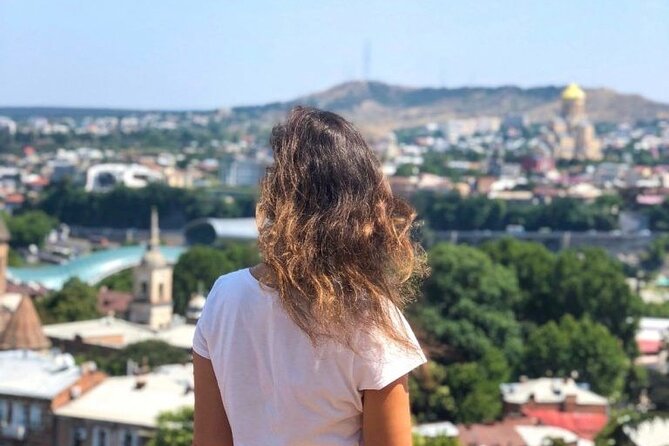
Tbilisi looks best when the lights come on. This evening walk links grand Rustaveli Avenue, the old lanes, sulfur baths, Narikala Fortress, and the Mtkvari river, then adds Georgian wine and a boat ride for just $10. It is a lot of city for very little money.
I like the easy start at Rose Revolution Square, and I like how the tour gives you both the polished center and the rough-edged Old Town. Guides such as Freddie, Toko, Tanu, and Fantastika are praised for humor, photos, local tips, and clear English.
The catch is simple: this is a walking tour with stairs, hills, and dark alleys. The advertised time is about three hours, but some groups run longer, especially when the guide adds places such as Maidan Bazaar or spends more time tasting wine.
Key points to know before you book
- Georgian wine is part of the evening: A tasting adds local flavor and often includes chacha, depending on the guide and tasting setup.
- The route covers both new and old Tbilisi: You move from Rustaveli Avenue and Freedom Square into the sulfur-bath district and Old Town.
- The boat ride gives you a different view: Seeing the illuminated riverfront from the Mtkvari is one of the evening’s most memorable extras.
- Guides shape the experience: Freddie is often singled out for energy and humor, while Toko, Tanu, Nino, Fantastika, and others bring their own style.
- Expect a social group outing: The maximum group size is 50, so this feels more like a shared city walk than a private tour.
- Weather matters: Rain can alter the route or cancel the boat ride, though the operator may offer another date or a voucher.
Starting at Rose Revolution Square
The meeting point is Rose Revolution Square, in front of the Radisson hotel. The stated evening start is 6:00 pm, though the tour details also refer to a 7:00 am or 6:00 pm booking time. Check the time shown on your confirmation and arrive early enough to find the group without a last-minute dash.
This is a practical place to begin. It is central, near public transportation, and easy to recognize. You do not get hotel pickup, so you must make your own way there.
The square is more than a place to gather. It introduces the contrast that defines Tbilisi: broad modern avenues, formal civic buildings, and, only a short walk away, uneven lanes and old balconies. A guide can help you connect those two sides instead of seeing them as separate cities.
More Night Walking Tours in the world:
- Private Street Food Evening Walking Tour in Ho Chi Minh City
★ 5.0 · 3,175 reviews - Granada: Albaicín and Sacromonte Guided Sunset Walking Tour
★ 4.9 · 2,962 reviews - Savannah’s Ghost City “Dead of Night” Walking Night Tour
★ 4.5 · 2,482 reviews
Rustaveli Avenue and Freedom Square
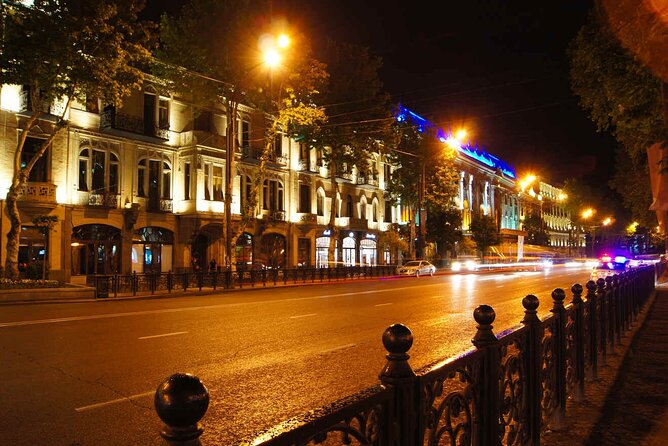
The first walk follows Rustaveli Avenue, Tbilisi’s grand central boulevard. Allow about 20 minutes here, though the guide may pause longer for buildings, cafés, hotels, restaurants, shops, and cultural sites.
This is a good orientation stretch. You get a sense of the city’s main public face, and you can note places to return to during daylight. If you are staying nearby, the avenue also helps you understand the basic layout of central Tbilisi.
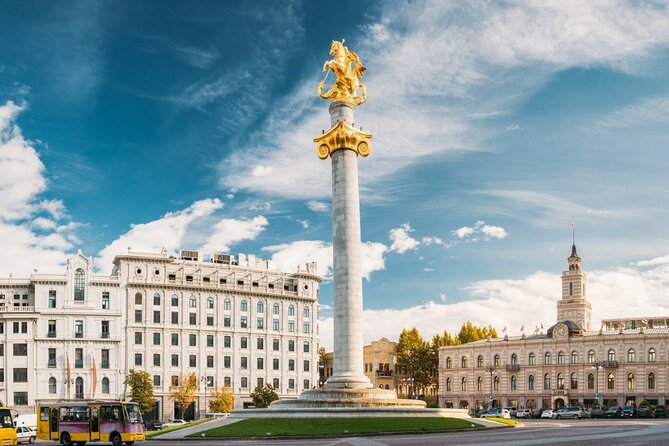
The group then reaches Freedom Square, marked by the golden Freedom Monument. It is the city’s central meeting point and a useful place to get your bearings before the route turns into the older quarters.
I would pay attention here to the change in scale. The avenue feels open and formal; the Old Town soon becomes close, irregular, and much more personal.
The clock tower that rewards a pause
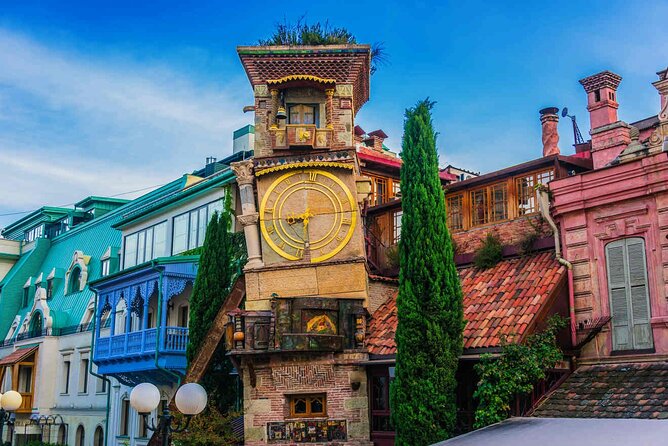
The Rezo Gabriadze Marionette Theater and its crooked clock tower are among Tbilisi’s most unusual sights. The tower was built beside the theater in 2010 and decorated with hundreds of hand-designed tiles.
An angel appears with a small hammer to ring the bell every hour. A short puppet performance called The Circle of Life takes place at noon and 7:00 pm, so the exact timing of your walk may affect what you see. The 7:00 pm show is especially relevant to an evening group, but the tour does not promise that the schedule will line up perfectly.
Even if you miss the performance, the tower is worth a close look. It is playful, handmade, and unlike the grand stone architecture elsewhere in the city. This is a good example of the route’s mix of famous landmarks and smaller details you might pass without a guide.
Crossing the Bridge of Peace into Rike Park
The Bridge of Peace carries the group over the Mtkvari River into Rike Park. Its curved glass-and-steel form opened in 2010, and more than 10,000 LED bulbs light it each evening before sunset.
The bridge can be divisive. Some people love its modern shape against the older city; others find it too new beside Tbilisi’s historic quarters. Either way, it is an important part of the city’s present-day identity and gives you clear views along the river.
Rike Park is a relaxed pause point with paths, fountains, climbing walls, a children’s maze, and giant chess boards. The park is popular with families and tends to feel more open than the lanes ahead. At night, the bridge and river make this one of the better spots for group photos, something several guides make a point of arranging.
A few more walking tours around the world worth a look
- Magical London: Harry Potter Guided Walking Tour
★ 4.7 · 22,044 reviews - Reykjavik Food Walk – Local Foodie Adventure in Iceland
★ 5.0 · 18,952 reviews - History and Hauntings of Salem Guided Walking Tour
★ 5.0 · 14,564 reviews - New Orleans Premier Ghost, Voodoo and Vampire Walking Tour
★ 4.5 · 12,856 reviews
King Vakhtang Gorgasali and Metekhi Cathedral
Near the river, the statue of King Vakhtang Gorgasali looks toward the city he is traditionally credited with founding. His reign belongs to the late fifth and early sixth centuries, a period shaped by conflict with Sasanian Iran and close ties with the Byzantine world.
The stop is brief, about five minutes, so expect a compact explanation rather than a long history lesson. That is useful on a route with many stops, but anyone wanting a serious study of Georgian history will need a museum or a longer specialist tour.
Metekhi Cathedral sits on a cliff above the Mtkvari. Tradition connects the site with Vakhtang Gorgasali, and the church is linked to the story of Saint Shushanik. The elevated position matters as much as the building itself. You get a strong river view and a sense of why this part of Tbilisi has held religious and strategic importance for centuries.
There are stairs and uneven ground around this section. Guides have been praised for keeping groups together and adjusting their pace for older people, but you should still wear sturdy shoes and expect a steady amount of walking.
Sulfur baths and the Abanotubani district
Abanotubani is Tbilisi’s famous sulfur-bath quarter. The district takes its name from the hot springs that feed the public bathhouses along Abanos Kucha.
Chreli Abano is the most eye-catching building in the area. Its patterned façade can look like a mosque, but it is a sulfur bath, not a religious building. The walk normally gives you an introduction from outside rather than a bath session.
This is one of the places where a guide adds real value. You learn why bath culture matters in Tbilisi and can decide if you want to return for a private room or public bathing experience later. The tour itself does not include a bath, so do not arrive expecting spa time.
The area is also a good place to notice how Tbilisi mixes practical daily life with tourism. The baths are working businesses, not just monuments, and the streets around them lead directly into cafés, restaurants, and small shops.
Leghvtakhevi Waterfall and the climb to Narikala
Leghvtakhevi Waterfall is tucked into a narrow gorge behind the bath district. It is a pleasant place to cool down in warm weather and creates a surprising change of mood after the busy streets.
The stop is short, around ten minutes, so you will likely have time for a few photos and a quick look rather than a long rest. The route can be slippery or uneven after rain, which is another reason to wear sensible footwear.
Narikala Fortress is the major viewpoint of the evening. Its walls are worn, but the setting is powerful, with the Mtkvari below and Tbilisi spreading out in several directions. The fortress is one of the city’s best places to understand its shape.
Do not expect a polished castle interior. The appeal is the stone remains, the height, and the sense of a city built around a river and defended from above. At night, the lights make the view especially appealing, though darkness also makes footing less certain.
Nearby, the Kartlis Deda statue, or Mother of Georgia, holds a bowl of wine in one hand for friends and a sword in the other for enemies. The 20-meter aluminum figure was erected in 1958 for Tbilisi’s 1,500th anniversary and has become a city symbol.
The statue gives you a neat visual key to Georgian hospitality: welcome is generous, but the country has not forgotten its difficult past.
Old Town balconies and Jan Shardeni Street
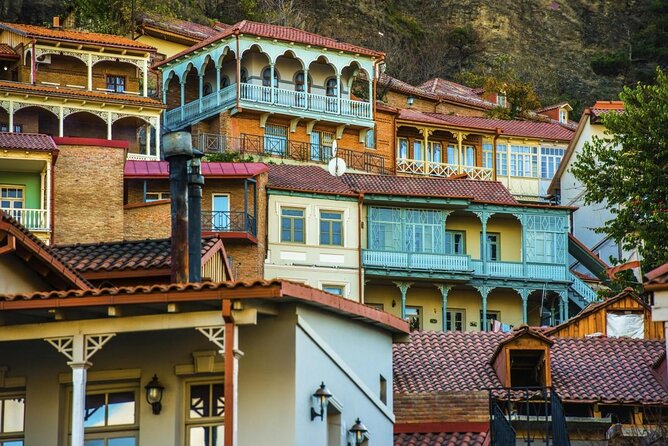
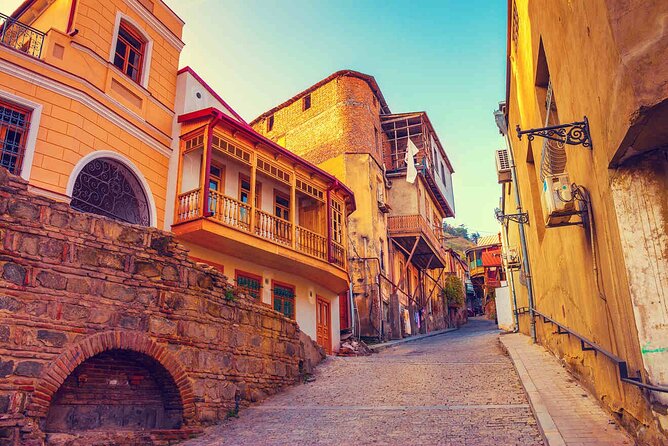
The Old Town section is where the tour becomes less about individual monuments and more about atmosphere. Narrow lanes, wooden balconies, old walls, small courtyards, and changing elevations make this part of the walk feel very different from Rustaveli Avenue.
Some alleys are dark at night. That adds character, but it also means you should stay close to the group and watch your footing. The pace can feel fast when the guide is trying to cover the whole route, though other groups take a more leisurely approach.
Jan Shardeni Street is a pedestrian lane lined with restaurants, cafés, and nightlife. It is popular and central, but not necessarily the quietest or most local-feeling part of the Old Town. I see it as a useful reference point rather than the final word on Tbilisi dining.
The best practical benefit here is the guide’s advice. Freddie, Toko, and Fantastika have been praised for suggesting restaurants, pointing out overhyped spots, and naming places worth returning to. That can save you a mediocre meal on your first night.
Some groups also visit Maidan Bazaar, where you can browse souvenirs and return later if something catches your eye. This extra stop depends on the route and guide, so treat it as a possible bonus, not a fixed promise.
Wine tasting and the Mtkvari boat ride
The wine tasting is one of the tour’s strongest local touches. Georgia has a long wine tradition, and tasting a few pours gives you more than a quick photo stop. It helps you connect the city walk with one of the country’s best-known cultural traditions.
The tasting may include chacha, Georgia’s strong grape spirit. Drink at your own pace, especially if you have already walked up to Narikala and still have the boat ride ahead. The tastings can be generous, according to the information provided, so this is not simply a token sip.
The boat ride is a pleasant change after hours on foot. From the river, you see the illuminated bridges, cliffs, churches, fortress walls, and Old Town from below. The seats are described as comfortable, and the ride gives you a calm finish after the noise and hills of the city.
Weather can interfere. One rainy evening, the route was rearranged so the group could taste wine while waiting, and the guide arranged a voucher when the boat could not operate. That is a useful example of why you should keep some flexibility in your schedule. The boat is a key part of the experience, but it cannot be guaranteed in poor weather.
The tour ends back at Rose Revolution Square. Depending on the group, pace, and stops, the evening can last about three hours or run closer to four hours or more. Do not book a tight dinner reservation immediately afterward.
The $10 price and the group format
At $10 per person, this is unusually good value if you want a broad first look at Tbilisi. You receive an English-speaking guide, a long city walk, a wine tasting when that option is selected, and a boat ride as part of the experience described by the operator.
The tradeoff is scale. Up to 50 people may join, so the guide cannot give everyone private attention. Freddie and other guides have been praised for managing the group, answering questions, and taking photos, but a large group can still make conversation and sightseeing less personal.
This is best seen as an orientation walk, not a specialist history tour. It shows you where things are, gives you useful stories, and helps you choose what to revisit on your own. If you want detailed architecture, museum time, or a slow food-focused visit, a smaller paid tour would suit you better.
Who will enjoy this evening most
I would choose this tour if you are visiting Tbilisi for the first time, have only a short stay, or want a friendly way to meet people on your first night. It also works well after a day trip, when you want an easy introduction rather than another formal attraction.
The route suits reasonably active walkers who can manage hills, stairs, uneven lanes, and several hours outside. It may be less suitable if you have limited mobility, though one guide was specifically praised for being patient with older people.
The experience is also a good fit for solo visitors. The group format makes it easy to share photos, restaurant suggestions, and a glass of wine without having to plan the evening alone.
Should you book the Tbilisi evening walk?
Book it if you want maximum city coverage at a very low price, especially when the wine tasting and boat ride are important to you. The strongest guides turn the route into a social evening filled with stories, jokes, local advice, and useful orientation.
Skip it if you dislike group tours, need a slow pace, or want guaranteed boat departure in uncertain weather. For most first-time visitors, though, this is a smart opening move: see the main sights, learn the city’s shape, sample Georgian wine, and mark the places you want to explore more deeply tomorrow.
FAQ
Where does the tour start and finish?
It starts at Rose Revolution Square in Tbilisi, in front of the Radisson hotel, and ends back at the same meeting point.
What time does the tour start?
The meeting information gives an evening start time of 6:00 pm. The tour details also refer to a 7:00 am or 6:00 pm booking time, so check your booking confirmation for the exact departure.
Is the tour offered in English?
Yes. Guide service is provided in English.
Is wine tasting included?
Wine tasting is included if you select that option when booking. The experience may also include chacha during the tasting.
How large can the group be?
The maximum group size is 50 people.
What happens if bad weather affects the tour?
The experience requires good weather. If poor weather causes cancellation, you can be offered another date or a full refund. Rain may also lead to changes, including a postponed or canceled boat ride.
Just added around the world
- Fira: Guided Foodie Walking Tour with Tastings★ 4.9 · 474 reviews
- Fez: Guided Walking Tour of the Historic Medina★ 5.0 · 359 reviews
- Fez: Walking Tour in the Ancient City of Fez★ 4.8 · 73 reviews
- Faro: Old Town Guided Walking Food Tour★ 4.9 · 94 reviews
- Feel like a local – Walking Tour in Mykonos Town 2hours★ 4.4 · 77 reviews
- Fes: A Guided Walking Tour Through the Historic Medina★ 4.4 · 97 reviews
- Fez: Half-Day City Private Walking Tour with a Guide★ 4.6 · 114 reviews
- Fanal / Assobiadores – Levada Walk★ 4.6 · 93 reviews
Night Walking Tours, compared.

Private Street Food Evening Walking Tour in Ho Chi Minh City
Read our review →
Albaicín and Sacromonte Guided Sunset Walking Tour
Read our review →
Savannah’s Ghost City “Dead of Night” Walking Night Tour
Read our review →
Gion Magical Night Walking Tour with Geisha Trivia
Read our review →

Madrid by Night Small Group Tour: Stories, Sights and Tapas Bites
Read our review →
Paranormal Night Walking Tour & Secret Backstreets
Read our review →
Munich Ghosts and Spirits Evening Walking Tour
Read our review →Browse the lists this tour appears in