
REVIEW · BUDAPEST
Budapest City Landmarks Walking Tour in 2 Hours
Budapest’s most useful introduction may be its simplest: a guided walk from Erzsébet Square to Parliament, linking grand buildings, riverside views, public art, and difficult history in about two hours. You get the city’s basic shape quickly, then can return to the places that catch your eye.
I like the exceptional value, with a $3.63 booking fee and no admission charges along the route. I also like the practical side: guides such as Gary, Dora, Esther, Rita, and Judith explain what to eat, where to go next, and how to avoid tourist traps. The main consideration is that this is an outdoor overview, not an in-depth visit inside the Basilica or Parliament, and the donation-based format means you should plan to tip the guide.
Key points to know before you book

- A strong first-day orientation: Walk from the Budapest Eye to Parliament and learn how Pest, Buda, the Danube, and the major sights fit together.
- Much more than monuments: The route includes food advice, Hungarian phrases, public art, local customs, inventions, politics, and Jewish history.
- No interior admissions: You see St. Stephen’s Basilica and Parliament from outside, so plan separate visits if you want to go in.
- The Danube is the visual highlight: The embankment brings views of Buda Castle, Matthias Church, Fisherman’s Bastion, and Gellért Hill.
- A donation-based tour: The listed price covers administration, while the guide depends on your tip at the end.
- Wear comfortable shoes and bring water: The walking is manageable, but the route is outdoors and can take around two to two and a half hours.
Starting beside the Budapest Eye in Erzsébet Square
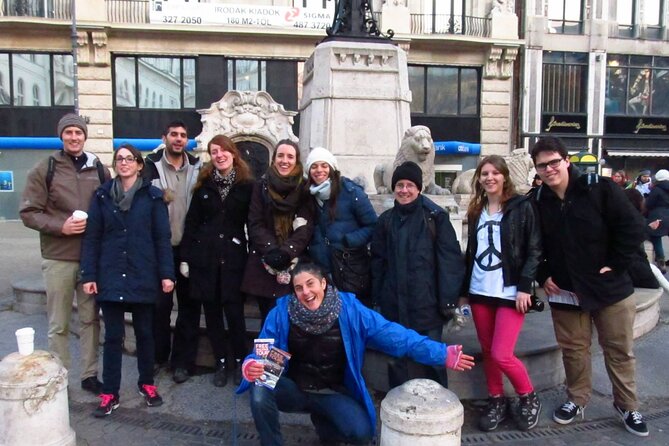
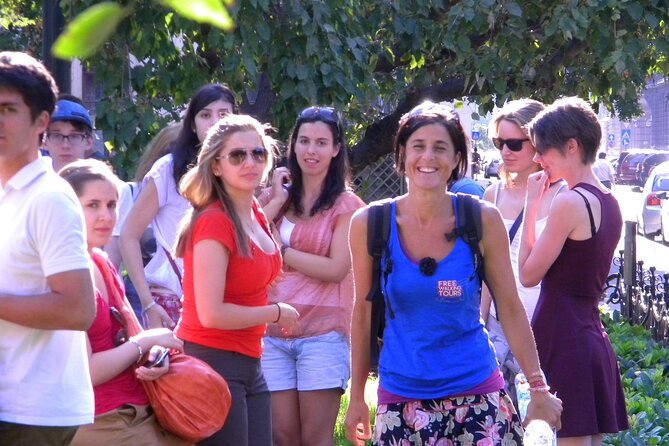
The walk begins at Erzsébet tér, about 20 meters from the Budapest Eye. Look for the licensed local guide carrying a small blue flag. This is an important detail, since the meeting area can be busy and one person missed the group after searching for a blue jacket and then an umbrella instead of the blue flag.
I would arrive early, stand near the Ferris wheel, and check the exact meeting instructions before leaving your hotel. If you are running late or cannot find the group, call the tour office before the scheduled departure. Once the walk has begun, catching up may be difficult.
The opening introduction gives you a useful map of the morning. You hear which famous landmarks are ahead, along with a few backstreets and less obvious corners. The guide also sets the tone by mixing architecture and political history with Hungarian food, society, public art, and simple language.
That broad approach is the tour’s real purpose. You are not expected to remember every date. Instead, you get enough context to make sense of the buildings you pass and decide which places deserve a longer visit later.
More Two-Hour Tours in Budapest:
- Berlin’s Best: 2 Hour Walking Tour Third Reich and the Cold War
★ 5.0 · 5,486 reviews - Leipzig: 2-Hour Guided Walking Tour in German
★ 4.8 · 1,612 reviews - Lucca: 2-Hour City Center Walking Tour
★ 4.7 · 1,314 reviews
St. Stephen’s Basilica and the flavors of Budapest
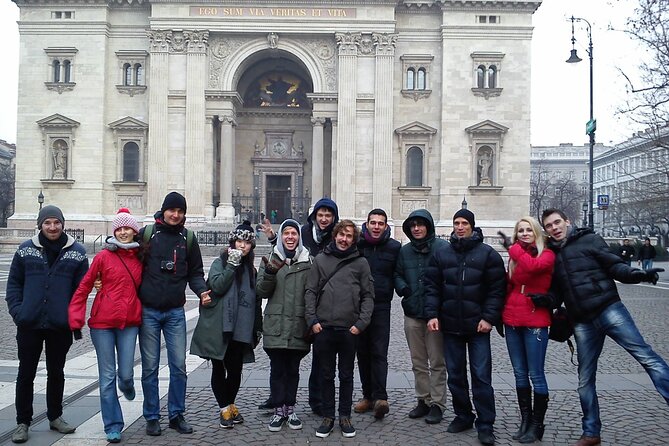
The short stop outside St. Stephen’s Basilica introduces one of Budapest’s grandest churches. The building can seat about 8,500 people, and its architecture reflects the city’s changing periods of prosperity and style.
You do not go inside, so this stop is best viewed as an orientation. The pedestrianized square gives you a chance to look at the surrounding buildings and hear why the Basilica matters. If the interior, dome, or treasury interests you, you will need to return on your own.
At St. Stephen’s Square, the subject shifts from stone to food. The public art featuring fat policemen with shiny bellies provides a light moment, while the guide explains Hungarian cooking and suggests what to eat in Budapest. This is also where you get advice on avoiding tourist traps.
That practical advice can shape the rest of your stay. A first-time visitor may recognize goulash, paprika, and Hungarian pastries, but still have no idea what to order or where to begin. The food discussion gives you a starting point without turning the walk into a restaurant tour.
Habsburg connections, porcelain, and Vörösmarty Square
At József Nádor tér, the guide explains the Hungarian Habsburg connection and points out examples of two famous forms of Hungarian craftsmanship. Herendi is known for hand-painted porcelain, while Zsolnay is associated with colorful glazed ceramics.
This is a good reminder that Budapest’s story is not only about battles and kings. Design, manufacturing, trade, and royal taste also shaped the city’s public image. The stop is brief, so you will get an introduction rather than a full lesson in either company.
The route continues to Vörösmarty Square, a popular people-watching spot at the end of Váci utca. This is also where the second-oldest underground railway in the world has one of its terminals. The guide points out the surrounding Neoclassical buildings and the famous Gerbeaud café.
The square is especially useful for future planning. You hear about Budapest’s Christmas markets and holiday traditions, and you can note Váci utca as a place to explore, even if you later decide that the city’s quieter streets suit you better. The stop lasts only a few minutes, so do not expect time to browse shops or sit down for coffee during the tour.
The Danube Embankment brings Budapest into focus
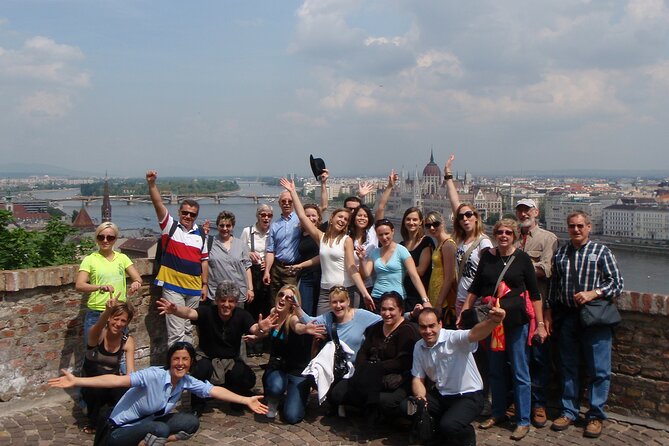
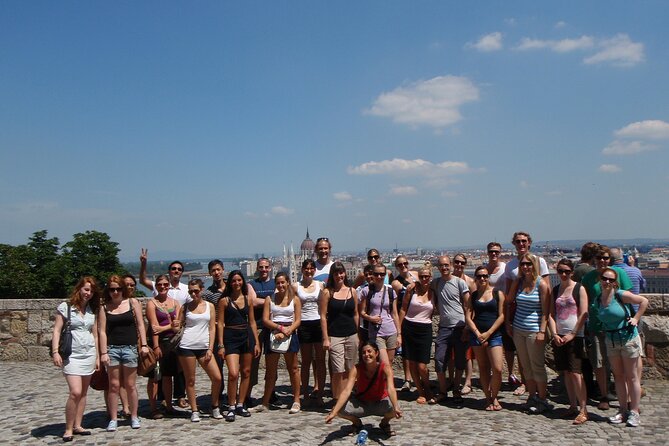
The walk reaches the Korzó, Budapest’s Danube embankment, where the city’s two halves finally come together in one view. From here, you can look toward Castle Hill, Matthias Church, Fisherman’s Bastion, Buda Castle, and Gellért Hill with its Citadel.
This is the strongest photography section of the route. The river separates Pest from Buda, but the view explains how closely the two sides belong to one city. Several of the surrounding sights are included on UNESCO’s World Heritage list, and the guide helps you identify them instead of leaving you to guess from a postcard view.
You also hear about the panoramic tramline that follows the river and see one of Budapest’s first non-Communist statues. These details add modern political context to the older architecture.
The embankment can be exposed to sun, wind, or rain. Bring water, especially in warm weather. One four-star assessment specifically suggested taking a drink, and that is sensible advice for any outdoor walk of this length.
A few more walking tours around Budapest worth a look
- Budapest: Buda Castle Walk with Saint Stephen’s Hall
★ 4.5 · 3,012 reviews - Big Bus Budapest Hop-On Hop-Off Bus and Walking Tour
★ 3.5 · 2,206 reviews - Budapest: Buda Castle District Walking Tour
★ 4.6 · 2,108 reviews - 3-Hour Orientation Walking Tour of Buda and Pest
★ 4.8 · 1,834 reviews
Little Princess, Vigadó, and a playful pause
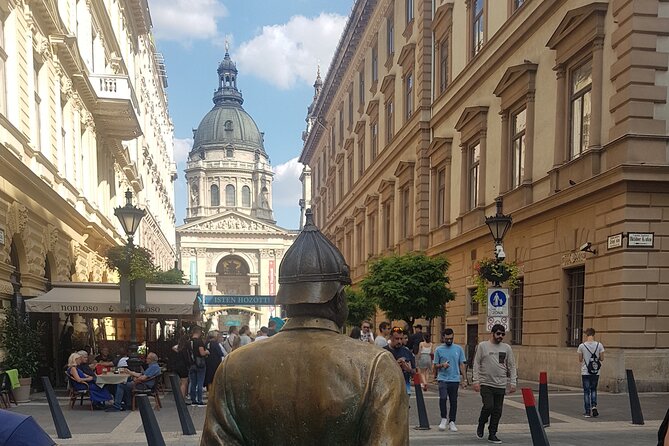
Near the river, the Little Princess Statue offers a quick break from serious subjects. The guide invites you to touch the statue’s shiny knees while making a secret wish. It takes only a couple of minutes, but it gives the group a small local ritual and a memorable photo opportunity.
At Vigadó Square, the guide explains the site’s connection to the coronation banquet held for Franz Joseph and Sissy in the 19th century. The square also recalls performances by major Central European musicians, including Franz Liszt, Debussy, and Brahms.
These two short stops work well because they keep the pace moving. The tour does not linger at every landmark, but it offers enough background for you to recognize why a seemingly simple statue or square matters.
Chain Bridge and the story of Buda and Pest
The short stop at Széchenyi Chain Bridge uses the bridge to explain how Buda and Pest developed on opposite sides of the river before becoming one city. The Chain Bridge was the first permanent bridge connecting them, making it an ideal place to discuss Budapest’s growth.
You will not cross the bridge as part of the stated route. Instead, you pause to learn its role in the city’s story and see how it frames the hills of Buda. If you want bridge photographs, this is a good moment to take them, but the stop is brief.
The bridge also helps you plan later outings. From the Pest side, you can see why a separate Buda Castle visit makes sense. One past itinerary combined this Pest walk with a Buda Castle tour the next morning, a sensible pairing if you want both sides of Budapest without cramming everything into one day.
Gresham Palace and Hungarian inventions
Gresham Palace is one of the route’s best architecture stops. Built during Budapest’s golden age around the turn of the 20th century, it shows the Secessionist style, the Central European form of Art Nouveau.
The guide points out the ornaments and explains the ideas behind the style. Even if you are not an architecture specialist, you can use this stop to notice the curved lines, decorative surfaces, and theatrical details that separate Gresham Palace from the more restrained buildings nearby.
At the Hungarian Academy of Sciences, the discussion becomes more personal and interactive. You learn a few Hungarian words and phrases, hear about Hungarian Nobel Prize winners, and get introductions to famous people of Hungarian origin and inventions used in everyday life.
The language lesson is not a full Hungarian class. Its value is social. Knowing a few basic words can make ordering food, greeting someone, or asking for help feel less intimidating. The guide’s light tone keeps the subject from becoming a list of names and dates.
Shoes on the Danube Bank requires a slower tone
The memorial of Shoes on the Danube Bank is the most solemn stop. Sixty pairs of metal shoes line the river to honor Jewish people killed during the Holocaust. The guide discusses World War II, deportations, and the more recent story of Hungarian Jewish communities.
The memorial works through absence. The shoes represent people who were forced to remove their footwear before being killed beside the river. The guide asks you to imagine the individuals behind the memorial, from synagogue worshippers and assimilated Jewish people to grandparents, children, workers, and business owners.
This part deserves your attention and respect. The walk includes jokes, food talk, and playful statues, but it does not treat every stop with the same mood. The change in tone at the memorial is appropriate and gives the city’s 20th-century history a human scale.
You may want to take photographs elsewhere and simply listen here. The stop is short, but its subject is not light, and some people may prefer to return later for a quieter visit.
Parliament finishes the walk with modern Budapest
The final stop is the Hungarian Parliament Building on Kossuth Lajos tér. The guide explains its Neo-Gothic design and discusses Hungary’s recent history and elections. The building is visually grand, but the talk also connects it to the country’s present-day political life.
This is where the group receives final orientation and suggestions for restaurants, nightlife, and activities for the next few days. That closing advice is one of the strongest reasons to take the walk early in your stay. You can use the rest of your visit to follow up on places that match your interests.
The tour ends outside Parliament. There is no Parliament admission included, and the walk does not take you inside. If you want an interior visit, book that separately and treat this tour as the introduction that helps you understand what you are seeing.
What the price really means
The listed price is $3.63 per person, which makes this an unusually inexpensive way to get a guided overview of central Budapest. The booking fee covers administration and does not go to the guide.
The donation model changes how you should think about the price. The guide depends entirely on donations at the end, and the amount is your choice. So the $3.63 is not the complete cost if you want to support the person leading the walk.
Even with a tip, the format can be excellent value. You receive roughly two hours of live explanation, city orientation, food suggestions, and help deciding what to see next. You also avoid paying admission fees during the walk because the stops are viewed from public spaces.
The tradeoff is less predictability than with a standard fixed-price tour. You do not know in advance which guide will lead your group, and the experience can vary with the guide’s style. The many strong guide-specific comments point to a roster that includes engaging people such as Esther, Gary, Dora, Rita, Judith, Andy, Marton, Endre, and Sophie, but individual personalities naturally differ.
Group size, pace, and guide style
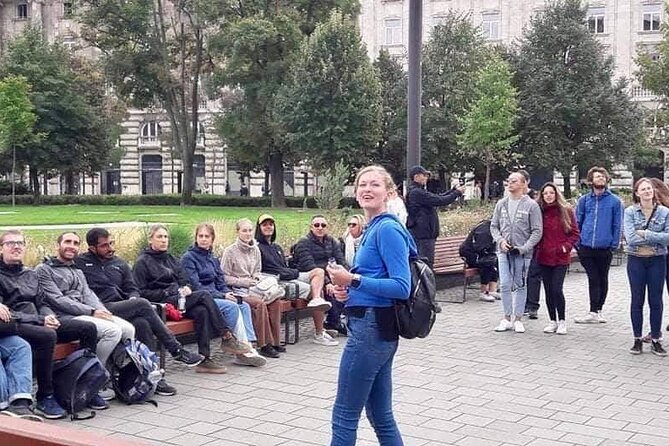
The maximum group size is 30 people. That is not a private walk, and busy pavements can make it harder to stay close to the guide. On the other hand, the group is still small enough for questions and general conversation when the guide manages the pace well.
Several guides use a speaker, which helps you hear the commentary in a larger group or on noisy streets. Dora, for example, was praised for keeping a larger group orderly, speaking clearly, answering questions, and maintaining a comfortable pace. That is exactly what matters on a city walk.
The route is described as easy walking, but it remains a two-hour outdoor activity. You will move between 13 stops, with some stops lasting only two minutes and others around 8 to 15 minutes. The official duration is about two hours, while the highlights describe it as around two and a half hours, so leave some flexibility in your schedule.
Most people can take part, and service animals are allowed. Public transportation is nearby. Good weather is required, and if poor weather cancels the walk, you can choose another date or receive a full refund.
Who should take this Budapest walk?
I would choose this tour if you are visiting Budapest for the first time, especially on your first morning or afternoon. It gives you a mental map of Pest, points you toward Buda, and leaves the rest of your day free for museums, baths, markets, or a return to the places you liked best.
It also suits people who want history without a long lecture. The guide moves from Habsburg politics to Hungarian food, from Art Nouveau ornaments to Holocaust memory, and from language tips to restaurant advice. That mix keeps the walk accessible.
You may want something else if you prefer quiet, specialist guiding or a slow architectural study. The tour covers a lot of ground and gives each stop limited time. It also will not satisfy anyone expecting entry to St. Stephen’s Basilica or Parliament.
Should you book it?
Book it if you want a low-cost, broad introduction to Budapest and can handle an outdoor walk with a group of up to 30 people. The route connects the Budapest Eye, Basilica, Danube, Chain Bridge, Gresham Palace, Shoes on the Danube Bank, and Parliament in a tidy westward sweep through central Pest.
Take it early, arrive at the blue flag near the Budapest Eye, bring water, and keep your schedule flexible. Plan to tip the guide, since the booking fee does not support the guide’s earnings. If you use the final restaurant and sightseeing suggestions, the tour can save you from spending your limited Budapest time at random.
FAQ
Where does the Budapest City Landmarks Walking Tour start?
The tour starts at Ferris Wheel of Budapest in Erzsébet tér, about 20 meters from the Budapest Eye. The guide carries a small blue flag.
Where does the walking tour end?
The tour ends at the Hungarian Parliament Building, at Kossuth Lajos tér 1-3.
Does the tour enter St. Stephen’s Basilica or Parliament?
No. Both buildings are discussed and viewed from outside, but admission inside is not included.
How long does the tour last?
The stated duration is approximately two hours. The tour highlights describe the walk as around two and a half hours, so allow extra time beyond the two-hour estimate.
Is the tour free?
The booking price is $3.63 per person, covering an administrative booking fee. Tips are not included, and the guides depend entirely on donations at the end.
Can I cancel the tour for a full refund?
Yes. You can cancel at least 24 hours before the start time for a full refund. Changes or cancellations made less than 24 hours before the start time are not accepted, and poor weather may lead to a different date or a full refund.
Just added around Budapest
- Budapest 3-Hour Walking Tour in Italian★ 4.6 · 217 reviews
- Budapest: Castle District Walking Tour★ 4.8 · 223 reviews
- Budapest: Jewish History Guided Walking Tour with Historian★ 4.8 · 205 reviews
- Budapest Guided Food Walking Tour with Drinks Included★ 4.8 · 472 reviews
- Budapest: Walking Tour to the Shoes Memorial and Parliament★ 4.7 · 151 reviews
- Budapest: Walking Tour in the Buda Castle District★ 4.9 · 113 reviews
- Budapest: Walking Tour and Photoshoot with Digital Photos★ 4.7 · 82 reviews
- Budapest: Hungarian Cooking Class and Market Walk★ 5.0 · 91 reviews
Walking Tours, compared.

Magical London: Harry Potter Guided Walking Tour
Read our review →
Reykjavik Food Walk – Local Foodie Adventure in Iceland
Read our review →
History and Hauntings of Salem Guided Walking Tour
Read our review →
New Orleans Premier Ghost, Voodoo and Vampire Walking Tour
Read our review →
Amsterdam Anne Frank: Small-Group Walking Tour & Local Guide
Read our review →

Edinburgh Castle: Guided Walking Tour with Entry Ticket
Read our review →
Anne Frank’s Story – Guided Walking Tour through Amsterdam
Read our review →Browse the lists this tour appears in