
REVIEW · AMSTERDAM
Absolutely Amsterdam – the Essential Introductory Walking Tour
Amsterdam’s story comes alive through its contradictions on this 2.5-hour city walk: Catholic worship hidden in a canal house, a legal Red Light District beside old churches, global trade built on both ambition and exploitation, and a cycling culture that prizes battered bikes over pretty ones. It is a brisk lesson in how water, money, religion, war, and tolerance shaped the city.
I like two things right away. First, the route links major sights with the ideas behind them, rather than treating Amsterdam as a collection of photo stops. Second, the pay-what-you-wish format makes it a very low-risk way to get your bearings, especially when the listed price is about $5.93 per person.
The main consideration is that you see several places from outside rather than entering them. The hidden church is discussed with photographs, and the Oostindisch Huis courtyard is accessible only on weekdays. Busy streets and bicycle traffic can also make it harder to hear or keep pace.
Key points to know before you book
- Ten central stops in about 2.5 hours: The route covers the old center without requiring public transport between sights.
- History with uncomfortable edges: Expect frank discussion of prostitution, drug policy, colonial trade, Nazi occupation, and the destruction of Amsterdam’s Jewish quarter.
- A strong introduction for first visits: You finish with useful context for deciding which museums, neighborhoods, and markets to revisit.
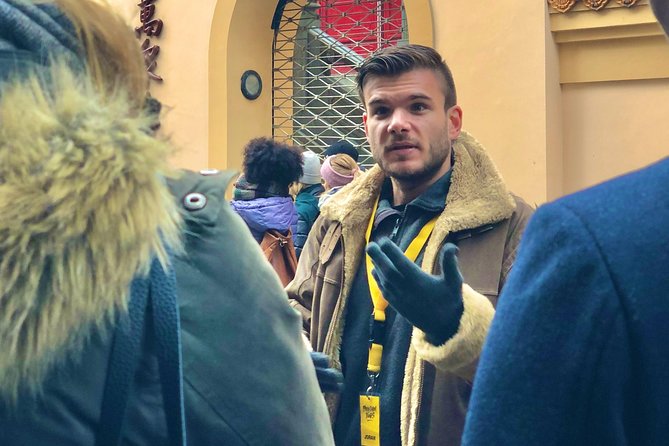
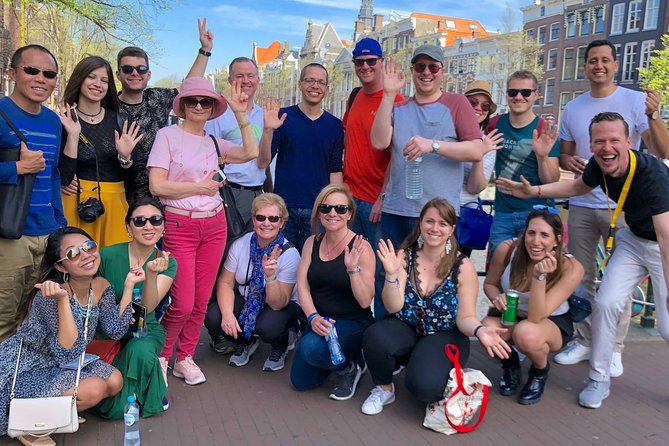
- Small-group setting: The maximum group size is 15 people, which should make questions and guide interaction easier.
- Several popular guides: Raymond, Jaap, Sergio, David, Fernando, and others have been praised for humor, clear storytelling, and local insight.
- Comfortable shoes matter: You cover a good stretch of the old city on foot, and bicycles share much of the same space.
Why this Amsterdam walk works as a first-day orientation
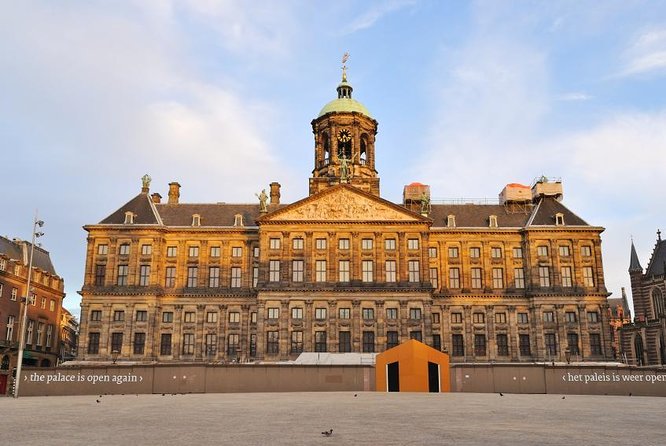
This tour does more than point out the Royal Palace and canals. It gives you a working map of Amsterdam’s old center and explains why the city looks and behaves as it does.
You begin at Beursplein 5, in front of the Beurs van Berlage. The site once sat along the Amstel River, and the opening talk connects the river to Amsterdam’s growth. Water made trade possible, while finance turned the port into a major commercial center. That is a useful frame for the rest of the walk: Amsterdam did not become prosperous by accident, and its handsome streets often hide hard questions about who benefited.
The tour is offered in English. Guides have included Raymond, described as a lifelong local, along with Jaap, Sergio, David, Fernando, Esi, Samuel, Alexander, Roman, Sebastien, and others. The exact guide matters because the experience leans heavily on storytelling. Jaap and Sergio are noted for humor and strong historical explanations, while Raymond is praised for his local background, easy pace, and ability to bring a group together.
A few more walking tours around Amsterdam worth a look
- Amsterdam Anne Frank: Small-Group Walking Tour & Local Guide
★ 4.8 · 12,789 reviews - Anne Frank’s Story – Guided Walking Tour through Amsterdam
★ 5.0 · 11,619 reviews - Amsterdam: Anne Frank Guided Walking Tour in DE/EN/IT/ES
★ 4.9 · 3,107 reviews
Damrak and the Red Light District: Amsterdam’s holy and practical sides
From the Beurs van Berlage, you walk toward Damrak, the old harbor area. This is where the tour tackles one of Amsterdam’s most famous and misunderstood subjects: the Red Light District.
The explanation covers the neighborhood’s links to the Church, commerce, and the port. You learn how the area changed over the centuries, why prostitution became legal, and what challenges the district faces today. The goal is not cheap shock value. It is to show how Amsterdam’s tradition of tolerance has often been practical, limited, and full of contradictions.
That distinction is valuable. Amsterdam is often sold as a city where anything goes, but the walk gives you a more careful view. You hear how laws and social attitudes changed during the 20th and 21st centuries, and how the neighborhood’s identity has been shaped by tourism and public debate.
You spend about 15 minutes here. That is enough for context, not an exhaustive study. If you want a detailed look at the district’s present-day rules, businesses, or social issues, you will need more time on your own.
The hidden church and the real meaning of tolerance
At Our Lord in the Attic Museum, you learn about the period when Catholic worship was illegal but quietly tolerated under specific conditions. Amsterdam’s religious policy was not simple freedom. It was a set of compromises that allowed people to practice privately while public life remained controlled by the dominant Protestant order.
You do not enter the museum or the hidden church on this walk. Instead, the guide shows you the building from outside and uses photographs of the interior. That is an important limitation if you hoped to see the steep, concealed church firsthand.
Still, this stop gives the tour one of its best ideas: tolerance can mean different things in practice. It may protect a minority, but it may also place that minority under restrictions and out of public view. The guide draws a line between 17th-century Amsterdam and questions about tolerance today.
At roughly 15 minutes, this is a concise introduction rather than a museum visit. I would treat it as a reason to return to the museum if religious history interests you.
Chinatown and Amsterdam’s complicated drug policy
The next stop is Chinatown, where the guide explains Dutch drug policy and the rise of coffeeshops. The discussion focuses on how the area became a no-go district in the 1970s and how that period helped shape the businesses associated with marijuana sales.
This is useful preparation for Amsterdam because drug policy is often reduced to a slogan. The tour places it in a social and urban setting, showing how a troubled neighborhood, public policy, and a new type of business became connected.
You will not get a long policy seminar. The stop lasts about 15 minutes, so expect the broad story and the main turning points. The subject can be sensitive, but it fits the tour’s wider interest in how Amsterdam handles behavior that other cities may ban outright.
Same streets, a different route:
- Amsterdam: Anne Frank Guided Small Group Walking Tour
★ 4.8 · 2,722 reviews - Amsterdam: Cultural Highlights Walking Tour
★ 4.9 · 2,629 reviews - Amsterdam: Ganja Walking Tour
★ 4.2 · 2,127 reviews - Anne Frank Walking Tour Amsterdam Including Jewish Cultural Quarter
★ 5.0 · 1,879 reviews
The Waag and Rembrandt’s breakthrough
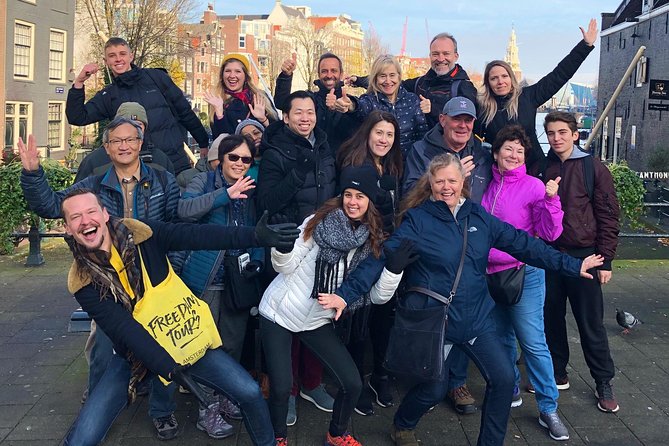
At the Waag, the focus shifts from policy to art. Here you hear where Rembrandt painted his first major work and how it changed portrait making.
The guide brings a copy of the painting and points out its details. That visual aid matters. A discussion of a famous painting can become vague when you are standing in a crowded square, but a printed image gives you something concrete to inspect.
This is a short stop, about ten minutes, and it works best as a compact art lesson. You will not visit a museum gallery or spend time with a full collection. Instead, you get a specific story about one artist, one work, and a change in how people were represented.
Oostindisch Huis and the price of the Golden Age
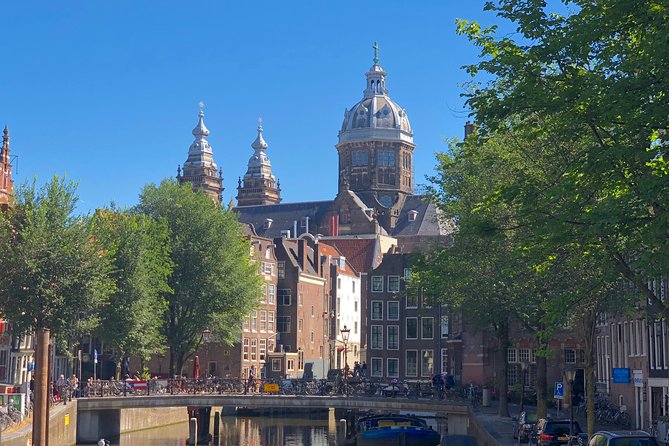
Oostindisch Huis offers some of the tour’s strongest historical material. Inside is a 17th-century courtyard, though access is limited to weekdays. The building was the headquarters of the Dutch East India Company, a major force in Amsterdam’s rise as a global trading center.
The guide explains how Amsterdam became one of the world’s wealthiest cities during the Golden Age and how this company helped shape modern capitalism. You also hear about the darker side of that success. The tour does not present trade and wealth as a clean triumph. It asks you to consider the human and colonial costs behind the city’s prosperity.
The weekday restriction is worth checking before you book. If the courtyard is closed, the guide can still explain the building and its role, but you lose the chance to see this particularly atmospheric part of the route.
This stop also adds needed balance. The canal houses and grand civic buildings can look purely elegant. Here, you are reminded that Amsterdam’s wealth came from a global system that involved power, unequal exchange, and exploitation.
Waterlooplein and the Jewish quarter during wartime
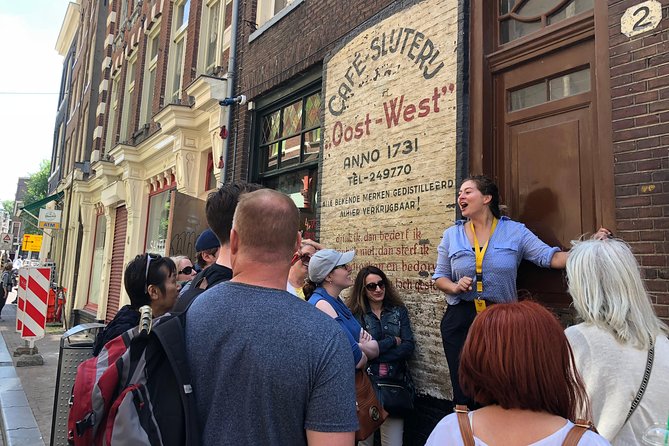
At Waterlooplein Market, the walk enters the former Jewish quarter. The market is described as Amsterdam’s oldest, but the main subject is the neighborhood’s destruction during the Second World War.
The guide explains how Nazi occupation decimated Amsterdam’s Jewish population and what happened during the final hunger winter. The stop also addresses a common misunderstanding about who destroyed the quarter, making this one of the more serious and corrective parts of the tour.
This is not a light market visit. The stalls and open space provide a modern setting for a painful history, and the contrast can be striking. You spend about 15 minutes here, enough for an introduction but not enough to cover every family, deportation, or postwar story.
I value this stop because it prevents the tour from turning Amsterdam into a postcard. The city’s famous tolerance did not protect everyone, and the wartime record requires more than a quick mention.
The Amstel and the clues built into canal houses
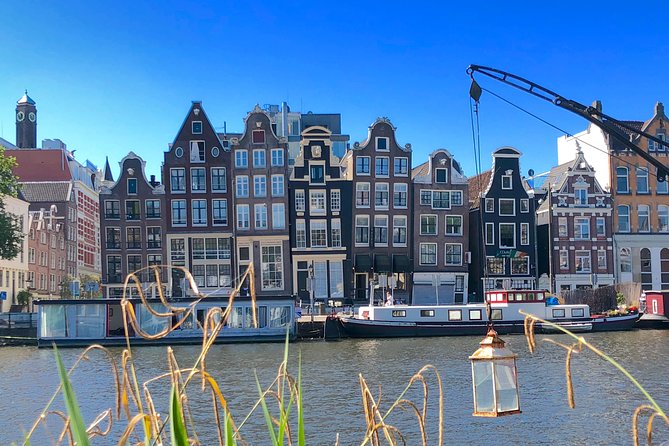
Near the Amstel, or at another canal if weather or the guide calls for a change, you learn why Amsterdam has canals and how its canal houses work.
The talk covers the narrow fronts, the buildings that lean, the hooks above the windows, and the habit of leaving curtains open. These details are easy to notice but harder to interpret without context. The guide turns ordinary streets into evidence of the city’s past.
The leaning houses, in particular, are not all leaning for the same reason. Some movement reflects age and construction, while certain angles and hooks relate to how goods were moved into buildings. The tour gives you a way to read the architecture instead of simply photographing it.
This is also a good time to look around and slow your eyes down. Amsterdam’s canals are not just scenic corridors. They reveal old property rules, trade needs, engineering choices, and social habits.
Oudemanhuispoort and Amsterdam’s bicycle culture
Oudemanhuispoort is a former monastery that later became a hospital and now forms part of the University of Amsterdam. It is a hard-to-find passage, so having a guide lead you there adds real value.
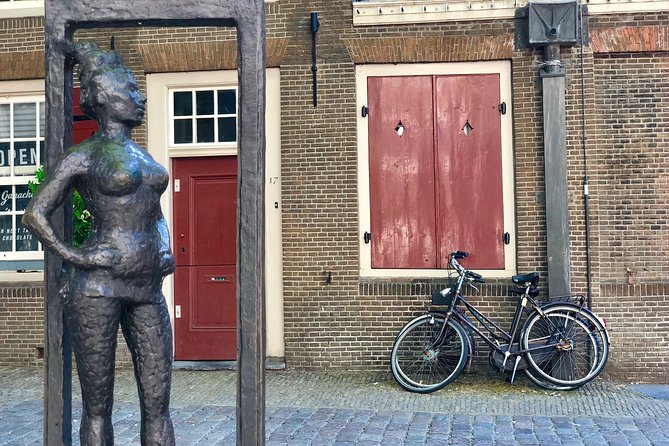
Here the subject is cycling. Amsterdam has more bikes than people, and the guide explains why cycling became such a central part of city life. You also learn why so many bikes look plain, old, or even ugly. In a city where a bicycle is daily transport, practicality matters more than polished appearance.
Pay attention while walking. Several people note that bicycle traffic can be challenging, and that is not a minor detail. You need to watch lanes and crossings while keeping up with the group. Comfortable shoes and a drink are sensible choices, especially if the weather is warm or wet.
The stop lasts about ten minutes, but it gives you an important survival tip for the rest of your stay: do not assume a quiet-looking street is safe to cross without checking for bikes.
Dam Square and the Royal Palace
The final stop is the Royal Palace Amsterdam, with the tour ending at Dam Square. You learn how the Netherlands moved from a republic to a monarchy and get an introduction to the current royal family.
The guide also adds lighter material, including current royal gossip and personal details shown through photographs. That change of tone works well after the wartime and colonial subjects. You leave with both civic context and a sense of the modern institution.
The palace itself is not included as an interior visit. You discuss it from outside, so you should not book this walk expecting palace rooms or a formal palace tour.
Ending at Dam Square is practical. You are back in one of the city’s main central areas, with a better idea of where you are and what deserves a return visit. Guides such as Fernando have also been praised for offering suggestions for later in a stay, which can be especially useful if this is your first few hours in Amsterdam.
Price, group size, and the walking effort
At about $5.93 per person, this is unusually inexpensive for a guided introduction to Amsterdam. The low price reflects the tip-based structure, so you should think of the booking amount as access rather than the full measure of the guide’s work. You can tip as much as you like after the walk.
The maximum group size is 15 people. That is small enough for a guide to manage questions and keep the group together, though the actual feel will depend on attendance and the guide.
The listed duration is approximately 2 hours and 30 minutes. Several accounts describe the pace as manageable, with one putting the walk closer to two hours. Allow the full stated time, since stops, questions, crowds, weather, and bicycle traffic can affect the finish.
Free cancellation is available up to 24 hours before the start time. Changes or cancellations inside that window are not refunded, and the tour requires a minimum number of participants. If that minimum is not met, you are offered another date or experience, or a full refund.
Who should book this walk
I would choose this tour for a first visit, a short stay, or a morning when you want a clear introduction before choosing museums and neighborhoods. It also suits repeat visitors who want more context than a simple photo walk. One guide, Ramses, is praised for helping even frequent Amsterdam visitors see familiar places differently.
You should be comfortable walking for roughly two to two and a half hours. Service animals are allowed, the route is near public transport, and most people can participate, but the details provided do not promise a fully step-free route or seating at every stop.
The strongest guides appear to combine humor with serious material. Jaap, Raymond, Sergio, David, Alexander, Fernando, and Sebastien are singled out for warmth, storytelling, local experience, and useful advice. Guide assignments can vary, so book for the route and format rather than expecting one named person.
Should you book Absolutely Amsterdam?
Book it if you want a broad, thoughtful first look at Amsterdam at a very low upfront cost. The route covers canals, trade, religion, art, war, drug policy, cycling, and the monarchy without requiring separate transport.
Skip it if you mainly want interior access to museums, the hidden church, or the Royal Palace. You should also choose another activity if you dislike serious discussions of prostitution, colonial power, Nazi occupation, and religious restrictions.
For most first-time visitors, I would take this near the start of the stay. Wear good shoes, watch for bikes, and keep a few places in mind to revisit. The tour gives you the city’s basic coordinates, then leaves you to decide where to spend more time.
FAQ
How long does the Amsterdam walking tour last?
The experience is advertised at approximately 2 hours and 30 minutes. Some accounts describe the walk as closer to two hours, so you should allow the full stated duration.
Where does the tour start?
It starts at Freedam Tours, Beursplein 5, 1012 GZ Amsterdam, in front of the Beurs van Berlage.
Where does the tour end?
The walk ends back at the meeting point area, at Dam Square by the Royal Palace Amsterdam.
Is the hidden church entered during the tour?
No. At Our Lord in the Attic Museum, the guide discusses the church from outside and uses photographs of the interior. Admission is not included.
Is the Oostindisch Huis courtyard always open?
No. The 17th-century courtyard is accessible only on weekdays. The building and its role in Amsterdam’s trading history are still discussed on the route.
How much does the tour cost?
The listed price is about $5.93 per person, and the format allows you to tip as much as you wish. Free cancellation is available up to 24 hours before the start time.
Just added around Amsterdam
- Amsterdam: Walking Tour, Jewish Museum & Synagogue Tickets★ 4.3 · 110 reviews
- Amsterdam: Small-group Guided Walking Tour (French/English)★ 5.0 · 289 reviews
- Amsterdam: Jordaan District Local Food Walking Tour★ 4.8 · 311 reviews
- Amsterdam: Sex, Drugs, and Freedom Walking Tour★ 4.6 · 74 reviews
- Amsterdam: Private Walking Tour with a Local★ 4.7 · 102 reviews
- Amsterdam Walking Tour and Canal Cruise★ 4.6 · 117 reviews
- Amsterdam: Ghost Walking Tour and Dark History★ 4.8 · 118 reviews
- Amsterdam: Iconic Canals & Historic Sights Walking Tour★ 4.5 · 90 reviews
Walking Tours, compared.

Magical London: Harry Potter Guided Walking Tour
Read our review →
Reykjavik Food Walk – Local Foodie Adventure in Iceland
Read our review →
History and Hauntings of Salem Guided Walking Tour
Read our review →
New Orleans Premier Ghost, Voodoo and Vampire Walking Tour
Read our review →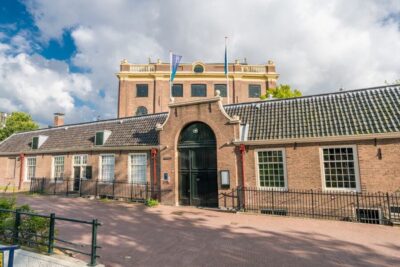
Amsterdam Anne Frank: Small-Group Walking Tour & Local Guide
Read our review →

Edinburgh Castle: Guided Walking Tour with Entry Ticket
Read our review →
Anne Frank’s Story – Guided Walking Tour through Amsterdam
Read our review →Browse the lists this tour appears in