
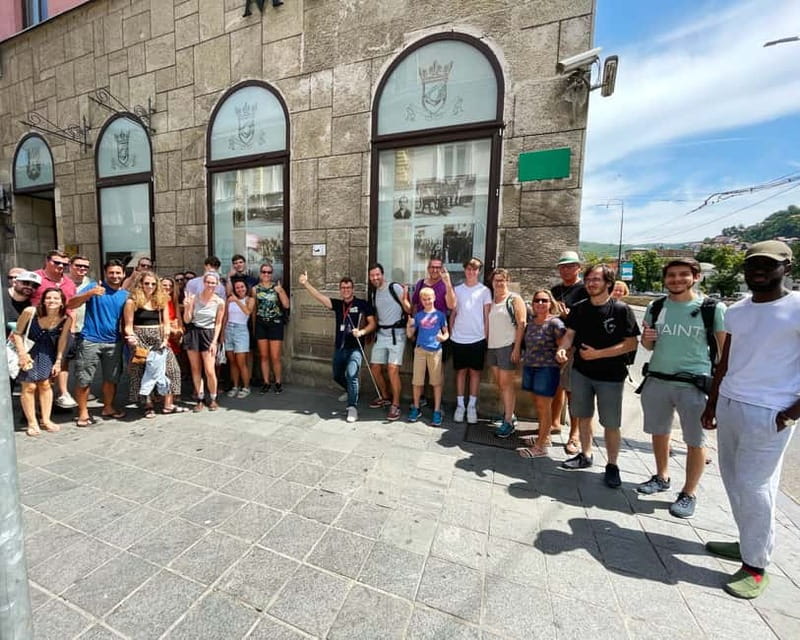
REVIEW · WALKING TOURS
Sarajevo: Old Town Walking Tour with Local Guide
Sarajevo’s story comes at you in layers: an Ottoman market, an Austro-Hungarian city hall, a mosque, Orthodox church, and Catholic cathedral all within a short walk. This small-group walking tour puts those layers together, so you are not just looking at handsome buildings, but understanding why Sarajevo became one of Europe’s most unusual meeting points.
I like the tour’s human scale and its strong local focus. You get the main Old Town sights in 150 minutes, then hear about coffee, crafts, food, politics, and everyday life from guides such as Arna, Kiki, Elma, Benjamin, and Selma. The possible drawback is that the pace is fairly full, and some stops are brief rather than long museum visits.
Key points at a glance
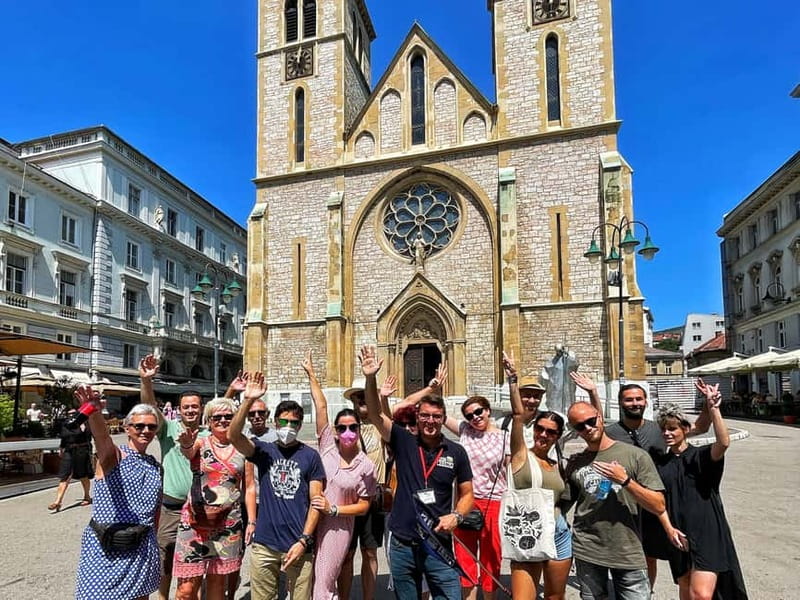
- Four faiths in one compact center: See the Orthodox Cathedral, Sacred Heart Cathedral, Gazi Husrev-beg Mosque, and the city’s multi-confessional character in a short walk.
- Sarajevo’s Ottoman heart: Explore Baščaršija, Sebilj, Kazandžiluk, Morića Han, and the legacy of Gazi Husrev-beg.
- The place where World War I began: Visit Latin Bridge and learn about the assassination of Archduke Franz Ferdinand.
- History beyond dates: Guides connect the Ottoman and Austro-Hungarian periods with Yugoslavia, the 1984 Winter Olympics, and the siege of Sarajevo.
- Useful local advice: Expect suggestions for food, shops, artisans, and further sightseeing, not just a memorized speech.
- Good value at $20: A two-and-a-half-hour guided introduction costs little compared with booking several separate visits.
Sarajevo in one walk
The basic appeal is simple: Sarajevo’s center is compact, but its past is not. Within a few streets, you move from an Ottoman market to Austro-Hungarian architecture, then to places tied to World War I, religious coexistence, Yugoslav memory, and the city’s recent war.
That makes a guide especially useful here. You can walk Baščaršija alone, of course. But without context, Sebilj is just a pretty wooden fountain, Latin Bridge is just another crossing, and the close grouping of mosques and churches may not register as the remarkable fact it is.
This tour is designed as an introduction. It does not attempt to cover every museum or war-related sight in Sarajevo. Instead, it gives you a framework for the city, then points you toward places you may want to explore on your own.
The group is limited to 10 people, though some departures may be much smaller. One person on a quiet-season departure received the full tour alone, and another private-feeling experience came from a small booking. That can make a major difference when you have questions or want to pause for a closer look.
More Old Town Walking Tours in the world:
- Underground Vaults Walking Tour in Edinburgh Old Town
★ 4.5 · 8,506 reviews - Prague: 3-Hour Walking Tour of Old Town & Prague Castle
★ 4.7 · 5,696 reviews - Dubrovnik: Old Town Walking Tour
★ 4.8 · 5,174 reviews
Sebilj and the first taste of Baščaršija
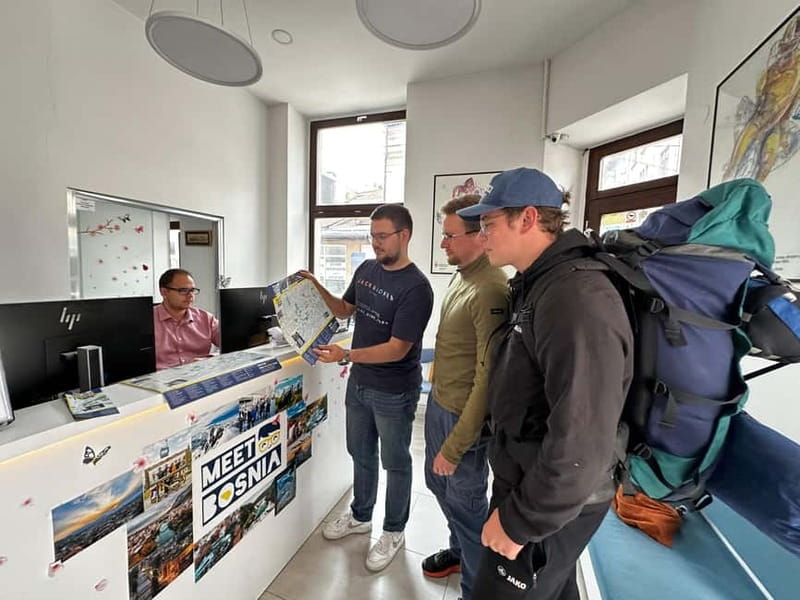
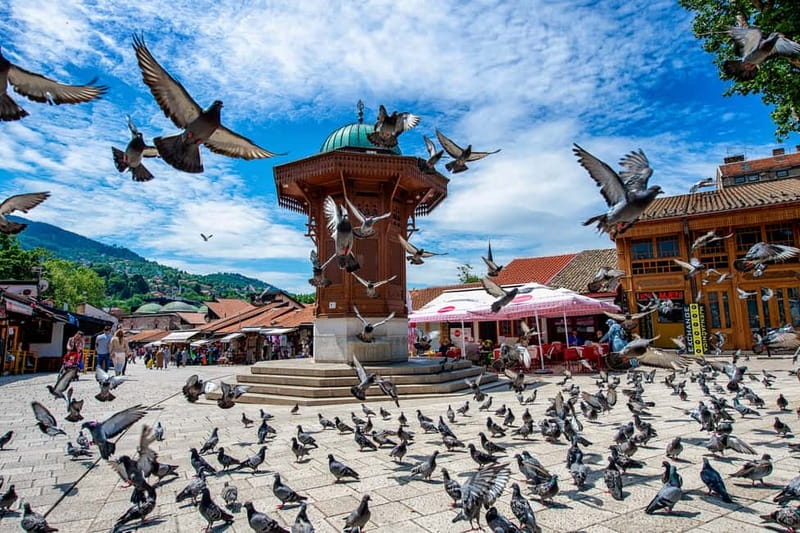
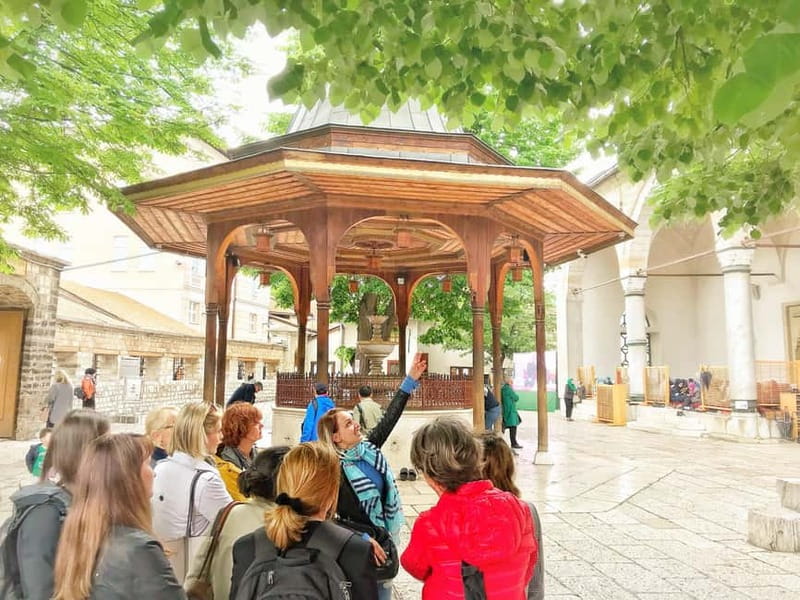
The walk begins at the Meet Bosnia Tours office and heads to Sebilj, the wooden fountain that has become one of Sarajevo’s main symbols. It sits on Baščaršija Square, the center of the old Ottoman market district.
This is a useful first stop because it introduces the feel of Sarajevo immediately. The square leads into lanes filled with small shops, cafés, metalwork, and traditional crafts. You get a sense of how the city’s commercial life was organized during the Ottoman period, when Baščaršija served as a market and meeting place.
The stop at Sebilj lasts about 10 minutes. That is enough for photographs and an opening explanation, but not a long pause. If you want people-free pictures, you may need to use your free time later, since the square is a natural gathering point.
City Hall and the Austro-Hungarian turn
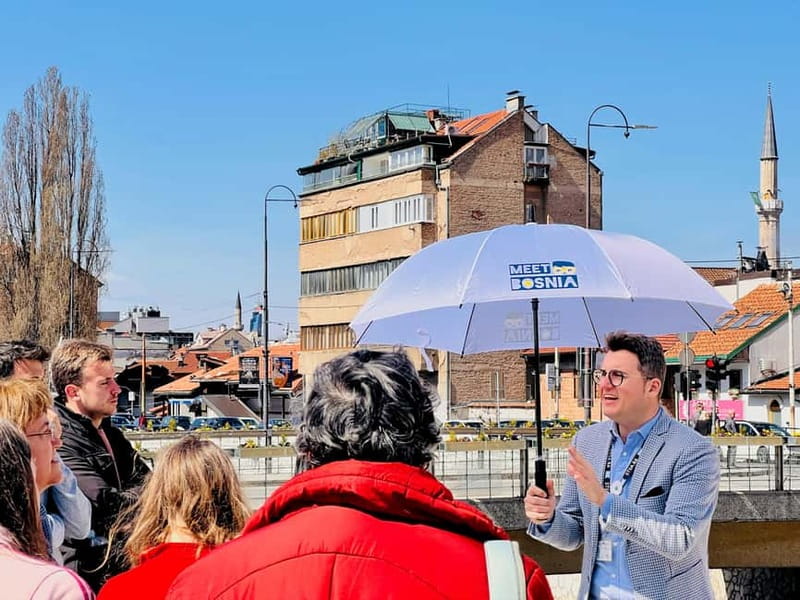
From the Ottoman market, the route continues toward Sarajevo City Hall, one of the city’s most striking buildings. Its appearance reflects the Austro-Hungarian period, when Sarajevo was reshaped with new public buildings, roads, and administrative institutions.
The city hall is more than a grand façade. It helps explain how Sarajevo changed from an Ottoman provincial center into a city influenced by Central European planning and design. The building has also taken on symbolic weight because of the damage Sarajevo suffered during the 1990s war and its later renovation.
The guided stop lasts about 15 minutes and includes scenic views along the way. Do not expect an extended interior tour or a long architectural study. The value is in seeing how the building fits into Sarajevo’s changing political story.
Kazandžiluk and the sound of copper
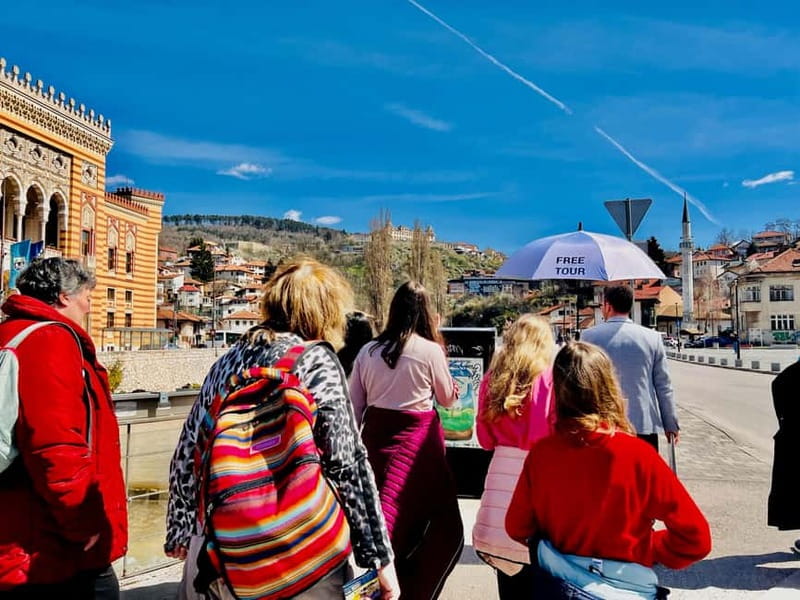
Kazandžiluk is the traditional coppersmith street, and it gives the tour one of its most tangible stops. Here, the focus shifts from rulers and wars to skilled work and local trade.
You may see decorative copperware and handmade objects in the shops. The point is not simply to browse for souvenirs. A good guide explains what you are looking at and how the craft fits into the character of Baščaršija.
Several guides have taken time to introduce visitors to local artisans and small shops, including an artisanal brush maker. That is a nice touch for anyone who prefers meeting working craftspeople to passing a row of souvenir stalls. You are not pushed to buy, and the stop is short, around 10 minutes.
If shopping interests you, remember the names of places you like and return after the tour. Ten minutes is enough to look, but not always enough to compare prices or choose carefully.
More Guided Tours in the world:
- Magical London: Harry Potter Guided Walking Tour
★ 4.7 · 22,044 reviews - History and Hauntings of Salem Guided Walking Tour
★ 5.0 · 14,564 reviews - Amsterdam Anne Frank: Small-Group Walking Tour & Local Guide
★ 4.8 · 12,789 reviews - Edinburgh: Harry Potter Magical Guided Walking Tour
★ 4.8 · 11,944 reviews
Morića Han and Ottoman Sarajevo
Morića Han is a former caravanserai, an inn where merchants and travelers could rest during the Ottoman era. The walk here takes about 10 minutes, and the site helps you picture Sarajevo as part of a wider trading network.
This is where the city begins to feel less like a collection of separate sights. The market, workshops, inn, mosque, and library all belonged to a connected urban system. A guide can explain those links far better than a plaque at a single monument.
The route then turns toward the Gazi Husrev-beg complex, the most important Ottoman-era heritage area on the walk.
Gazi Husrev-beg Mosque and the Ottoman legacy
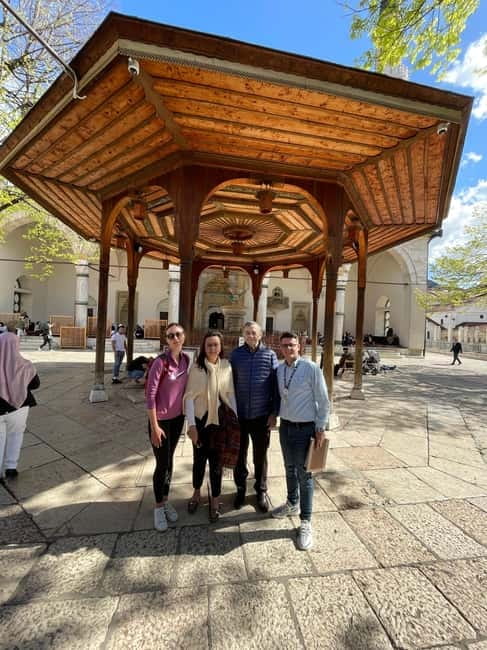
Gazi Husrev-beg Mosque is the central religious and architectural stop. Gazi Husrev-beg, the Ottoman governor associated with Sarajevo’s growth, helped create many of the institutions that shaped the old city.
The visit lasts about 10 minutes. Dress comfortably and respectfully, and follow the guide’s instructions when entering a religious space. Since this is a working place of worship, access and timing can vary.
Nearby are Gazi Husrev-beg Madrasa and Gazi Husrev-beg Library. The madrasa receives a short visit and photo stop, while the library is introduced through brief guided stops. These locations show that the complex was not only about prayer. Education, books, public life, and religious institutions were closely linked.
The short timings are both a strength and a limitation. You see several important places without spending the whole afternoon in one complex. If you want detailed Islamic art or architectural study, you will need a separate visit.
Latin Bridge and the start of World War I
Latin Bridge is the tour’s most famous historical location. Near this bridge, Archduke Franz Ferdinand of Austria and his wife Sophie were assassinated in 1914. The event helped trigger World War I, a conflict that changed Europe and the world.
A guide can make this stop much more useful than a quick photograph. You learn what happened, why the assassination mattered, and how Sarajevo was pulled into a crisis far beyond its own streets.
The visit takes about 15 minutes. It is enough time to understand the setting and ask questions, though not enough for a full lecture on the political tensions of the era. The best guides keep the explanation connected to the physical place rather than reciting a list of dates.
This is also a good point to ask about the Austro-Hungarian period, the treatment of different communities, and how Sarajevo’s political importance changed over time.
Three religious buildings, one short walk
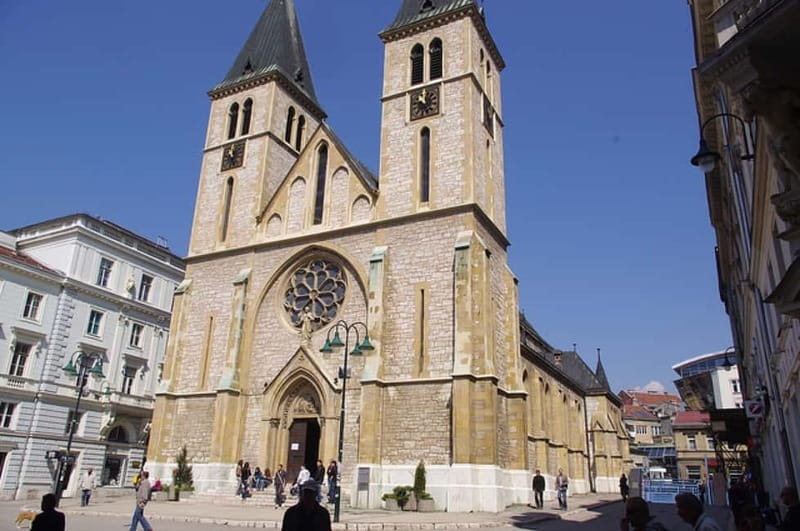
The route continues to the Cathedral Church of the Nativity of the Theotokos, the Serbian Orthodox cathedral, and the Sacred Heart Cathedral, the Roman Catholic cathedral. These stops follow the Gazi Husrev-beg Mosque and its surrounding institutions.
Together, they make Sarajevo’s multi-confessional character easy to see. Four major religious traditions appear within roughly 100 meters: Islam, Serbian Orthodoxy, Catholicism, and Judaism in the wider old-center setting. The exact experience inside each building can depend on opening conditions and religious services, so expect guided orientation and photo stops rather than guaranteed long interior visits.
This part of the walk is especially valuable for first-time visitors. Sarajevo is not simply a city with many religions. Its streets reveal how those communities lived close to one another, sometimes cooperatively and sometimes under heavy political pressure.
The religious stops also call for sensitivity. Listen to the guide’s instructions, dress in comfortable but respectful clothing, and remember that these are places of worship, not just attractions.
From 1984 to the siege of Sarajevo
The tour places the old city in a larger modern setting. Sarajevo hosted the 14th Winter Olympics in 1984, putting the city on the world stage as a center of sport and international attention.
Only eight years later, Sarajevo became a war zone during the Bosnian War. The siege lasted almost four years and left a lasting mark on the city and its people. The old center still carries reminders of that period, even when the immediate route focuses on older monuments.
Guides bring different strengths to this part of the story. Benjamin has been praised for handling Sarajevo’s history and politics alongside wider European events. Other guides, including Armina and Emma, have connected the public story with personal memories and family experiences. That personal element can make the recent past feel less abstract, although it may also be emotional.
If you want a full examination of the siege, look for a dedicated war-history tour afterward. This walk gives you essential context, but its main purpose is to introduce the whole city.
The guide makes the difference
The experience depends heavily on who leads your departure. The tour is conducted in English, and guides who have led it include Arna, Kiki, Elma, Masud, Hanan, Selma, Emina, Vicky, and others.
The strongest pattern is clear: guides explain history while also answering questions about current life. They recommend places to eat, explain where locals shop, and point out crafts that you might otherwise miss. One guide even continued the conversation over coffee after the formal walk, giving the visitor more insight into daily Bosnian life.
That personal approach is more useful than a polished speech. You can ask about religion, politics, the war, food, architecture, or what to do next. Several visitors found the guides patient and flexible, including with families and with people who asked many questions.
The tour can still vary by guide. Some may focus more on architecture, others on politics, religion, or personal stories. If you have a special interest, say so at the start. The guide may be able to adjust the emphasis.
Is $20 a fair price?
At $20 per person, this is a strong-value introduction to Sarajevo. You receive 150 minutes with a professional guide, and the route covers the city’s major old-center themes without requiring transport between stops.
The value is highest if you are new to Sarajevo or have limited time. A guide helps you understand the relationship between places that could otherwise feel disconnected. The tour may also save you from spending your first day wandering without knowing which streets or buildings deserve a closer look.
Meals and drinks are not included, though food or refreshments can be arranged on request. Plan to buy your own coffee or snack if you want one during or after the walk.
The main tradeoff is depth. The tour moves through many sites, so the stops at the madrasa, library, and religious buildings are short. Think of this as your city orientation, not a substitute for every museum and interior visit.
Practical advice before you go
Wear comfortable shoes. The route is a walking tour through the old center, with frequent stops and time spent on city streets.
Bring a camera and dress for the weather. Comfortable clothing is recommended, with respectful clothing particularly sensible for visits near religious buildings.
The tour is wheelchair accessible, and the group size is limited to 10 participants. Starting times vary, so check availability when booking. You can cancel up to 24 hours before the tour for a full refund, and the reserve-now, pay-later option gives you some flexibility.
Book this near the start of your Sarajevo stay if possible. You will gain restaurant, shopping, and sightseeing ideas while the city is still new to you. If you already know the center well, a more specialized tour may offer greater value.
Who should book this Sarajevo walking tour?
I would recommend it to first-time visitors, history fans, architecture lovers, and anyone who wants context before exploring Sarajevo alone. It also suits people who prefer a small group and the chance to ask direct questions.
Families can benefit from the clear route and short stops, though the war and political sections may need a little explanation for younger children. Visitors with only one day in Sarajevo will get a useful overview, but should not expect to see the Olympic venues or all the major siege sites.
You may want to skip it if you dislike guided walks, already have detailed plans for the Old Town, or prefer spending a long time inside one monument. Otherwise, $20 buys a thoughtful starting point, local recommendations, and a much clearer understanding of why Sarajevo feels so different from other European capitals.
FAQ
How long does the Sarajevo Old Town walking tour last?
The tour lasts 150 minutes, or two and a half hours.
What language is the tour conducted in?
The live tour guide speaks English.
What sights are included?
The route includes Sebilj, Sarajevo City Hall, Kazandžiluk, Morića Han, Gazi Husrev-beg Mosque, Gazi Husrev-beg Madrasa, Gazi Husrev-beg Library, Latin Bridge, the Cathedral Church of the Nativity of the Theotokos, and Sacred Heart Cathedral.
Is the tour wheelchair accessible?
Yes, the activity is listed as wheelchair accessible.
How many people are in the group?
The tour is offered as a small-group experience limited to 10 participants. Some departures may have fewer people.
What is included in the price?
The professional guide is included. Meals and drinks are not included, though they can be arranged on request.
Just added around the world
- Nahargarh Water Walk – Guided 2-Hour Heritage Tour in Jaipur★ 5.0 · 89 reviews
- Downtown Fernandina Historical Walking Tour★ 4.5 · 119 reviews
- Cultural Walk and Food Tasting In Jaipur★ 5.0 · 118 reviews
- Local Food, History and Hidden Places Walking Tour in Istanbul★ 4.5 · 81 reviews
- Old Town Of Istanbul Orientation – Tip Based Walking Tour★ 5.0 · 181 reviews
- Full Day Historical Walking Tour of Istanbul Old City from Hagia Sophia★ 4.5 · 114 reviews
- Istanbul Private Walking Highlights Tour★ 5.0 · 102 reviews
- Half day Fener-Balat Walking Tour in Turkiye★ 5.0 · 308 reviews
Old Town Walking Tours, compared.
Underground Vaults Walking Tour in Edinburgh Old Town
Read our review →
3-Hour Walking Tour of Old Town & Prague Castle
Read our review →
Old Town and Jewish Quarter Guided Walking Tour
Read our review →
Marrakech: Ben Youssef, Secret Garden, & Souks Walking Tour
Read our review →Browse the lists this tour appears in