
REVIEW · SAVANNAH
Savannah: Civil War Walking Tour
Savannah’s Civil War story comes alive in the city streets, where grand homes belonged to generals and Sherman’s headquarters became the setting for one of the war’s most famous promises. This 105-minute walking tour connects military decisions with the people, politics, and enslavement that shaped Savannah.
I like the focus on real addresses, especially the homes of William Hardee, James Bartow, and Joseph E. Johnston. I also like the stop connected with Field Order No. 14, the order first issued in Savannah that promised 40 acres of land and a mule to freed slaves in the area. The drawback is simple: uneven sidewalks, heat, and a fairly steady amount of standing can make this harder for young children or anyone with mobility concerns.
Key points to know before you go
- Walk past generals’ homes: See residences linked to William Hardee, James Bartow, and Joseph E. Johnston.
- Visit Sherman’s Savannah headquarters: Discuss the wartime order that promised land and a mule to freed slaves.
- Expect more than battle dates: The tour also touches on Savannah’s founding, architecture, the American Revolution, and the city’s earlier centuries.
- Guides bring the subject to life: Cathy and Zack have led especially engaging departures, with room for questions and conversation.
- Plan for city walking: The tour begins at Warren Square, and some sidewalks are uneven enough to make a stroller awkward.
- Good value at $20: You receive nearly two hours of live history in central Savannah, but transportation and gratuity are extra.
Starting at Warren Square in Savannah
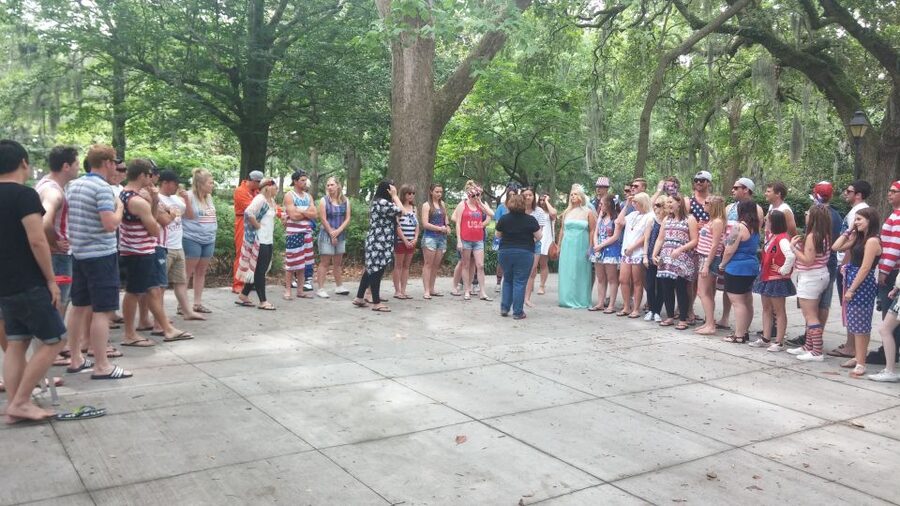
The tour begins at Warren Square, at 22 Habersham Street, enclosed by Congress and Habersham streets. This puts you in the middle of Savannah’s historic district, where the walk can move naturally between public squares, old homes, and military landmarks.
You do not need transportation during the experience. The guide leads the group on foot, so wear shoes that can handle uneven pavement and dress for the weather. Savannah’s charm comes partly from its walkable streets, but those same old sidewalks can be hard on tired feet.
Arrive ready to listen while standing. The tour lasts 105 minutes, and the guide keeps moving through the city rather than settling into one indoor presentation. That format works well if you want to see Savannah while learning, but it is less comfortable than a seated talk.
If you drive, metered parking is available around the departure area. A city garage is about a block from Reynolds Square, a couple of blocks east of the meeting point, at Drayton and East Bryan streets, with entrances on Drayton and Abercorn. The first hour costs $1, each additional hour costs 50 cents, and the daily maximum is $4.
A few more walking tours around Savannah worth a look
- Savannah History and Haunts Candlelit Ghost Walking Tour
★ 5.0 · 3,235 reviews - Savannah First Squares Culinary & Cultural Walking Food Tour
★ 5.0 · 3,229 reviews - Historic Savannah Guided Walking Tour
★ 5.0 · 2,918 reviews
Savannah’s generals, homes, and divided loyalties

The most appealing part of this walk is its use of actual buildings. Instead of hearing about Civil War leaders in the abstract, you pass homes connected with William Hardee, James Bartow, and Joseph E. Johnston.
Those addresses help you picture Savannah as a working city caught in a national crisis. Military leaders were not distant names on a battlefield map. They lived among merchants, families, churches, and civic institutions. The guide uses these places to explain who held power and how Savannah fitted into the Confederacy’s military plans.
The tour also covers military strategy. You can expect discussion of the choices made by commanders, the pressure on Savannah, and the wider conflict that set neighbor against neighbor. The emphasis is not only on troop movements. It also considers the political effects of the war and the human cost of a conflict fought within the United States.
This is a useful distinction. If you already know the major battles, you may appreciate the local angle more than another general Civil War overview. If you are new to the subject, the buildings and streets give you fixed points to follow as the story develops.
Sherman’s headquarters and Field Order No. 14
The stop at Gen. William T. Sherman’s headquarters is the tour’s clearest link between Savannah’s wartime occupation and the future of formerly enslaved people.
Here, the guide discusses Field Order No. 14, first decreed in Savannah. The order promised 40 acres of good land and a mule to every freed slave in the area. That promise became one of the most remembered symbols of Reconstruction’s early hopes, even though the policy did not become a lasting settlement for freed families.
The value of this stop is that it moves the conversation beyond generals and battlefield strategy. You hear how military decisions connected to freedom, property, labor, and the political fight that continued after the armies stopped. The subject deserves a serious tone, and the best guides use the location to show why the war’s effects lasted long after 1865.
You should expect the guide to address the difficult parts of the conflict directly. This is not a tour that treats the Civil War as a costume-drama backdrop. The description promises discussion of intrigue, horror, and political consequences, and the tour’s subject naturally includes slavery and the struggle over emancipation.
A wider story than the tour name suggests
Although the advertised focus is the Civil War, the walk can reach further back. A strong guide may begin with Savannah’s founding and explain how earlier decisions shaped the city that entered the war.
Past departures have included discussion of the American Revolution, pirates, architectural details, and earlier centuries. That wider context can help you understand why Savannah looked and functioned as it did during the 1860s. It also explains why the experience may feel broader than a strict military tour.
That is a plus if you want a general introduction to Savannah with a Civil War lens. It may be a slight mismatch if you want 105 minutes devoted only to battles, commanders, and troop movements. The title sets a narrow expectation, but the content can be more expansive.
I see this as a useful balance. The homes and headquarters anchor the Civil War material, while the city’s older story gives the guide more room to explain why Savannah mattered. You get a more complete sense of place without needing to book a separate introductory history walk first.
Same streets, a different route:
- Savannah’s Ghost City “Dead of Night” Walking Night Tour
★ 4.5 · 2,482 reviews - Southern Flavors Food, Pub Crawl, and History Walking Tour
★ 4.5 · 1,623 reviews - Genteel and Bard’s Savannah Dark History and Ghost Encounter Walking Tour
★ 5.0 · 1,546 reviews - Bonaventure Cemetery Walking Tour with Transportation
★ 5.0 · 1,467 reviews
Guides who teach rather than recite
The guide makes a major difference here. Cathy has led departures with an educator’s background, a quality that suits a tour built around complex political and military material. Her approach has included extra time for points of interest and detailed answers to questions.
Zack has also led the walk with a mix of historical detail, architectural explanation, and humor. Other departures have featured guides who kept the group moving while covering a large amount of information. That combination matters because 105 minutes can feel long if the presentation is stiff, but short if the guide knows how to connect facts.
You should feel free to ask questions. The experience works particularly well when it becomes a conversation rather than a one-way lecture. A small departure can feel nearly private, giving you more chances to ask about a person, building, or military decision.
The tone is generally informal. Guides use humor and local details to keep the subject approachable, but the material itself includes war, slavery, death, and political conflict. If you want a solemn academic seminar, this may feel too relaxed. If you want serious content delivered in plain language, the style should suit you.
What the 105 minutes feel like on foot
The full duration gives the guide enough time to explain connections, but you should still expect a compact city walk rather than a long-distance hike. The route links several historic addresses and public spaces, with stops for explanation and discussion.
You will likely spend time looking at buildings from the street rather than entering private homes. That is important when setting expectations. The attraction is the setting and the interpretation, not interior access to each residence.
The uneven pavement deserves attention. One family managed the walk with a four-year-old, but a stroller was difficult because of the sidewalks. If you are bringing a young child, consider whether the child can walk for much of the route. A stroller may need careful handling.
Comfortable shoes are essential. In warm or wet weather, the guide’s advice to dress for the conditions is practical rather than decorative. Bring water if you normally need it on city walks, although transportation and other personal items are not part of the tour.
Who gets the best value for $20
At $20 per person, this is a good buy for anyone who wants a live introduction to Savannah’s Civil War role. You receive nearly two hours with a guide, several historically important addresses, and an explanation of Field Order No. 14. The cost is modest compared with a private history lesson or a longer specialty excursion.
The price works best if you value interpretation. You are not paying for transport, museum admission, food, or a dramatic production. You are paying for the guide’s ability to turn ordinary-looking streets into evidence of military and political change.
I would especially recommend it to:
- First-time visitors who want historical context while seeing the old city on foot.
- Civil War enthusiasts who prefer local stories and buildings to a broad national survey.
- Families with older children who can listen and walk for about two hours.
- Visitors who enjoy asking questions and learning from a flexible guide.
- People who have already taken a trolley tour and want more detail.
A trolley tour can cover more ground with less walking. This experience gives you more explanation at street level, which is why it makes a strong follow-up to a general city tour. If you have limited time, it also combines sightseeing and history efficiently.
Gratuity is not included, so budget for a tip if the guide gives you a strong experience. Free cancellation is available up to 24 hours before departure, and the reserve-now, pay-later option can help if your schedule is still changing.
The tour’s main strengths and limits
The strongest feature is the guide’s command of the subject. A good departure does more than list names. It explains how Savannah’s founding, buildings, military leadership, emancipation, and postwar politics fit together.
The second strength is the choice of locations. The generals’ homes and Sherman’s headquarters give the walk a physical structure. You are not simply standing in a square while someone reads dates from a script.
The third strength is flexibility. Questions are welcomed, and smaller groups can feel personal. A guide may also spend extra time on an architectural detail or an unexpected point of interest if the group wants more.
The main weakness is consistency. The guide controls much of the experience, and one departure had a late start, a long wait before walking, and an awkward opening comment. That does not define the tour, but it is worth knowing that timing and presentation can vary.
You should also check your expectations about subject matter. The walk can include the American Revolution, pirates, architecture, and Savannah’s founding alongside Civil War content. That makes it broader and more useful for many people, but not ideal if you want a tightly limited military itinerary.
Should you book the Savannah Civil War Walking Tour?
Book it if you want to understand Savannah through its buildings, commanders, and wartime decisions. The price is fair, the route is central, and the stop at Sherman’s headquarters gives the experience a meaningful focus on emancipation and the uncertain promises made to freed people.
I would choose this over a general sightseeing walk if Civil War history is a main reason for your visit. I would also choose it after a trolley tour, since the walking format adds details that a vehicle cannot provide.
Skip it if you dislike standing, have trouble with uneven sidewalks, or want a tour focused only on battlefield tactics. Otherwise, bring good shoes, allow the full 105 minutes, and arrive ready to ask questions. With a guide such as Cathy or Zack, the walk can turn familiar Savannah scenery into a much sharper picture of a city caught in America’s defining conflict.
FAQ
How long does the Savannah Civil War Walking Tour last?
The tour lasts 105 minutes.
How much does the tour cost?
The listed price is $20 per person.
Where does the tour begin?
It departs from Warren Square at 22 Habersham Street in Savannah, Georgia, enclosed by Congress and Habersham streets.
Is transportation included?
No. The experience is a walking tour, and transportation is not included.
What language is the tour offered in?
The live guided tour is offered in English.
Which historic homes will I see?
The walk passes homes connected with William Hardee, James Bartow, and Gen. Joseph E. Johnston.
What is the Sherman headquarters stop about?
The guide discusses Sherman’s headquarters and Field Order No. 14, which was first decreed in Savannah and promised 40 acres of land and a mule to freed slaves in the area.
Should I wear special clothing?
Wear comfortable walking shoes and dress for the weather.
Is gratuity included?
No. Tips are not included in the tour price.
Can I cancel for a refund?
You can cancel up to 24 hours in advance for a full refund. A reserve-now, pay-later option is also available.
Just added around Savannah
- Savannah: Highlights Off the Beaten Path Guided Walking Tour★ 4.8 · 112 reviews
- Savannah: History and Culture Walking Tour★ 4.6 · 149 reviews
- Savannah: Terrors, Ghosts, and Ghouls Walking Tour★ 4.3 · 171 reviews
- Savannah: Ghosts, Asylums, Voodoo, and Horror Walking Tour★ 4.5 · 383 reviews
- Savannah: Local Favorites Walking Food Tour★ 4.7 · 147 reviews
- Savannah: Historic District Foodie Walking Tour★ 4.8 · 613 reviews
- Genteel and Bard’s Savannah History Walking Tour★ 5.0 · 684 reviews
- Savannah Haunted Pub Crawl Walking Tour★ 4.5 · 695 reviews
Walking Tours, compared.

Magical London: Harry Potter Guided Walking Tour
Read our review →
Reykjavik Food Walk – Local Foodie Adventure in Iceland
Read our review →
History and Hauntings of Salem Guided Walking Tour
Read our review →
New Orleans Premier Ghost, Voodoo and Vampire Walking Tour
Read our review →
Amsterdam Anne Frank: Small-Group Walking Tour & Local Guide
Read our review →

Edinburgh Castle: Guided Walking Tour with Entry Ticket
Read our review →
Anne Frank’s Story – Guided Walking Tour through Amsterdam
Read our review →Browse the lists this tour appears in