

REVIEW · AMSTERDAM
Amsterdam: Iconic Canals & Historic Sights Walking Tour
Amsterdam’s story comes together on foot: royal power at Dam Square, trade and faith along the canals, wartime loss in the Jewish Quarter, and daily life shaped by bicycles. This two-hour route gives you a useful first look without asking for a full day.
I like the mix of major sights and quieter corners, especially the peaceful Begijnhof and the look at secret churches and leaning houses. I also like that guides such as Adrián and Craig bring a personal touch, with practical advice on eating, drinking, and getting around. The main drawback is pace: five substantial areas in two hours means some stops receive a short introduction rather than a full visit. You should also expect a tip request at the end, as Craig’s tour information makes clear.
Key points at a glance
- Dam Square sets the story: Begin beside the National Monument, with the Royal Palace close at hand.
- Oude Kerk brings history into the Red Light District: Amsterdam’s oldest building sits in one of its most famous modern districts.
- Canals reveal the city’s odd details: Look for leaning houses, bridges, courtyards, and churches that are easy to miss alone.
- The Jewish Quarter adds serious wartime context: The route covers tragedy, courage, and survival during Nazi occupation.
- Begijnhof offers a quiet finish: This enclosed historic courtyard feels far removed from central Amsterdam’s traffic and noise.
- The price is unusually low: At $4.71 per person, the tour offers strong value, though paid entrances, food, drinks, and a guide tip are separate.
Why this route works for a first look at Amsterdam
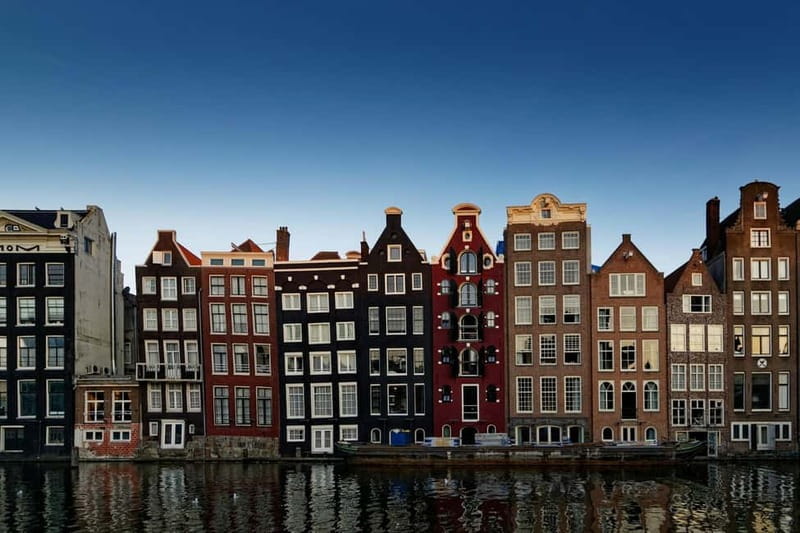
I like walking tours that explain how a city works rather than simply pointing at buildings. This one connects Amsterdam’s political center, oldest church, canal belt, Jewish Quarter, and a secluded courtyard in a compact route.
That range matters. You get architecture, religion, trade, wartime memory, local customs, and bike culture in one outing. The tour is not only a checklist of postcard views. It helps you understand why Amsterdam feels open, layered, and slightly unusual.
The guide speaks English or Spanish, so choose the language that lets you follow historical details with ease. The tone is intended to be friendly and practical, with stories about the people who shaped the city and advice on places to eat, drink, and explore after the walk.
At $4.71, the value is hard to ignore. Even if you treat the outing as a two-hour orientation rather than a complete history course, the price is low for a live guide and a central route. The tradeoff is that the tour is likely to keep moving. You should not expect long, detailed visits inside every landmark.
A few more walking tours around Amsterdam worth a look
- Amsterdam Anne Frank: Small-Group Walking Tour & Local Guide
★ 4.8 · 12,789 reviews - Anne Frank’s Story – Guided Walking Tour through Amsterdam
★ 5.0 · 11,619 reviews - Absolutely Amsterdam – the Essential Introductory Walking Tour
★ 5.0 · 3,629 reviews
Starting at Dam Square and the National Monument
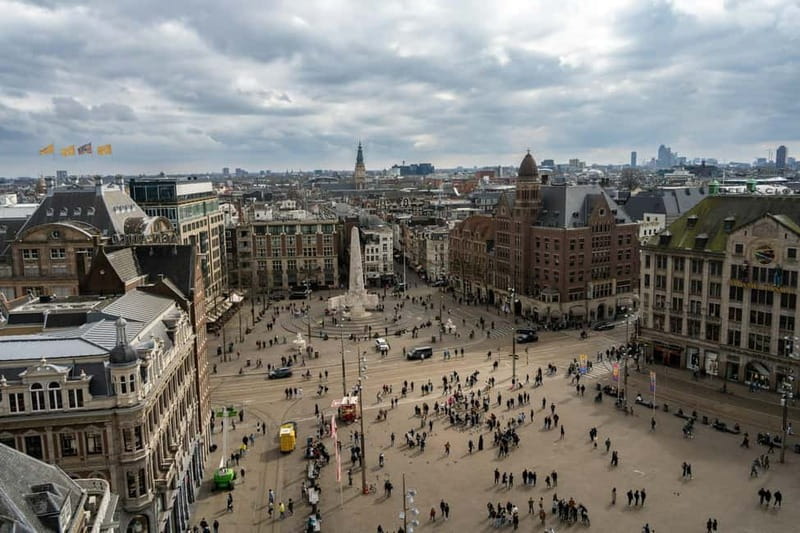
The meeting point is in front of the National Monument in Dam Square. This is a simple place to find, but it can be busy, so arrive with enough time to identify the guide and settle in before the walk begins.
Dam Square is a useful starting point because it brings several sides of Amsterdam together. The National Monument carries solemn meaning, while the Royal Palace gives the square a grand civic face. From here, the guide can set up the larger story of Amsterdam’s growth from a trading town into a major European capital.
I appreciate a starting point that gives you immediate bearings. After the tour, you will know where Dam Square sits in relation to several central districts, and you will have a clearer sense of how the canals and older streets connect.
The square itself is not a quiet place for a long talk. Pedestrian traffic and city noise may compete with the guide, so stay close and listen carefully. This is also a good moment to ask for recommendations about food, drinks, or later sightseeing, since insider tips are part of what you are paying for.
The Royal Palace and Amsterdam’s powerful past
The Royal Palace of Amsterdam is the first major landmark. You receive a guided explanation from outside and around the building, but entrance to paid attractions is not included.
The palace helps balance the image of Amsterdam as a relaxed, informal city. Its grand scale points to the money and ambition of the Dutch Golden Age, when commerce gave the city enormous influence. A good guide can use the building to explain how trade wealth became civic and royal power.
You should think of this stop as context rather than a palace visit. If you want to see the interior, plan a separate visit and pay the admission yourself. The walking tour gives you the background you need to decide if that extra time suits your schedule.
I like this early stop because it sets up a useful contrast. Amsterdam’s character is not only narrow lanes, bikes, and casual cafés. Behind that easygoing style is a city that once handled serious international wealth and political power.
Oude Kerk in the Red Light District

The route continues to Oude Kerk, Amsterdam’s oldest building, located in the center of the Red Light District. This pairing is one of the most striking parts of the walk. A centuries-old church and one of the city’s best-known adult entertainment districts occupy the same compact area.
The guide explains the church’s place in Amsterdam’s past and points out how the surrounding district developed. You can expect a short guided presentation rather than a full architectural study. Entry is not included if you choose to visit the church’s interior.
For me, this stop shows why an Amsterdam walk should include more than pretty canals. The city’s history is full of contrasts: religious buildings beside commercial streets, private belief beside public tolerance, and old structures surrounded by modern city life.
Use a little sensitivity here. The Red Light District is an active neighborhood, not a stage set for sightseeing. Follow the guide’s lead, avoid treating working areas as a photo backdrop, and pay attention to the architectural and historical information.
Same streets, a different route:
- Amsterdam: Anne Frank Guided Walking Tour in DE/EN/IT/ES
★ 4.9 · 3,107 reviews - Amsterdam: Anne Frank Guided Small Group Walking Tour
★ 4.8 · 2,722 reviews - Amsterdam: Cultural Highlights Walking Tour
★ 4.9 · 2,629 reviews - Amsterdam: Ganja Walking Tour
★ 4.2 · 2,127 reviews
Canals, bridges, leaning houses, and secret churches
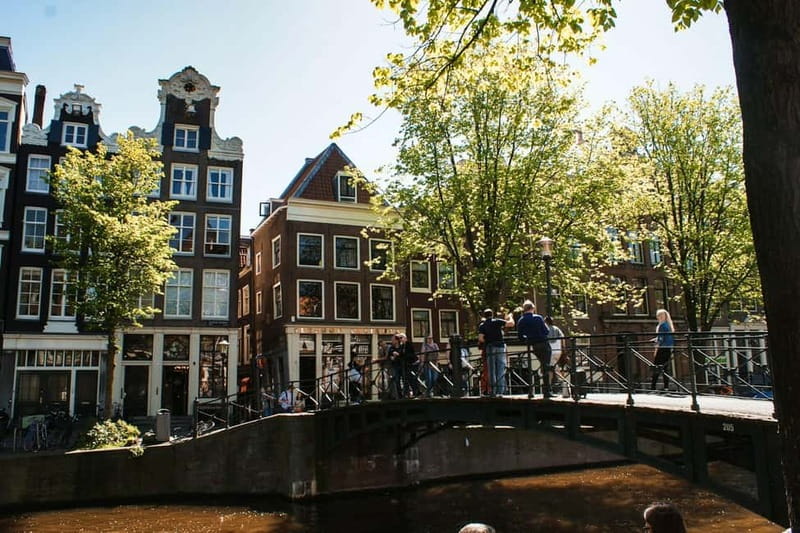
The canal portion gives the tour its classic Amsterdam views. You cross bridges, follow canal-lined streets, and see the narrow houses that make the city instantly recognizable.
The leaning houses are not just a fun photo detail. They help you notice how old and individual the city center can feel. The guide also points out courtyards, churches, and less obvious features that you could easily pass without context.
The tour includes stories about secret churches, an important clue to Amsterdam’s complicated religious past. These buildings and concealed spaces add depth to the city’s reputation for tolerance. You learn that freedom of worship and public religious life did not always look the same.
This section is likely to be the most camera-friendly part of the walk. Bring comfortable shoes rather than relying on fashion, since the route covers historic streets and bridges. Rain or shine, the walk goes ahead, so a weather-ready layer is sensible, though only comfortable shoes are specifically required.
Do not expect a canal cruise. You remain on foot, which gives you a closer view of doorways, façades, bridges, and street life. You also need to stay alert around cyclists. The tour includes an explanation of why bikes outnumber people in the city and how cycling became central to Amsterdam life, but the lesson is much easier to remember when you watch the lanes carefully.
The Jewish Quarter and wartime memory
The Jewish Quarter brings a serious change in tone. Here, the guide discusses the Jewish community, the Nazi occupation, and stories of tragedy, bravery, and resilience.
I value this part because it prevents Amsterdam’s easygoing image from becoming too polished. The city’s past includes profound loss, and the route gives that history a place beside the canals and grand civic buildings.
This is not a museum visit, and the tour does not include admission to paid sites. Instead, the guide provides a walking introduction to the area and its wartime meaning. If the subject matters especially to you, use this stop to decide which museums or memorial sites deserve a separate visit.
Listen closely here. Historical stops can pass quickly on a two-hour route, and the subject deserves more than a distracted glance at a map. The guide’s ability to explain personal stories and local setting will shape how much you take away.
The Jewish Quarter also adds another layer to the city’s identity. Amsterdam is often sold as carefree and tolerant, but tolerance is not a simple label. This part of the walk asks you to see the city through both its ideals and its painful history.
Begijnhof, a quiet courtyard behind the center
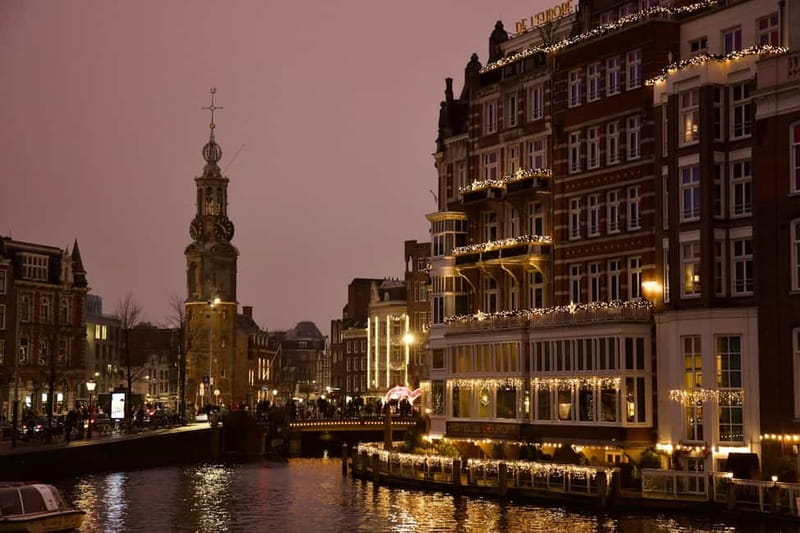
Begijnhof is the route’s calmest stop. Tucked behind busy streets, this enclosed courtyard has centuries of history and a very different feel from Dam Square or the Red Light District.
I like ending with a place that rewards quiet attention. You can look at the courtyard’s buildings, absorb the change in atmosphere, and see how Amsterdam preserves small spaces within a busy center.
The stop is guided, but it is not described as a paid attraction visit. Keep in mind that courtyards and historic residential spaces call for respectful behavior. Walk quietly, follow any local signs, and avoid assuming every doorway or interior is open to the public.
Begijnhof also makes a good final image of Amsterdam. The city can be loud, crowded, and full of movement, yet a peaceful historical space may sit just behind an ordinary street. That contrast is one of the most useful ideas the tour gives you.
What the two-hour pace means
Five main areas are covered in two hours: the Royal Palace, Oude Kerk, the canals, the Jewish Quarter, and Begijnhof. That is an ambitious route, and the listed plan allows roughly 24 minutes of guided attention at each stop.
In practical terms, you get a broad introduction rather than a deep visit to any one attraction. The advantage is variety. If you have only just arrived, you can quickly learn which districts and subjects deserve more of your own time.
The limitation is equally clear. You may not have much time for long photo stops, browsing, or entering buildings. The tour is best for orientation, stories, and local pointers, not for replacing visits to the Royal Palace, Oude Kerk, or museums.
I would book it early in your stay if you want help planning the rest of your time. Afterward, you can return to the places that caught your attention with a better sense of direction and context.
Guides, language, and the human touch
The tour includes a live local guide in English or Spanish. Specific guide assignments can change, but Adrián and Craig are two names associated with this experience. Adrián is described as a fantastic guide, while Craig is noted for his friendly manner, city knowledge, and helpful approach.
That personal element matters on a city walk. A guide can point out details you would miss, explain local habits, and help you avoid basic mistakes, especially around bicycle traffic.
The included advice on where to eat, drink, and explore is also useful because it extends the tour beyond the final stop. Ask direct questions if you want recommendations suited to your plans, since general advice is less useful than a specific conversation.
You should also budget for a tip. Craig’s tour information says guides expect one at the end, and the comment treats that as fair compensation for the work. The tip is not included in the $4.71 price, so carry a little extra.
Price, inclusions, and who gets the best value
At $4.71 per person, this is a low-cost way to get a live introduction to central Amsterdam. The price includes an English or Spanish-speaking local guide and practical tips for the rest of your visit.
Food and drinks are not included. Entrance to paid attractions is also not included, so you should view the tour as a walking orientation rather than an admissions package.
I see the strongest value for:
- First-time visitors who want to understand the central districts quickly
- People with a short stay who need a compact overview
- History-minded visitors who want both Golden Age and wartime context
- Anyone who prefers walking to a bus or boat introduction
- English- or Spanish-speaking visitors who want a live guide
You may want something else if your priority is detailed indoor sightseeing. A museum visit or dedicated palace tour will give you more time inside one place. This walk is better at connecting several parts of Amsterdam than studying one landmark in depth.
The tour is wheelchair accessible, which is useful for anyone who needs an accessible option. Still, the route includes historic streets and bridges, so it is wise to confirm the exact meeting and route details when booking if you have specific mobility needs.
Booking advice and the final call
Free cancellation is available up to 24 hours before the tour for a full refund, and you can reserve now and pay later. Those terms make it easier to place the walk near the start of your Amsterdam plans without locking in too early.
Bring comfortable shoes. The tour runs for two hours, takes place outdoors, and continues in rain or shine. Check the available start times when choosing a date.
I would book this tour if you want a low-cost first orientation, enjoy city history in small pieces, and appreciate a guide who mixes major sights with local details. I would skip it if you want long indoor visits, extensive free time at each stop, or a quiet photography walk.
For most first visits, the route earns its place early in the schedule. You get the Royal Palace, Oude Kerk, canals, Jewish Quarter, and Begijnhof, plus a clearer idea of how to move around Amsterdam without treating the city as a string of disconnected sights.
FAQ
Where does the Amsterdam walking tour start?
The tour starts in front of the National Monument in Dam Square.
How long does the walking tour last?
The tour lasts two hours.
Which sights are included on the route?
The route includes the Royal Palace of Amsterdam, Oude Kerk, Amsterdam’s canals, the Jewish Quarter, and Begijnhof.
Is the Royal Palace entrance included?
No. Entrance to paid attractions is not included, though you may visit them separately after the tour.
Is food or drink included?
No. Food and drinks are not included.
Which languages are available?
The live guide is available in English or Spanish.
Is the tour wheelchair accessible?
Yes, the activity is listed as wheelchair accessible.
What should I bring?
Bring comfortable shoes.
Can I cancel the booking?
Yes. You can cancel up to 24 hours in advance for a full refund. You can also reserve now and pay later.
Just added around Amsterdam
- Amsterdam: Walking Tour, Jewish Museum & Synagogue Tickets★ 4.3 · 110 reviews
- Amsterdam: Sex, Drugs, and Freedom Walking Tour★ 4.6 · 74 reviews
- Amsterdam: Small-group Guided Walking Tour (French/English)★ 5.0 · 289 reviews
- Amsterdam: Jordaan District Local Food Walking Tour★ 4.8 · 311 reviews
- Amsterdam: Private Walking Tour with a Local★ 4.7 · 102 reviews
- Amsterdam Walking Tour and Canal Cruise★ 4.6 · 117 reviews
- Amsterdam: Ghost Walking Tour and Dark History★ 4.8 · 118 reviews
- Amsterdam: Guided Anne Frank Small-Group Walking Tour★ 4.2 · 485 reviews
Walking Tours, compared.

Magical London: Harry Potter Guided Walking Tour
Read our review →
Reykjavik Food Walk – Local Foodie Adventure in Iceland
Read our review →
History and Hauntings of Salem Guided Walking Tour
Read our review →
New Orleans Premier Ghost, Voodoo and Vampire Walking Tour
Read our review →
Amsterdam Anne Frank: Small-Group Walking Tour & Local Guide
Read our review →

Edinburgh Castle: Guided Walking Tour with Entry Ticket
Read our review →
Anne Frank’s Story – Guided Walking Tour through Amsterdam
Read our review →Browse the lists this tour appears in